Home Blog Page 806

$400m Annual Importation Of Chicken Is A Shame -Mahama

0
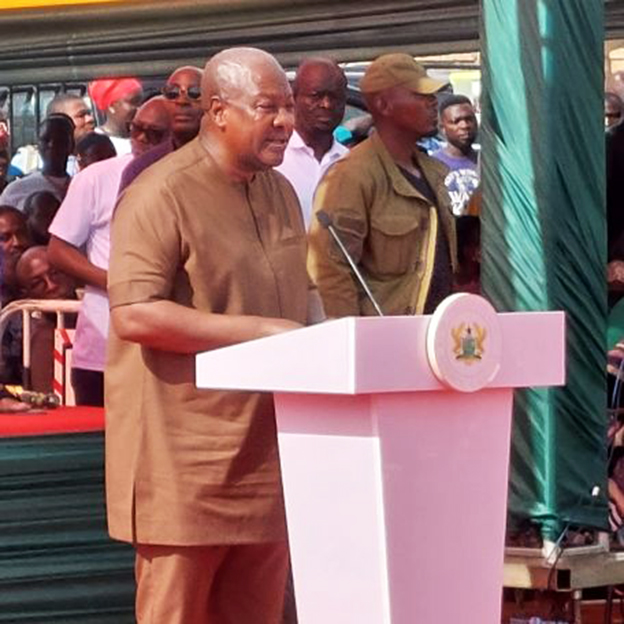
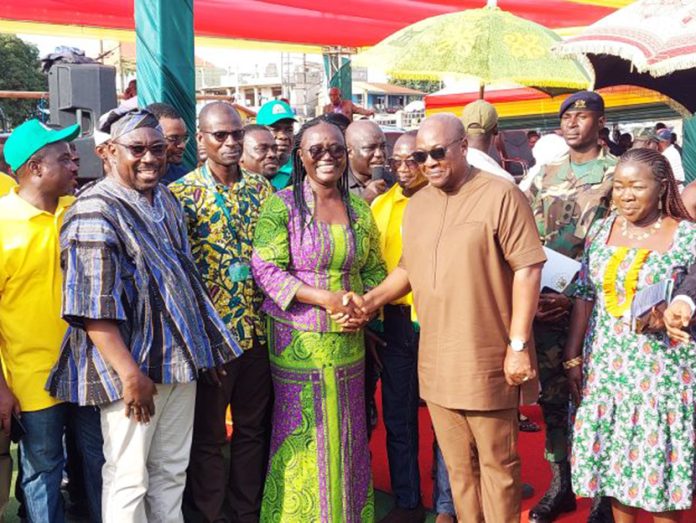
President Mahama a Techiman yesterday

Ghana imports nearly $400 million worth of chicken every year, President John Dramani Mahama has said. The President said the imports ought to be a source of shame for all Ghanaians, reiterating plans to support 54 individuals to produce four million birds that would amount to 10,000 metric tons of chicken.

President Mahama stressed his government commitment to advancing livestock development to improve cattle production and small ruminants, including goats and sheep, and improving access to high-quality breeds alongside.

The President made this known when he launched the government’s Feed Ghana Programme, a flagship initiative in Techiman in the Bono East Region.
He said the livestock production component of the programme would also focus on agro production enclaves and infrastructure.
That involves the execution of irrigation systems, improved road infrastructure, provision of power supply, and establishment of warehousing facilities that would attract private investment.

The President said that the programme would further enhance the production and processing of agricultural produce.
President Mahama presented maize seeds, fertilizers, a Kia truck, and tractors to some institutions including the Ghana Prisons Service, National Service Authority to spearhead the implementation of the programme.
He called for unity and shared commitment in transforming the nation’s agriculture, as a driver of national growth and prosperity, saying the Feed Ghana Programme presented a proactive initiative rather than just a policy.

Admitting some challenges in the sector, the President said he was highly optimistic that the implementation of the programme would achieve successes, and called on farmers, agribusinesses, financial institutions, and development partners to join forces for the programme to achieve desirable outcomes.
The programme aims to implement strategic measures to increase food production, promote the adoption of modern farming techniques, improve infrastructure, and establish agro-industrial zones across Ghana.

President Mahama said key interventions within the Feed Ghana Programme include smart agriculture involving establishment of farmers’ service centres nationwide.

The centres will provide essential services such as mechanization, quality inputs, financial support, market access, primary processing and training for farmers.
President Mahama announced the creation of farm banks or land banks in designated irrigable zones to support young agri-entrepreneurs and contribute to the enhancement of national food production.

He said the second component of the programme, grains and legumes development would also focused on increasing the production of maize, rice, soya beans, and sorghum for consumption, agro-processing, and export.
The third component, which is vegetable development project or ‘Yeredua’ aimed at reducing imports from neighbouring countries by promoting the cultivation of vegetables locally.

President Mahama highlighted the importance of investing in controlled environmental farming, such as greenhouse technologies, urban and peri-urban agriculture, and promoting schools to grow their own vegetables through backyard gardening.
The fourth component of the initiative will focus on promoting institutional farming to empower households and communities to cultivate vegetables such as tomatoes, peppers, and garden eggs to enhance self-sufficiency.

It will also extend support to institutions such as Senior High Schools to access lands to engage in crop production and livestock farming.
The fifth component of the programme involves the revitalization of the poultry industry, known as the “NkokoNketenkete” project.

From Benjamin Akoto, Techiman

GNA

Estate developer, 2 others charged with engaging in Landguard Activities

0
Court

The Accra Circuit Court, presided over by His Honour Samuel Bright Acquah, has ordered that three men accused of engaging in landguard activities at Prampram, near Tema, be brought before the court on Tuesday, April 15, 2025.

Their pleas are yet to be taken as the prosecution informed the court that investigations were still underway.

The accused – Enock Armah Tachie, also known as “Animal”, 44, an estate developer; Francis Nii Armah Boyefio, 26, an ‘okada’ rider and Alfred Brako, 37, a driver – are facing three counts related to vigilantism and illegal possession of firearms.

According to court documents, the three are charged with conspiracy to commit crime, specifically the prohibition of landguard activities, under Section 23(1) of the Criminal Offences Act, 1960 (Act 29) and Section 7(3) of the Vigilantism and Related Offences Act, 2019 (Act 999).

On April 8, 2025 the accused allegedly organised themselves as landguards and were found protecting a parcel of land at Prampram, on behalf of one Chris Abbossey.

They were reportedly in possession of a SAASILMAZ SAR pistol loaded with 34 rounds of 9mm ammunition, for which Enock Armah Tachie has also been separately charged with possession of firearm and ammunition without lawful authority, in violation of the Arms and Ammunition Act, 1972 (NRCD 9) and its 1996 amendment (Act 519).

The complainant in the case, Dr. Kofi Amoa Abban, an entrepreneur based in East Legon, had alerted the Surveillance Unit of the National Operations Directorate after reporting harassment and intimidation by suspected landguards in the Prampram area.

Following the tip-off, a joint security team apprehended the three accused, who were allegedly found actively guarding the disputed land with the said weapon.

During the initial investigations, Tachie admitted to possessing the weapon, but denied engaging in landguard activities.

However, the accused reportedly failed to provide satisfactory explanations for their presence at the site, especially, given their known affiliation with a vigilante group based in Ashaiman.

Preliminary investigations further revealed that the firearm found on Tachie was not registered in his name and that the license for it had expired.

The court has remanded the accused into custody and adjourned the case to Tuesday, April 15, 2025, pending further investigations.

Tension in Tema NDC over MCE position

0
Ebi Bright

The alleged backdoor inclusion of Ebi Bright’s name to the shortlisted names of applicants vying for the Tema MCE position by party executives is creating tension in the National Democratic Congress (NDC) at Tema East and Central constituencies.

According to snippets of information The Chronicle has gathered from the two constituencies, NDC party supporters did not understand why Ebi Bright, whose name was not among the seven original applicants from Tema Central Constituency, who submitted their names for the vacant position, would be added to the three final shortlisted names.

Patience Ankamah Addi, Sedinam Matanawey and Robert Kempes Ofosuware are the three shortlisted applicants from both Tema East and Central Constituencies for the final vetting.

The supporters also hold the view that Ebi Bright’s alleged clandestine inclusion in the final shortlisted names could be a way to compensate her for her “painful” loss in the 2024 parliamentary elections.

However, this alleged ‘Nicodemus’ move by some gurus in the NDC to add Ebi Bright’s name on the list and finally submit her name as the MCE choice has infuriated the party supporters to question the alleged credibility and honesty of the vetting committee.

In all, nineteen applicants – twelve from Tema East and seven from Tema Central – picked forms for the MCE position. After going through the vetting process, Patience Ankamah Addi, Sedinam Matanawey and Robert Kempes Ofosuware were shortlisted for the last round of vetting, out of which number the President will appoint one person for the MCE position.

When The Chronicle reached out to Robert Kempes Ofosuware on the telephone on Saturday afternoon about the allegations, he responded by saying “I have also heard what you are asking me, but I can’t confirm it.

“I am, however, receiving pieces of information about the alleged tensions the said allegation is causing in our two constituencies. All I will plead for is calm among our NDC supporters in both constituencies.”

When asked whether he would be flabbergasted should the allegation eventually turn out to be true, Mr Kempes said, “Well, let’s wait. Meanwhile, I will still urge the NDC in the two constituencies to remain calm.”

Attempts by The Chronicle to talk to Patience Ankamah Addi and Sedinam Matanawey on the same subject were unsuccessful. The last attempt to reach them on phone was on Sunday, April 13, 2025 but their phone numbers could not be reached.

An SMS and WhatsApp message The Chronicle sent to Ebi Bright on Sunday, about the allegation did not receive any response from the recipient. Her number was always busy when The Chronicle called.

Mahama: Gov’t is planning strategically to meet palm oil demand

0
President Mahama launching the programe at Techiman on Saturday.

President John Dramani Mahama says the country is positioning itself strategically to meet the increasing national demand for palm oil.Currently, the president said the nation produces 300,000 metric tons of palm oil but national demand was about 450,000 metric tons.

President Mahama said the about 150,000 metric ton shortfall required the need for strategic planning and increased productivity in order to capitalize on the projected growth of the global palm oil market, expected to hit $65 billion by 2027.

The President said this when he launched the government’s flagship initiative, the Feed Ghana Programme, in Techiman in the Bono East Region on Saturday.

It is the government intervention strategy that will enhance food production, encourage the adoption of modern farming techniques, improve infrastructure, and establish agro-industrial zones throughout Ghana.

President Mahama announced the implementation of palm oil industry policy that would provide incentives in the palmoil value chain, from cultivation to export.

The Tree Crop Development Authority would also develop six key economic trees of oil palm, cashew, mango, coconut, shea, and rubber with emphasis on oil palm.

President Mahama said his government vision was to modernise and expand the agricultural sector to generate employment opportunities, mitigate food inflation and enhance food security.

The Feed Ghana Programme remained a comprehensive framework under which all agricultural initiatives and projects would be carried out.

Enactment of Democratisation of Violence?

0
Opinion

Having a take from Di Sara Herrer Fernandez write-up on Democratisation of Violence, published on April 1, 2022, I submit my candid opinion on that matter.

To Fernandez, democracy, as a way of governing depends on the will of the people. Therefore, systems in which one person rules ignoring the interest of the majority cannot be defined as democracy. Nonetheless, democracy should not even be “rule of the majority”, if that implies that the interests of minorities are completely neglected.

Violence can occur in a democracy with examples of Cote d’Ivoire in 2011, with public outcry against corruption in government which resulted in a civil war; in the streets of Catalonia, Spain in 2017 when violent demonstrations went on because the people felt government was not listening to their demands and in the USA, in 2020, after the murder of George Floyd, when there were nation wide demonstrations and riots. These examples are democratisation of violence. It is more about the people against government.

In Ghana, however, democratisation of violence is more like the state against the people. During the early days of the PNDC, institutionalised violence was enacted and it was the people who suffered. Jerry Rawlings then boldly proclaimed that the only way to resolve issues is for one to pull a gun and if the other pulled a gun also, then the two would sit down and talk over the matter. However, this implied that if one does not have access to a weapon, then he could be shot dead and the matter would also be resolved.

Violence was used against the poor people which saw many dying without committing any offence. It could just be that someone did not like them or they were at the wrong place at the wrong time. In 1987, W.O. Salifu Amankwah shot and killed 70-year-old Robert Norbert Quarshie, a retired accountant who was only walking home. Jerry John Rawlings, pardoned the soldier after he was found guilty in court and sentenced to death.

From every indication, when democratisation of violence is applied in Ghana, it is always an institutionalised violence against the people.

In 1998, senior journalists, Kofi Coomson and Eben Quarcoo were arrested for reproducing a publication in a foreign newspaper, an allegation that the Rawlings’ were into drug trafficking and pleaded with the government to clear the air.

During the Kufuor administration, the NDC scored low points for him, when police officers went after Tsatsu Tsikata while he was in church. They claimed it was an infringement on his rights. This video is now making rounds in social media to say, Kufuor infringed on people’s right. However, what is being kept under the lid is what happened in February 1982, during the PNDC era under Rawlings, when a man of God was killed for not allowing his congregation to stop church service and go and fill potholes. Earlier about 78 members of his church were also killed for the failing to go and do as instructed.

In this era of Mahama’s administration, the three-month-old government has re-enacted the Ghana edition of democratisation of violence by raiding people’s homes with armed state security in what we are told is information gathering.

These raids are so patented in destruction of equipment like CCTV systems, the overturning of rooms, leaving behind something that looks like refuse dumps and breaking up of doors and windows, among other signs of violent intruding of people’s rights and properties. And who pays for all these?

In this democratic era, how can anyone suspected of any form of malfeasance, be subjected to this, before he or she is taken to court to prove their innocence or confirm their guilt?During the June 4 era, some good and innocent people were pronounced guilty and sentenced to death before they even appeared for trials. Forty years later, Rawlings made an admission of killing innocent souls.

And what is happening now is very much likeduring the dictatorship era. And worse of all, precedents are being set and soon Ghana, known for it democratic credentials may soon become a nation rule under institutionalised violence.

How is it known that anyone who is suspected of any form of crime should be treated violently in a democratic state, even before he goes to face the law? There are some people found guilty in court and locked up in jail, only for the truth to emerge later and have them pronounced innocent and freed.

An MP, Hon. Ntim Fordjour made public allegations about two suspicious aircrafts that landed at the Kotoka International Airport, which he linked to drug trafficking and financial crimes. This was the call for his arrest and the national security stormed his home for a raid. Can we get serious with this democracy? Twenty-seven years ago, two senior journalists were arrested and jailed for drawing government’s attention to a publication in foreign media that sought to tarnish the image of Ghana.

Twenty-seven years later a Member of Parliament, is facing the full realm of institutionalised violence for making allegations of drug trafficking. In his case, unlike Coomson and Quarcoo, he never made mention of anyone involved.

Where lies freedom of expression? Is democratisation of violence being enacted into law?

Hon Daniel Dugan

The views expressed in this article are the author’s own and do not necessarily reflect The Chronicle’s stance.

Editorial: Accra Is Still Dirty!

0
Editorial

Accra, the capital city of Ghana, continues to face significant sanitation challenges with concomitant impact on public health and the environment. On daily basis, Accra produces over 3,000 tonnes of solid waste, much of which are not efficiently collected.

Indiscriminate dumping of refuse and plastic waste, choked gutters and unregulated landfill sites are some of the other challenges. Plastic waste in particular is a major issue, because the waste materials clog drains and contribute to flooding when it rains.

Also, several households in our national capital, Accra, lack access to basic toilets. They, therefore, resort to open defecation at the beach and other places. This is an eyesore for tourists who visit these places for relaxation and enjoyment.

Most of our principal streets and some public places, including markets and lorry stations are engulfed with filth. It is sad to even mention that some so-called estates in Accra do not manage waste properly. Refuse sometimes pile up in some of these estates for days, if not weeks, before being collected.

The stench emanating from these wastes is simply unbearable and in most of the cases, lead to the spread of diseases. Why should a marketplace where foodstuffs are sold be engulfed with filth or a principal street that leads to a significant national installation that attracts visitors, both home and abroad, be ‘decorated’ with refuse?

Though Ghana’s aim is to become the Centre of Tourism  in Africa, our leaders  are failing to even keep the capital city clean, notwithstanding the fact that there are sanitation by-laws and levies charged to deal with cleanliness across the country.

The gospel truth is that over the years, the sanitation by-laws have not been properly enforced. Though the authorities have been lapse in enforcing the laws, the citizens are also worsening the situation with their bad sanitation attitude.

In April 2017, President Nana Addo Dankwa Akufo-Addo promised to make Accra the cleanest city in Africa, but that pledge could not be fulfilled, though his government did its best.

The Chronicle believes that some of these promises go beyond the vision bearer, as we all have the collective responsibility of ensuring that our environment is clean.

If we do not take up the responsibility to clean our small corner and desist from indiscriminate dumping and open defecation, no efforts of the government will achieve positive results.

However, the government should also account for the sanitation levies she collects from citizens. Where is the evidence that these levies are yielding the needed outcome justifying its continuous collection?

Under the Sanitation and Pollution Levy (SPL), 10 pesewas is charged on every litre of petrol and diesel purchased. The SPL introduced in 2021 under the Energy Sector Levies Act aimed to generate funds for various environmental initiatives, including improving urban air quality, re-engineering landfill sites, and constructing waste treatment plants.

Cumulatively, the state has accrued about GH¢1.93 billion from 2021 to 2024. However, the streets are still dirty and waste collection remains unreliable.

Surely, we need to deal with the monopoly in waste management across the country and encourage a decentralised system, allowing other service providers to formally come on board.  If every district is allowed to engage its own waste management companies, positive results will be achieved. The sanitation budgets should be given to the assemblies to engage the services of those who can meet the target.

In February, this year, the Greater Regional Minister, Linda Ocloo, announced the reintroduction of the Regional Sanitation Day, to be observed on the last Friday of every month.

We commend the minister for reintroducing the exercise and hope it will be sustained. Other regions should emulate it, in addition to their own homegrown measures to address sanitation problems facing them.

We recommend the reintroduction of the Town Councils (Tankas) to inspect and deal with individuals and households that do not keep their surroundings clean.

Above all, the government must intensify efforts to rid our Principal Streets and public places of filth.

KATH, Frankcare offer help to Adventist SHS Shooting Victim

0
Mrs. Amoakohene presenting GH¢10k to father and Uncle of Pinamang

Komfo Anokye Teaching Hospital (KATH) and the Frankcare Foundation have partnered in principle to provide psychological support and medical treatment for Suzzy Pinamang, the second year student at Adventist Senior High School, a victim of the recent shooting incident in Kumasi.

This development comes after the Foundation donated GHC10,000.00 to cater for Pinamang’s medical bills at Twedie, in the Atwima Kwanwoma District of the Ashanti region.

Pinamang was accidentally shot by her classmate last week, as a result of which the family needs support.

Pinamang being comforted with words of encouragement from Mrs. Amoakohene

Mrs. Juliet Amoakohene, after presenting the money, promised to liaise with her husband, Dr. Frank Amoakohene, through the foundation to provide the necessary support for Pinamang’s well-being.

Prof. Otchere Addae-Mensah, Chief Executive Officer of KATH, promised to collaborate with Frankcare Foundation to provide all necessary psychological and psychiatric assistance to the student and the immediate family.

According to him, the partnership aims to ensure that Pinamang receives the support she needs to cope with the difficult situation she finds herself in.

Professor Addai Mensah disclosed that psychological support is crucial for individuals who are traumatised to help them in the process of their emotions, manage stress and develop coping strategies.

Frankcare Foundation pays for surgery bills of 12-year-old boy at KATH 

0
Mrs Amoakohene with Christian on his hospital bed

The Frankcare Foundation is a charitable organisation established by Dr. Frank Amoakohene, the Ashanti Regional Minister and his wife, to provide support to individuals and tneedy in the society.

Mrs. Juliet Amoakohene presenting the money to Madam Gladys Abu, mother of Christian at KATH

Mrs. Juliet Amoakohene, on behalf of her husband, Dr. Frank Amoakohene, the President and Executive Director of the Foundation presented over GH¢7,000.00 for the payment of  hospital bills of the knee surgery and GH¢5,000.00 for his upkeep.

Presenting the money to Christian at Komfo Anokye Teaching Hospital last Thursday, Mrs. Juliet Amoakohene explained that the payment was made because the young boy who was supposed to be preparing to write his examination had been detained in the hospital because of the inability of his parents to pay the hospital bills.

She stated that her husband, Dr. Frank Amoakohene, has a special affection for children of school-going age and felt compelled to rescue the vulnerable child to enable him to partake in the examination.

Madam Gladys Abu, mother of the child, explained that her son had initially complained of stomach abnormalities, but was later diagnosed with a knee problem that required surgery, resulting in his two months hospitalisation, but it had been difficult to raise GHC6,374  to settle the bill.

The woman expressed appreciation for the timely intervention of Frankcare Foundation, which has relieved them of related stress.

Landowners in Ejisu Municipality petition Otumfuo

0
Isaac Opoku addressing the media

Landowners in the Ejisu Municipality in the Ashanti Region have petitioned His Royal Majesty, Otumfuo Osei Tutu II, the Asantehene, over their (Land owners) tract of land measuring about 1,950 acres, purported to have been sold to the Ghana Free Zones Authority (GFZA).

The said tract of land is situated within the boundaries of several towns – Nyinataase, Abenase, Ampabame, Adadientem, Asarpong, Ejisu-Manhyia, Donaso, Hwereso and Aduaprokyre – all in the Ejisu Municipality, and traditionally under Oguakro Afrane Okese II, Omanhene of Ejisu Traditional Area.

Permanent structures springing up on the disputed land

Mr. Isaac Opoku, Chairman of the Concerned Group of Land owners, at a news conference commended Otumfuo for setting the records straight, when he affirmed that there has not been any “monetary gains” in respect of a sale transaction between the Landowners and GFZA.

According to Mr. Isaac Opoku, in the year 2004, the GFZA approached them (Landowners) and showed interest in purchasing the said tract of land, but for over two decades they “never returned nor made any payment” in respect of the land  in question.

As a result the affected landowners took possession and control of their lands and subsequently relinquished their “interest” to some individuals, who have also put up permanent structures thereon for their habitation.

The Chairman indicated that the chiefs who appeared before Otumfuo had falsely informed him that some payments had been made to them (Landowners) in respect of the said tract of land.

Mr. Opoku emphasized that currently there is no land available for GFZA, as they (Landowners) have long declined the transaction, since the authority failed to come back for the transaction.

Mr. Opoku gave notice that Land owners have released their parcel of lands to interested individuals, who have erected permanent structures and that there is “no land available” for GFZA.

From Oswald Pius Freiku, Ejisu

Soyinka Calls for Reversal of Ban by Government onEedris Abdulkareem’s Song

0
Prof. Wole Soyinka

Nobel Laureate, Professor Wole Soyinka, has criticised the recent ban placed on a song by Nigerian musician, Eedris Abdulkareem, calling for the reversal of the action.

Abdulkareem, who is popular for his song ‘Jaga Jaga’, which was critical of the then President, Olusegun Obasanjo, recently released a new song titled ‘Tell Your Papa’ directed at President Bola Tinubu’s son Seyi.

In the song, the singer criticised the President for the worsening economy and hardship in the country.

This moved the Nigerian Broadcasting Corporation (NBC), to release a memo on Wednesday, banning the song from being aired on radio and television, citing its “objectionable nature.” The action has since sparked outrage from Nigerians.

In a statement he issued from New York University, Abu Dhabi, on Sunday, Soyinka described the ban as a return to the culture of censorship and a threat to the right to free expression.

According to him, the action echoed past attempts to stifle artistic and socio-political commentary in Nigeria.

The Nobel Laureate noted that any government that is only tolerant for praise-singers and dancers to the official beat has already commenced a downhill slide into the abyss.

“Courtesy of an artist operating in a different genre – the cartoon – who sent me his recent graphic comment on the event, I learnt recently of a return to the culture of censorship with the banning of the product of a music artist, Eedris Abdulkareem.

“My position is that such a progressive move by the government and its agencies does not go far enough. It is not only the allegedly offensive record that should be banned – the musician himself should be proscribed. Next, PMAN, or whatever musical association of which Abdulkareem is member, should also go under the hammer. Nor should we ignore the cartoonist, Ebun Aleshinloye, who not only etched out his trenchant response to the ban but disseminated it all the way to Abu Dhabi. Let’s simply go the whole hog!

“I have yet to listen to the record, but the principle is inflexibly etched on any democratic template. It cannot be flouted. That, surely is basic. This is why I feel that we should look on the bright side of any picture.”

Credit: channelstv.com

The Ghanaian Chronicle