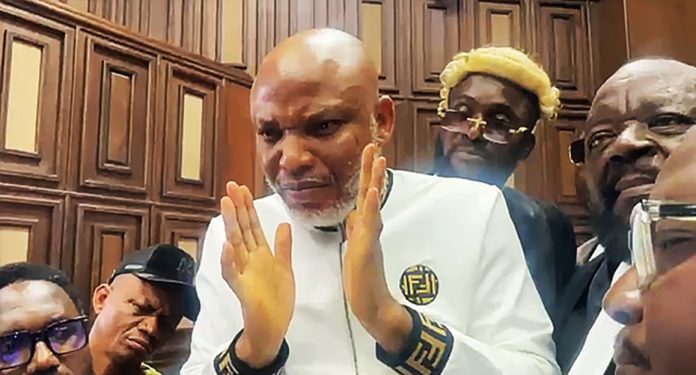
Justice Musa Liman of the Federal High Court Abuja, has sent back to the Chief Judge, a motion filed by the leader of the proscribed Indigenous People of Biafra (IPOB), Nnamdi Kanu, for reassignment.
Kanu, in the motion ex parte, is seeking an order of the court transferring him to the National Hospital, Abuja, for urgent medical attention.
In a short ruling, Justice Liman ordered the transfer of the case file back to the CJ of the Federal High Court, following an application by Kanu’s counsel, Uchenna Njoku, SAN, considering the fact that the annual vacation of the court will end on September 15 (today).
Counsel to the Department of State Services, Adegboyega Awomolo, SAN, did not oppose Uchenna ‘s application.
At the resumed hearing earlier, the judge hinted that there was no time for the vacation court to decide Kanu’s motion.
He said not less than 30 cases were listed for the day’s proceedings by the registrar, and since the court would be unable to take all, the cases were pruned down to six.
Justice Liman added that, in line with Section 46(8) of the FHC Rules, any case that could not be completed within the vacation period would have to be sent back to the CJ for reassignment.
He said that though Kanu’s motion was an urgent one in view of the health ground, it was filed late.
Responding, Awomolo said in case management, the court had the overriding decision on which case to go on and which is not to go on.
Awomolo said it was unfortunate that the matter was coming up rather late.
“Had it been that they filed the application earlier, it would have been taken during vacation. But we are ready to take the motion any time, any day,” he added.
Justice Liman consequently ordered that the case file be referred to the registry for reassignment.
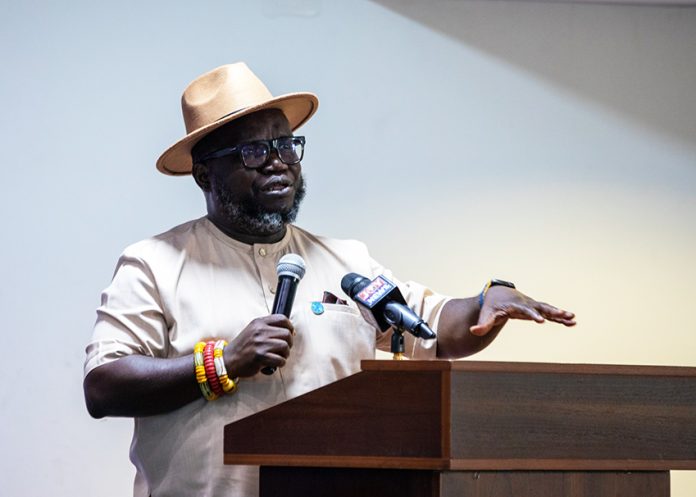
Mr Ken Ashigbey, Member of anti-galamsey coalition
The Coalition Against Galamsey (CAG) has issued a strong condemnation of the government’s handling of illegal mining activities, warning that Ghana may be teetering on the edge of environmental and economic collapse. The group has called for immediate and decisive action to address the worsening crisis of galamsey—the term widely used for illegal and irresponsible small-scale mining in the country.
In a press statement shared with The Chronicle, CAG expressed disappointment in what it called a “troubling posture” adopted by the current administration toward galamsey, accusing government officials of being inconsistent, lenient, and at times enabling the environmental destruction taking place across the country.
Government’s Silence and the President’s Recent Remarks
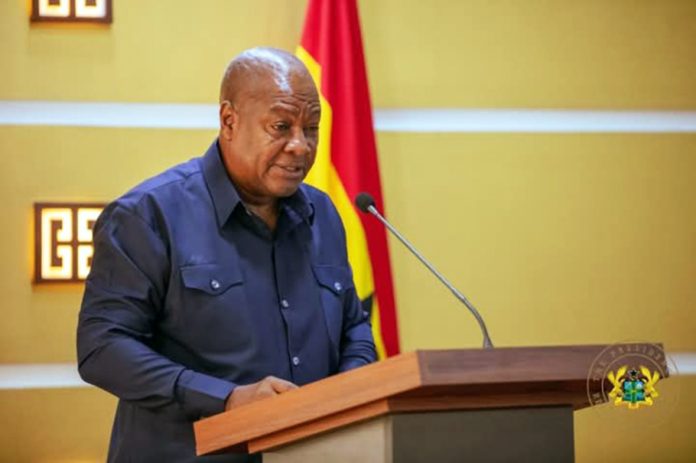
The Coalition particularly criticised President John Dramani Mahama’s recent remarks during a media engagement at Jubilee House on September 10, 2015 describing them as dangerously permissive and counterproductive. The Coalition believes these comments, whether made knowingly or inadvertently, undermine national efforts to curb illegal mining.
According to the CAG, such statements risk legitimizing illegal operations and embolden those responsible for the ongoing environmental degradation. The Coalition argued that the President’s tone failed to reinforce a firm stance against illegal mining and instead could serve to reverse years of public education and political messaging aimed at discouraging the practice.
The group called the president’s rhetoric “deeply unfortunate and regrettable,” noting that it creates room for impunity and dilutes the urgency needed to confront the crisis.
The Current State of Environmental Emergency
CAG painted a dire picture of the country’s current environmental state. The group pointed out that over 20 million Ghanaians now depend on water sources that are severely polluted due to illegal mining operations. Additionally, Ghana has witnessed the destruction of more than 50 forest reserves, with severe consequences for climate security and biodiversity conservation.
The impact on agriculture is equally alarming. Fertile farmlands, particularly those used for cocoa, rubber, and oil palm cultivation are being lost at an increasing rate. Many farmers, according to the Coalition, are struggling to find arable land to continue their livelihood, a situation that threatens national food security and export earnings.
Perhaps most alarming is the potential impact on public utilities. The Ghana Water Company Limited (GWCL) has requested a 280% increase in water tariffs, citing the rising cost of treating polluted water caused by mining activities. According to the Coalition, this request is not merely a financial appeal but a reflection of catastrophic failure at the state level. Ghanaian citizens, it says, are being forced to bear the cost of a crisis they did not create.
The Breakdown of Water Infrastructure
The degradation of water quality has already led to the near-collapse of some treatment facilities. The Kwanyarko Water Treatment Plant, for instance, has reported a turbidity level as high as 32,000 NTU, far exceeding the acceptable standard for safe water treatment. Similarly, the Bunso Water Treatment Plant has remained closed for nearly a year, unable to operate due to extreme pollution. In Kyebi, the water facility runs at minimal capacity and experiences frequent shutdowns.
These developments, according to CAG, signify not just an environmental emergency, but a looming public health and economic disaster. The group warned that if the situation is allowed to persist, Ghana risks losing its ability to provide even basic public services.
Calls for a State of Emergency
The Coalition has renewed its call for a State of Emergency to be declared in regions most affected by galamsey.
Citing Article 31(9) of the 1992 Constitution, CAG noted that the law allows for the declaration of a state of emergency when essential services such as access to potable water, are under threat. The actions of illegal miners, the group argued, have effectively deprived large communities of clean water, thereby meeting the constitutional threshold for emergency powers.
CAG stated unequivocally that Ghana has moved beyond the “last resort” phase, and that only the swift implementation of emergency protocols can salvage the nation from further deterioration. The group urged President Mahama to present a detailed action plan, with clearly defined timelines and milestones, to assure the public of government’s genuine commitment to ending the crisis.
Accountability at the Local Level
Referring to the President’s earlier commitment to dismiss any Municipal or District Chief Executive (MCE/DCE) under whose watch illegal mining continues, CAG insisted that this must not be an empty threat. The Coalition called on the President to follow through by dismissing and investigating such local officials for possible complicity.
The same level of scrutiny, it added, should be extended to district-level police commanders and officers of the National Intelligence Bureau (NIB) operating in mining-endemic areas.
Funding and Resourcing Enforcement Agencies
While acknowledging the establishment of the National Anti-Illegal Mining Operations Secretariat (NAIMOS) as a step in the right direction, CAG stressed that without adequate funding, it will not achieve its intended impact. The Coalition proposed two primary funding mechanisms to support NAIMOS:
First, it suggested that a portion of the proceeds from the Ghana Gold Board (GoldBod) should be earmarked for the operations of NAIMOS. Second, it recommended that excavators and machinery seized during anti-galamsey operations be auctioned at a discounted rate, with the proceeds allocated to joint enforcement efforts between the Forestry Commission and local police units.
The Role of the Ghana Police Service
The Coalition reiterated that while NAIMOS is a key coordinating body, the Ghana Police Service remains the primary state agency responsible for enforcing laws against illegal mining. CAG urged the government to fully equip and empower district-level police stations with the necessary personnel, training, and logistics to execute sustained enforcement.
Furthermore, CAG called on the Inspector General of Police (IGP) to address longstanding issues of corruption and complicity within the ranks of the police, which it says have significantly hampered progress in the fight against illegal mining.
A Nation at a Crossroads
“This is no longer just an environmental challenge; it is a test of national integrity. If we continue to sacrifice our rivers, forests, and farmlands for short-term gold profits, we are trading away our future. We must ask ourselves—what kind of country are we building? And what kind of government allows this level of destruction to persist unchecked?”
The Coalition called on citizens, traditional leaders, civil society, the media, and all political actors to hold the government accountable and demand swift, transparent, and sustained action to end the galamsey menace once and for all.
The unchecked scourge of illegal mining, known locally as galamsey, continues to devastate Ghana’s environment polluting rivers, destroying forests and threatening public health.
As the crisis deepens, a wave of criticism is mounting against President John Dramani Mahama over what many describe as his administration’s slow and ineffective response.
Over the weekend, prominent voices joined the chorus of concerned citizens, demanding urgent action from the Jubilee House to stem the environmental damage.
Among the most outspoken was Dr. Cadman Atta Mills, former Senior Presidential Advisor and brother of the late President John Evans Atta Mills.
Taking to his X (formerly Twitter) handle, Dr. Mills lashed out at the Mahama administration, accusing it of prioritising short-term economic gains over environmental and public health.
“I refuse to pay for the accolades president Mahama and the NDC are receiving for the Cedi’s recovery with my health or life.
“Call it Galamsey or ‘legal’ small-scale mining (when bankrolled by the politically connected). It is killing us. #StopGalamseyNow,” he posted.
The former World Bank Economist expressed disbelief at the government’s inaction and questioned when President Mahama would decisively lead the nation in addressing what he called a catastrophic environmental threat.”
“What will it take for us to act?? Mr President, this is the water that feeds a huge chunk of the central region, thanks to ‘legal small-scale mining’!” he wrote in another post.
His comments have since sparked widespread discussion online, with many echoing his frustrations and fears.
Adding his voice to the public outrage, private legal practitioner, Martin Kpebu, also criticised the government’s handling of the situation.
Speaking on TV3 over the weekend, Martin Kpebu called on the Jubilee House to reinstate specialised personnel who had been withdrawn from anti-galamsey operations.
“We need trained, knowledgeable officers on the ground who can distinguish between legal and illegal operators.
“Right now, there’s too much confusion and speculation because there’s no clear presence or oversight,” he said.
Martin Kpebu also rejected proposals to deploy the military to police forest reserves, insisting that the constitution assigns enforcement responsibilities to the police—not the military.
“Let the Ghana Police Service do its job. We don’t need soldiers in the forests. This is a law enforcement matter, not a military one,” he emphasised.
The growing public dissatisfaction underscores increasing pressure on President Mahama and the government to act swiftly and decisively to combat galamsey, which continues to threaten Ghana’s ecosystems, water bodies and food security.
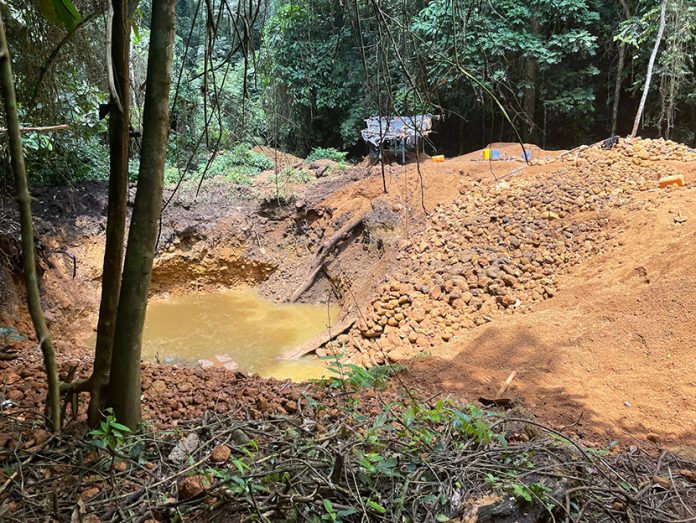
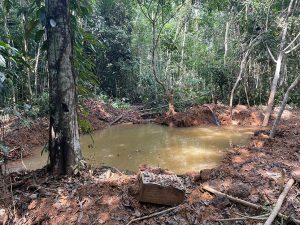
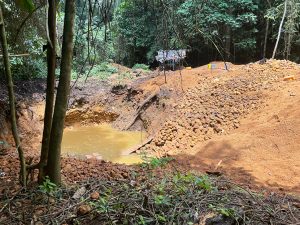
A freshly dug galamsey pit- Image Credit, Arocha Ghana
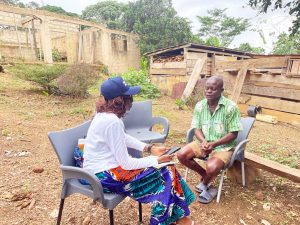
The scorching midday sun filtered through the branches of an old tree, casting shadows across a dusty compound in Sagyimase, about 90 kilometres north of Ghana’s capital, Accra.
Isaac Agyare Boadi, a retired teacher, in his late 60s, sat quietly on a worn out wooden chair, the weight of his thoughts heavy, as the trees surrounding him were visible on his face.
A galamsey pit dug by illegal miners -Image Credit ARocha Ghana
As chicks peeped around his compound house, he began narrating slowly, almost as if weighing each word.
“They are destroying what feeds us. Our water is dirty, our soil is weak and the trees are dying. How do we live when the very ground we depend on is sick?” he questioned, glancing towards the distant green hills.
But those hills are changing. The Sagyimase community, where Boadi lives, housed the 26,000-hectare Atewa Forest, which is under threat from illegal mining and logging activities that have stripped the forest bare and poisoned its soil.
A freshly dug galamsey pit- Image Credit, Arocha Ghana
He recounted how in 2018, he joined a six-day walk from the community to Accra, to petition the government to protect the forest.
“We didn’t walk because we had nothing to do,” he said with a faint smile. “We walked because our survival depends on this land. Without it, we are finished.”
Nature Under Attack
The Atewa Range Forest Reserve is internationally recognised as one of the highest-priority ecosystems in West Africa. It is valued for its rich species diversity, high levels of endemism and significant hydrological importance.
The forest was designated as a National Forest Reserve in 1926, then recognised as a Special Biological Protection Area in 1994, and a Hill Sanctuary in 1995. In 1999, it was included as one of Ghana’s 30 Globally Significant Biodiversity Areas (GSBAs).
The forest serves as the source for three major rivers, which are the source of water for approximately 5 million Ghanaians: the Ayensu River, the Densu River (which flows south into the Atlantic Ocean) and the Birim River, known for its longer, northern detour. This makes the Atewa Range Forest Reserve a critical water source for the region.
Since the 1990s, the Atewa Forest has faced significant threats due to illegal chainsaw logging. This issue has intensified over the years, necessitating the deployment of military personnel to maintain order. Additionally, activities such as bushmeat hunting, illegal farm encroachment and artisanal mining have further contributed to the forest’s degradation.
In 2018, Ghana entered a $2 billion barter agreement with the Chinese government, known as the Sinohydro deal. In exchange for the infrastructure projects that the Chinese will build, the Atewa Forest Reserve was earmarked for bauxite mining and the proceeds will be used to repay the loan.
According to the Africa Centre for Energy Policy, an Accra-based research and advocacy non-profit organisation, a research analysis of the deal revealed that Ghana’s bauxite wasn’t as lucrative as projected.
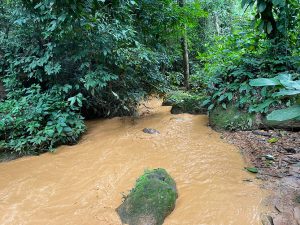
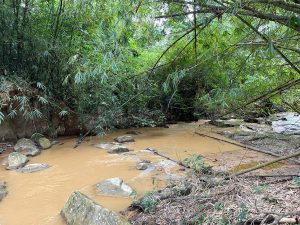
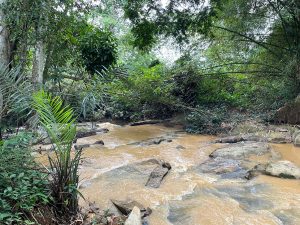
A Polluted Stream, Image Credit, Arocha Ghana
It is estimated that Ghana’s total bauxite reserves are around 550 million tonnes and Atewa only has 20% of it. The analysis further concludes that the government cannot make enough money from the bauxite extracted in Atewa to pay back a $2 billion debt.
In 2019, the government-owned Ghana Integrated Aluminium Development Corporation (GIADEC) began prospecting for bauxite in the Atewa Forest, drilling 53 exploration boreholes without an Environmental Impact Assessment, as required by Ghana’s laws.
This exploration process affected around nine tributaries of rivers in the forest and resulted in the loss of centuries-old trees and the destruction of over one hundred hectares of land, equivalent to more than 100 football pitches.
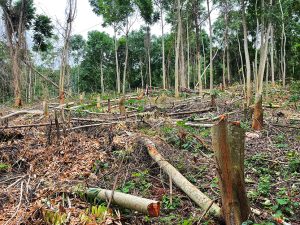
Trees cut down by illegal miners-Image Credit ARocha Ghana
Over the years, several companies, including ALCOA (Aluminium Company of America), have engaged in exploration activities in the area.
In 2011, Vimetco Ghana (Bauxite) Ltd., a subsidiary of the international aluminium company Vimetco N.V., was granted prospecting licenses to mine bauxite in the forest.
However, the company faced significant opposition from residents and environmental groups concerned about the potential impact on water sources and biodiversity, leading to public protests.
In 2022, Vimetco Ghana was granted another prospecting license for the same forest, which sparked further public outcry and controversy regarding the licensing and operations.
For many in Atewa, the struggle to protect their ancestral heritage is deeply rooted and generational.
Illegal mining has expanded rapidly following the Sinohydro agreement, leading to severe degradation of the reserve. Bauxite mining has not yet commenced in the forest due to a lawsuit against the Ghanaian government, with the case currently pending in court.
The discoloured Birim river- Image Credit ARocha Ghana
Today, the consequences are visible: lost forests, dying trees, silted rivers, collapsing farmlands, and a way of life under siege.
Madam Asabi Asara, a farmer, has watched the creeping advance of illegal mining threaten the forest, once bordered by clear, flowing streams, which are now polluted.
“Before the encroachment by illegal miners, we didn’t have problems with our water bodies, and our harvests were plentiful,” she said. “The soil was good, and farming could sustain us.”
But that reality is fading. For Asabi, resisting any mining interest in Atewa has become a daily act of resistance — a fight not just for soil and crops, but for the survival of their families and the preservation of their community’s identity.
Interactive Map – Atewa Forest
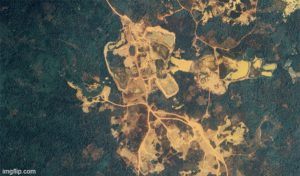
Satellite images showing the current high level of destruction inside Atewa Forest via Google Earth
“Mining inside forest reserves is prohibited,” said Alfred Ameyaw, the Atewa District Manager of the Forestry Commission, the government agency responsible for protecting and managing permanent forest estates and protected areas.
Since January of this year, he explained that they have arrested 25 illegal miners inside the Atewa forest in 17 different cases currently before the Koforidua Circuit Court “B”.
Crediting community sensitisation campaigns and tips from informants have contributed to a reduction in illegal mining activities.
However, he warned that without increased logistical and financial support, the fight will be lost. He cited the need for reliable vehicles to access remote sites, fuel to sustain patrols, and adequate funding to support court-related expenses such as transporting suspects and evidence.
Without these basic resources, he warned, operations risk grinding to a halt, giving illegal miners a free pass to return.
“Protecting Atewa’s forests is a shared responsibility,” he said, “and if we fail, it will not only be our loss, but the loss of future generations.”
The devastating effect of Galamsey on a river- Image Credit ARocha Ghana
To monitor the activities of illegal miners in the Atewa Forest, A Rocha Ghana, a not-for-profit environmental organisation that has been leading advocacy efforts against mining in the Forest, developed SMART Mobile for Conservation.
This remote phone-based application helps a group of forest workers known as ‘local monitors’ to report live updates of illegal activities in the Atewa Forest.
Eli Etsra, a Project Manager at the organisation, explained the group’s ongoing efforts to protect the forest, which include community sensitisation, policy engagement, and collaboration with civil society organisations.
He called for a collective commitment from government, traditional leaders, and citizens to safeguard Atewa for future generations, not to be swayed by short-term economic gains that could lead to irreversible harm. “The forest is our heritage and our life. Once we destroy it, we destroy ourselves,” he added.
The National Park Request
To address the inconsistencies in policies and directions from successive governments regarding the status of the Atewa Forest, the Concerned Citizens of Atewa Landscape, a community-based organisation of 500 members from the 53 communities surrounding Atewa, suggested that the Ghanaian government designate and build the forest into a National Park.
In a letter to the then-President, Nana Akufo-Addo, whose government proposed mining in Atewa as part of a Chinese loan agreement, the Concerned Citizens of Atewa Landscape stated, “Atewa as a National Park would be a lasting, positive legacy for the Government of Ghana.”
They emphasised that this option ‘’enjoys significant public support among the forest-edge communities and would honour Ghana’s commitment to the international Convention on Biological Diversity and the Sustainable Development Goals.’’
The journalist interviewing Isaac Boadi, a resident of the area
Experts like Awula Serwah, Esq., the founder of Eco-Conscious and a prominent advocate for various nature campaigns, believe that the Ghanaian government should focus on enhancing forest reserves for ecotourism. This approach would help preserve nature while also supporting local communities.
‘’Ghana could carve out a share of that market by monetising its natural resources in a way that preserves forest reserves and pristine rivers while leveraging them to develop a sustainable and profitable green economy,’’ Awula explained.
‘’Mining is a short-term approach that ends up costing us more when we factor in the cost of restoring and repairing the damaged environment. The resulting health challenges add to the cost of mining, making its profitability a mirage.’’
For the people of Atewa, the struggle to protect the forest is twofold. First, they must engage with the government, which is constitutionally responsible for safeguarding the forest.
Second, they face the challenge posed by illegal miners and loggers who exploit legal loopholes. The community needs to succeed in this fight if it wants future generations to inherit this natural heritage, just as it was passed down to them by previous generations.
By: Jennifer Ambolley & Ibrahim Khalilulahi Usman
This reporting was supported by the Pulitzer Center.
Kareem Abdul-Jabbar is one of the most prominent public figures who resents the stereotypes of black people. As a social activist, Abdul-Jabbar believes it’s one of the concerning issues that society is facing nowadays, and the media isn’t really much of a help.
From Kareem’s point of view, the fascination with famous black celebrities and athletes strengthens the narrative that black people’s capabilities are limited. For the NBA Hall of Famer, patronizing black people only for what they are known for is stereotyping at its best, which has been exactly the case for decades now.
Abdul-Jabbar firmly believes that black stereotypes could only dissipate once black people begin to realize that they are more valuable than how they are being showcased to the world. Then again, Kareem implied that it would only be the start.
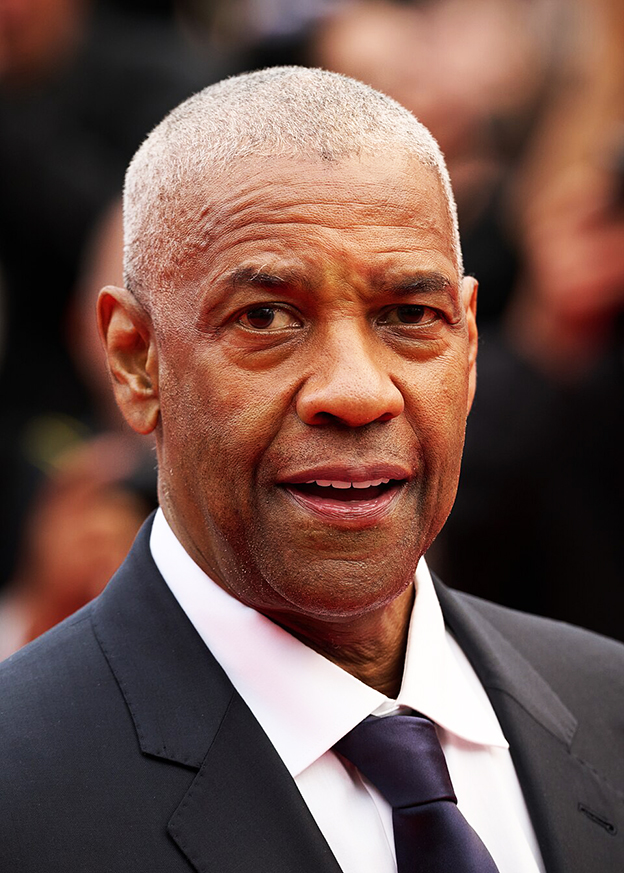
“I think it has a lot to do with accepting stereotypes both by people in minority communities and by society at large,” Abdul-Jabbar told Slam in 2012. “They accept stereotypes and what their potential is. And there’s a lot more than just picking up a guitar or being out there on the football field. Denzel Washington should not be the role model for everybody.”
The US treasury secretary has said Washington has reached a “framework” deal with China on the ownership of TikTok’s American operations.
Scott Bessent said the framework was set in trade talks in Madrid to pave the way for US ownership. He added that US President Donald Trump and Chinese President Xi Jinping would “complete” the deal on Friday. China has not commented.
Trump said on Truth Social that talks in Madrid had “gone very well”, with a deal reached “on a certain company that young people in our country very much wanted to save”.
A deadline is looming for the Chinese owner of TikTok to find a buyer for its American operations or face a ban in the US.
Brief History
TikTok was fending off claims that its Chinese parent company, ByteDance, would share user data from its popular video-sharing app with the Chinese government, or push propaganda and misinformation on its behalf.
China’s foreign ministry accused the US of spreading disinformation about TikTok’s potential security risks following a report in the Wall Street Journal that the committee on foreign investment in the US – part of the treasury department – was threatening a US ban on the app unless its Chinese owners divest their stake.
TikTok said it would route all data from US users to servers controlled by Oracle, the Silicon Valley company it chose as its US tech partner in 2020 in an effort to avoid a nationwide ban. But it is storing backups of the data in its own servers in the US and Singapore. The company said it expects to delete US user data from its own servers, but it has not provided a timeline as to when that would occur.
British actor Owen Cooper has become the youngest male ever to win a primetime Emmy Award, in a night dominated by Netflix’s acclaimed drama Adolescence.
Cooper, 15, was named best supporting actor in a limited series for his portrayal of a schoolboy accused of murdering a classmate.
The four-part drama also won best limited series, as well as prizes for its directing and writing, and acting prizes for Stephen Graham and Erin Doherty.
In his acceptance speech, Cooper said: “Standing up here is just, wow, it’s just so surreal.
“When I started these drama classes a couple of years back, I didn’t expect to even be in the United States, never mind here.”
Cooper, who played teenager Jamie Miller, said: “I think tonight proves if you listen, and you focus and you step out your comfort zone, you can achieve anything in life.
“Who cares if you get embarrassed? Anything can be possible. I was nothing about three years ago, I’m here now.”
He also thanked his family, co-stars, and the show’s production team, adding: “It may have my name on this award, but it really belongs to the people behind the camera.”
Cooper broke the record previously held by Scott Jacoby, who was 16 years old when he won a Primetime Emmy in 1973 for That Certain Summer.
Roxana Zal remains the youngest acting winner overall. She was 14 when she won an Emmy in 1984 for Something About Amelia. Bindi Irwin is the youngest person to have won a Daytime Emmy, when she was nine.
Gospel musician Piesie Esther has dismissed speculations that she is not on good terms with ‘Watch Me’ hitmaker Empress Gifty.
Concerns about their relationship arose after an interview on Power FM on Saturday, 13th September 2025. During the show, host Agyeman Prempeh asked Piesie to mention who won Artiste of the Year at the 2025 Ghana Music Awards USA. It took some persuasion before she eventually mentioned Empress Gifty’s name.
When asked if she had congratulated Empress on her award, Piesie responded that nobody had congratulated her when she won Artiste of the Year at the Ghana Music Awards Europe in 2023. This response triggered conversations on social media, with some suggesting there might be tension between the two gospel musicians.
However, speaking on Daybreak Hitz with Doreen Avio and Kwame Dadzie on Hitz FM, Piesie clarified that there was no problem between them.
“The reason I didn’t want to mention Empress’s name on Agyeman’s show was that when she won the award people said a lot about it. Some said she deserved it, others said otherwise.
By God’s grace the controversy died down, so the moment you raise it again then you want it to escalate. That was why I didn’t want to bring her into the conversation.
I don’t have any problem with Empress Gifty. I don’t know anyone who can boldly say I have an issue with him or her. It will not happen. I have a good relationship with Gifty. We talk,” she said.
Meanwhile, Piesie Esther has released a new song titled Nyame Ye, which is already winning the hearts of music lovers.
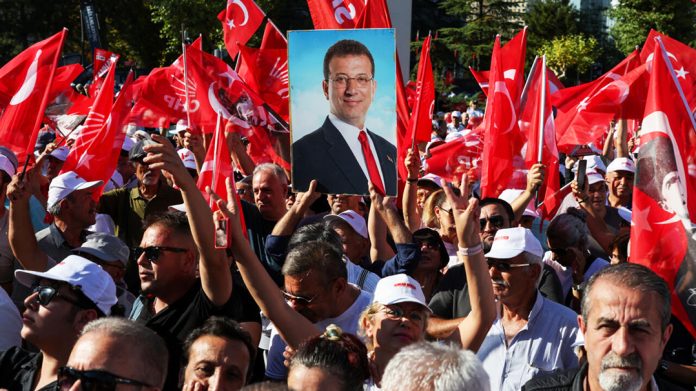
A court in Ankara has postponed the hearing of a controversial case that could oust the leader of Turkiye’s main opposition party, amid protests against the government of President Recep Tayyip Erdogan.
On Monday, the hearing about alleged internal irregularities during the Republican People’s Party’s (CHP) 2023 congress was adjourned until October 24.
Prosecutors have accused CHP leaders of vote-buying at the internal event in 2023 in which Ozgur Ozel was elected chairman, allegations the CHP says are politically motivated.
The case is the latest in a long line of challenges faced by the party.
The Turkish government has rejected accusations of political interference, insisting the judiciary acts independently.
Officials said the cases against CHP figures stem from corruption charges, which the party denied and argued are designed to weaken the opposition.
Turkish authorities have jailed hundreds of CHP members this year for alleged corruption, including Erdogan’s main political rival, Istanbul Mayor Ekrem Imamoglu, who was arrested in March.
Critics say the crackdown is an attempt to destabilise Turkiye’s oldest political party, which won a large victory over Erdogan’s AK Party, or Justice and Development Party, in local elections last year.
On Sunday, Ozel told thousands of protesters in the national capital that the case was part of Erdogan’s wider attempt to undermine democracy.
“This case is political, the allegations are slander,” said Ozel, who claimed CHP was experiencing the “grave consequences” of government oppression.
US President Donald Trump has renewed his accusation that Venezuela is sending gang members and drugs to the United States, which he said was “not acceptable”.
Tension has been high between the two countries since the US deployed warships to the Southern Caribbean on what officials said were counter-narcotics operations.