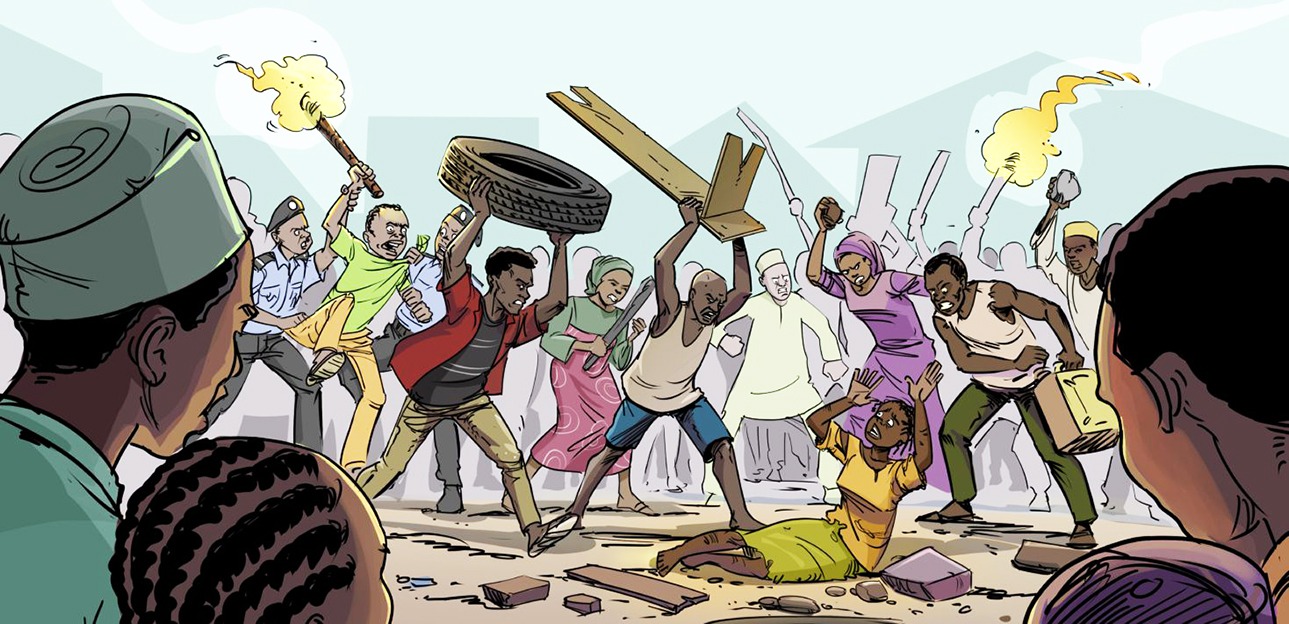
Indeed, life is precious. This is a core reason everyone must strive to preserve it. Nonetheless, life can sometimes take a tragic twist. Misfortunes occur day in and day out, and death is one of them. But where, how, and when it happens often remain a mystery. Some people die through drowning at sea, others through illness, and for some, it is road accidents.
Among all these, mob justice stands out as one of the cruelest ways anyone can die. Whether a person is guilty or not, it should never be encouraged. This is because many innocent people have lost their lives. What appears to be a culprit may, in fact, be a close, innocent friend, relative, or neighbour.
See it as cruelty, control tactics, or outright inhuman behaviour, mob justice in Ghana remains a harsh reality. It persists, and many people have fallen victim to it. What makes the situation even more disturbing is that some victims are innocent, yet they are brutally assaulted, sometimes even to death.
Fatal suspicion
Stories shared by people around us reveal just how dangerous such situations can become.
In a conversation, a female colleague narrated an incident that occurred at a bus station. One day, she noticed a pickpocket dipping his hand into her handbag. She immediately called him out. Within seconds, a crowd gathered around them.
Realising the danger, she quickly told the mob that the man had not taken anything from her bag. That single statement caused the crowd to disperse.
Later, she admitted that she had been frightened by the intensity of the mob. Looking back, she believed the man might have been beaten to death, considering the kind of men who had gathered, ready to act.
Such moments show how quickly a crowd can turn violent and how easily suspicion can escalate into tragedy.
Growing concern
Relationships add flavour to our lives. Knowing that someone cares about you builds confidence and reduces the need to impress or perform. Life becomes more meaningful when relationships are cordial and supportive.Sadly, this was not the case for a young and upcoming musician whose life ended tragically.
A criminologist at the Kwame Nkrumah University of Science and Technology, Jones Opoku, has expressed concern about the growing tendency of some Ghanaians to lynch suspected criminals instead of allowing the law to take its course.
His concerns followed the lynching of Wilberforce Appiah, popularly known as Wyllbee, at Tanoso in the Ashanti Region.
The budding musician was reportedly attacked by a mob after he was accused of theft when he stepped outside his girlfriend’s house. Reports indicate that Wilberforce Appiah had travelled from his base in Accra to Kumasi for radio promotions. Some accounts suggest that he had visited his girlfriend, Nana Yaa, who is said to be married and, while outside the house at dawn, residents suspected him of being a thief.
A mob quickly formed and attacked him. He was later rushed to the hospital but sadly died from his injuries.
However, the family of the deceased, including ObremponKwakuAsiamah, rejected claims that their relative was a thief. For them, the tragedy reflects the danger of allowing suspicion and rumour to replace due process (myjoynews.com, 2024).
Another gruesome incident that shook the entire nation was the killing of Maxwell Mahama.
Major Mahama was lynched at Denkyira-Obuasi on May 29, 2017, while he was on duty. Residents reportedly mistook the soldier for a robber.
The incident sparked widespread outrage across the country and triggered calls for stronger action against mob violence. Following investigations, more than 50 suspects were arrested, and 14 were screened for prosecution.
The mother of the late soldier, Veronica Bamford, later expressed satisfaction with the sentencing of 12 persons involved in the murder of her son (citinewsroom.com, 2024).
In recent times, even foreigners have experienced similar ordeals.
An incident on February 27, 2026, renewed concerns about mob justice in Ghana and the safety of foreign nationals living in the country. The victim, identified as Austin Tengeeh, was reportedly confronted by residents who suspected him of theft.
According to preliminary police findings, he was chased and beaten by a group before officers arrived at the scene (ghanamedia.net, 2026).
Beyond these disturbing incidents, public opinion data also reveals worrying attitudes toward mob justice.
A recent survey by Afrobarometer found that about 15 percent of Ghanaians support mob justice under certain circumstances. The figure becomes even more concerning when regional differences are considered. According to the report, support rises to 39 percent among residents in the Upper West and Northern Regions (citinewsroom.com, 2018).
These findings suggest that despite the dangers associated with mob violence, a section of the population still views it as an acceptable response to suspected crime.
Call to reflect
The recurring stories of mob justice should force society to pause and reflect.
No matter the suspicion or anger, no individual or group has the authority to act as judge, jury, and executioner. When a crowd takes the law into its own hands, the line between justice and injustice quickly disappears.
Many victims of mob attacks are never given the opportunity to prove their innocence. In some cases, mistaken identity, rumours, or mere suspicion have led to the brutal loss of human life.
By the time the truth emerges, the damage has already been done.
A society that allows mob justice to thrive risks weakening the very institutions meant to protect its citizens. When people begin to believe that instant punishment by the crowd is acceptable, trust in the police, the courts, and the rule of law gradually erodes.
Ending this troubling practice requires more than condemnation after each incident. Public education, stronger law enforcement, and community vigilance are necessary to ensure that suspects are handed over to the authorities rather than to an angry mob.
Traditional leaders, religious institutions, and the media also have an important role to play in shaping attitudes and discouraging violent responses to suspicion.
The stories we hear, whether of ordinary citizens, musicians, soldiers, or foreigners should remind us that mob justice spares no one.
In the heat of suspicion, anyone could become the next victim. Perhaps that is the most haunting lesson of all.
WRITTEN BY:
Henry Atta Nyame
Institutional Assessment Practitioner
hattanyame@gmail.com
For more news, join The Chronicle Newspaper channel on WhatsApp: https://whatsapp.com/channel/0029VbBSs55E50UqNPvSOm2z