Home Blog Page 469

Netanyahu does not rule out further strikes on Hamas leaders

0
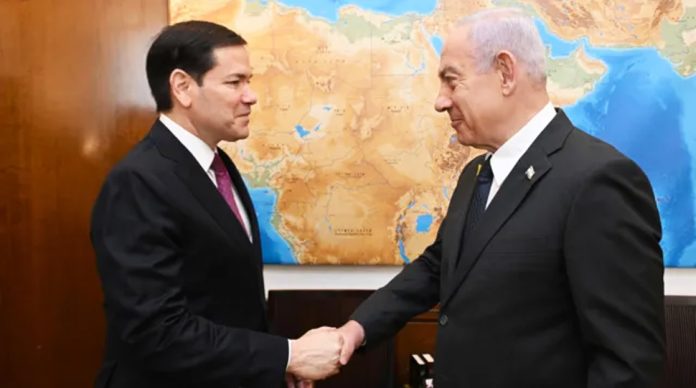
US Secretary of State Marco Rubio and Prime Minister Netanyahu

Israeli Prime Minister Benjamin Netanyahu has not ruled out further strikes on Hamas leaders following last week’s attack in Qatar, saying they would not have immunity “wherever they are”.

Speaking at a joint press conference with US Secretary of State Marco Rubio in Jerusalem, Netanyahu said every country had the right “to defend itself beyond its borders”.

Israel’s decision to target senior Hamas leaders in Qatar – a close US ally – drew international outrage and criticism from US President Donald Trump. Hamas said six people were killed but that its leaders survived.

When pressed on whether the US had any involvement in the strike, Netanyahu told journalists: “We did it on our own. Period.”

In response to a question from the BBC about whether Israel’s strike had damaged US relations in the region, Rubio said Washington maintained “strong relationships with our Gulf allies”.

The meeting between Rubio and Netanyahu comes as Arab leaders hold a summit in a show of support for Qatar. Its prime minister urged the international community to stop applying “double standards” and to punish Israel.

Qatar hosts a major US airbase and has played a key role in brokering diplomatic efforts to end the war in Gaza, serving as a mediator of indirect negotiations between Hamas and Israel. It has hosted the Hamas political bureau since 2012.

On Sunday, Netanyahu told reporters that the US-Israel relationship was as “durable as the stones in the Western Wall” while he and Rubio made a short visit to the holy site in Jerusalem’s Old City.

Credit: bbc.com

Nepal’s PM Karki appoints ministers after deadly Gen Z protests

0
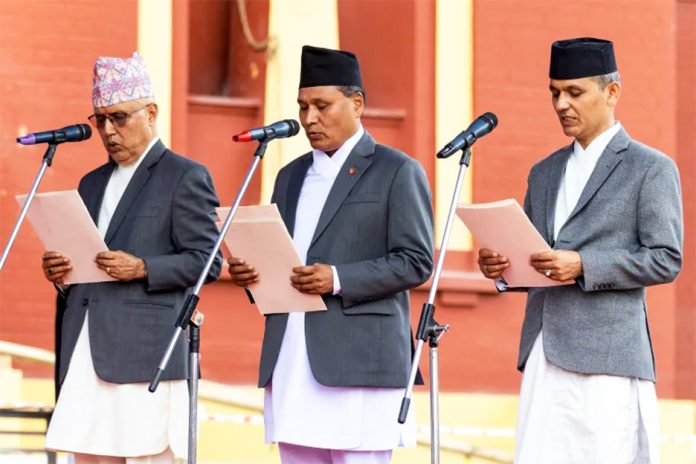
New Finance Minister Rameshwar Khanal, Energy Minister Ghising and Home Minister Om Aryal take oath

Nepal’s Prime Minister Sushila Karki has named three new ministers, just days after the dissolution of parliament was triggered by deadly protests.

Karki, who on Friday became the Himalayan nation’s first female leader, made Om Prakash Aryal home minister, Rameshwar Prasad Khanal finance minister and Kulman Ghising energy minister on Monday.

Aryal is a human rights lawyer who has taken on legal cases in the public interest, Khanal is a former finance secretary who recently recommended major economic reforms, and Ghising is a former state power utility chief credited with ridding the country of its load-shedding problems.

In a ceremony broadcast on television from outside the fire-damaged presidential office, President Ramchandra Paudel swore in the three new ministers.

Known for their anticorruption stances, they will serve alongside Karki in an interim government that has promised to work towards ending corruption. It will govern the country for six months until national elections are held in early March.

Their appointments come less than a week after veteran leader KP Sharma Oli resigned as prime minister amid unrest that deepened when demonstrators were shot dead by police on Monday.

Led by Gen Z, the protests quickly escalated, with key public buildings, including Parliament, set ablaze.

The demonstrations started on September 8 over a short-lived social media ban and exacerbated burgeoning popular anger over systemic corruption and poverty.

At least 72 people died in last week’s violence, the Nepalese authorities said on Sunday.

Credit: aljazeera.com

Struggling with brain fog? Here’s how to fix it

0

When life gets busy and stress levels rise, it’s not uncommon to find yourself walking into a room and forgetting why you went there, losing your train of thought mid-sentence or struggling to stay focused on simple tasks.

Especially after the weekend, it can be hard to get back into work or study mode.

This mental cloudiness is often called brain fog and while it isn’t a medical condition in itself, it refers to a collection of cognitive symptoms such as difficulty concentrating, forgetfulness, and mental slowness.

Common causes of it can include menopause or perimenopause, and conditions such as long Covid and autoimmune conditions like lupus disease, but it can also strike when you’ve got too much on your mind at once.

Medical doctor and Morning Live expert, Dr. Tharaka has these four tips and a special acronym to help cut through the haze.

1. Be kind to yourself

Brain fog can happen to anyone and it’s not a personal failing or a sign that you’re not coping.

Often, it’s simply your brain’s way of saying it’s tired, stressed or overstretched.

Remind yourself that brain fog is usually temporary and it’s okay to slow down, delegate tasks or ask for help when you need it.

If you are concerned then you should contact your GP.

2. Create routines

Reduce decision fatigue by having a set rhythm to your days – a predictable structure can take pressure off your working memory.

Knowing what’s coming next stops your brain from constantly asking, “What am I doing today?”

It’s worth creating a morning and evening routine and even something as simple as laying out clothes or prepping breakfast ahead of time frees your mind from constant decision-making.

3. Take breaks

It’s easy to fill your diary with back-to-back commitments – meetings, social events, errands and daily tasks – without leaving any breathing room.

But constantly jumping from one thing to the next can leave your brain no time to reset, making brain fog more likely.

Try deliberately scheduling short breaks between activities, even just 5–10 minutes to stretch, get a drink, step outside or sit quietly.

Think of these firebreaks like mental buffers: they give your mind a chance to process what you’ve just done, let go of lingering stress and prepare for what’s next.

4. Use calendars and reminders

Trying to hold every appointment, task and reminder in your head can quickly lead to mental clutter and forgetfulness.

Let tech do the remembering for you – use calendars and reminders to free up mental space.

Schedule recurring tasks so they happen automatically – for example, block out lunch in your diary each day or set weekly reminders for bills and chores.

This means you’re not constantly thinking, “What do I need to remember next?”

Alongside these practical daily strategies, Dr T also recommends using his Swans acronym to support brain health and sharpen focus.

Each letter stands for a key habit that can help clear the mental mist and keep your mind performing at its best:

  • Sleep:Sleep is non-negotiable – it gives your brain time to rest and consolidate memories. Aim for between seven and nine hours each night.
  • Water:Our bodies are about 60% water and even mild dehydration can make you feel unfocused so keep water nearby and sip it regularly
  • Activity: Moving your body boosts blood flow and oxygen to the brain, which helps you think more clearly. Try going on short walks, a light jog or regularly stretching
  • Nutrition:Nourish your brain with whole foods rather than processed ones. Choline is a nutrient vital for brain health so eating food that is rich in it like eggs, fish and nuts can support concentration and focus.
  • Stress:Chronic stress floods the body with cortisol – a hormone that helps regulate your body’s response to stress – and that can cloud your thinking. Find ways to lower stress through breathing exercises, mindfulness and hobbies.


Credit: bbc.com

Feature: Gaza’s Worst Fear Is No Longer Bombs But ‘Humanitarian Cities’

0

We, survivors of Israel’s genocidal war, now face a greater terror: military-run camps disguised as relief that would strip us of our last dignity and freedom.

By Logain Hamdan

We thought returning home would end the nightmare.

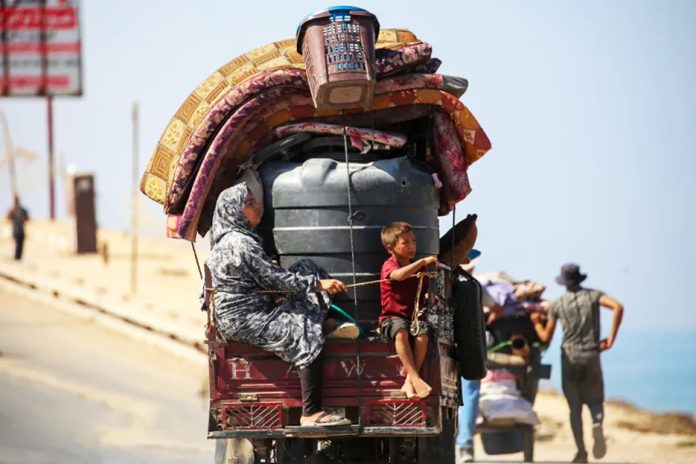
After months of fleeing bombardment, sleeping in tents, schools, or under makeshift nylon sheets, many families finally walked back to their homes in northern Gaza during the fragile ceasefire in January 2025. The roads were lined with rubble. Our houses were broken shells, neighborhoods unrecognisable. Yet we carried a fragile hope: that by stepping back onto our land, even among ruins, we were reclaiming our lives.

But as soon as we returned, the headlines followed us. Terms like “mass relocations”, “humanitarian cities,” and “population transfers” began to appear, suggesting that even after everything we had endured, our next destination might not be what remains of our homes, but military-controlled camps in the far south of Gaza, where the army had swept through and wiped out entire residential neighbourhoods, turning them into barren, flattened deserts.

For many outside Gaza, such reports read as distant political debates. For us, they land like threats. Each new statement feels like a draft of our next exile. The idea that the Israeli military might herd hundreds of thousands of us is terrifying precisely because we know what those “cities” would really be: overcrowded compounds, controlled checkpoints, food and water distribution under armed watch — if we are lucky enough to receive them — no freedom of movement, no guarantee of ever leaving.

Families who have just swept dust from their broken floors now whisper about whether they should keep bags half-packed, ready to flee once again. Children, who have barely adjusted to sleeping in their own beds after months away, overhear the word “relocation” and start crying. We all know what it means: another round of humiliation, another erasure of what little normal life we are trying to piece together.

Meanwhile, life in northern Gaza is already unbearably hard. Water and electricity are scarce. Food is overpriced and often unavailable. Families live among rubble, patching holes with nylon sheets. Yet even in these conditions, people cling to the dignity of being on their own land.

But that fragile dignity is overshadowed by the possibility that it could all vanish. Every attempt to rebuild — a repaired roof, a replanted garden, a reopened shop — feels provisional. Parents ask themselves: Should we invest in repairing the house if we may be forced out again? Students sit with books by candlelight yet wonder: What school will I graduate from if we are moved tomorrow? Every moment of normality feels as though it could be interrupted by soldiers demanding we leave.

What would it mean to live in these camps? The very thought keeps us awake at night.

We picture long queues for food, dependent on ration cards for every meal. We imagine tents lined in rows, stripped of privacy, where families huddle with strangers and women fear for safety in overcrowded conditions. We imagine soldiers controlling the gates, deciding who enters and who leaves, monitoring our lives with cameras and watchtowers.

For children, it would mean growing up without classrooms they know, without streets that carry their memories. Their “playground” would be a fenced dirt lot. For young men and women, it would mean the end of any chance at education or work; for, inside camps, life shrinks to survival. For the elderly, it would mean dying away from what remains of the houses and trees they planted with their own hands.

These are not abstract fears; they match what has already been documented in displacement zones and what legal experts predict. Analysts writing for JURIST and the Council on Foreign Relations note that once inside such camps, Palestinians would be unable to leave freely, their movements tightly monitored, their lives dependent on aid distribution. The United Nations agencies and NGOs have also warned that further mass relocations under military oversight could constitute forcible transfer.

The danger of these proposals is not only the physical hardship but the permanence they suggest. History has taught us that once people are forced into camps, “temporary” becomes long-term. A tent pitched “for now” becomes a marker of exile for decades.

That is why the fear today feels heavier than even the destruction we have endured. Bombs destroy cities, but forced relocation destroys roots. If we are pushed into these camps, it will not just be the loss of homes; it will be the loss of any claim to return.

Satellite imagery already confirms this danger is not theoretical. In Rafah, Al Jazeera’s Sanad agency documented the destruction of nearly 30,000 buildings between April and July 2025, providing evidence of land-clearing consistent with preparations for such a “humanitarian city”.

What makes this looming threat unbearable is the trajectory of our lives. We have already been pushed from hard to harder: from homes to schools, from schools to tents, from tents back to broken houses. And now, the plan being whispered is the hardest yet — military-run shelters that strip us of autonomy altogether.

What we really fear is not paranoia. It is a recurring project to erase us from our land. Some may wonder why the idea of relocation is more terrifying than the bombs we have survived. The reason is simple: bombs destroy walls, steal lives, but they do not sever us from our land. Forced relocation uproots us forever.

To lose a home is devastating. To lose the possibility of return is annihilating. That is why families whisper about the proposals with trembling voices. Because deep down, we know: once we are herded there, we may never see home again.

The world must see through the language being used. The term “humanitarian” is a mask. What is being proposed is not relief but imprisonment. What is being prepared is not shelter but a system of control designed to make displacement permanent.

If you read those headlines, do not imagine children playing safely in neat new towns. Imagine them staring through barbed wire, asking why they cannot go home. Imagine mothers queueing for a ration of flour under the eyes of soldiers. Imagine fathers pacing at night, unable to protect their families from the indignity of being treated as captives.

For us in Gaza, the worst may still be ahead. We returned home believing the nightmare was beginning to end. Instead, we live in the shadow of a new displacement, one that could erase even the ruins we call ours. This is the horror that defines our present: not only surviving bombardment, but living every day with the dread that the next chapter is already written, that the hardest chapter is still to come.

Credit: aljazeera.com

Ghana Premier League starts on a good note

0
Officiating was good in match day one

The 2024/25 season of the Ghana Premier League (GPL) kicked off over the weekend, with shocking results and chaos free encounters.

Nine matches were played and the results were as fascinating as the game of football, full of surprises.

Officiating was on point as referees made the right calls, though as humans, they got some wrong. Overall, they were able to take control of proceedings of the matches.

Thirty-three yellow card and two red cards were shown in matchday 1 of the GPL. The match between Karela and Aduana was the most discipline match as no card was shown in that match.

A scene from the Ghana Premier League

Players comported themselves well and remained disciplined on the pitch, leading to low rate of recorded bookable offences.

Football fans supported their teams rather than engaging in any violent activities which would make negative headlines. Getting to the end of last football season, hooliganism rose to the apex, with fans and even players going into games with fear and trepidation.

Ghana Football Association (GFA) must be committed to their promise of eradicating hooliganism from the sports and also, fans should learn from previous incidents that chaos does not build the game, but rather cause pain to individuals and also tarnishe the image of the country as a whole.

According to Ghanasoccernet.com, Benedicta Owusu-Ansah writes that the 2025/26 Ghana Premier League kicked off with all signs pointing to a rejuvenated domestic competition ready to reclaim its glory. 

A Game-Changer: GH¢18 Million Sponsorship Boost

After years of struggling without sponsorship and TV rights deals, the Ghana Premier League has been handed a lifeline.

Thanks to a GH¢18 million package from the government through a partnership with Adesa Productions, each of the 18 top-flight clubs has received GH¢1 million in pre-season funding.

GFA President Kurt Okraku called it a new dawn: “As part of our new approach, and through this unique partnership with Adesa Productions, each of our GPL clubs will, before the start of the league season, receive GH¢1 million.”

This injection of capital is already having an impact from better branding and matchday organisation to improved competitiveness on the pitch.

The production quality by Adesa Productions has raised eyebrows for all the right reasons.

Broadcasting is a cornerstone of modern football, and the visuals, graphics, and commentary now rival those of bigger leagues.

The opening ceremony, headlined by dancehall star Stonebwoy, added a new layer of entertainment, setting the tone for a season that blends football with culture.

Competitive Matches, Encouraging Officiating

The opening fixtures have been lively and competitive. From the Hearts of Oak vs. Hoehoe United stalemate to the thrilling Berekum Chelsea vs. Asante Kotoko clash, fans have been treated to spirited contests.

Stonebwoy performs to open the football season

Officiating, often criticised in the past, has shown noticeable improvement in the televised games.

One standout observation: the pitch at Berekum.

It looked sharp and TV-friendly, something the GFA’s competitions department and Club Licensing Board must ensure remains consistent across all venues.


Why This Season Matters

The 2025/26 campaign feels different. There’s energy, professionalism, and above all, hope.

The sponsorship has breathed new life into the clubs, the coverage is world-class, and the football on display is competitive.

Fans who may have drifted away now have every reason to return.

As a football-loving nation, it’s on us to own, support, and cherish this rebirth of our domestic league.

God bless Ghana football. This is our own – let’s make it our own. The Ghana Premier League is truly back.

By Jesse Otoo

Today’s UEFA Champions League Fixtures & Previews

0
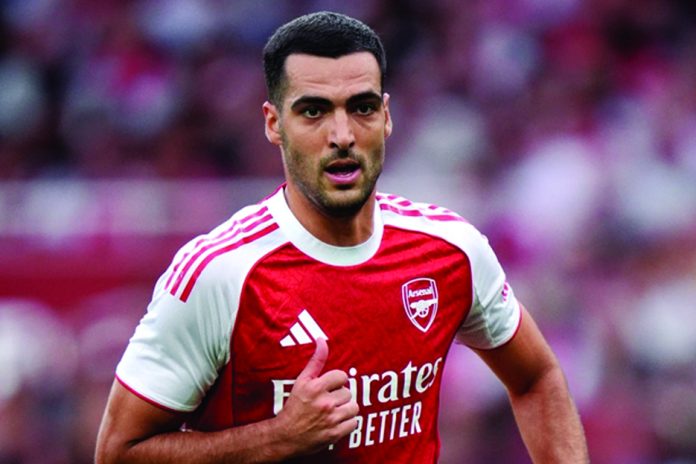
Mikel Merino, Arsenal

Arsenal open Champs League campaign at Athletic Bilbao

Clashing in competitive action for the very first time, Arsenal and Athletic Bilbao open their 2025-26 Champions League league phase campaigns today at the San Mames Stadium.

The Gunners have only been on an upward trajectory in Europe since returning to the elite, while their hosts are competing in the Champions League proper for just the third time ever.

The lack of European silverware continues to bedevil all associated with Arsenal, who have not conquered the continent in any shape or form since winning the 1994 UEFA Cup Winners’ Cup, but there is a sense that Mikel Arteta‘s men are now genuine contenders for Champions League stardom.

Now entering a new European campaign on the back of a £250m summer spending spree, Arsenal harbour realistic ambitions of a Premier League and Champions League double, having amassed a respectable nine points from their first four games in the English top flight.

Despite missing Bukayo Saka, William Saliba and Kai Havertz before losing Martin Odegaard to another shoulder problem, Arteta’s men made extremely light work of Ange Postecoglou’s Nottingham Forest on Saturday lunchtime, easing to a 3-0 win .

Likely rearguard alterations on Arsenal’s end could see the Gunners lose some of their well-documented defensive steel, but a Nico Williams-less Athletic are not well-placed to capitalise.

Even without Odegaard and Saka pulling the strings, Arteta’s men still possess offensive quality in abundance, and we can only envisage the visitors making a triumphant start to another Champions League campaign.

Credit: sportsmole.co.uk

Tottenham welcome Villarreal to North London

Both recent winners of the Europa League, Tottenham Hotspur and Villarreal aim to take the first step towards Champions League glory in Tuesday’s league phase opener in North London.

Tottenham conquered the second-tier tournament last season to return to the big time, while the visitors’ fifth-placed La Liga finished sufficed for UCL football.

Mohammed Kudus, Tottenham

Set to reap the rewards of his predecessor’s hard work, Thomas Frank leads Tottenham into Champions League battle on Tuesday after Ange Postecoglou masterminded Spurs’ run to Europa League supremacy last season, their first major trophy in a long and torturous 17 years.

Spurs already have one UEFA defeat next to their name this season, but they came out of their Super Cup loss to Paris Saint-Germain with a certain amount of credit, and the pre-game statistics make for pleasant reading thanks to last year’s Europa League success.

Indeed, Tottenham have avoided defeat in each of their last 20 UEFA competition games played at home, while they have only failed to score in one of their last 16 continental matches – an inconsequential 1-0 loss to AZ Alkmaar in last year’s Europa League last-16 first leg.

Thanks to Spain’s high UEFA coefficient ranking, Villarreal’s fifth-placed La Liga finish last season was enough to earn them a ticket back to the Champions League, but Marcelino‘s men have started to lose their way at an inopportune time.

Villarreal’s atrocious record against English clubs in the Champions League and Spurs’ pitiful performances vs. Spanish teams adds another layer of intrigue to this battle, where the hosts have our vote to defy their old La Liga struggles.

Credit: sportsmole.co.uk

R. Madrid kick-off their bid to win 16th trophy against Marseille

Real Madrid will kick off their bid to win a 16th Champions League trophy when they welcome Marseille to the Santiago Bernabeu for Tuesday’s league phase meeting.

This will be the first meeting between the two sides since Cristiano Ronaldo netted braces in home and away victories in the 2009-10 group stage.

Kylian Mbappe, Real Madrid

After falling at the semi-final stage at the Club World Cup, Real Madrid have dusted themselves off to make a perfect start to their first La Liga campaign under former Bayer Leverkusen boss Xabi Alonso.

Los Blancos carried significant momentum into the international break after they recorded victories over Osasuna, Real Oviedo and Mallorca.

The league leaders will now turn their focus to their European campaign, and they will be keen to better last season’s league phase campaign when they had to settle for an 11th-placed finish following five wins and three defeats in eight matches.

Real Madrid will aim to maintain their 100% record against Marseille, having won each of their previous four head-to-head encounters, scoring at least three goals in all bar one of those matches.

Marseille will not be content with taking part in the league phase, as they look to reach the Champions League knockout rounds for the first time since reaching the quarter-final stage in 2011-12.

Marseille may have beaten Lorient with consummate ease on Friday, but they have lost narrowly in both of their Ligue 1 road trips, which will not inspire confidence ahead of a daunting visit to the Santiago Bernabeu.

Credit: sportsmole.co.uk

With the Champions League set to return on Tuesday, Juventus will host Borussia Dortmund on Tuesday at Allianz Stadium.

The Italian home side will hope to continue their perfect start to the campaign, with the club beating rivals Inter Milan 4-3 in Serie A on Saturday, while the Bundesliga visitors won 2-0 against Heidenheim on the same day.

Jobe Bellingham, Borussia Dortmund

The hosts’ Champions League performances last term were poor considering they finished 20th in the league phase with nine points, but while they were entered into the round of 16 playoff round, they squandered their lifeline by losing 4-3 on aggregate against PSV Eindhoven in February.

Juve failed to score in three of their final four games in the league phase, and though they did beat Bundesliga opponents RB Leipzig 3-2 in October 2024, they were beaten 1-0 by Bundesliga side Stuttgart in the same month.

The White and Blacks have triumphed in their past six home fixtures – all six were in Serie A – but they suffered two defeats at Allianz Stadium in their four most recent European matches at the ground.

Juventus showed their vulnerability against Inter, and given Dortmund have been strong away from home, they should be confident of creating opportunities.

The hosts should also be confident that they can threaten BVB’s ravaged backline, so it would not be surprising if the two sides played out an entertaining draw.

Credit: sportsmole.co.uk


FIXTURES

Athletic Club 17:45 Arsenal

PSV 17:45 Union Saint-Gilloise 

Benfica 20:00 Qarabağ

Juventus 20:00 Dortmund

Real Madrid 20:00 Marseille

Tottenham 20:00 Villarreal 


NACOC Partners INCB to Host Global Rapid Interdiction of Dangerous Substances Programme in Accra

0

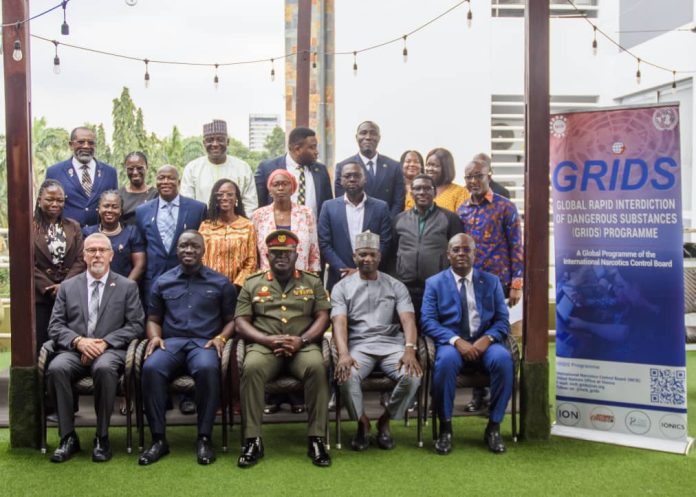
The Narcotics Control Commission (NACOC) held a two-day twinning mission aimed at preventing the trafficking of dangerous substances through E-Commerce and Internet-related services.

The programme, facilitated by the International Narcotics Control Board’s Global Rapid Interdiction of Dangerous Substances (GRID), was held from Thursday, 11 to Friday, 12 September 2025 in Accra, in collaboration with the Nigerian Law Enforcement and the private sector counterparts, such as the courier service providers and E-Commerce providers.
The event focused on sharing experiences and strengthening the regional efforts of authorities in Ghana and Nigeria, as well as internet-related services in preventing the exploitation of legitimate services for the trafficking of new psychoactive substances (NPS).It also focused on discussions related to non-medical synthetic opioids and their relevant precursors, which needed attention by regulators.

The Director-General of the Narcotics Control Commission, Brig Gen Maxwell Obuba Mantey, in his welcome address, highlighted that the gathering reflects the collective commitment by all stakeholders to tackle a pressing global challenge, namely, the trafficking of dangerous substances through e-commerce platforms and internet-related services.

He added that across the globe, the online ecosystem has become both a gateway for opportunities and a channel for exploitation, with criminal networks increasingly using digital platforms, social media, and online marketplaces to traffic new psychoactive substances (NPS), synthetic opioids, and other controlled precursors.



“For us in West Africa, the challenge is particularly complex. Limited border resources, evolving trafficking techniques, and cross-border vulnerabilities demand regional cooperation and innovative strategies,” Brig Gen Mantey stressed.

Brig Gen Mantey commended the INCB’s Global Rapid Interdiction of Dangerous Substances (GRIDS) Programme team for putting in place measures to provide participants with timely tools, intelligence support, and an invaluable collaborative framework. NACOC remains steadfast in our mandate under Act 1019 to protect public health and national security.

Over the past few years, we have strengthened our efforts in tackling digital forensics and cyber-enabled investigations. Expanded our public-private partnerships with leading e-commerce platforms and Internet Service Providers (ISPs).

Enhanced intelligence-sharing mechanisms with regional and international partners, and prioritised capacity-building and cross-border collaboration to counter the evolving exploitation of our cyberspace for illicit drug trafficking.

On his part, the Law Enforcement Advisor to Ghana of the International Narcotics and Law Enforcement (INL), Clarence ‘Chip’ Duncan, indicated that the INL was proud to support the INCB-GRIDS programme, which seeks to mark a significant step toward enhancing West Africa’s regional collaboration in combating the online trafficking of dangerous substances, adding that the issue is one of great urgency and complexity, demanding robust cooperation between your law enforcement agencies and internet service providers.

He underscored the need to acknowledge the rapidly evolving landscape of cybercrime, where the Internet serves as both a tool and a battleground.

“The trafficking of hazardous substances online poses a significant threat to public health and safety, crossing borders with anonymity and speed. Therefore, our joint efforts will not only focus on enforcement but also on prevention and education”. Clearance Duncan mentioned.

He added that the initiative represents a strategic alliance aimed at strengthening the collective capabilities through the sharing of knowledge, best practices, and resources, where participants can create a framework that enables both cyber specialists and law enforcement to swiftly identify and dismantle networks engaged in such illicit activities.“A critical component of this initiative is the emphasis on training and capacity building.

By equipping law enforcement officers with advanced digital skills and fostering innovation, you can enhance your investigative and operational proficiency.

We encourage you to remain committed to utilising cutting-edge technologies and data analytics to stay ahead of the perpetrators,” he stressed He noted that the INL values your commitment and dedication to this essential cause. Together, we can pave the way for a safer and more secure future.

MSport 2025: Ghana’s #1 Sports Betting Site Powers Up for the New Season with Chelsea & BVB

0
MSport

MSport is built for African fans who want a fast, reliable sports betting site and casino in one place—mobile-first, with quick onboarding, fast withdrawals and 24/7 support so you can focus on the action. That’s why more users see it as the biggest and most trusted sports betting platform, and a strong contender for the best sports betting site in Ghana.

MSport Power Partnerships: Chelsea FC & Borussia Dortmund

Chelsea FC — Official Betting Partner in Africa. The MSport Chelsea partnership signals long-term commitment to elite football storytelling and region-wide activations closer to passionate Blues supporters across the continent, underscoring MSport’s credibility and reach.

Borussia Dortmund — First-ever African regional partner. As Borussia Dortmund explores fans in Africa, MSport became Dortmund’s first-ever commercial partner on the continent—growing credibility with a club famed for talent development and high-energy football. MSport’s multi-year partnership with Borussia Dortmund deepens its European football footprint while connecting African bettors to world-class football brands.

Branded experiences and campaigns. During marquee moments you’ll see Chelsea/BVB-led creative across the platform. Most importantly, the MSport app now offers Chelsea and Borussia Dortmund club-themed UI versions, alongside black/white mode—giving fans the option to personalize their sports betting app in a way no other competitor provides.

New Season, New Games: MSport’s Virtual Playground

MSport Originals: Sky Ace

Sky Ace is MSport’s headline exclusive crash game. It’s designed as a fan-favourite alternative to Aviator: the flight multiplier rises, and your job is to cash out before the plane flies away—high drama in seconds, perfect on mobile. If you love the cash-out-before-it-disappears tension popularised by Aviator, Sky Ace delivers the same genre with a sleeker MSport feel and frequent promos. MSport regularly runs free voucher “rain” all day across its games hub so new players can test strategies with less risk.

Super O/U – Exclusive Real Sports Feature

MSport is also trialling Super O/U, a brand-new real sports betting feature designed to bring fresh flexibility and excitement to football betting—another example of MSport leading innovation in the African market.

Value boosters: Super Odds

MSport’s Super Odds promotion gives better-than-best odds on top teams, so you can aim for bigger potential returns with the exact same picks—ideal for derby days and continental nights. It’s a simple lever that Big Odds-hunters and high stakers in live betting and bet builders routinely watch for. This feature ensures that bettors aiming for bigger payouts find MSport to be the go-to sports betting site in Ghana.

Smarter picks with M Stats

Inside match coverage and previews, M Stats provides betting insights—head-to-head records, scoring streaks, clean-sheet data and trend lines—so you’re betting with information, not guesswork. You’ll see M Stats featured throughout MSport’s match coverage making it a handy pre-bet checklist.

Virtuals—football and Beyond

when real-world schedules pause, virtual betting and virtual football keep the action running 24/7 with familiar markets and rapid settlements. Football is the headliner, but there’s also tennis, basketball, horse racing and dog racing—so there’s always a market live, day or night.

Casino Portfolio – Expanded with Hub88

Beyond MSport Originals like Sky Ace and Super Kick, the casino portfolio has expanded with Hub88 integration, bringing a wider variety of online casino games. Easy-to-play, quick-to-settle, and mobile-optimized titles ensure both new and experienced players enjoy seamless entertainment.

Why MSport Is Ghana’s #1 Sports Betting Platform

Put the pieces together—as Borussia Dortmund Exclusive Regional African partner and Chelsea official betting partner in Africa credentials, constant feature releases like super odds, always-on Virtuals, and service fundamentals such as fast withdrawals betting and 24/7 support, and mobile-first design—and it’s clear why MSport is positioned as Ghana’s #1 sports betting site and a leading betting company.

Ready to bet smarter? Join MSport today, Visit: www.msport.com (sign up in minutes).

Conclusion


Conclusion

MSport’s edge rests on three pillars:

  1. Global football partnerships that fans recognize (Chelsea & BVB).
  2. Exclusive betting features that reward smarter play (Sky Ace, Super O/U, Super Odds, M Stats).
  3. Reliable service and casino variety, with instant access to sports and virtual games.

For bettors in Ghana, MSport continues to deliver an unmatched and innovative sports betting experience, cementing its reputation as the biggest and best sports betting platforms in Ghana.

Please play responsibly—18+ only.

Mahama Slams GMO Chicken …On The Ghanaian Market As Government Eyes Poultry Sector Shake-Up

0
President Mahama symbolicallying selling 2000 birds to Agri-Impact one of its partners

President John Dramani Mahama has declared his firm opposition to the influx of Genetically Modified Organism (GMO) and hormone-injected chicken into Ghana, reiterating his government’s commitment to expanding the country’s local poultry industry to ensure food security, reduce imports and create sustainable employment for young people.

President Mahama made these remarks during a working visit to the National Service Authority (NSA) Poultry Production Hub at Papao, in the Greater Accra, where the Authority, under the auspices of Mastercard foundation is implementing a pioneering model in sustainable poultry farming, youth training and agri-enterprise development.
John Mahama’s rejection of genetically modified (GM) poultry has raised important questions about the future direction of Ghana’s poultry industry.

President Mahama arriving at the event as NSA Staff welcome him

While the country’s existing biosafety laws technically allow for the introduction of GMO poultry, the President’s public stance signals strong political resistance to adopting such technology in the near term.

This position reflects broader concerns about potential health risks, the protection of local farmers and national food sovereignty.

As a result, despite the legal framework permitting GMO poultry, the likelihood of its adoption, under the current administration, appears low.

The decision underscores the uncertainty surrounding Ghana’s path toward modernising its poultry sector and balancing innovation with public trust.
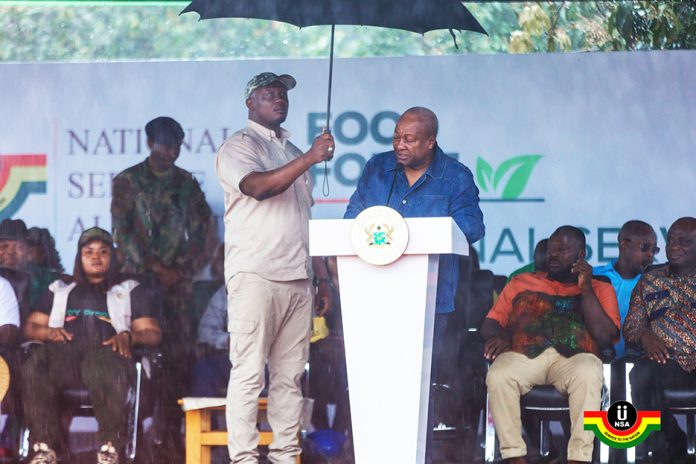
Despite heavy rains on the day of the visit, the President toured the facility, interacted with National Service Personnel and lauded their efforts in boosting domestic poultry production through modern, eco-friendly farming methods.
We don’t know how those chickens were raised,” President Mahama said, referring to imported frozen poultry.

“In many countries, they use genetically modified chickens. They inject them with hormones to speed up growth, wondering why Ghana allows such meat to enter her markets while neglecting its own farmers.

Concerns over Imported Chicken: ‘Nkoko Funu’ No More
Ghana spends hundreds of millions of dollars annually on the importation of frozen chicken -locally referred to as ‘nkokofunu’.

Much of this poultry originates from countries with different agricultural and food safety standards, a situation President Mahama finds alarming.
He added that Ghanaians have no idea how these imported chickens are processed. Yet, they are sold cheaply and in huge quantities, undermining Ghana’s local farmers and exposing consumers to potential health risks.

The President described the NSA’s work at Papao as a “national model” that embodies his vision of agricultural transformation led by young people, supported by the state and rooted in science, innovation and sustainability.

Nkuko Nkitikiti’ Initiative to Launch in October
A key part of the President’s plan is the “Nkuko Nkitikiti” initiative, a major national programme to transform poultry production in Ghana.

The initiative, which he announced will officially launch in October 2025, seeks to ensure that within three years, Ghana will produce nearly 100% of the chicken consumed domestically.
We believe that in three years, with the right investment and training, we can produce almost all the chickens Ghanaians eat right here in Ghana.

“We can end our reliance on imported chicken and invest in the health and livelihood of our people.”
The President emphasised that ‘Nkuko Nkitikiti’ is not only a food security policy, but also a job creation programme targeted at Ghana’s youth, especially graduates entering the National Service Scheme and agriculture sector.

Support for Feed Production and Crop Diversification
President Mahama also highlighted the importance of integrated agricultural development, revealing that the NSA is cultivating maize farms in multiple regions to support poultry feed production. He announced plans to visit the Authority’s maize farms in October, underscoring the synergy between maize cultivation and poultry production.
In addition to poultry and maize, the NSA is also engaged in vegetable farming, producing crops such as tomatoes, which President Mahama said would further enhance food security and nutrition across the country.

Commendation for NSA and National Service Personnel

President Mahama commended the leadership of the NSA, as well as the young national service personnel and volunteers, for their dedication to the cause of national development.
“You are climbing a good tree, and I will push you with all my strength,” The President said and added, “I am very impressed with what I’ve seen. You’ve shown that the youth can lead in agriculture if given the tools and opportunity.”

He reaffirmed his administration’s commitment to supporting the NSA’s projects, stating that his government will work closely with the Authority to scale up operations and replicate the model across other regions of Ghana.

President Mahama ended his visit with a call for a national mindset shift towards self-reliance and pride in local production.

The President’s remarks align with his broader policy agenda to industrialise agriculture, reduce import dependency, and build resilience within Ghana’s economy through innovation and youth-led initiatives.

By Richard Owusu-Akyaw & Jennifer Ambolley

Mahama pledges to make NSS Papao Project a model farm

0
President John Mahama addressing the gathering

President John Dramani Mahama has assured the National Service Authority (NSA) of his government’s full support in transforming the Authority’s Papao Farm into a model poultry and training center, promising to provide the necessary resources to expand its operations and maximize its potential.

The President, who paid a working visit to the farm on Friday, September 12, 2025 as part of his commitment to youth empowerment and food security, praised the Authority and its partners for what he described as “an impressive achievement.

“This project is said to have a 100,000-bed capacity. So far, you have 70,000 beds, and I am certain that soon you will reach the full capacity to feed the Ghanaian market. I promise to help you develop this poultry farm into a center of excellence,” President Mahama said.

Traditional Leaders of Papao seated at the event

The President announced that the Papao Farm would not only serve as a production hub, but also as a training and research center for young people venturing into agriculture.

He revealed plans to involve the Ministry of Finance directly in the farm’s development, stressing that the government would not hesitate to release funds for key facilities including a feed plant, vehicles, hostels, and solar power systems.

President Mahama also disclosed that next month government would launch the NkukoNkitikiti Project, a nationwide poultry initiative designed to empower large-scale, medium-scale and household producers.

According to him, the project would supply millions of day-old chicks, feed and vaccines to beneficiaries, while government would buy back matured birds for processing.

“Once ‘NkukoNkotikiti’ begins, we believe that in three years, we will be producing almost 100% of the chicken that we eat in Ghana ourselves. We want fresh, Ghanaian-grown chickens so that our people can live a healthy life,”he stated.

The President emphasised that the project would drastically cut Ghana’s poultry import bill, create jobs and promote healthy consumption by avoiding genetically modified and hormone-injected chicken often imported from abroad.

President Mahama, in his closing remarks, applauded the Authority’s achievements and reiterated his commitment to ensure that the farm becomes a benchmark for modern agriculture in Ghana.

“This is not just about producing chickens. It is about creating jobs, empowering our youth and building a healthier nation. You can be sure we will support you all the way,” the President said.

Earlier, the Executive Director of the National Service Authority, Madam Ruth Dela Seddoh, gave a historical overview of the Papao Farm, tracing its establishment in the early 1990s as a demonstration farm.

She said when the current administration took over in January 2025 the facility had only 2,500 birds.

Today, it accommodates 70,000 comprising 50,000 broilers and 20,000 layers, with plans to reach the 100,000 target.

Madam Seddoh explained that the Authority’s vision was aligned with President Mahama’s Feed Ghana Agenda, which seeks to engage the energy and intelligence of the youth in productive ventures.

She stressed that the farm was designed not only as a production centre, but also as a hub for skills training, technology transfer and research.

“We have designed a comprehensive integrated model that demonstrates a new pathway for poultry production. It reduces costs drastically, improves efficiency and creates sustainable income streams.

“Beyond the figures, this facility will serve as a national centre for practical and vocational training, while creating tens of thousands of direct and indirect jobs.”

The Director, however, appealed for more government support to build a modern three-in-one processing facility, expand hostels to accommodate the growing number of trainees and provide additional vehicles for sales and distribution.

She acknowledged the contributions of partners such as the MasterCard Foundation, Agri-Impact, Rich Soil, Avita Group and Multicorp IOM, which has deployed artificial intelligence monitoring systems to regulate the poultry houses.

By Jennifer Ambolley, Richard Owusu Akyaw 

The Ghanaian Chronicle