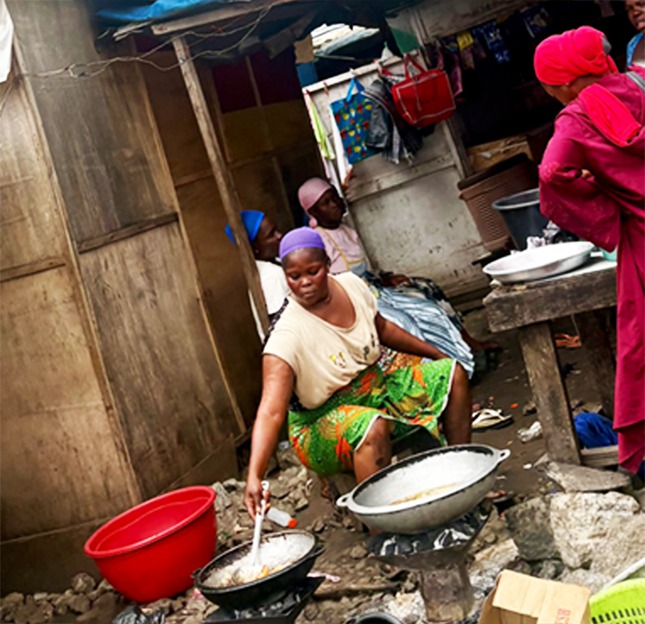
ASHAIMAN, Accra — Salma Iddrisu sits beside her large pan here in the centre of the Ashaiman scrapyard, selling food to workers as the day’s activities go on around her.
The 38-year-old has been doing this for the past six years. She arrives in the morning, sets up her food and can remain until 7 p.m. Her five-year-old child would often come her after school when there is nobody at home to take care of her.
But lately Iddrisu started seeing a difference in her daughter.
“She used to hear very well, so I did not know what was happening. When I spoke to her, sometimes she could not hear me properly,” Iddrisu says switching between Twi and her local language.
At the hospital, Iddrisu says the doctor diagnosed her daughter with anemia, a shortage of healthy red blood cells that leaves people tired and weak. The doctor asked where the girl spent most of her time. When Iddrisu said she sometimes stayed with her at the scrapyard after school, he advised her to stop it.
Scientists think smoke and fine particles inflame the body, making it harder to absorb and use the iron needed to make red blood cells, causing anemia. Anemia, in turn, may harm children’s hearing, because the inner ear needs a steady supply of oxygen-rich blood to work and iron helps protect the nerve that carries sound to the brain.
Experts say Iddrisu’s experience reflects a wider concern around informal recycling sites in Ghana, where workers, traders and children can spend long hours close to activities involving lead-containing batteries and other scrap materials. When used batteries are opened, processed or burned without proper controls, lead-containing dust and fumes can enter the air and settle on soil, food, household surfaces and other parts of the surrounding environment, creating possible routes of exposure for people who live and work nearby.
Lead exposure is already a major concern for Ghanaian children. A national blood lead level survey conducted between November 2022 and January 2023 across nine communities in three regions by the Ghana Health Service, UNICEF and Pure Earth tested 3,227 children between one and five years and found that more than half had blood lead levels at the level at which the World Health Organization recommends action to identify and stop the source of exposure.
Lead poisoning is estimated to kill more people worldwide each year than malaria and H.I.V./AIDS combined, causing seizures, strokes, blindness and lifelong intellectual disabilities. Children are particularly vulnerable because their brains and nervous systems are still developing. The World Health Organization is clear that no level of lead in the body is safe.
The survey also found some of the highest blood lead levels among children living near formal lead-polluting industries, including used lead-acid battery recycling facilities in Greater Accra. Children living near two formal battery-recycling businesses, Success Africa Ghana Ltd and White Star Global Ltd, had dangerous levels.
Iddrisu was eventually able to change the arrangement. She began keeping the child in school until the end of her working day before going to pick her up. Iddrisu said she has since noticed a significant improvement.
But while Iddrisu has found a way to reduce her child’s time around the scrapyard, the activities that raised concerns about exposure continue around her putting her own health at risk as well as the many other children who must spend time here and whose parents don’t have the same choices as Iddrisu. A short distance from where she sells food, old lead-acid batteries are opened.
Inside one of the battery-recycling shops is Evans Akornor, a 58-year-old man who has spent 27 years doing the work. He says he opens the batteries without any protective glasses and worries that a persistent eye irritation is connected. Akornor’s eyes are noticeably red, with one appearing particularly bloodshot.
He says his doctor has prescribed medication and told him the condition would gradually clear. He does not routinely undergo medical checks, saying that when he becomes unwell, he calls his doctor for advice and medication. He sees no danger in his work.
“We have been doing this work for a very long time. Our forefathers were doing it before us and they passed the work on to us,” Akornor says. “We open the batteries, change what is inside and cover them again. We have been doing it for years, so we don’t really see it as something that will give us a problem.”
He says the batteries are opened outside, while the shop is mainly used for storing and charging them. The liquid from old batteries and other waste is also discarded around the area.
Akornor also describes a practice he believes helps when he experiences stomach ache. He puts his hand into battery liquid when he has stomach trouble, before washing it with warm water. He believes the practice helps relieve the discomfort.
That is dangerous misinformation according to Dr Collins Hodoli, Founder and Executive Director of Clean Air One Atmosphere. Informal battery recyclers often break open used lead-acid batteries and smelt their plates over open fires or crude furnaces without emission controls.
He said the pollution is not limited to lead, as battery processing can also release lead oxides, sulphates, antimony, arsenic and sulphur dioxide. Burning battery casings and insulation can also produce black smoke containing fine particulate matter and other harmful chemicals.
“These pollutants combine with lead dust to form a toxic airborne mixture that spreads well beyond the recycling site itself,” says Dr Hodoli. People can then be exposed by breathing contaminated dust or by ingesting contaminated soil, food or water, with children particularly vulnerable because they often put their hands in their mouths after coming into contact with contaminated surfaces.
The health impacts for workers like Akornor could be catastrophic. People who break open used lead batteries for many years can suffer lead poisoning, because lead builds up in the bones and stays in the body for decades. Health experts say long-term exposure can damage the kidneys, raise blood pressure and the risk of heart disease and stroke, and cause anemia,.
It can also harm the brain and nerves, leading to memory loss, headaches, numbness in the hands and feet, and hearing loss, and it can make it harder for men and women to have children. Lead dust also travels home on workers’ clothes and skin, putting their children at risk. The World Health Organization says there is no safe level of lead in a child’s blood, and the damage to a child’s brain and learning can be permanent.
Pure Earth’s published work on Ghana also identifies used lead-acid battery recycling as a source of lead contamination and highlights the risks to children living around contaminated environments. Its work has included efforts to identify contaminated sites and support safer management of lead-containing materials.
The organisation’s work in Ghana has focused on communities around Kpone and Afienya, where formal and informal used lead-acid battery recycling activities take place.
In 2023, following the presentation of the survey findings, the Environmental Protection Authority closed non-compliant used lead-acid battery facilities in the Greater Accra and Tema areas and subsequently introduced technical guidelines for the sound management of used lead-acid batteries and metal-recycling facilities.
But it took two years to release the results publicly and has done nothing to help the building impacted by the lead poisoning according to communities.
The EPA has also raised concerns about lead exposure among children from other sources. In a report published by MyJoyOnline in July, the EPA warned that one in every two children could be vulnerable to brain damage and reduced intelligence from lead exposure. The warning followed findings from an EPA study that detected hazardous chemicals, including lead, in toys commonly used by children.
For the Ghana Health Service, one of the challenges is ensuring that health workers have the tools and guidance needed to identify and manage people who may have been exposed to lead.
Dr Caesar Nyadedzor, Head of the Poison Control Unit of the Ghana Health Service, said the country is developing a standard treatment guideline for lead exposure and poisoning. The guideline is important because it will provide health workers with a standard approach to identifying and treating lead poisoning, while also helping decision-makers determine the tests, medicines, equipment and facilities needed to manage cases at different levels of the health system.
The guideline will set out the tests health workers should conduct, treatment options and the equipment needed at different levels of the health system.
“The kind of tests that are supposed to be done to be able to identify and confirm lead poisoning are all specified in the guideline,” Dr Nyadedzor says. “The decision-makers also need to know what kind of facilities, equipment and so on are needed at different places,” he said.
For Iddrisu, the scrapyard remains the place where she earns money to support herself and her daughter. But her daughter’s experience has changed how she balances work and protecting her child.
Iddrisu said she wants other parents who work around such environments to be made aware of the risks so they too can be cautious about exposing their children to them.
“We come here to work, but the children don’t know what is happening around them, so we have to protect them.”.
This story was a collaboration with New Narratives. Funding was provided by the Clean Air Fund which had no say in the story’s content
For more news, join The Chronicle Newspaper channel on WhatsApp: https://whatsapp.com/channel/0029VbBSs55E50UqNPvSOm2z