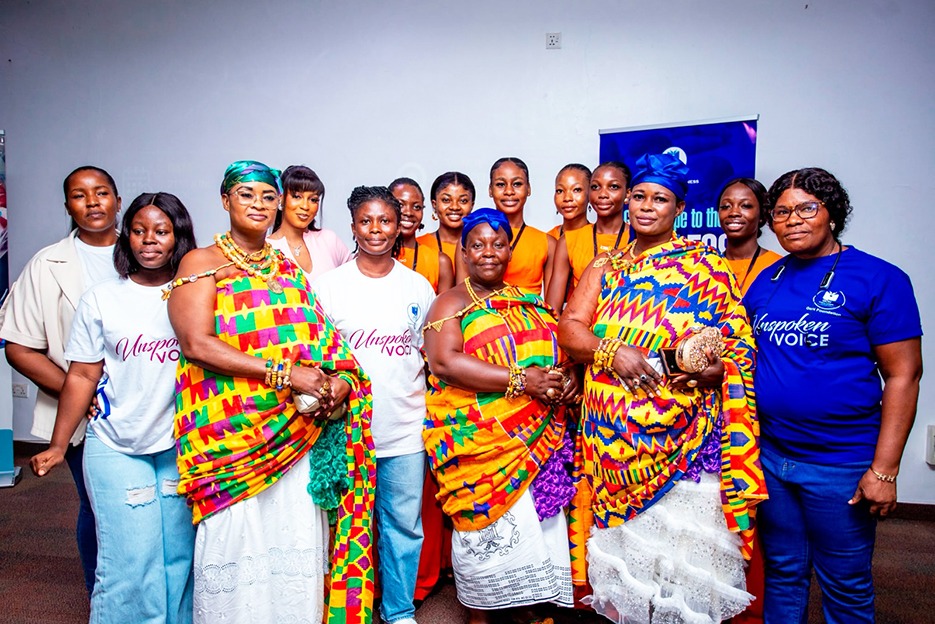
The launch of the Unspoken Voices Project in Accra has ignited renewed calls for urgent, coordinated national action to address the deepening crisis of poverty, displacement, and marginalization among head porters (kayayei), widows and vulnerable women in Ghana’s urban centres.
Spearheaded by the Berth Foundation in partnership with the Givers of Happiness (GoH) Foundation, the initiative is being framed not merely as a social intervention, but as a direct challenge to policymakers, institutions and society to confront what speakers described as “a silent emergency hiding in plain sight.”
At the heart of the advocacy is a simple but uncomfortable reality: thousands of women and girls continue to survive under precarious conditions in markets and streets, despite their central role in sustaining urban economies.
“We See Them, But We Do Not Hear Them”
Delivering a powerful address at the launch, Founder of the Berth Foundation, Madam Bernadette A. Lambi, accused society of normalizing the struggles of vulnerable women.
“Every day, we see them in our markets—carrying loads, carrying children, carrying burdens. But the truth is, we see them and we do not hear them,” she said.She warned that the continued neglect of these women reflects a broader failure of social responsibility.
“This is not just about awareness. It is about recognition, dignity, and action. We must move from sympathy to responsibility,” she stressed.
The immediate trigger for the intervention—the destruction caused by recent fires at Madina market—was described by organisers as only a symptom of a much larger structural problem.
Nana Adwoa Marfo, International Relations Officer for both foundations, said the disaster exposed how vulnerable many women already were.
“When their shops burned, it didn’t just destroy goods. It exposed how fragile their lives already were,” she said.
She argued that without targeted support systems, affected women are often pushed further into poverty, with little chance of recovery.
“We cannot keep responding to crises with short-term relief. We need long-term solutions that give people the ability to rebuild and sustain themselves,” she added.
A National Development Concern
Speakers at the event consistently framed the plight of kayayei and vulnerable women as a national development issue, not just a social one.
A medical specialist highlighted the broader economic consequences of neglecting girls and young women, particularly in relation to teenage pregnancy.
“We are losing future doctors, nurses, teachers—because of circumstances we can prevent,” he said, recounting the story of a brilliant student whose education ended abruptly after pregnancy.
“This is not just a personal loss. It is a national loss,” she added.
Development advocate Ramatu Gumah reinforced the urgency of the issue, describing the realities facing women and girls as interconnected crises.
“Teenage pregnancy, unemployment, lack of education—these are not separate issues. They are part of the same cycle. And these are not just statistics. These are real people—mothers, daughters, sisters—whose voices have been ignored for too long,” she said.
She called for policies that prioritize education, skills development and economic inclusion for women at the grassroots level.
The Unspoken Voices Project is being positioned as a model for intervention, combining vocational training, housing support, mentorship and small business development.However, organisers insist that civil society efforts alone are not enough.
“NGOs cannot replace systems. We can support, we can innovate—but real change requires national commitment,” Nana Adwoa Marfo emphasized.
She called for stronger collaboration between government agencies, local authorities, and development partners to scale such initiatives.
One of the key advocacy points emerging from the launch is the issue of housing.
Organisers revealed plans to accommodate beneficiaries in a shared facility to ensure stability during training—highlighting a gap that experts say remains largely unaddressed in urban policy.
Without stable housing, speakers noted, many vulnerable women are unable to transition out of survival-based livelihoods.
The event also raised alarm over the growing health implications of poverty.A nutritionist warned that poor dietary habits—often driven by economic constraints—are contributing to rising cases of diabetes, heart disease and other non-communicable diseases.“People are eating to survive, not to nourish themselves. And it is costing us in the long run,” he said.
Changing Mindsets, Restoring Dignity
Beyond policy and economics, speakers stressed the need to confront social attitudes that stigmatize vulnerable women.Queen Teiya, addressing the beneficiaries, challenged prevailing stereotypes about kayayei.
“Being a kayayo is not your identity. It is only a chapter in your story,” she said and added that
“Your current situation does not define your future.”
Her message underscored the importance of restoring dignity and self-belief as part of any meaningful intervention.
While applauding the initiative, speakers repeatedly emphasized that sustainable impact will depend on broader institutional support.
“We welcome partnerships—from government, from corporate Ghana, from individuals.
This is not a problem one organisation can solve,”Nana Adwoa Marfo said.
The project is expected to expand to other regions, including Tamale and the Volta Region, but organisers stress that scaling requires resources, coordination, and political will.
From Advocacy to Action
Ultimately, the Unspoken Voices Project is as much a campaign as it is a programme—one aimed at shifting national attention toward those who have long remained invisible.
“The most powerful voices are not always the loudest, sometimes, they are the ones we finally choose to hear,”Madam Lambi concluded.
For Ghana, the challenge now is whether that listening will translate into policy, investment, and lasting change—or remain another moment of awareness without action.
By Stephen Larbi
For more news, join The Chronicle Newspaper channel on WhatsApp: https://whatsapp.com/channel/0029VbBSs55E50UqNPvSOm2z