Home Blog Page 2534

Industries, Banks pledge to help solve economic crisis

0
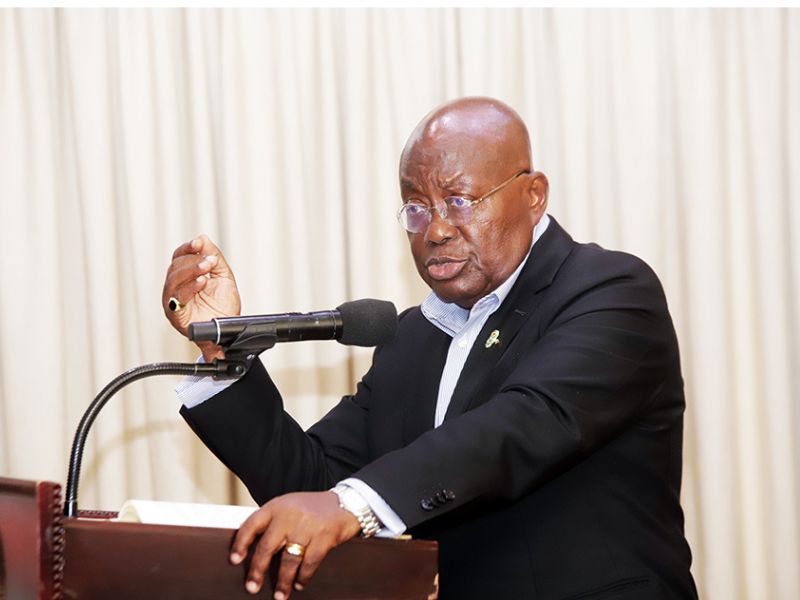
President Akufo-Addo speaking to the delegation from the AGI at Jubilee House

The Association of Ghana Industries and the Ghana Association of Banks have pledged to support the government to solve the economic challenges in the country. The two associations gave their support at separate meetings with President Akufo-Addo yesterday at Jubilee House, at the instance of the President.

A delegation from the Association of Ghana Industries (AGI) at the Jubilee House

The meetings were to discuss measures the government is putting in place to salvage the current crisis and how the associations could help to deal with the issue at hand. Both meetings later moved into conclave.

In his brief remarks to the Association of Industries, President Akufo-Addo said the meeting was to brief members about where the negotiations with the International Monetary Fund (IMF) had reached.

He added that the engagement would also provide an opportunity to solicit input from industry, particularly since the negotiations would have an impact on the economy.

“Basically, what I want to do is to indicate to you, where we have gotten to in the negotiation we are having with the fund, what it portends for the future of the economic policy in our country,” he said.

The President continued, “…hopefully, to have the opportunity to get your particular buy in, because we are talking, hopefully concluding soon, these important negotiations which we are going to have, you know as well as I do, have an important impact on the way forward for the Ghanaian economy in the months ahead, in the immediate years ahead.

“It is basically a familiarisation program and also to hear from you—what you think will be significant that you would want to hear about how we are going forward.”

The government officials at the meeting included the Chief of Staff, the Trades Minister, the Agric Minister, the Employment Minister, the Finance Minister and the Governor of the Bank of Ghana.

THE PLEDGE

The President of the Association of Ghana Industries, Dr. Humphrey Ayim-Darke, responding to President Akufo-Addo expressed delight at the purpose of the meeting.

According to him, the association recognises what he described as the relentless efforts of President Akufo-Addo to steer the economy, and then followed up with the pledge.

He said, “We recognise your relentless efforts to steer our economy to a pride of place and your desire to transform our economy to the best of your ability. We pledge our support that together we shall resolve the intended difficulties as we so find them.”

He had earlier introduced his team, which included the Chief Executive Officer of AGI, Mr. Seth Twum Akwaboah; the Group Chairman of the Jospong Group, Mr. Joseph Siaw Agyapong; the General Manager of Irani Brothers; the Managing Director of Uniliver and the Managing Director of Wilmar Ghana.

MEETINGS CONTINUE TODAY

The Chronicle published yesterday that marathon meetings had been rolled out on how to address the economic crisis.

Yesterday, apart from the meetings with the Association of Ghana Industries and the Ghana Association of Banks, President Akufo-Addo also met with the Council of State, GPRTU and transport operators.

Today, the President will continue with the consultative meetings by engaging Forex Bureau Association of Ghana, market women, Ghana employers’ association, national executives of the Ghana Journalists Association among others.

COKA bounces back in pursuit of “break the 8” agenda

0
Odeneho Kwaku Appiah – Leading NPP member

The former Afigya Kwabre South Constituency Chairman of the New Patriotic Party (NPP), Odeneho Kwaku Appiah, has affirmed his resolve to champion the party’s vision of breaking the 8 in the 2024 elections. The head of the COKA fraternity said his primary goal was to work towards the ultimate in the 2024 elections, which called for all hands to be put on deck to win the 2024 elections and maintain power.

COKA, as he has become known, said in an interview that he would continue to do all he could to help the NPP retain power. “I will not relent in my efforts to ensure that my party retained power,” he said, and called on all party members to work together as one to break the NPP’s eight-year mantra.

The former Constituency Chairman, who failed in his bid to lead the party in the region last May, emphasised that the regional elections were over, and once the delegates decided and settled on Mr. Bernard Antwi Boasiako alias Chairman Wontumi, his focus currently was to mobilise resources and the members to work hard towards victory by the party.

According to him, he and Chairman Wontumi were not enemies, and as a true democrat, he had moved on, and that his target now was not Wontumi, neither was he Wontumi’s target, stressing that “we are brothers and friends.”

“What is important now is for me to help the party in my own small way to encourage people to win the elections,” he said explaining that it would not augur well if the party loses the polls through his apathy. On the menace of illegal mining, COKA called on all Ghanaians to get

Involved in the fight against the canker.

He said the fight against galamsey needs a collective national effort and therefore must be every person’s concern to win.

“The fight requires collective efforts of chiefs, media, civilians and everybody. I mean all hands on deck devoid of party partisanship else we will lose the fight,” he said. COKA further explained that mining is not a bad venture but becomes problematic when the right procedures in acquiring license and best practices are compromised.

He insisted that in order that our water bodies and farmlands are protected the players in the business should adopt the right procedures to achieve the desired results. Talking about the fallen value of the cedi which he attributed to the currency fluctuations and floating exchange rates as characteristic of most major economies, the former constituency Chairman blamed the situation partly on speculations by Ghanaians lately.

COKA said the panic reaction to the exchange rate is as a result o four usual ‘noise making’ which in the long run will do us no good. According to him, the louder the speculations, the more the foreign exchange market responded negatively and called on Ghanaians to tone down on unnecessary speculations.

“We are not doing our economy any good by speculating” he noted and pleaded with Ghanaians to tone down a bit because that was a sure way to get our economy back in shape. He noted that the current economic hardships are a global phenomenon since not a single country across the world is spared of the economic downturn.

The NPP guru was hopeful that the country’s economic performance could influence the exchange rate stressing that all was not lost.

Ghana needs stringent economic policies -Asumadu

0
Dr. George Asumadu, Senior Lecturer, Kumasi Technical University

A Senior Lecturer at the Kumasi Technical University (KsTU), Dr. George Asumadu, has called for stringent economic measures to address the chronic challenges that have bedevilled the Ghanaian economy over the year.

According to him, the quest of the government of Ghana to seek a bail out from the International Monetary Fund (IMF) was a temporary measure to improve the economy, emphasising that Ghana must take stringent short-term, medium term, and long term economic policies to change the narratives of the Ghanaian economy.

According to him, the balance of payment should be a guide to improve domestic competitiveness to ease the demand for foreign currencies.

In an exclusive interview with The Chronicle, Dr. George Asumadu explained that political development was faster than economic development, and the two main paths of development could never be at par, hence there was the need for stringent economic policies that must be adhered to by our governments.

Citing the United State of America as a typical example, he noted that when there was a change of government, the economic policies of the State remain virtually the same, and that was why the former Federal Reserve Chairman, Mr. Alan Greenspan, was in office for about 19 years – a period where he served under both Republican and Democratic governments.

Dr. Asumadu also wondered why Ghana should import food in spite of her vast fertile lands. The KsTU academic was of the view that in order to improve the economic challenges, the country had to improve her domestic capabilities.

Part of the measures Dr. Asumadu noted was to know how to use what the country produces. This, he added, would curb the unbridle demand for dollars for importation of goods into Ghana.

The KsTU economist, however, argued that if Ghanaians do not create alternatives and even take advantage of the African Continental Free Trade Area (AfCFTA), it would be daunting to reverse the plight.

According to him, Ghana had all what it took to balance the economy, adding that the resources were available, but they were not being efficiently utilised.

Dr. George Asumadu further explained to The Chronicle that if Ghana produces a commodity and does not know how to use it to the advantage of her economy, the country cannot balance its economy.

On the agriculture front, Dr. Asumadu told The Chronicle that rice production in South-eastern state of Asia has been supported by the World Bank for their nationals and even export the excess.

This feat, he told this paper, could only be achieved by signing an agreement with the World Bank to provide inputs for credible Ghanaian farmers who meet the yardsticks.

Editorial: African leaders must learn to leave when the applause is loudest

0
Editorial

On Thursday, October 20, 2022, the United Kingdom (UK) Prime Minister Liz Truss showed the way by tendering her resignation letter to the Conservative Party, following a failed tax-cutting budget that rocked the British financial markets. She bowed out just 44 days after her appointment to lead government business.

Prior to her resignation, the shortest ever serving Prime Minster, Truss had earlier dismissed her Finance Minister, Kwasi Kwarteng, after his so-called mini-budget did not settle down well with the British people.

The moral lesson here, which African leaders must take a cue from, is that even though the former UK Prime Minister meant well with the policies that she introduced, she did not hang onto power after it backfired.

African leaders tend to hold onto power at a cost to their nation’s peace, economy, and food security. Thus, no matter how bad or worse the lives of the people become under a serving government, resignation is often out of the question. Unfortunately, unorthodox ways have been devised to seize power from such power drunk leaders, such as through civil uprising or coup d’états.

Recently, six countries in the West African region – Guinea Bissau, Chad, Mali, Guinea, Sudan and Burkina Faso – had experienced overthrows of governments that had existed for over a decade or came to power less than a year ago.

The African Union (AU) turns 20 this year and celebrations are underway, under the motto: Our Africa, Our Future. Though coups d’état have become rare, there is another kind of coup – when incumbent African presidents have manipulated constitutions to extend their tenure of office.

For the long term, the AU is working towards developing guidelines to prevent constitutional abuses. If adopted, the guidelines would formalise the power of the AU to suspend countries and sanction incumbents engaging in constitutional coups.

But these would take time to adopt, and there is no guarantee that they will be effective. Instead, the AU should engage more aggressively to detect and prevent instability that results from incumbent attempts to cling to power.

Although Ghana has had it fair share of political turbulence after the first republic, The Chronicle is glad to say that the Fourth Republic has remained the most peaceful of all. The Chronicle is happy we have been a good example in a chaotic sub-region.

We, as a media house that interfaces between the public and the government, we believe that the majority of people are glad with the democratic path we have chosen and we must guard it jealously. African politicians must learn to leave the stage when the applause is loudest.

MP Duker presents motorcycle to okada operators

0
Mr. Duker (with microphone) presenting a motorcycle to a beneficiary

The Member of Parliament (MP) for Tarkwa- Nsuaem, Mr. George Mireku Duker, has presented five motorcycles and accessories worth GH¢50,000 to okada operators at Nsuaem in the Western Region.

The gesture was to promote okada business, one of the key reliable modes of transportation to remotest hamlets within the Nsuaem communities.

The beneficiaries are George Asaah, Paul Abel, Bright Koufie, Maxwell Tandoh and Frederick Akumanyi, who would pay the full cost by installments.

At the same ceremony, Mr. Duker inaugurated a three-member committee, comprising Paul Abel, Rexford Baidoo and Christian Arthur, to help manage welfare issues, streamline okada operations, and also ensure discipline in the Nsuaem communities.

The MP explained that, the gesture was to support the okada business to grow and expand in Nsuaem, and that the committee would ensure that the operators worked according to road regulations and laws to avoid arrest.

Mr. Duker believed that, as the beneficiaries pay for the motorcycles, more operators would benefits for incomes and economies to grow among the families and society.

“We want the okada business to thrive not for criminal activities. Organise well, be disciplined and go by the rules. As a major mode of transport, you offer valuable service in communities. More of such programmes have been earmarked for Simpa and Dompim, please be good ambassadors,” he urged.

He said Nsuaem should be ready for good projects, including the new Polyclinic, which would soon be inaugurated, tarring of roads and the construction of the senior high school.

The Municipal Chief Executive, Benjamin Kesse, told the gathering that the ceremony indicated the good news yet to come to the Municipality, particularly Nsuaem, and pleaded with the people to pray for Mr. Duker so that more projects come to the area.

He added: “But, in all these, we need unity, peace.”

Paul Abel thanked Mr. Duker for the gesture, saying, “Some people never believed this would happen; what they saw as a dream is now a reality.”

Pensioners pray for COLA

0
F.F. Azumah (middle) chairman of the Effiakuma branch of SSNIT pensioners

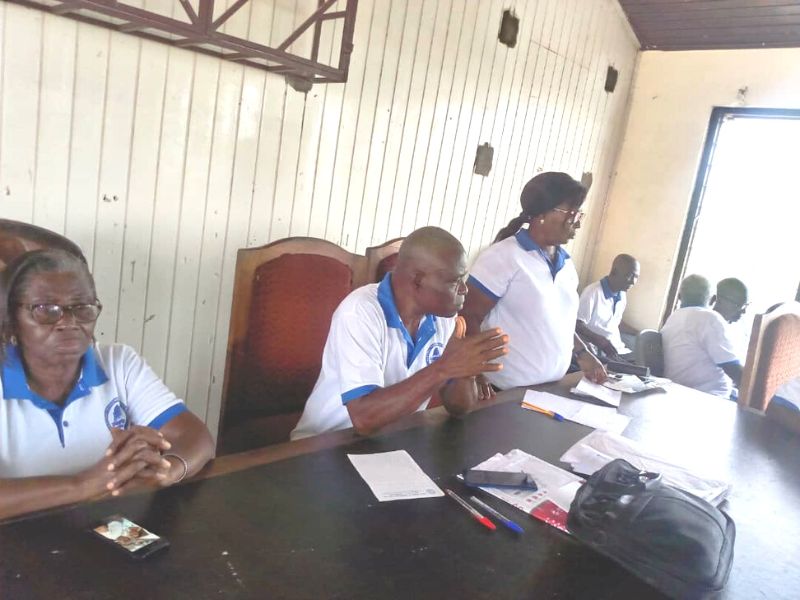
The Pensioners Association of Ghana has pleaded with the Social Security and National Trust (SSNIT) Board to be considerate when granting the 2023 annual increases of their monthly stipends, since they were not considered in the implementation of the recent Cost of Living Allowance (COLA) paid to cushion workers.

Members of the branch at the conference

It said considering the escalating cost of living standard in the country, where prices of commodities change almost every week, it was important the SSNIT Board considered them when granting the 2023 annual increases of their monthly allowances.

Addressing a press conference on Tuesday, the Chairman of the Effiakuma branch of the SSNIT Pensioners Association, F.F Agbenu Amuzu, however said while they were aware that the basis of each pensioner’s allowance was hinged on the three best year’s basic pay before retirement.

The SSNIT Board should not forget that a lot of them retired before the implementation of the Single Spine Salary Policy (SSSP), therefore, the current allowances of certain pensioners who were in the low salary bracket before retirement was a reflection of poor salary levels in the country.

Consequently, he called on SSNIT to stop the rhetoric for better conditions for pensioners and rather walk the talk to enable pensioners enjoy better retirement benefits.

“Please, the rhetoric for better conditions for SSNIT pensioners must stop. We implore the SSNIT Board to have compassion on pensioners and walk their talk to enable pensioners enjoy a little before their death. It is important at this juncture, to recollect the sacrifices of pensioners who used their youthful lives to build the economy of Mother Ghana.”

Continuing, the Chairman said: “We wish to draw the attention to the escalating cost of living standard in the country whereby prices of commodities change almost every week. Of late, research in the country indicates that one would require GH¢10.00 to be able to offer for a meal which means one will spend GH¢30.0 a day as an individual on feeding, excluding other relevant needs.”

Shockingly, he said, a pensioners who worked for over 30 years in the civil service received GH¢332.00 as monthly pay.

“The fact must be established that old age in Africa goes with health problems and heavy financial obligations. Due to this reason, pensioners die prematurely and also at a fast rate.”

Consequently, he called for a review of section 80 of Article 766 which took care of their welfare to be amended to allow the Social Security and National Insurance Trust (SSNIT) Board have flexibility to decide on the plight of SSNIT pensioners.

He called on the public to judge if a pensioner could live on GH¢332.00 a month considering the high cost of health care, coupled with the astronomical increases in utility services.

To that end, Chairman Amuzu called on the SSNIT Board to consider a better 2023 increment for SSNIT pensioners, taking into account COLA and the general increases in cost of goods and services in the country.

He concluded that the living standard of pensioners in the county had been worsened due to uncontrolled inflation and high cost of living.

Youth urged to act in consonance with development -Acquaye

0
B&FT CEO Dr Godwin Acquaye

The Chief Executive Officer of Business and Financial Times, Dr. Godwin Acquaye, has advised the youth to accept the challenge as the next generation national economic leaders who are ready to take up responsibilities that come with growth and development.

He said the youth must first accept leadership roles in their various communities and disciplines to ensure growth and development happens.

“You form the vanguard of the next generation of national economic leaders. It is incumbent upon you to solve some of the nation’s most intricate and exciting challenges, so let the YEF (Youth Economic Forum) and the world be your canvas, your playground, and your market place of ideas,” he urged.

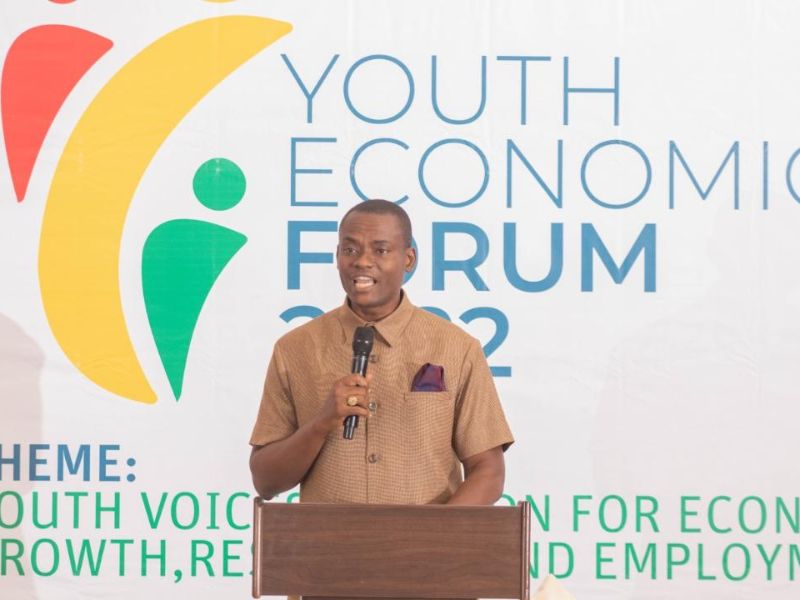
Dr. Acquaye was speaking at the opening of a 3-day Youth Economic Forum 2022, organised under the theme: “Youth voices and action for economic growth, resilience, and employment,” in Accra yesterday.

According to him, the objective of the forum was to better amplify the opinions and voices of the youth and give impetus to their ideas.

He added that the forum was also to create an opportunity to network and hold discussions on marketing, agri-business, and entrepreneurship.

“Networking and the act of networking are of paramount importance to people’s careers and social lives, alike and one of the best parts of YEF is the opportunity to meet and network with peers, friends, mentors, and professionals.

“This is an unparalleled opportunity. YEF is full of diverse approaches and view points, and I think that the idea of connectivity within a larger cohesive network gives a thesis for our discussion of so many seemingly divergent topics.

“Utilise the opportunity to speak about how the various topics interact with each other and ultimately cannot exist without each other. Think, share, collaborate and apply your favourite,” solutions to the problems that you care about the most,” he states.

Rosy Fynn, Country Director for Ghana Mastercard Foundation, gave the assurance that the Mastercard Foundation remained committed to getting behind the ambitions of young Ghanaians and creating pathways to dignified and fulfilling work opportunities for them.

She said the Foundation hoped to provide dignified work opportunities for 3 million young women and men by 2030 through deepening efforts in the agricultural sector and exploring opportunities in emerging sectors of the economy.

“We believe that by doing this, and working alongside our partners, government, the private sector, and young people, we will unlock the full potential of young people to contribute to building back our economy and creating work opportunities for themselves and others,” she postulated.

Newmont Ahafo adjudged 2nd best coy in Ghana

0
Newmont-Ghana

Newmont, this year, stood out as the most outstanding mining company on this year’s Ghana Club 100 listings. Newmont’s Ahafo mine was adjudged second best company in Ghana with the Akyem mine ranking ninth best company at the 19th Ghana Club 100 Awards, organised by the Ghana Investment Promotion Centre (GIPC).

These recognitions position Newmont as the only mining company with two of its operations among the top 10 companies in Ghana. For outstanding business performance in Corporate Social Responsibility (CSR), the Akyem mine was also named Best CSR Company for 2021. Speaking on these awards, Newmont Africa’s Regional Vice President, David Thornton said

“Mining is a critical contributor to Ghana’s development and these awards are a testament to the value responsible mining brings to the Ghanaian economy.” He also noted that “Newmont Africa’s performance underscores the company’s resilience in a challenging business environment.” Newmont has, over the years, performed exceptionally on the Ghana Club 100 listing.

In 2016 and 2017, the Akyem mine was named twice as best company in Ghana. Ahafo mine also ranked 8th in 2016. In 2018, Akyem ranked 5th with Ahafo following closely at number eight. 2019 saw Ahafo mine being named Ghana’s Corporate Social Responsibility Organisation of the year.

The Ghana Club 100 is an annual competitive ranking of the top 100 limited liability companies in Ghana and recognises successful enterprise building. Overall standings are based on the size, growth, profitability, and corporate social responsibility performance of the companies.

This year’s event was under the theme “Ghana’s Private Sector, a catalyst for post-pandemic economic transformation.” Newmont Africa commits to collaborating with government, regulators, local authorities, and all other stakeholders to stimulate a vibrant economy that will improve the lives of our workforce and host communities.

GRC wants bailout from gov’t

0
Ghana Railway Company Limited

The Ghana Railway Company Limited (GRCL) has sent an SOS to the government to immediately intervene and save it from collapse. The company says its financial situation has become so dire, to the extent that it is unable to purchase fuel to run its manganese freight, as well as the Diesel Multiple Unit (DMU), a passenger train.

As a result, for the past few days all the freight trains, as well as the DMU, have been parked.

In a press statement released by the Ghana Railway Workers Union (GRWU) and copied to The Chronicle, the Union Secretary, Godwill Ntarmah, stated that, aside the inability to purchase fuel, payment of salaries, as well as workers welfare dues, Social Security and National Insurance Trust (SSNIT), and Credit Union contributions amongst others are also becoming a herculean tasks for management.

The statement, therefore, called on the President, Nana Akufo-Addo, to immediately direct the release of revenue realised from the auctioning of the scrap metals of the GRCL to purchase fuel and other operational challenges to save the company. “We wish to put on record that GRCL is [a] state institution and everything possible must be done to salvage it from total collapse.”

Meanwhile, information available to this reporter indicates that, though the GRCL constantly receives payment from Ghana Manganese Company (GMC) for the haulage of manganese from Nsuta to Takoradi Harbor, the money is expended on other operational costs. That apart, the company is unable to break even for the shuttle rail service it runs from Takoradi-Kojokrom and Tema to Accra.

I’m satisfied with Agenda 111 project in Dormaa Central -Bono Minister

0
The regional minister(m) being taken around projects

The Bono Regional Minister, Justina Owusu Banahene, has expressed satisfaction with progress of work on the Agenda 111 Hospital project at Amasu in Dormaa Central of the Bono Region.

She has, however, charged the contractors on the projects to speed up work to ensure their completion on schedule.

Justina Owusu Banahene said the difficulty in accessing timely and quality healthcare services by many communities in the area informed the decision of the government to embark on the project.

Justina Owusu Banahene said this at Amasu in Dormaa Central during her visit to the district to inspect progress of work.

She was elated that the three projects in the region were still alive despite the prevailing economic situation of the country.

She said the projects would provide a clear policy direction to the government in the health sector and ensure access to quality healthcare without funding being a barrier to any citizen.

According to her, Agenda 111 projects were one of the many policies that “we have to appreciate fundamentally. It is really a bold initiative by the government because the government is saying that every district should have a hospital; that is the vision.”

Agenda 111 is part of a massive vision for Ghana’s healthcare sector, the realisation of which would lead to Ghana becoming a Centre of Medical Excellence.

The objective of the Agenda 111 project, as envisioned by President Nana Addo Dankwa Akufo-Addo, is to ensure that Ghanaians in every district and region in the country had access to quality healthcare services.

The proposed project would boost the provision of healthcare infrastructure in line with the government’s commitment to ensuring universal health care to all citizens.

At the site, the Minister encouraged the workers and the contractor to work with diligence and not to hesitate to report all challenges relating to their work to the Assembly for urgent assistance.

On his part, the Project Manager of CYMAIN Limited, the construction company for the Amasu Agenda 111 project, Daniel Lamptey, gave an assurance the project would be completed on time and a standardised facility.

The Ghanaian Chronicle