Home Blog Page 1287

40-bed Drobonso Agenda 111 Hospital to be commissioned soon 

0
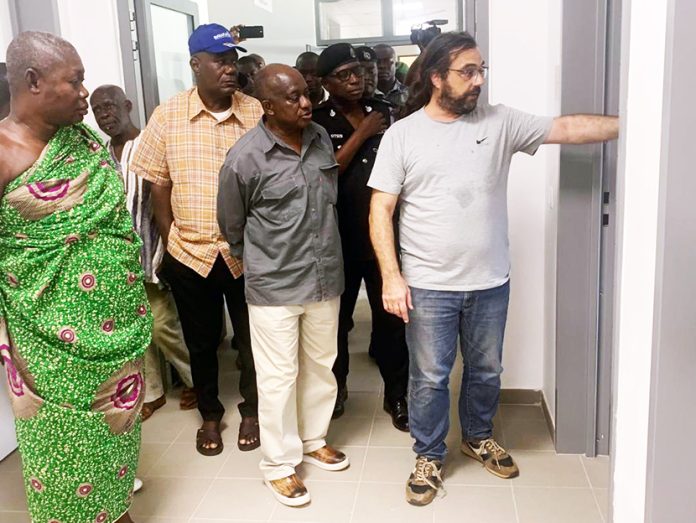
The Ashanti Regional Minister and his entourage being taken through various components of the hospital by Ing. Emanuel Achille

Barring any last-minute hitches, the Drobonso Agenda 111 Hospital, with residential staff housing would be commissioned to enhance healthcare delivery in the Sekyere Afram Plains District Assembly (SAPDA) of the Ashanti region.

Located at the district capital of Drobonso, the ultra-modern 40-bed health infrastructure, which is being executed by Vamed Engineering GmbH is made up of Outpatient Department (OPD), consulting rooms, pharmacy, surgical unit, pediatric unit, theatre, mortuary and pathology, staff quarters, 300 KV power plant and security post, among others.

Furnished with gadgets, the walkways at the facility have been done with pavement bricks for easy movement.

Addressing the media at the facility, the Ashanti regional minister, Mr. Simon Osei-Mensah, who was on a working visit in the SAPDA, to inspect government projects in the said area, expressed satisfaction at the project.
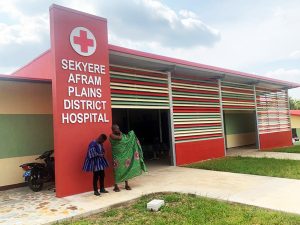
The frontage of the 40-bed Drobonso District Hospital

Describing the unique nature of Agenda 111 health infrastructure in the farming enclave of Sekyere Afram Plains, Mr Osei-Mensah said “As you entered, you can attest that the facility is very neat and completed with pathways laid with pavement bricks and by the grace of God, very soon, residents of Drobonso will have their modern hospital ready. Per the serene environment, when you visit such a facility for healthcare, you get healed easily.”

He expressed appreciation to the Vanaah Contractor who executed the project, explaining that they have done a great job, in that they have completed five hospitals that were awarded to them in the region, naming Drobonso, Sabronum (Ahafo Ano South-East), Twedie (Atwima Kwawoma), Suame (Suame Municipality) and Manso Nkwanta (Amansie West).

Speaking to the media, the Vamed Engineering GmbH Supervisor on site, Ing Emanuel Achille disclosed that the Sekyere Afram Plains Hospital is 98 percent complete, adding that as of last week, the Ministry of Health (MoH) inspected the facility and added that they are waiting to hand over the facility to the MoH, latest by December.

Achille mentioned some of the components as pharmacy, sterilisation room, X-ray, theatre, kitchen and staff quarters, among others.

INHERITED PROJECTS  

On the health projects that the current government inherited from the previous administration, the Ashanti regional minister noted that they have not neglected them.

“One thing I have realised with this government is that we have tried to complete projects we inherited. If you look at the hospitals we came to meet, numbering around eight, we have completed most of them.”

He told the media that the current administration has completed health facilities, citing Tepa Konongo, Fomena and Kumawu as prime examples.

To Mr Osei-Mensah, the 500-bed Ashanti Regional Hospital, which is located at Sewua, in the Bosomtwe district of the region, would be commissioned soon.

“What we have not completed is Sewua and with that one, latest by October, it would be commissioned because everything is set and the Contractor has given us one month, and if he fulfills his promise, then it would be completed by one month time. The ECG substation, which was a problem, has been solved.
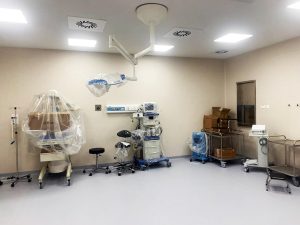
Surgical Room of the Hospital

On the reconstruction of the Komfo Anokye Maternity Block, Mr Osei-Mensah, who is the former member of Parliament for Bosomtwe and former member of the Economic Committee of West Africa State (ECOWAS) Parliament in Abuja, Nigeria, disclosed to the media that the said project could not be completed by the end of the year.

“I am not sure the Komfo Anokye Maternity Block can be completed. That project started in the erstwhile administration of Kutu Acheampong, so for over forty years it has not been completed. The project failed the structural integrity test we conducted, so we had to demolish it and restart it.”

Giving details about the rate of work on the infrastructure, the Ashanti region minister indicated that the contractor is done with the civil and electrical works and they are now laying pipes, doubting it could be completed on time.

“I am not too sure it works, like installation of equipment can be met for commissioning, but even if we are unable to do that, we have done well. On the 500-bed Afari Military Hospital Infrastructure,” the regional minister revealed to the media that the government could conduct partial commissioning, undergirded by the fact that the main hospital has been completed, adding that it is only left with a few specialised departments that have to be worked on.

He added that all equipment has a guarantee period, and if they expire, it would be rendered unusable.

“It is left with some few specialised departments that we have to work on, and all the equipment has a warranty period, and if we wait till this department is completed, the equipment could expire its warranty period.

“If the warranty period expires and the gadgets are tested but turn out to be defective, you cannot take them back and the nation has to fork out other funds to purchase new ones, and we cannot do that, so we have to do a partial commission and the small area that is left would be worked on.

DROBONSO DISTRICT COURT

Prior to his visit to the 40-bed health infrastructure at Drobonso, the Ashanti regional minister and his team visited the Drobonso District Court facility, which was commissioned last year by himself and former Chief Justice Annin Yeboah.

According to Mr Osei-Mensah, having commissioned the court facility, he has not been able to see how the facility is faring, hence he had to come see how the court was being operated.

“Sometime last year, the former Chief Justice and I commissioned the court at the Sekyere Afram Plains, which is located at Drobonso and after the completion, I have not been able to see how the facility was being run, so I had to come and see how it was being operated.”

He continued that unfortunately, there are no residences for the magistrate, hence the judge commutes from Agona to the court, which is once a week, so the government, through the Sekyere Afram Plains District Assembly, is going to see to it that the resident is completed so that the judge can work on a number of days.

E-Block 

The Ashanti regional minister and his team inspected the E-block project that is 7.5 kilometers away from the district capital of Drobonso and located at Issahkura, a sparsely populated enclave.

The E-block, located at Isaah Krom, Drobonso-Ashanti.

According to Osei-Mensah, the E-block is more than seven kilometers apart from the district capital, and imagine if the student is walking to school; it means the child is going to walk for more than 17 kilometers a day, a development he bemoaned that it does not enhance learning, saying “By the time the child accomplishes the task, the brain will be exhausted, so when you report home, you are tired and cannot even learn what you were taught in school.”

He disclosed to the media that in an attempt to utilise the educational project and curb the inconveniences associated with the facility, the government is putting up a boarding structure to complement it.

“We are adding a boarding facility to the school, but there has been a challenge, so I will engage the education minister about it, so that we can start admitting students into the facility.

Giving his candid opinion about the E-block, Osei-Mensah opined that per the location and proximity of the E-block to the district capital, it does not befit for second cycle education since it is located in a remote area that is sparsely populated. He subsequently called for the E-block infrastructure to be turned into something else.

“When I came here in 2017 to inspect the project, there has not been any change and it looks the same. For a perfect utilisation of the facility, it should be converted into the Agricultural Research Institute of the Agricultural and Environmental Research Institute – something that will see the elderly accessing the facility and not kids.”

He told the media, “If the school becomes operationalised, how will the day students go to school with this kind of road? The children cannot go to school when the river overflows its boundaries. So for me, I will still push for an agricultural and environmental research institute that can easily assist foreign support and then bring the children here.”

According to him, sometime in 2017, some parents did not allow their wards to be admitted to the school, having looked at the location of the school, adding that these students had to be re-admitted to different schools.

He continued that, with the E-block, the final decision rests with the Ministry of Education, so he will discuss it with the minister and if he finds it feasible, in that it can be converted into such a specialised institute, they will do it, and if the residents still feel they need the Senior High School, we can also use it as senior high school.

Mr Simon Osei-Mensah added, “But I do not understand why they did not site the school between the Drobonso and Kumawu stretch, citing the location of the Drobonso Hospital as a prime example.

“Drawing contrast between the Drobonso Government Hospital and the E-block in the bush, Osei-Mensah argued that health facilities can easily be accessed, unlike the latter. With the hospital, we have an easy access road and we have to make sure the E-block is useful.”

Types & Causes Of Cough

0

Got a cough? Experts say it’s the top reason people see a doctor — more than 30 million visits a year.

Your first step toward relief is to identify the type of cough you have and what is causing it. Then consider your symptoms. With that info, you can choose the best treatment.

Types of Coughs

A cough is supposed to protect you. It gets out stuff that doesn’t belong in your lungs and windpipe, like inhaled dirt or food. But it can also be caused by other things. How long a cough lasts depends on what’s causing it.

There are several classifications for coughs. They include:

  • Productive cough. Also called a wet cough, this cough brings up mucus or phlegm.
  • Non-productive cough. This is a dry cough that doesn’t bring up mucus or phlegm.
  • Acute cough. It comes on suddenly and lasts for 2-3 weeks.
  • Subacute cough. This type lingers after you’ve had an infection and can last 3-3 weeks.
  • Chronic cough. This is a cough that lasts 8 weeks or longer and may require medical attention.
  • Refractory cough. This is the name for a chronic cough that hasn’t responded to treatment.

What Causes It?

There are many common triggers.

  • Viruses. Colds and the flu are the most common causes. While annoying, coughs that are “productive” get germy mucus out of your lungs when you’re sick. Most go away in a few days. After a cold, though, some “dry” coughs last weeks. That could be because coughing irritates your lungs, which leads to more coughing, which irritates your lungs, and so on.
  • Allergies and asthma. If you have them, inhaling a trigger like mold can cause your lungs to overreact. They’re trying to cough out what’s bothering them.
  • Irritants. Even if you’re not allergic, things like cold air, cigarette smoke, or strong perfumes can set off a hacking spell.
  • Postnasal drip. When you’re congested, mucus drips down from your nose into your throat and makes you cough. You can get postnasal drip from colds, flu, sinus infections, allergies, and other problems.
  • Acid reflux. When you have heartburn, stomach acids back up into your throat, especially at night. They can irritate your windpipe, vocal cords, and throat and make you cough.
  • COPD. This includes one or more of three separate serious conditions: Emphysema, chronic bronchitis, and chronic obstructive asthma. These illnesses weaken the tubes in your airway (bronchial tubes) and the tiny sacs (alveoli) that pass oxygen into your blood and remove carbon dioxide. Cigarette smoking is the most common cause of COPD.
  • Other causes. Many other problems — lung inflammation, sleep apnea, and drug side effects — can be triggers. Get coughs that won’t go away checked out to make sure you don’t have a separate problem.

What Can You Do to Treat It?

That depends on the cause. Options include:

  • Medicines. Over-the-counter cough remedies can help in a number of ways. Suppressants lessen your urge to cough. Expectorants thin mucus and make it easier to hack up.
  • Home remedies. You can drink warm fluids, inhale warm, moist air, and use cough drops. Add a spoonful of honey to hot tea, or choose a cough drop that has it. Never give honey to a child under a year old — it can make them very sick.
  • Avoid triggers. If you have allergies or asthma, remove allergens from your home. Keep pets out of your bedroom. Use air conditioners to filter air during pollen season. You won’t see the effects right away, but if you stay away from what bothers you, you’ll start to feel better.
  • Treatment for another problem. Coughs triggered by asthma, acid reflux, COPD, and other medical conditions need special treatment — often medicine. Talk to your doctor.
  • Time. Common viruses are the most likely causes. Sometimes, the cough can last weeks or months after the virus is gone. Over time your airways will heal and the cough will stop.

When to See a Doctor

Most lingering coughs are harmless. But you can’t figure out the causes on your own. If your cough isn’t getting better after 1 week, it’s time to call your doctor.

Credit: webmd.com

Feature: The Future Of Insurance Through The Crystal Ball: Navigating Tomorrow’s Landscape

0
Feature

1.0 Introduction

Seasonality has a significant impact on the operations, demand, and revenue cycles of many industries. For Ghanaian banks, seasonality can manifest as fluctuating customer activity, varying cash flows, and shifting financial needs. From agricultural harvests to holiday spending sprees, Ghana’s distinct cultural and economic rhythms can have an impact on banking operations.

Coping with these seasonal shifts necessitates creativity, adaptability, and a thorough understanding of the country’s economic pulse. Banks have devised innovative solutions to weather year-round fluctuations in demand, ranging from cocoa harvest cycles to peak holiday spending. The following describes how Ghanaian banks are stepping up to the plate.

2.0 Understanding Seasonality in Ghana’s Economy

Ghana’s economy is diverse, but agriculture remains a key pillar, accounting for roughly 20% of the country’s GDP and employing more than half of its population. This sector is heavily influenced by the seasons, owing to agricultural cycles that rely on rainfall.

Cocoa farming, one of the nation’s largest export earners, reaches its peak sales between October and December. Similarly, maize, cassava, and other staple crops experience seasonal shifts, resulting in significant income variability for farmers and agribusinesses. It is worth noting that, in addition to agriculture, Ghana experiences other seasonal factors.

Retail banking experiences peaks during the Christmas season as Ghanaians increase their consumer spending and remittances from the diaspora. Businesses and consumers alike frequently tighten their belts in the early months of the year, following the extravagant spending of the holiday season.

3.0 Impact of Seasonality on Banking Operations

For banks like Ecobank, CalBank, Stanbic, and Absa Bank, seasonal patterns present both opportunities and challenges. During peak seasons, the demand for loans and credit facilities frequently increases. Farmers, for example, may need capital to buy fertilizer or hire labor during the planting season.

Similarly, as the harvest season approaches, businesses that purchase and export agricultural products require financial assistance to process and transport goods to international markets. However, during off-peak seasons, there is frequently a lull in banking activity.

Fewer deposits, reduced borrowing, and slower business activity can all have an impact on cash flow and liquidity in the banking sector. Such fluctuations necessitate careful management to ensure that banks remain solvent and profitable all year.

4.0 Strategies for Coping with Seasonality

To navigate these fluctuations, banks in Ghana have adopted several strategies aimed at smoothing out the peaks and troughs caused by seasonality. These strategies not only help banks remain stable, but they also enhance their ability to serve customers effectively during both busy and slow periods. Among these strategies are:

4.1 Tailored Agricultural Loan Products

Recognizing the cyclical nature of agriculture, some Ghanaian banks (Agricultural Development Bank (ADB), Ecobank, Stanbic) have introduced specialized agricultural loan products. For instance, during planting seasons, banks provide short-term credit facilities with deferred repayment terms.

Farmers can access these loans to buy seeds and equipment, with flexible repayment structures that allow them to settle their debts after harvest when their cash flow improves. Examples include the “Agric Loan” from Stanbic Bank and the “Agric Input Support Scheme” by Ecobank, which are both designed to address the specific needs of farmers.

4 2Digital Banking and Mobile Solutions

In the past decade, digital banking has revolutionized financial services in Ghana. To cope with seasonal changes, banks are increasingly relying on mobile banking solutions to reach customers in rural and semi-urban areas, particularly during peak farming seasons when people are busy in the fields.

For instance, banks such as Fidelity Bank and Access Bank have embraced mobile money platforms like MTN Mobile Money and AirtelTigo Money, which allow customers to perform banking transactions remotely.

Farmers can receive payments for their produce, make purchases, and even apply for loans without needing to visit a physical branch.This digital shift also helps banks maintain steady customer engagement during off-peak periods, encouraging users to save regularly, apply for personal loans, or invest in various financial products at their convenience.

4.3 Flexible Loan Repayment Plans

One of the most significant innovations in Ghana’s banking sector has been the implementation of flexible loan repayment plans based on customers’ seasonal income patterns. For example, farmers and small businesses may be able to make larger repayments only after harvest or during the holiday season.

Understanding this, banks such as the Agricultural Development Bank (ADB) have developed products with repayment schedules that are tied to seasonal cash inflows, ensuring that customers can meet their obligations without defaulting during low-income periods.

4.4 Holiday and Festive Loans

Banks see an increase in demand for consumer loans around Christmas and Easter as Ghanaians prepare for travel, gifts, and celebrations. In response, many banks provide short-term festive loans, allowing customers to borrow at low interest rates with the understanding that they will repay after the holiday season.

Standard Chartered Bank’s “Christmas Loan” and GCB’s “Festive Loan” are examples of tailored products that not only meet the demands of seasonal spending but also keep banks’ cash flow stable during periods of high expenditure.

4.5 Seasonal Marketing and Promotions

Another effective strategy is to run seasonal marketing campaigns. Banks use the holiday season to promote savings accounts, insurance policies, and investment products with discounts and promotions. For example, during the “Back-to-School” season, some banks run promotions to encourage parents to save for their children’s education by providing special savings accounts with higher interest rates or bonuses.

4.6 Diaspora-Focused Banking Services

With significant remittances from the Ghanaian diaspora during certain seasons, particularly Christmas and Easter, banks have developed diaspora-focused services. These include lower fees for remittance transfers, foreign currency accounts, and investment packages for Ghanaians living overseas.

This helps to smooth out seasonal income streams and provides a critical financial lifeline during times when domestic economic activity may be slow. Recognizing this, Ecobank and Access Bank have launched tailored diaspora banking services that include no fees and competitive exchange rates to encourage holiday remittances. This influx of foreign currency increases local bank liquidity and boosts economic activity.

5.0 Conclusion

Seasonality in Ghana’s economy is unavoidable, but with the right strategies, banks can thrive no matter what time of year. Banks in Ghana are well-positioned to deal with the challenges and capitalize on the opportunities that seasonal changes bring by developing flexible loan products, embracing digital banking, and tailoring financial services to their customers’ specific needs.

The ongoing development of financial technology (Fintech) and innovative banking solutions ensures that Ghana’s banking sector is resilient, responsive, and ready to support the country’s economic growth season after season.

In this ever-changing landscape, one thing is certain: banks that can adapt to Ghana’s cyclical economy will continue to play an important role in the country’s development and prosperity.

By: Enoch K. Akuffu-Djobi (PhD Candidate, MSc, MBA, CA, ACIB)

Ecobank GH Plc / GIMPA Business School

Email: enakuffu@gmail.com

Contact: +233244201383.

Mbappe and Vinicius Jr score in Real Madrid win

0
Mbappe and Vinicius Jr celebrate win

Kylian Mbappe scored his third Real Madrid goal in two games in a hard fought victory over Real Sociedad at Reale Arena. The Frenchman opened his La Liga account before the international break and coolly sent Alex Remiro the wrong way from the penalty spot late in the second half after Jon Aramburu stood on Vinicius Jr’s foot.

Vinicius opened the scoring for Madrid in the 58th minute, also with a penalty, after former Manchester City left-back Sergio Gomez handled Arda Guler’s powerful hit.

Brazilian Vinicius made no mistake as he scored his second La Liga goal of the season.

Sociedad may have wondered how they had not taken the lead after hitting the woodwork three times – twice in the first half and once in the second.

Keeper Thibaut Courtois could only watch as Luka Susic’s powerful strike from the edge of the box rattled the crossbar in the 25th minute.

Madrid were saved by the woodwork again 10 minutes later. Dani Carvajal lost possession deep in his own half and Sheraldo Becker’s left-footed strike spun off the bar.

Credit: bbc.com

Harry Kane scores hat-trick in emphatic Bayern win

0
Kane scores one of his goals

Harry Kane scored a hat-trick as Bayern Munich took just 13 seconds to open the scoring against newly promoted Holstein Kiel, returning to the top of the Bundesliga with an emphatic win.

Kane nodded on for Jamal Musiala to run clear and score Bayern’s joint second-fastest goal in the Bundesliga era.

Kane scored twice in a rampant first half either side of an own goal from Nicolai Remberg, with former Crystal Palace forward Michael Olise grabbing his first Bayern goal after the break.

Kane then scored a penalty in stoppage time to wrap up victory and a fifth hat-trick for the club.

Vincent Kompany’s side have won all three league games while Kiel – in their first Bundesliga season – have yet to record a point.

Only striker Giovane Elber has scored a faster goal in the Bundesliga for Bayern than Musiala, the Brazilian netting after 11 seconds against Hamburg in 1998.

Musiala made no mistake after two defenders collided before former Tottenham and Fulham man Lewis Holtby gave the ball away and Musiala teed up Kane for the second.

Kane has now scored against all 18 teams he has faced in the Bundesliga, and after Remberg turned into his own goal the England captain curled in a fine second from 20 yards.

Olise swept in a rebound after Alphonso Davies had a shot saved to put Bayern 5-0 up, but Armin Gigovic gave the home fans something to cheer when he headed in a late consolation, their first goal at home in the league.

There was still time for Kane to win – and convert – a spot-kick in added time.

Credit: bbc.com

Messi scores two in four minutes on injury return

0
Messi

Lionel Messi marked his return from injury with two goals and an assist to help Inter Miami to a 3-1 win against Philadelphia Union.

The World Cup-winning Argentina captain had not played since injuring his ankle in his country’s Copa America final victory over Colombia in July.

That saw him miss this month’s World Cup qualifiers, while he also sat out eight games for his Major League Soccer side – though they lead the MLS Eastern Conference standings.

Philadelphia took the lead after 58 seconds through Mikael Uhre but Miami equalised in the 26th minute, Messi beating a defender and lashing home after collecting a pass from Luis Suarez following good work from another ex-Barca team-mate in Jordi Alba.

Messi fired his team ahead four minutes later after being teed up by Alba and went on to set up Suarez for Miami’s third deep in second-half injury time.

Credit: bbc.com

Aston Villa in memorable comeback victory against Everton

0
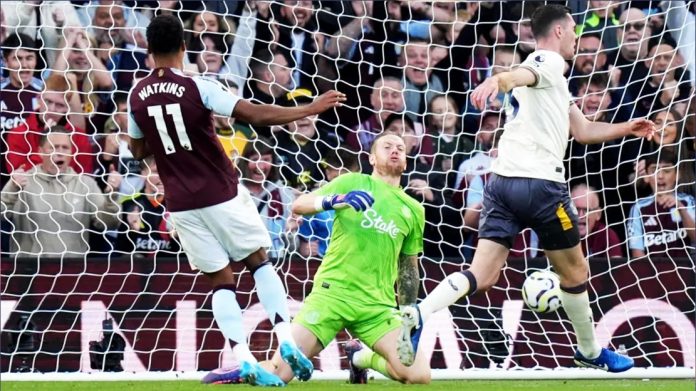
Ollie Watkins scored his first goals of the season for Aston Villa

Substitute Jhon Duran’s sensational long-range strike earned Aston Villa a memorable Premier League comeback victory as Everton crumbled from 2-0 up for the second consecutive game.

The Blues were left shell-shocked when they fell apart in the final minutes against Bournemouth last time out and they had a familiar feeling on Saturday, letting slip a two-goal lead once more to remain pointless this season.

The visitors were on the back foot early on with Ollie Watkins seeing a header cleared off the line before they shocked the hosts with the breakthrough.

Dwight McNeil robbed former Toffee Amadou Onana of possession – which the visiting fans enjoyed – before the winger darted forward and drilled a precise finish low into the far corner.

Bereft of confidence, Sean Dyche’s side were given little hope of a picking up a result but they doubled their advantage on 27 minutes through Dominic Calvert-Lewin’s towering header.

But Villa responded before the interval as ex-Everton full-back Lucas Digne teased a cross to the back post for Watkins to nod in his first goal of the campaign.

Unai Emery’s team begin their Champions League campaign on Tuesday and his side showed their mettle by restoring parity as England international Watkins slotted in from close range following Jack Harrison’s miscued clearance.

And the hosts completed a fine comeback 14 minutes from time as Colombian striker Duran picked the ball up 25 yards out before walloping a swerving drive in the top corner.

Credit: bbc.com

Man United secure much-needed victory at Southampton

0
Manchester United players celebrate their win

Matthijs de Ligt scored his first goal for Manchester United as Erik ten Hag’s side claimed a much-needed Premier League victory at Southampton.

The Red Devils went into the recent international break on a low after being comprehensively beaten by Liverpool, and needed to put in a performance on their return to action.

They survived a difficult start before a penalty save by Andre Onana from Cameron Archer proved the turning point as soon after they took the lead.

Summer signing De Ligt got the opener, heading into the bottom corner from Bruno Fernandes’ fantastic ball into the box.

Six minutes later Manchester United doubled their lead, Marcus Rashford opening his account for the season with his first goal since March, guiding a low strike through a crowd into the net.

The double blow seemed to quell Southampton’s eagerness and Manchester United were comfortable in the second half.

A bad day was rounded off for Southampton when Jack Stephens was shown a straight red card late on for a reckless challenge on Alejandro Garnacho.

The substitute then wrapped up the win for the visitors with a thumping finish into the roof of the net deep into stoppage time.

Credit: bbc.com


Mahama Promises Fiscal Discipline …When Voted For In December

0
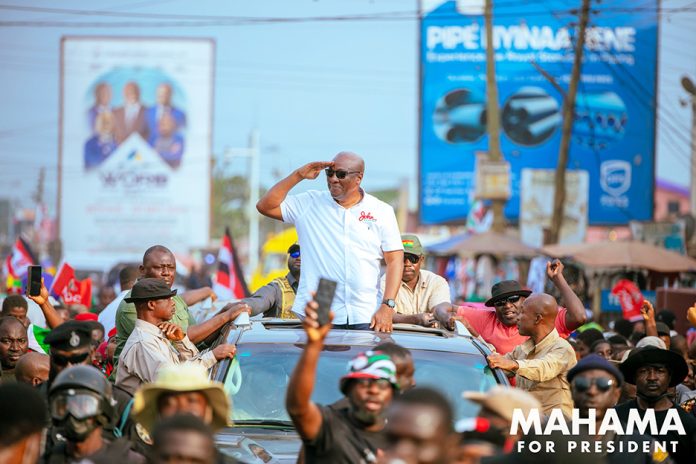
Former President John Dramani Mahama on a campaign tour

The flagbearer of the National Democratic Congress (NDC), John Dramani Mahama, says his next government will ensure fiscal discipline at all levels, as part of his drive to reset and transform the country.

The fiscal policy, he noted, would be anchored on his 24-hour economy catchphrase, which has been the running theme of the largest opposition NDC, ahead of the December polls.

In the “Resetting Ghana” manifesto, which has been duly launched, Mr. John Mahama explained that a fiscal policy anchored on a 24-hour economy would strategically enhance productivity and maximise production.

This, he said, would create sustainable jobs and transform Ghana into an import substitution and export-led economy to reset the nation on the path of growth, through the export of goods and services.

Specific objectives
According to the details of the 24-hour economy, as contained in the manifesto, it would enhance revenue mobilisation, reduce government expenditure and cut down waste, as well as reduce public debt to sustainable levels.

It would also reduce consumption-related expenditures and increase capital investments to spur economic growth and job creation, reduce the fiscal deficit progressively in accordance with the Fiscal Responsibility Act.

Scaling up Revenue Mobilisation
Mr. Mahama proposed that the next NDC government would enhance revenue mobilisation and create an equitable and efficient tax system by broadening the tax base.

It would also review the extractive sector regime to enhance Ghana’s stake in the country’s natural resources and the tax exemption regime to promote transparency, economic growth, technology transfer and job creation.

Additionally, there would be a review of the Public Financial Management Act, 2016 (Act 921) and the Public Procurement Act, 2016 (Act 914) to plug leakages and reduce waste and corruption.
Others include the review and rationalisation of port fees to enhance trade competitiveness and maximise revenue and resume the restructuring of the Ghana Revenue Authority (GRA) initiated by the previous NDC government to improve tax administration and compliance.
Operationalisation of the Independent Tax Appeals Board (ITAB) enactment of a Natural Resources Revenue Management Act (NRMA) to increase revenue from Ghana’s mineral resources, including green minerals.

Further, the party intends to review the Petroleum Revenue Management Act, 2011 (Act 815) to maximise petroleum revenue for development, harmonise and standardise the tax regime to ensure equity in tax administration for effective mobilisation.

According to the manifesto, the next NDC government would diversify funding options for development, by introducing Diaspora Bonds and pursue membership of the Islamic Development Bank to broaden opportunities for development financing.

The party would also implement the Public-Private Partnership Act, 2020 (Act 1039) for infrastructure financing and also revive fiscal decentralisation for local development.

Prudent Expenditure Management
The NDC disclosed in the manifesto that its next government would ensure fiscal discipline by rationalising government spending to promote efficiency, economic growth and job creation.

To achieve this, the party, he said, would prioritise investments in the productive sectors of the economy, digitalise and harmonise the government’s fiscal management systems for efficient expenditure management.

Enforce compliance with the Public Procurement Law to stop the abuse of sole-sourcing and other breaches and restore the contract database and management system created by the NDC in 2010 to ensure accountability, transparency and efficient administration of government contracts.

Complete the Treasury Single Account Project started by the previous NDC government to ensure efficient management of public funds and revamp the Ghana Infrastructure and Investment Fund (GIIF) to undertake well-targeted and self-financing projects.
It further intended to revise the Earmarked Funds Capping and Realignment Act, 2017 to free statutory funds (such as the GETFUND, NHIL, Road Fund and Student Loan Trust Fund ‘SLTF’) for their mandated objectives.

According to Mr. Mahama, his government would reduce expenditure by running a lean government that eschews profligacy and opulence.

He would improve disbursements into the District Assemblies Common Fund (DACF) for local development and revive fiscal decentralization for local development.

It would also determine a criterion for the grant of tax exemptions based on a measurable cost-benefit approach and a rigorous monitoring mechanism to ensure the state gains.
As a benchmark for the devolution, fiscal discipline basically is government’s ability to maintain a consistent macroeconomic stability and sustained economic growth and monetary operation and fiscal condition.

To achieve this, governments would be required to maintain fiscal positions by avoiding excessive borrowing and debt accumulation to ensure sustainable debt levels.

It helps to control inflation and maintain macroeconomic stability, enhance credibility and create favourable environment for businesses to thrive.

Galamsey And Community Mining Are Not The Same –Mireku Duker

0
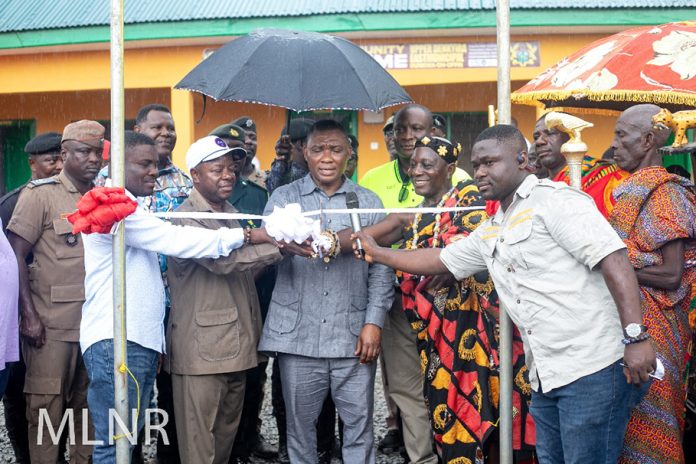
Deputy Minister for Lands and Natural Resources, Mireku Duker cutting the tape to commission the facility

The Deputy Minister for Lands and Natural Resources responsible for Mines, Mr. George Mireku Duker, has indicated that the Community Mining Scheme (CMS) and illegal mining, also known as galamsey, are not the same.

He said the government is absolutely against illegal mining of any kind and will continue to fight it.

Deputy Minister for Lands and Natural Resources, Mireku Duker addressing the media

The Minister was speaking at the launch of the 26th concession at Meretweso in the Dunkwa-on-Offin Municipality of the Central Region on Thursday, September 12, 2024.

He explained that the CMS, which has the support of President Nana Addo Dankwa Akufo-Addo, is modernised and more sustainable mineral exploration model.

As the government revamps operations to combat the illegal mining menace and protect the country’s water and forest resources, it also continues to create avenues for the economic empowerment of residents of mining communities, with the Community Mining Scheme being a prominent feature of this initiative.

Addressing a crowd of chiefs and residents at a durbar held to welcome the CMS concession, Mr. Mireku Duker disclosed that the concession will address unemployment challenges in the area, with 3000 jobs created directly and 500 jobs indirectly.

Mr. Mireku Duker outlined the disparities between illegal small-scale mining and the CMS, noting that while the CMS involves the use of environmentally friendly equipment, illegal mining involves the use of heavy metals and destructive chemicals and equipment.

Providing an update on the fight to protect Ghana’s mineral resources, the Deputy Minister explained that the government has made significant in-roads and will continue to ensure the protection of the country’s forest cover and water bodies.

A group photograph with chiefs and residents

He announced that river guards will soon be deployed to areas for the protection of water resources and forests. Hon. Duker reminded the community of their fiduciary responsibility to their communities and the country and urged them to collaborate with government to protect the environment.

He emphasised that “it is our collective responsibility to support and regularise community milking for the benefit of all.”

The Metropolitan Chief Executive of Dunkwa-on-Offin, Ebenezer Appiah Forson, highlighted the economic impact the CMS is going to have on the community and others nearby.

He announced that measures have already been instituted to ensure total adherence to the regulations and urged the people to comply with them.

The Member of Parliament for Upper Denkyira East, Dr. Festus Awuah Kofi, promised that the measures outlined in the licensing regime will be completely obeyed.

He urged the youth in the area to protect the concession as it will create sustainable economic growth in the area.

The Ghanaian Chronicle