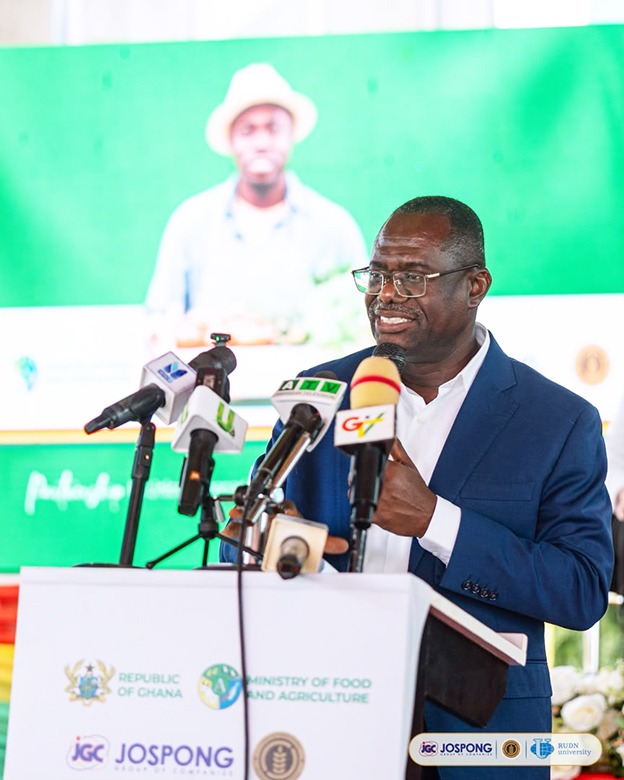
The Ministry of Food and Agriculture (MOFA) has allocated 750 acres of irrigated land at Konadu in the Afram Plains for the deployment of 118 Ghanaian postgraduate scholars trained in Russia, in a move aimed at translating advanced agricultural knowledge into commercial food production and supporting the government’s Feed Ghana programme.
The land, which forms part of a partnership between MOFA and the African Agribusiness Consortium (AAC), will serve as a vegetable production hub where the returning scholars are expected to apply modern farming techniques acquired during two years of postgraduate studies at the People’s Friendship University of Russia (RUDN University).
The scholars, sponsored by the Jospong Group of Companies and AAC, comprise 88 agronomists and 30 ecologists who specialised in agriculture, environmental sciences, waste management and sustainable development. The programme was designed to build local expertise to advance Ghana’s agricultural modernisation, food security and climate-smart agriculture agenda.

Speaking at a ceremony to welcome the scholars, the Minister for Food and Agriculture, Mr. Eric Opoku, described the initiative as a significant investment in Ghana’s agricultural future, stressing that government was committed to creating opportunities for the graduates to put their knowledge into practice rather than allowing their expertise to go untapped.
According to him, under the agreement with AAC, the Ministry has provided 750 acres of irrigated land at Konadu, while AAC will supply the logistics required to establish a commercial vegetable hub and also pay irrigation water charges to ensure the project’s sustainability.
“This partnership between the private sector and agricultural development is exactly the kind of collaboration Ghana needs to accelerate sustainable growth,” the Minister stated.
He explained that the collaboration would focus on the cultivation, processing, storage, value addition, marketing and commercialisation of strategic agricultural commodities to improve food security, create jobs, reduce imports and increase agricultural exports.

Mr Opoku challenged the returning graduates to justify the investment made in their education by demonstrating innovation and professionalism in the field.
“You have the responsibility to demonstrate the difference. Ghana has invested in you through the opportunities created by your sponsors, and today your country looks to you to become catalysts for agricultural transformation,” he said.
The Minister expressed confidence that within a year the vegetable project would begin producing tangible results, indicating that he expected to visit the site next year to witness increased production.
Chief Executive Officer of Jospong Group of Companies, Mr Joseph Siaw Agyepong, reaffirmed his outfit’s commitment to supporting government efforts to modernise agriculture despite the company being traditionally associated with environmental sanitation.
He said the company deliberately ventured into agriculture after studying successful farming systems in several countries and consulting with MOFA and other agricultural institutions.
Mr Agyepong encouraged the graduates to remain in Ghana and contribute to national development despite the challenges associated with farming and the country’s economic environment.
“We will build a new revolution of farming culture. Your skills, ideas and everything you learnt in Russia should be used to transform agriculture in Ghana,” he urged.
Chief Executive Officer of the African Agribusiness Consortium (AAC), Mrs Adelaide Araba Siaw Agyepong, said the return of the scholars marked the beginning of a broader strategy to strengthen Ghana’s agricultural and environmental sectors.
She noted that the objective of sponsoring the students was not merely to obtain academic qualifications, but to produce professionals capable of driving agricultural transformation through innovation, research, agribusiness development and environmental sustainability.
According to her, AAC wants the graduates to become entrepreneurs, researchers, innovators and problem-solvers rather than job seekers waiting for public sector employment. She stressed that for the initiative to succeed, the graduates would require access to productive land, irrigation infrastructure, agricultural machinery, finance, markets, research support and institutional partnerships.
Dr Agyepong therefore called for a structured framework between MOFA and AAC to integrate the scholars into commercial agriculture, agricultural mechanisation, climate-smart farming, environmental restoration, value addition and agribusiness development.
The initiative forms part of broader efforts by government and the private sector to strengthen Ghana’s agricultural value chain while creating employment opportunities for highly skilled young professionals returning from specialised training abroad.
For more news, join The Chronicle Newspaper channel on WhatsApp: https://whatsapp.com/channel/0029VbBSs55E50UqNPvSOm2z