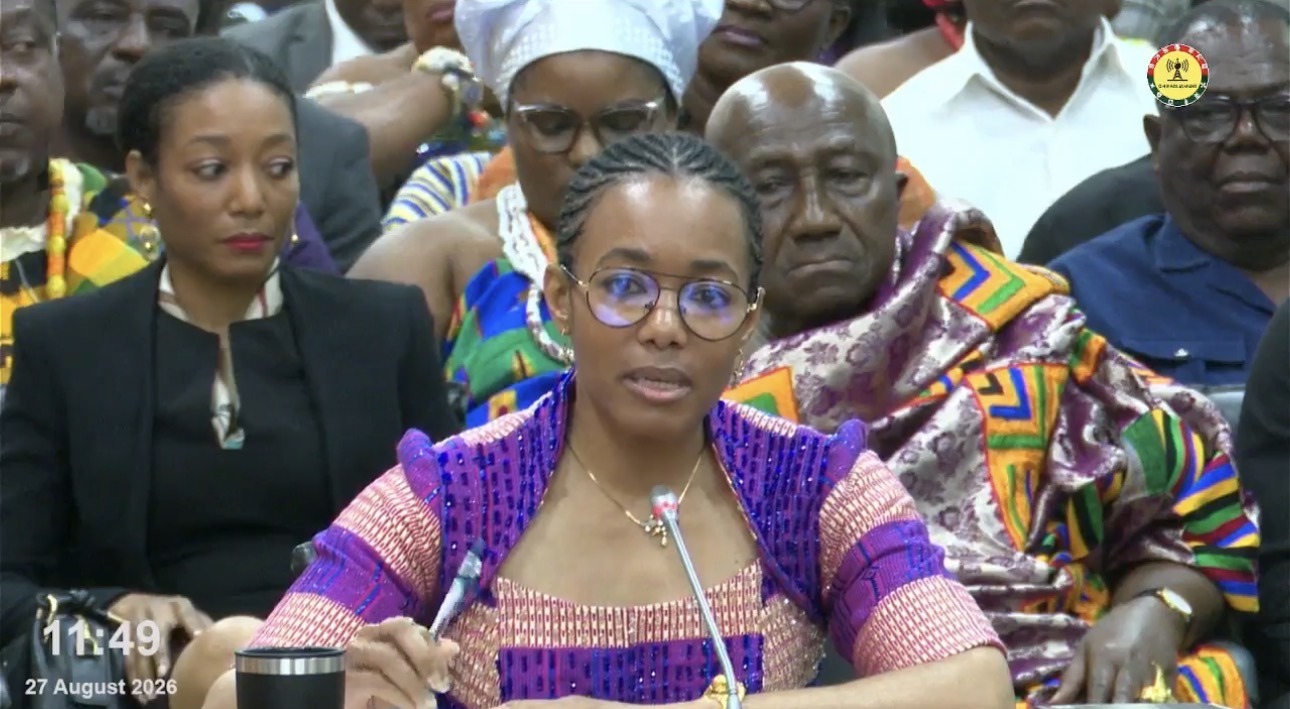
Minister designate for Environment, Science and Technology, Zanetor Agyeman-Rawlings, has called for caution in Ghana’s participation in carbon markets, saying the financial gains from carbon trading must be consistent with the country’s development agenda.
Appearing before Parliament’s Appointments Committee on Thursday, the nominee said Ghana’s participation in carbon markets under Article 6 of the Paris Agreement presented opportunities for climate finance, but the country must carefully consider what it gives up when trading carbon credits.
Ghana has already signed agreements with countries including Switzerland and Sweden for the bilateral exchange of carbon dioxide equivalents, she said.
“I believe that what it is for us that’s left to do is to ensure that in the process of trading the carbon credits or the carbon dioxide, we do not end up perhaps mortgaging whatever reserve space that we have as a country for developing on our own,” she said.
According to her, the accounting system used in international carbon trading means that when emissions are subtracted from one jurisdiction, they are added to another.
“So we end up with a net loss when we trade that in, and we have to make sure that the financial benefit that we’re getting is not out of sync with what our development agenda is,” she said.
Her response followed a question from the Minority Whip, Annoh Dompreh, who asked how Ghana could move from its commitments under successive international climate agreements to practical implementation.
The discussion also turned to climate finance and the longstanding challenge of developing countries accessing adequate funding to respond to climate change.
Dr. Agyeman-Rawlings said Ghana had already taken steps to take advantage of climate finance, including parliamentary support for a fund intended to support climate-related initiatives, although the expected financing had not been forthcoming.
She said Ghana needed to explore partnerships with countries that faced similar challenges but had different strengths that could be leveraged for mutual benefit.
“South-South cooperation is key,” she said.
“As a country, we need to look at strategic partners who perhaps share similar problems, but may have different advantages and then perhaps leverage on that.”
The nominee also proposed leveraging the African Continental Free Trade Area (AfCFTA) to strengthen Ghana’s access to climate finance and green technology.
She said the continental trade framework could provide an avenue for countries to work together to address climate-related challenges while expanding opportunities around green technologies.
Coordination
On Ghana’s broader environmental management, Dr. Agyeman-Rawlings said effective coordination among government institutions would be critical to addressing environmental challenges.
She noted that environmental issues cut across government and society and that many of the activities involved were taking place within the local governance system.
She therefore said, if approved, one of her first steps would be to engage relevant ministers and agencies with responsibilities relating to climate change.
“My first step would be to sit with the relevant ministers and coordinating agencies that have an interest in the climate fight to break the silo effect,” she said.
She also highlighted the importance of regular reporting, saying it would improve transparency and help government assess whether environmental interventions were having the intended impact.
“The regular reporting improves on transparency. It also helps us to track to what extent interventions are making an impact,” she said.
Dr. Agyeman-Rawlings said she would also work with the Environmental Protection Agency (EPA) as part of the process of understanding existing interventions and improving coordination among institutions.
Her nomination received expressions of support from members of both sides of the committee, with lawmakers commending her environmental advocacy and wishing her success in the proposed role.