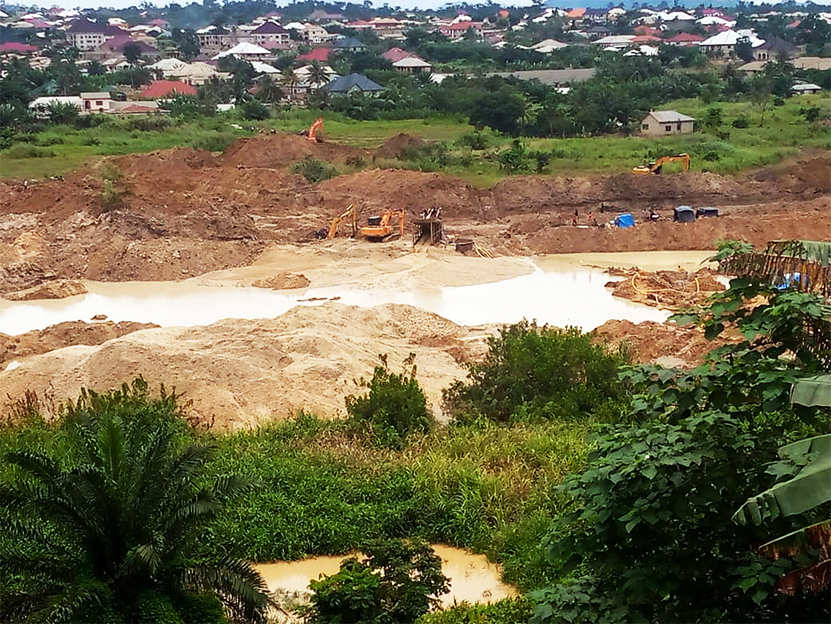
In a story published by graphiconline, President John Dramani Mahama has announced a new strategy to prevent illegal miners from returning to forest reserves after anti-galamsey operations have cleared them. Under the new arrangement, military detachments will remain in reclaimed reserves to prevent renewed encroachment.
The President said the decision followed the failure of the previous system, under which cleared reserves were handed back to the Forestry Commission. He explained that illegal miners often returned, drove away forest guards and resumed their activities.
Mr Mahama said government had cleared as many as possible of the nearly 49 forest reserves invaded by illegal miners, while NAIMOS had seized excavators and destroyed Changfan machines. NAIMOS reported in March that its operations had resulted in 94 excavators being seized, nearly 3,000 Changfans destroyed and 237 arrests of illegal miners.
The President acknowledged that keeping soldiers in the forests would increase government expenditure because they would require food, accommodation and logistics. However, he insisted that the government would not abandon the fight.
Ghana has fought galamsey for years, yet the menace continues to threaten forests, rivers, farmlands and livelihoods. What makes the crisis particularly troubling is the repeated cycle: security forces clear an area, leave, and illegal miners return.
President Mahama’s decision to change that approach is therefore welcome. His 2024 manifesto promised a “ruthless war” against illegal mining, including a ban on new mining activities in forest reserves, stiffer penalties for mining in water bodies, the Tree for Life programme, the Blue Water Initiative and the establishment of the Ghana Gold Board.
The government has since taken significant enforcement measures. NAIMOS says it has seized excavators, destroyed thousands of Changfan machines and arrested hundreds of suspects. By the first half of 2026, government reported 78 excavators seized, 90 immobilised and 2,800 Changfans destroyed, alongside 207 arrests.
These are important interventions. But even NAIMOS admits that Ghana is “not out of the woods yet.” That assessment is crucial. The success of the galamsey fight cannot be measured simply by the number of machines seized or suspects arrested. The real measure must be whether rivers remain clean, forests stay protected and degraded lands are restored.
Experts have also warned against relying exclusively on military force. Retired military officer and security analyst Colonel Festus Aboagye has argued for a multi-agency approach involving the Armed Forces, Police, Immigration, Customs and other institutions.
We agree. The military cannot solve the entire galamsey problem. But it can play a critical role in protecting reclaimed forests, particularly where illegal miners have repeatedly returned after security operations.
This makes President Mahama’s new strategy a sensible one. If illegal miners know that soldiers will remain behind after an operation, the incentive to return will be significantly reduced. It also gives the Forestry Commission the breathing space to strengthen its own capacity rather than being expected to confront well-organised illegal mining groups alone.
However, government must be extremely careful about one thing: the military deployment must not become another opportunity for corruption. Soldiers assigned to forest reserves must be properly trained, supervised and regularly rotated. They must understand that their responsibility is to protect the forest, not negotiate with illegal miners.
There must be zero tolerance for bribery. Any soldier, police officer, forest guard or public official who accepts money to allow excavators or Changfans into a protected forest must face serious disciplinary and criminal consequences. The recent allegations involving security operatives at illegal mining sites demonstrate why strong oversight is necessary.
Government should therefore establish independent monitoring, surprise inspections and clear reporting mechanisms around military deployments. Personnel must also have adequate logistics so that lack of resources does not become an excuse for compromise.
At the same time, the government must go beyond the people operating the machines. The financiers, equipment owners, gold buyers and politically connected individuals who sustain illegal mining must be pursued.
The fight must also continue beyond enforcement. Government must strengthen the Forestry Commission, expand forest surveillance, support local communities and ensure that legitimate small-scale miners have viable alternatives. NAIMOS has already highlighted the importance of intelligence from traditional leaders and communities.
Galamsey is no longer merely an environmental issue. NAIMOS has warned that the proliferation of weapons at mining sites makes it a national security concern. Ghana, therefore, needs sustained action, not periodic operations. We commend President Mahama for recognising that clearing a forest is only half the battle. Keeping it clear is the real challenge.
The military strategy is a good step. But the soldiers must be protected from compromise, the corrupt must be punished, the financiers must be pursued and the forests must ultimately be handed over to a properly resourced permanent protection system.
Ghana has already lost too much to galamsey. We cannot afford to clear our forests today only to watch illegal miners return tomorrow.
For more news, join The Chronicle Newspaper channel on WhatsApp: https://whatsapp.com/channel/0029VbBSs55E50UqNPvSOm2z