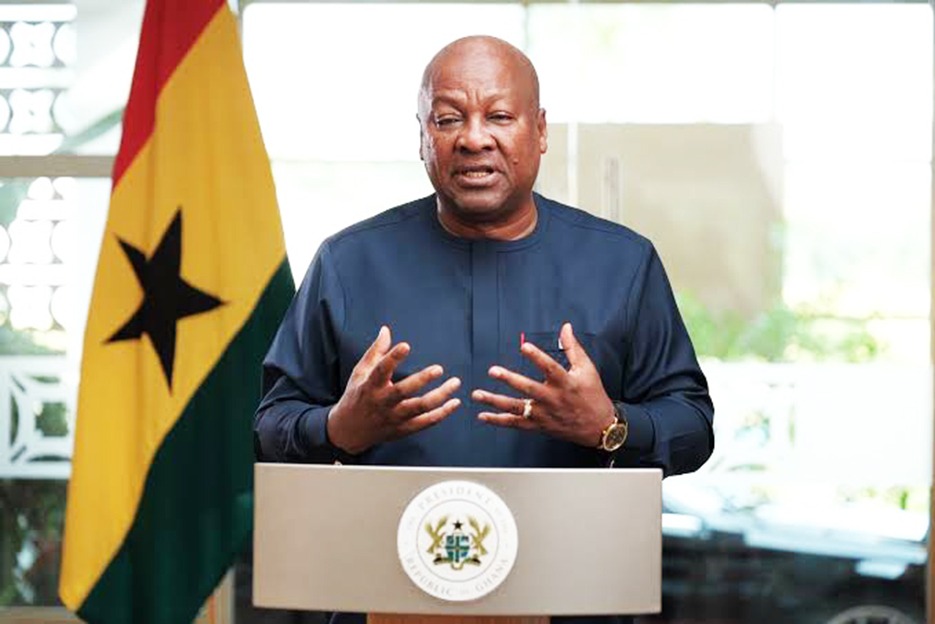
President John Dramani Mahama has announced a new hydrocarbon discovery offshore Ghana, raising fresh hopes for the country’s struggling petroleum industry as government intensifies efforts to attract investment, reverse declining production and open up new exploration frontiers.
The discovery, made by Planet One Oil and Gas Limited, in partnership with the Ghana National Petroleum Corporation (GNPC) and other partners at the Nya Gyidie-1X exploration well, in the Deepwater Cape Three Points contract area was announced at the 2026 Petroleum Commission Local Content Conference and Exhibition in Takoradi.
The find, which includes gas and condensate, marks an important milestone in Ghana’s exploration drive and represents the country’s first successful test of a Cenomanian-Turonian carbonate play as a primary exploration target.
President Mahama described the discovery as evidence of renewed investor confidence in Ghana’s petroleum sector, following years of declining production, reduced exploration activities and the withdrawal of major international oil companies.
He said his administration had prioritised resolving outstanding disputes with industry players, restoring investor confidence and creating a more predictable investment environment to encourage fresh capital into the upstream petroleum industry.
According to him, the interventions were beginning to yield results with crude oil production recovering to more than 120,000 barrels per day from approximately 88,000 barrels daily.
The President disclosed that partners in the Jubilee Field had committed US$2 billion, while operators in the offshore Cape Three Points area had committed another US$1.5 billion to support new wells, subsea infrastructure and expansion of production facilities.
He said the investments would not only help sustain existing production, but also strengthen domestic gas supply and create opportunities for Ghanaian businesses.
However, the President’s announcement comes against the backdrop of growing concerns about the sustainability of Ghana’s existing oil fields and the urgent need to discover new reserves to replace those being depleted through production.
This concern was strongly echoed by the Minister for Energy and Green Transition, Dr John Abdulai Jinapor, who warned that Ghana could not afford to become complacent about exploration.
“In the petroleum sector, you discover or you disappear,” he declared, drawing a parallel with the popular academic expression, “publish or perish”.
Dr Jinapor said local content development could not thrive in an industry that was not expanding, stressing that without continuous exploration and new discoveries, the opportunities available to Ghanaian companies and workers would gradually diminish.
He revealed that Ghana’s crude oil production had suffered a consistent decline since 2020, falling from a peak of approximately 71 million barrels annually to about 37 million barrels before the current administration began implementing measures to revive the sector.
He said production had now recovered to approximately 122,000 barrels per day, describing the development as encouraging but insisting that the government’s ambition went beyond merely stopping the decline.
The Minister said government was pursuing an aggressive programme to secure new investments, develop commercially viable discoveries and bring marginal fields into production.
He disclosed that negotiations with major international oil companies, including Eni, Vitol, Shell, Chevron and Petrobras, were progressing towards at least six new petroleum agreements expected to be signed by the first quarter of 2027.
Dr Jinapor, however, cautioned that signing petroleum agreements alone would not guarantee success, insisting that the real measure of progress would be the number of exploration wells drilled, discoveries made and projects developed.
In a significant development, he announced that GNPC and Expro had completed the processes for an onshore drilling programme in the Voltaian Basin, with drilling expected to commence in the coming weeks and months.
The Voltaian Basin represents a new frontier in Ghana’s search for petroleum resources, with the exploration programme expected to determine its hydrocarbon potential and possibly open another chapter in the country’s oil and gas industry.
The Chief Executive Officer of GNPC, Kwame Ntow Amoah, also underscored the importance of the exploration programme, warning that it was risky for Ghana to depend on a limited number of producing fields.
He said the country’s reliance on existing assets, particularly Jubilee, TEN and Sankofa, made it imperative for the national oil company to intensify efforts to discover new petroleum resources.
According to him, GNPC had moved essential exploration equipment to the Voltaian Basin as preparations advanced towards the commencement of drilling.
He explained that the Corporation’s decision was informed by the need to diversify Ghana’s petroleum resource base and reduce the risks associated with depending on a few established fields for national revenue.
The GNPC boss said exploration was inherently risky, but the country could not secure its long-term petroleum future without investing in the search for new resources.
Beyond the search for new oil and gas reserves, the three speakers stressed the importance of ensuring that increased activity in the sector translated into economic opportunities for Ghanaians.
Dr Jinapor disclosed that Ghanaians now constituted approximately 90 per cent of the upstream petroleum workforce, while the value of local content had increased from about US$237 million in 2024 to US$450 million.
President Mahama urged international operators to give qualified Ghanaian suppliers greater visibility of upcoming contracts and ensure that training and technology transfer were embedded in their partnerships.
He also encouraged local financial institutions to support indigenous petroleum companies with the financing needed to compete for larger and more complex contracts.
The President maintained that Ghana’s petroleum resources must translate into employment, indigenous industrial growth, technology transfer and lasting national prosperity.
For a country whose petroleum industry has been challenged by declining production and dwindling exploration activities, the latest discovery and the planned Voltaian Basin drilling represent important steps towards securing the future of the sector.
For more news, join The Chronicle Newspaper channel on WhatsApp: https://whatsapp.com/channel/0029VbBSs55E50UqNPvSOm2z