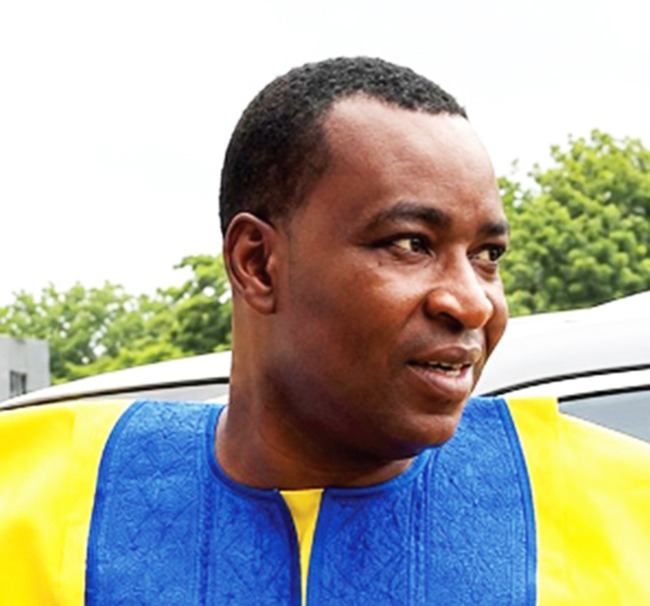
A prosecution witness in the criminal trial involving the Ashanti Regional Chairman of the New Patriotic Party (NPP), Bernard Antwi Boasiako, popularly known as Chairman Wontumi, has admitted that his desire to avoid a possible 15-year prison sentence influenced his decision to cooperate with the Attorney-General’s Department.
Edward Akuoko, a former General Manager of Akonta Mining, made the admission during further cross-examination by defence counsel, Samuel Atta Akyea at the High Court in Accra.
He, however, maintained that although self-preservation influenced his decision, he did not intend to secure his freedom at the expense of the accused persons.
The witness told the court, presided over by Justice Ruby Aryeetey, that he voluntarily approached the Attorney-General’s Department and offered to testify for the prosecution after becoming dissatisfied with the legal advice he was receiving from his former lawyer.
He also admitted that he entered into an agreement with the Attorney-General, which resulted in his transition from an accused person to a prosecution witness. The defence consequently sought an order compelling the prosecution to disclose the agreement, but the court dismissed the application.
Witness explains decision to approach AG
During the cross-examination, Mr Akuoko was confronted with his caution statement to the police, in which he stated that Akonta Mining had not entered the Tano Nimiri Forest Reserve to undertake mining activities. Although he confirmed that he signed the statement and accepted its contents, he said he had done so reluctantly under the guidance of his former lawyer, Andy Appiah Kubi.
He explained that he was aware of substantial evidence suggesting that Akonta Mining had operated within the forest reserve, including a viral video showing an encounter between the company’s personnel and security officials.
According to him, public statements had also been issued by three key institutions concerning the company’s activities. He said he questioned his lawyer about making a statement that contradicted evidence he knew existed, but was advised to proceed, with the possibility of a plea bargain if the need arose.
Asked whether he had deliberately withheld relevant background information from the police, Mr Akuoko denied doing so intentionally, insisting that he had acted on his lawyer’s guidance.
He further explained that he did not personally write the caution statement, but was allowed to read through it before consenting to its contents. The witness acknowledged that he had another opportunity to correct the statement when he subsequently gave a witness statement, which he said he prepared independently.
Admits agreement with Attorney-General
The cross-examination subsequently turned to the circumstances under which Mr Akuoko became a prosecution witness. He confirmed that before preparing his witness statement, he had entered into an agreement with the Attorney-General’s Department.
Explaining the circumstances, he said he voluntarily approached the department after concluding that his former lawyer was acting in a manner that was more protective of the interests of Chairman Wontumi than his own.
He said he had expected his lawyer to pursue a plea bargain for him because of the evidence he believed the state had gathered, but that did not happen. “I did all these… I didn’t do these for any other favour apart from non-prosecution,” he told the court.
Mr Akuoko said the Attorney-General had cautioned him against offering to testify merely to avoid prosecution. According to him, the Attorney-General asked whether he was approaching the office to lie against somebody to escape prosecution, to which he responded that he wanted to clear his conscience and provide information that would be supported by the state’s investigations.
He insisted that his decision was not motivated by a desire to falsely implicate the accused persons. He also maintained that he did not consider himself guilty merely because he approached the Attorney-General, stressing that only a court could determine his guilt after a trial.
Court rejects application for disclosure of agreement
Following the witness’s admission that he had signed an agreement with the Attorney-General, Mr Akyea asked the court to order the prosecution to produce the document for inspection by the defence.
He argued that the agreement was relevant to the witness’s credibility and the circumstances surrounding his transition from an accused person to a prosecution witness. The defence counsel relied on Article 19(2)(e) of the 1992 Constitution, arguing that all relevant documents necessary for the fair conduct of the trial ought to be made available.
He further contended that withholding the agreement could amount to concealment of relevant evidence. However, Deputy Attorney-General, Dr Justice Srem-Sai opposed the application. He argued that the Practice Direction on disclosures did not require the prosecution to disclose a plea-bargaining agreement.
He also relied on the Plea Bargaining Act, particularly Section 1(6), arguing that the law protected the confidentiality of such agreements and did not provide for their disclosure during the trial of another accused person.
Dr Srem-Sai further submitted that the agreement was reached after the alleged offences and could not constitute evidence of the acts for which the accused persons were being tried. He also argued that the application went beyond the limited purpose for which the witness had been recalled.
In dismissing the application, the court held that ordering disclosure of the agreement would amount to extending the recall of the witness into a reopening of the case. The court consequently declined the defence’s request.
Witness admits feeling marginalised by Wontumi’s release
In a further attempt to challenge the witness’s credibility, Mr Akyea confronted him with statements he had made in a recorded radio interview, which had been tendered in evidence as Exhibit 6.
The defence suggested that Mr Akuoko’s decision to cooperate with the state was influenced by bitterness over the circumstances surrounding his detention and the release of Chairman Wontumi. The witness admitted that he had expected both himself and his boss to be detained, only to be informed by his lawyer that Chairman Wontumi would be released while he remained in custody.
He described his feelings at the time as marginalisation.
He also confirmed that he had complained about losing his mother-in-law while in custody, although he rejected the suggestion that the development had deepened his pain. Mr Akyea further put it to him that he had secured his freedom at the expense of Chairman Wontumi.
The witness denied the suggestion, insisting that his call for fervent prayers was not directed at Chairman Wontumi alone, but also included his former lawyer, Andy Appiah Kubi.
When asked whether his desire to avoid the minimum 15-year prison sentence influenced his decision to cooperate with the state, Mr Akuoko answered in the affirmative. “Self-preservation is the first rule of existence, but I will not do that at the detriment of the accused,” he said.
He also confirmed that the Attorney-General had warned him that the state had sufficient evidence against him and that he could find himself in serious trouble if he lied.
Background
Chairman Wontumi and Akonta Mining are standing trial over alleged illegal mining activities in the Tano Nimiri Forest Reserve. The prosecution’s case centres on allegations relating to mining operations within the protected forest reserve and the respective roles of the accused persons in the activities.
Mr Akuoko, who served as General Manager of Akonta Mining, is a key prosecution witness whose testimony is intended to establish the circumstances surrounding the company’s operations and the involvement of the accused persons.
His evidence has come under sustained scrutiny from the defence, particularly over the apparent differences between his initial caution statement to the police and his subsequent witness statement to the prosecution.
The defence has also questioned his credibility on account of the agreement he entered into with the Attorney-General, which resulted in him becoming a prosecution witness instead of remaining an accused person.
The case has been adjourned to December 17, 2026, for the defence to file its submission of no case to answer, after which the prosecution is expected to file its response. The court will subsequently determine whether the accused persons have cases to answer and should be called upon to open their defence.
For more news, join The Chronicle Newspaper channel on WhatsApp: https://whatsapp.com/channel/0029VbBSs55E50UqNPvSOm2z