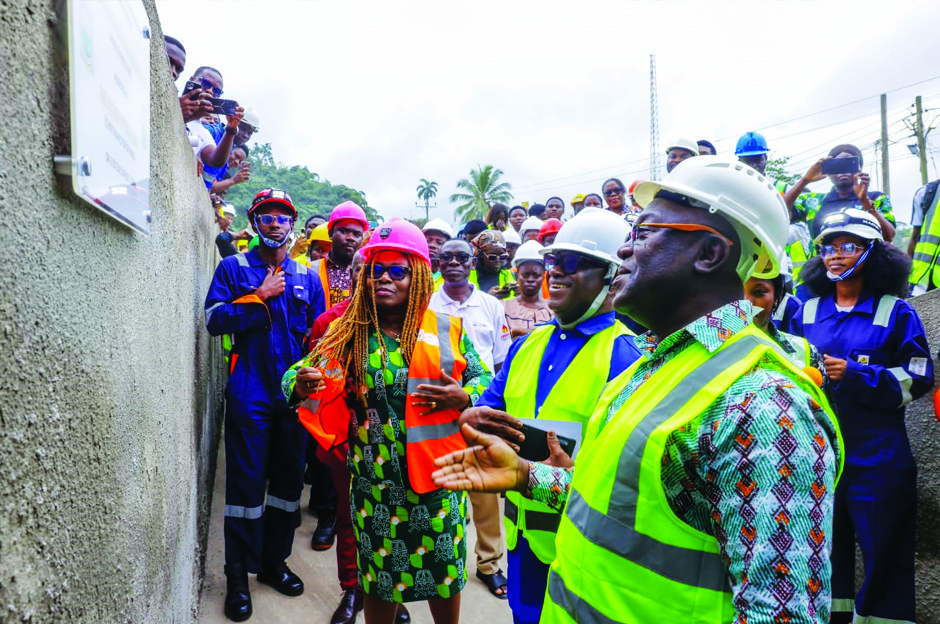
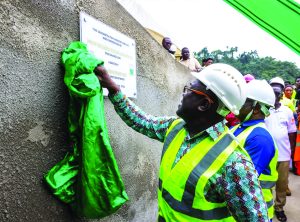
The University of Mines and Technology (UMaT) has officially commissioned a ground-breaking underground mine model in a historic move to cement its position as a leader in mineral education in Africa. The facility, the first of its kind in Ghana, represents a paradigm shift in how the nation trains its future mining engineers and geoscientists.
The event held at the UMaT Mechanical Block last Friday, brought together academia and industry to celebrate a new era of hands-on learning that promises to redefine mining education in the sub-region.
The landmark project stands as a testament to the visionary leadership of the immediate past Vice Chancellor, Professor Richard K. Amankwah, who initiated the project during his tenure.
Professor Amankwah’s focus was on transforming the university’s physical infrastructure into active learning tools that better prepare students for the complexities of the mineral industry. His foresight has provided UMaT with a unique asset that effectively bridges the gap between classroom theory and real-world field practice.
Highlighting the innovativeness of the project, Professor Amankwah revealed that the idea was born from observing underutilized space within the university’s administration block.
He identified a basement originally designated for the storage of materials and saw an opportunity to create something transformative.
By repurposing this space into a sophisticated training hub, the university has demonstrated a remarkable ability to maximize its resources for the benefit of student development and industrial relevance.
Speaking on what inspired the project, Professor Amankwah remarked, “That basement is supposed to be for storage of materials. But then as part of looking for spaces for attachment skills training, I thought, why don’t we turn this space into a demonstration underground mine where people can just enter and see how an underground mine looks like, which approach ensures that students gain vital exposure to subterranean environments long before they step onto a commercial mine site.
The technical utility of the facility is immense, particularly for geomatic engineering students who can now practice precision tasks in a controlled setting. Professor Amankwah noted that students can use the model to “take your points, do your mind planning, and you can also see how you can pick a point on the surface and then relate it to a point underground.”
This level of practical orientation is essential for developing the technical accuracy and confidence required in modern mining operations. For core mining engineering students, the facility provides a realistic simulation of a subterranean workspace. Students can enter the space to observe the structural layout of a typical underground environment, including specialized features like a stope.
The model even allows students to visualize the aftermath of operations, providing a clear view of “how blasted material in a stope” appears, which is an invaluable visual aid for understanding the mechanics of underground production.
Describing the project as a “patriotic investment in our future,” Professor Amankwah emphasized that the facility is more than just a training site; it is a “living laboratory.”
He envisions the mine as a hub for research and innovation where home-grown solutions will be developed to meet the evolving challenges of the global mining industry towards ensuring that Ghanaian engineers are not only consumers of technology but creators who drive the sector forward with local expertise.
The facility also serves as a beacon of national pride, signalling to the international community that Ghana possesses the ingenuity and dedication to lead the minerals sector.
The commissioning was attended by key industry and academic figures, including the Chief Inspector of Mines from the Minerals Commission, Mr. Joseph Frimpong, who delivered the keynote address which focused on the facility’s alignment with national safety and operational standards, emphasizing its importance for regulatory competence.
Also in attendance were the Pro Vice Chancellor, Professor Mrs. Grace Ofori-Sarpong Akuffo and the Dean of the Faculty of Mining and Mineral Technology, Associate Professor C. K. Owusu.
By Mohammed T. Kataba
For more news, join The Chronicle Newspaper channel on WhatsApp: https://whatsapp.com/channel/0029VbBSs55E50UqNPvSOm2z