
Many people believe quality education means acquiring knowledge in various academic disciplines, achieving good exam results, and earning certificates. While it is good to have depth of knowledge in the subjects one pursues, education should be more than acquiring theoretical knowledge. It should help learners acquire practical skills to contribute meaningfully to society. One area of study that deserves greater recognition, support and investment in Ghanaian schools is Clothing and Textiles.
Beyond the Sewing Machine
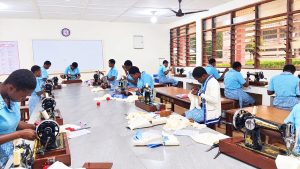
I was excited when I had the privilege of visiting the Home Economics Department at Kumasi Girls’ Senior High School, where I had the opportunity to interact with teachers and learners, particularly those involved in Clothing and Textiles. My experience has shown me that students learn better when they are allowed to put what they learn in the classroom into practice.
Through sewing activities, students acquire hands-on experience useful for creating beautiful designs. The experiences become the foundation for future careers and business opportunities.
Clothing and Textiles as a Tool for Girl-Child Empowerment
Stakeholders of education in Ghana must also consider whether girls are acquiring the competencies that will enable them to become independent, confident and productive adults.
Clothing and Textiles education provides one avenue for achieving this objective. A girl who understands garment construction, fabric selection, fashion illustration and sewing techniques is acquiring knowledge that can be developed into a profession or business. One student expressed her admiration for the subject, stating: “Studying Clothing and Textiles has equipped me with the skills to sew dresses for myself and my family. We no longer need to spend extra money paying others to sew our clothes because I can now make them myself.”
Another student also explained that she initially had little interest in the subject. However, she later developed an interest when she became aware of the prospects of the course. These responses suggest that studying Clothing and Textiles has immense benefits aside from the acquisition of practical skills.
Indeed, practical skills can give young women additional opportunities to earn a living, support their families and participate in economic activities. Such opportunities are particularly important in a society where unemployment and financial dependence remain concerns for many young people.
It is therefore necessary for parents, teachers and students to challenge the misconception that practical subjects are less beneficial than traditionally recognised academic subjects.
From the Classroom to Entrepreneurship
Students who acquire a strong foundation in Clothing and Textiles can eventually progress into advanced training, establish fashion businesses, or work with established designers and garment manufacturers.
More importantly, they can become employers rather than merely job seekers. A young woman who establishes a successful fashion enterprise may eventually employ other young people, contribute to household income and support local economic development.
However, this potential cannot be realised through classroom instruction alone. Students need opportunities to practise, experiment, develop their designs and understand the business side of the fashion industry. Schools should therefore consider introducing entrepreneurship education alongside practical lessons.
The Challenge of Resources
Unfortunately, the successful teaching of practical subjects depends considerably on the availability of appropriate resources. Sewing machines, scissors, needles, threads and other materials are needed for practice.
Where these resources are inadequate, teachers may struggle to provide learners with sufficient opportunities to practise and develop their competencies.
It is therefore important for government, school authorities, parents, corporate organisations, old students’ associations and other stakeholders to support Clothing and Textiles education in senior high schools.
Changing Public Perceptions
There is nothing inferior about learning to sew, design garments or develop textile products. These activities require knowledge, creativity, technical competence and discipline. Ghana must create an educational culture in which students are encouraged to appreciate both academic and practical excellence.
A learner who becomes an excellent fashion designer should be celebrated just as much as one who pursues a career in medicine, law, engineering or education.
Our schools must help young people understand that success does not follow only one career pathway.
A Call to Action
The responsibility to promote Clothing and Textiles education must be shared. School management should provide support for practical teaching, while parents should encourage their children to appreciate the value of practical education.
Government and educational policymakers must also ensure that skill-based education receives the maximum recognition and attention in curriculum implementation and resource allocation.
Conclusion
Empowering girls through Clothing and Textiles education is about more than teaching them how to sew. It focuses on providing solid practical training that helps our young learners develop the confidence, creativity, and entrepreneurial mindset needed to shape their own lives. Ghana must therefore recognise that investing in practical education is investing in the future of its young people. When girls are equipped with relevant skills, they do not simply stitch garments; they stitch together opportunities, independence and brighter futures.
By Isaac Nyarko Antwi
For more news, join The Chronicle Newspaper channel on WhatsApp: https://whatsapp.com/channel/0029VbBSs55E50UqNPvSOm2z