The real review of the 2026 budget is the unfulfilled job creations and stifling of the economy, the minority in Parliament has said.
The caucus sent this message out on the floor of the House Tuesday, July 28, 2026 during the debate on the budget review presented by the Minister for Finance, Dr Cassiel Ato Forson, last week Thursday.
Referencing the 2026 budget statement and the economic policy presented in 2025 and having perused the review document, the minority concluded that the promises of the government vis-à-vis implementation were not aligned.
SHORTFALL
The Member of Parliament for Atiwa East, Abena Osei-Asare, who opened the debate, noted a close to GH₵2 billion shortfall in the total revenue and grants for the fiscal year.
She mentioned that the shortfall related to domestic goods taxes on domestic goods and services.
Indicating that value-added tax also told the same story, the former deputy finance minister argued the shortfall and revealed that, “people are not buying, businesses are not flourishing and that is how come you see a fall in VAT and excise duty tax.”
Referring to last year, she noted that there was a shortfall of revenue to the tune of GH₵5 billion, despite all the eight new taxes that the government put in place in 2025.
“Mr Speaker, for expenditure, at the same time last year, the half-year 2025, we saw expenditure fall by GH₵18.5 billion.
“But this year, the half-year expenditure is down by GH₵31.3 billion. Government is, therefore, not balancing the books,
“Mr Speaker, it is balancing the books by just not spending, and if spending is not spending at the right places,” she debated.
UNEXECUTION
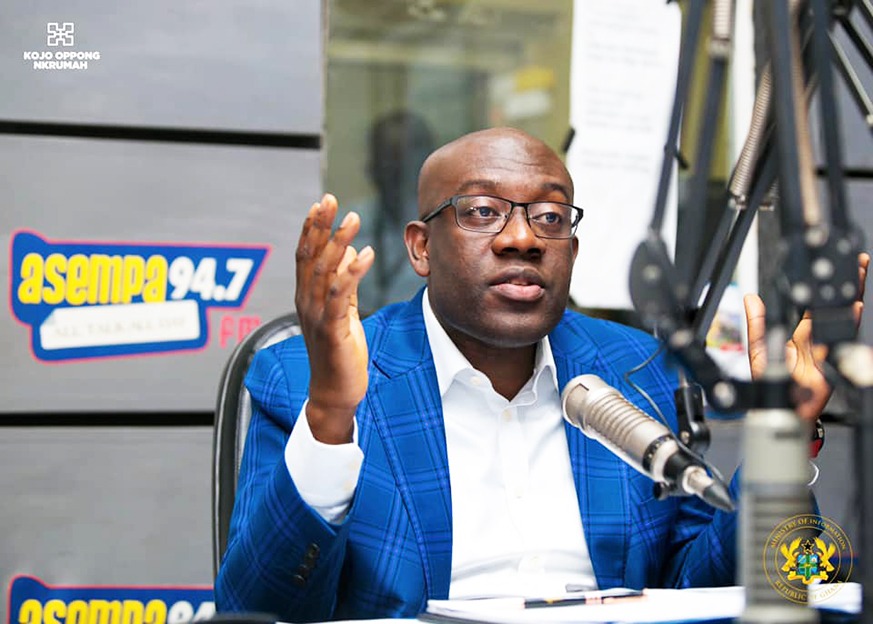
On his part, the minority spokesperson on economy, Kojo Oppong Nkrumah, argued that for the first time a finance minister has presented a mid-year budget review with no information of the execution of economic programme.
Referencing Appendix 2A of the review document, the Ofoase-Ayirebi MP noted that the government made promises of projects, jobs and programmes to the tune of GH₵30 billion, which it has not executed as of the half-year.
“As at half-year, they have under-executed the budget. The reason for which many of you don’t have projects going on in your constituency because they have under-executed the budget by GH₵30 billion,” Kojo said.
He argued that the cost of refusing to spend on planned projects and programmes may have dire consequences, though the books of the government may look good.
“Now, Mr Speaker, when you fail to execute GH₵30 billion worth of projects in your budget, let me show you what it is.
“You see the money you are supposed to spend on flood control programmes. When the floods came, 34 people died and 6 went missing. That’s the cost of what you are doing,” he stated.
He asserted that the agriculture minister needed money for fertilisers and others, the health and education ministers are also awaiting financial clearance to recruit unemployed graduates, but the government is not releasing funds just to make its books look good.
JOBS
The MP for Bosome-Freho, Nana Asafo-Adjei Ayeh, on his part, recalled the items the government had promised in the 2026 budget to create various jobs.
According to him, the government promised that the big push would create 490,000 jobs, three new garment factories to create 20,000 jobs, seven new agro-plant processing factories to produce or provide 700,000 new jobs and the oil pump, which was to provide 250,000 jobs.
“Mr Speaker, when you put all these jobs together, the [2026] budget that was presented is providing 800,000 jobs.
“Mr Speaker, I beg to submit that the Ghanaian youth are so disappointed that the review could not tell us the number of jobs that have been provided as we speak now or by the review,” he argued.
According to him, the various ministries are getting less of their allocations, citing that the ‘Adwumawura Project’ has received about 21% of its earmarked funds for the half-year and 26% for the national apprenticeship programme.
“This is what we are facing. This is the reality of the review. This is where the majority of Ghanaian youth are disappointed,” he added.
SPENDING RIGHT
Members of the majority who debated yesterday refuted the minority’s claim that the government was not spending. On the contrary, the majority argued forcefully that the government was rather spending prudently in the right sectors.
The MP for Lambussie argued that if spending were not spending recklessly, “then the finance minister is not spending” and if spending were spending prudently, then Ato is spending.
He mentioned the expenditure in the health and the education sectors, citing the no-fees stress policy as an example.
On his part, Kofi Arko Nokoe, Evalue Ajomoro-Gwira, claimed that at his hometown, Axim, prices of foodstuffs were down, reflecting the excellent job the minister for finance was doing.
He spoke about the payment the minister had made in the energy sector, stressing that the sector was the backbone of the growth of every economy. He concluded saying that the budget review had brought hope to the entire country.
The MP for Tain, Sulemana Adams, said the commitment authorisation law passed by Parliament under this government was dealing with over expenditure.