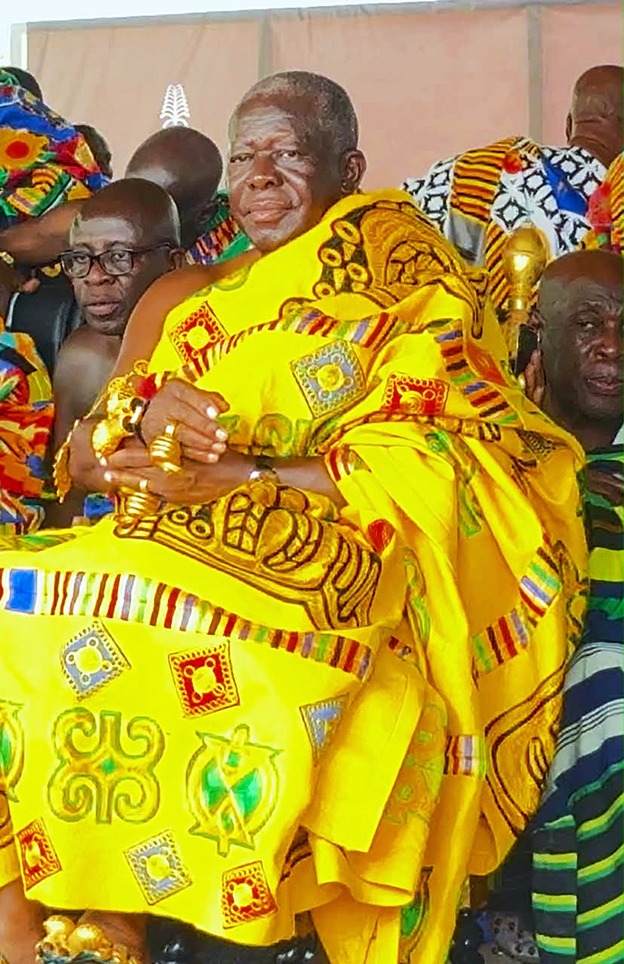
The Asantehene, Otumfuo Osei Tutu II, has challenged Ghanaian artists, designers and students to preserve the country’s cultural heritage and transform its rich artistic traditions into economic opportunities through innovation, technology and modern creative production
He said Ghana’s heritage must not be treated merely as a relic of the past or an object of nostalgia, but as a valuable resource capable of inspiring creativity, generating employment and shaping the country’s economic future.
Delivering a keynote address at the Faculty of Applied Arts’ Annual Open Day celebration of Takoradi Technical University (TTU) on Monday, November 16, 2026, Otumfuo described heritage as the foundation of a people’s identity, values and collective existence.

The celebration was held under the theme, “Celebrating Heritage, Innovation, and Excellence: A Tribute to Otumfuo Osei Tutu II’s Legacy.”
“Heritage is the core of our being. It invokes the spirit that drives us, the soul that nourishes us, the umbilical cord that connects us to the culture from which we spring,” he said.
Africa’s cultural heritage
He observed that Africa’s cultural heritage had endured centuries of colonial exploitation, prejudice and suppression, but had remained resilient, continuing to find expression in the continent’s music, dance, art, crafts and spirituality.
According to him, the responsibility of the present generation was to preserve that heritage while finding innovative ways to make it relevant to contemporary society.
“Even the most enthralling heritage suffers if it becomes merely an object of nostalgia. That is why we strive to make our heritage at once a source of inspiration and a fountain of value,” he stated.
Otumfuo said traditional craftsmanship, indigenous knowledge and cultural practices offered enormous opportunities for Ghana’s creative economy, particularly in fashion, textiles, sculpture, painting and other artistic disciplines.
He identified Takoradi Technical University as occupying a strategic position in connecting Ghana’s cultural heritage to economic development through technical and creative education.
He challenged the university to bridge the skills gap in the country’s industrial sector by producing technically competent graduates capable of translating indigenous knowledge into commercially viable products.
The Asantehene called for stronger collaboration between traditional artisans and young designers, saying the integration of indigenous knowledge with formal education and modern technology could unlock significant opportunities for the country’s creative industry.
He also urged the university to strengthen partnerships with manufacturers, fashion houses, galleries and cultural institutions to provide students with practical training, internships and apprenticeship opportunities.
Touching on the global fashion industry, Otumfuo noted that Ghanaian fashion had considerable potential to expand its international footprint, pointing to celebrated designers such as Ozwald Boateng and Kersley Hanford, whose achievements have helped project African-inspired fashion onto international markets.
He said the fashion industry was already believed to be contributing about $2 billion to Ghana’s economy and remained one of the biggest employers in the informal sector outside agriculture. However, he maintained that the existing contribution represented only a fraction of the opportunities available to Ghanaian designers and other creative professionals.
The Asantehene also drew attention to the growing international recognition of Ghanaian artists, citing the achievements of Ibrahim Mahama and other emerging talents as evidence of the potential of the country’s artistic industry.
He said global art sales had reached an estimated $57.5 billion, while Ghana’s arts and culture sector contributed approximately 2.5 per cent to the national Gross Domestic Product (GDP).
He challenged artists and their tutors to improve the quality of their products to meet international standards, stressing that Ghanaian creative must be prepared to compete globally while overcoming prejudice and other barriers confronting African artists.
Otumfuo further emphasised that fidelity to Ghana’s cultural values must remain central to artistic expression, arguing that the works produced by artists should reflect the identity, history and aspirations of the people.
He cited Ghana’s rich traditions in weaving, pottery, metalworking, woodcarving, architecture, symbolism and visual communication as important cultural resources that could inspire contemporary artistic production.
Asante tradition
In the Asante tradition, he explained, stools, regalia, cloth and other cultural objects carried meanings shaped by history, beliefs and customary practices, communicating important lessons about leadership, courage, wisdom, unity and responsibility.
The Asantehene also used the occasion to highlight his efforts to retrieve Asante artefacts taken from the kingdom during colonial conquests, describing their return as an important step towards reclaiming Ghana’s cultural identity and preserving history for future generations.
He expressed delight at the growing number of children visiting the Manhyia Palace to see some of the returned artefacts, including the impomposuo and other cultural ornaments.
He said the return of artefacts from institutions including the British Museum and the Victoria and Albert Museum in the United Kingdom, as well as the University of Michigan in the United States, would help inspire future generations of Ghanaian artists and researchers.
Otumfuo encouraged students and faculty members to visit museums, work with traditional artisans, document endangered techniques and undertake research into cultural symbols to deepen their understanding of Ghana’s artistic heritage.
He stressed that preserving cultural heritage did not mean resisting change or modernity, but rather providing a solid foundation upon which contemporary creativity could flourish.
“Preservation does not necessarily prevent change. It does not stand in the way of modernity. It provides the foundation, the inspiration from which modernity rises,” he said. He urged the university to ensure that students understood traditional symbols and craftsmanship and were equipped to reinterpret them with originality, technical competence and respect.
TTU calls for national creative economy framework
The Vice-Chancellor of Takoradi Technical University, Professor John Frank Eshun, also called for a deliberate national policy framework to connect technical universities, creative industry practitioners, traditional institutions and the private sector to unlock the economic potential of Ghana’s cultural heritage.
He said the creative arts must move beyond being treated largely as a cultural and recreational sector to being recognised as a strategic component of Ghana’s industrial and economic development agenda.
According to him, the country’s artistic traditions, textiles, fashion, sculpture, design and craftsmanship were productive assets capable of generating employment, attracting investment, expanding exports and strengthening Ghana’s cultural diplomacy.
Professor Eshun said the proposed framework should support research and product development, provide access to technology and financing, strengthen intellectual property protection, promote local content and create structured pathways for commercialising innovations emerging from universities.
“Ghana must move from celebrating its cultural heritage to building an economy around it,” he stressed. He maintained that technical universities must be positioned as centres for developing the skills, technologies and enterprises needed to translate the country’s cultural assets into wealth, jobs and international competitiveness.
This, he said, would require sustained public investment, policy coordination and measurable partnerships between government, academia and industry.
Professor Eshun said the Faculty of Applied Arts played a strategic role in this transformation by equipping students with the creative, technical and entrepreneurial competencies required by the evolving creative industry.
He described the annual Open Day as an opportunity to showcase students’ talents, innovations and creative works, adding that Ghana’s textiles, crafts, sculpture, design and other cultural expressions possessed significant economic potential when supported by technology, skills development and investment.
The Vice-Chancellor also paid tribute to Otumfuo’s leadership, particularly his commitment to cultural preservation, education, peace and development.
In recognition of these contributions, he announced that the university was conferring on the Asantehene the “Lifetime Achievement Award for Heritage, Innovation and Excellence”.
The award, he said, was in recognition of Otumfuo’s exemplary leadership in preserving Ghana’s heritage, championing innovation in education and advancing excellence for humanity.
Among the dignitaries present were the President of the Western Region House of Chiefs, Nana Kobina Nketsia V, Minister for Lands and Natural Resources, Emmanuel Armah-Kofi Buah, Minister for Tourism, Culture and Creative Arts Abla Dzifa Gomashie and Western Regional Minister Joseph Nelson.
For more news, join The Chronicle Newspaper channel on WhatsApp: https://whatsapp.com/channel/0029VbBSs55E50UqNPvSOm2z