President John Mahama (right) handing over an instrument of office to BoG Governor, Dr. Johnson Asiama
President John Dramani Mahama has assured the newly sworn-in Governor of the Bank of Ghana that he will not ask him to print money.
This statement is a subtle jab at the previous government, as the then-opposition criticised the government at the time for directing the Central Bank to print more money into the system.
The BoG Governor, Dr. Johnson Asiama (right) and First Deputy Governor, Dr. Zakaria Mumuni reciting their oaths
Addressing the new Governor, Dr. Johnson Pandit Kwasi Asiama and his First Deputy, Zakaria Mumuni, on Tuesday, February 25, 2025 after swearing them into office, President Mahama pledged To uphold independence of the Central Bank from political manoeuvring.
He said, “As President, I’m committed to ensuring that the Central Bank operates free from political interference, guided solely by its mandate. This is the path to building a resilient economy, one where policies are driven by discipline, foresight and the best interest of the Ghanaian people. One thing for sure is that I’m not going to come and ask you to print more money.”
CONSULTATION
However, he encouraged the new management to work closely with key institutions, including the Ministry of Finance, Parliament and the financial industry, while maintaining the independence its mandate requires.
President Mahama reminded them of the sensitive nature of their work, stating that wrong decisions might affect every business and household in the country.
He urged them to go beyond mere technical considerations and act in full recognition that every statistic, every movement on a chart and every shift in an index is more than just data.
“It is the pulse of an economy, it is a measure of resilience or distress and it has a direct impact on our people,” he opined.
He continued that, “Behind these numbers are real human beings, real human stories, people’s dreams either nurtured or shattered, demanding not just your highly extolled analytical expertise, but empathy and foresight that acknowledge the profound human consequences of every decision you take.”
The president referred to the recent banking history, remarking that it showed the country the cost of neglecting this truth, disregarding the impacts of wrong choices at the Central Bank.
CONSUMPTION
According to the president, when the government resorts to unsustainable consumption, expenditure, and finance by excessive and unregulated printing of money, the consequences can be severe.
He mentioned some of the effects to be spiraling inflation, erosion of incomes, and driving millions into poverty. Such actions, he noted, not only weaken public confidence in financial institutions, but also threaten long-term stability.
President Mahama proffered a remedy, saying that to safeguard the economy from these risks, the government must uphold responsible fiscal management, strict adherence to legal and regulatory frameworks, and protect the independence of the Bank of Ghana.
The appointments of the governor and deputy are in accordance with Article 183 (4) of the Constitution and in adherence to Section 17 (1) of the Bank of Ghana Act 2002.
As outlined under Article 183 (1.2.3), the Bank of Ghana’s core mandate is to regulate the currency, ensure monetary stability, and promote the sustainable economic development of Ghana.
President Mahama spoke highly of the Governor and the deputy, stating that they both have demonstrable financial and banking experience.
He said the choice is a deliberate affirmation of his government’s unshakeable commitment to professionalism, integrity, and proven competence as the sole criteria for appointment to high office.
Indicating that Ghana’s financial sector is in crisis, President Mahama also said the task ahead demands experienced foresight and decisive leadership.
ECONOMIC RESET
In response to the remarks by President Mahama, the Governor, Dr. Johnson Pandit Kwasi Asiama, stated that under the leadership of his boss, the President, Ghana is embarking on an economic reset.
He explained the reset to be about stabilising the macro-economy and addressing key issues such as high inflation, persistent fiscal deficits, and excessive debt levels.
“Achieving this stability will require monetary and exchange rate policy reforms, fiscal austerity measures, and debt restructuring to reduce fiscal risks and create a stable economic environment,” he intimated.
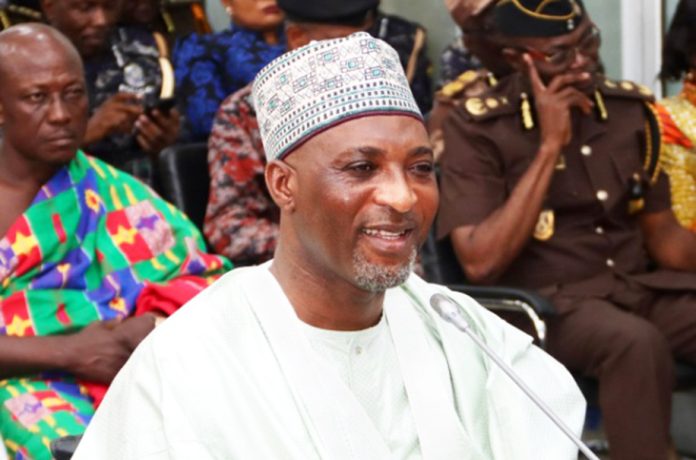
Minister for the Interior, Mubarak Mohammed Muntaka
The Minister for Interior, Mubarak Mohammed Muntaka, has assured the Ghana Immigration Service (GIS) that the government of President John Dramani Mahama is not interested in engaging in baseless allegations or political witch-hunting.
Speaking during his maiden visit to the GIS headquarters, Mr. Muntaka emphasised that investigations would only be conducted when deemed necessary, particularly in matters affecting national security and service morale.
His remarks were in response to concerns raised by GIS Comptroller-General, Kwame Asuah Takyi, who indicated that he had been accused of embezzling funds related to the purchase of service buses.
“We are not interested in a wild goose chase simply because people are making comments or complaints. If you have facts, bring them forward and we will investigate. But I can assure you, we will not engage in witch-hunting,” Mr. Muntaka stated.
Government to Deploy Technology to Prevent Revenue Leakages
The Interior Minister also revealed government’s commitment to enhancing GIS operations through technology. He announced plans to digitize all payment services under the Ministry of Interior within a year, eliminating cash transactions to curb extortion, bribery and revenue leakages.
“In the next year, no service under the Interior Ministry will collect cash payments. Everything will be electronic to ensure transparency and efficiency,” he declared.
Recognising GIS’s critical role in national security and border management, Mr. Muntaka pledged to retool the service and improve working conditions.
He acknowledged challenges such as promotions, transfers and accommodation and assured officers that these concerns would be addressed under President Mahama’s administration.
Additionally, he commended the GIS for its intelligence operations, highlighting its effectiveness in providing daily security briefings.
“As Minister for Interior and now overseeing national security, I will work closely with you to ensure our borders remain safe and our officers are well-equipped to carry out their duties,” he assured.
Commitment to Public-Private Partnerships
Mr. Muntaka further revealed that government would explore Public-Private Partnerships (PPPs) to support the Interior Ministry.
He assured stakeholders that such collaborations would not compromise internal security, but rather enhance service delivery.
“We will look at how we can partner with private entities – both for-profit and non-profit – to improve services, generate revenue and create opportunities for our agencies,” he said.
The Interior Minister concluded his visit by reaffirming the government’s commitment to strengthening GIS operations and ensuring that officers receive the necessary support to execute their mandate effectively.
Comptroller-General Calls for Probe into Bus Purchase Allegations
During the visit, Comptroller-General Kwame Asuah Takyi called for an official investigation into allegations surrounding the procurement of twenty 30-seater buses for GIS officers.
He expressed concerns that some officers had misinterpreted the purchase, leading to public speculation and attempts to tarnish his reputation.
“In order to clear any doubts and uphold the integrity of this office, I respectfully request the constitution of an investigative body to examine the procurement process, while I am still in office,” he appealed.
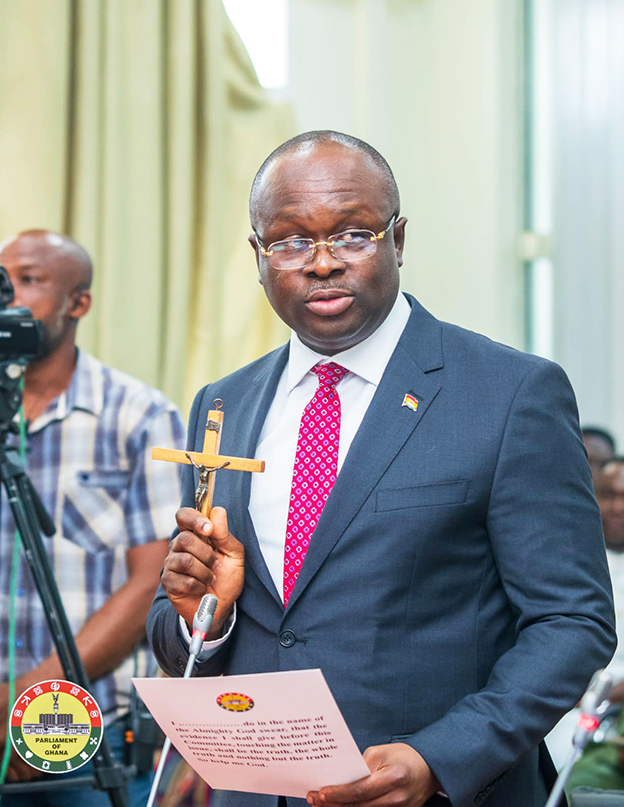
Dr Omane Boamah, Minister for Defence taking the oath
Rickett-Hagan: Thank you very much, Mr. Chairman. I did say I would ask one question, so I’ll stick to that. I know that we’ll have opportunity in the future to have more constructive and progressive discussions on military funding in this country. I know you do well. I wish you well. God bless you. Thank you.
Chairman: Thank you very much. I now proceed to give the floor to the ranking member and the minority leader.
Edward Kofi Omane Boamah, Minister for Defence
Alexander Afenyo-Markin, MP, Effutu: Honourable nominee, thank you for spending time with us for this vetting. Please, let’s go to page three of your CV. Please, can I proceed? Please, you have the leadership positions held, and the last on the list, if you may read it aloud. You may read the last one aloud. Proceed.
Omane Boamah: Yeah. President Cadet Commandery 403 of Knights of St. John International, 1994 to 1996.
Afenyo-Markin: Are you a member of this, the Knights of St. John’s order?
Omane Boamah: I was part of the Cadet Commandery. That is the younger ones, but I didn’t progress to the senior level.
Afenyo-Markin: So, let’s stay there a bit. At that level, was it a fraternity of the Catholic order, the Knights of St. John? Was it a fraternal order?
Omane Boamah: It is an association in the Catholic Church, just like we have the Charismatic Renewal, just like we have Knights of Marshall, just like we have St. Vincent de Paul. Knights of St. John is also an association within the Catholic Church. So, it’s a fraternal order within the Church.
Afenyo-Markin: That’s fair enough. Fair enough. So, in that order, in that society, what were you taught?
Omane Boamah: At the cadet level, we were taught discipline, being time conscious, values of Christianity, fellow feeling, love for one another. And the military drills that we went through, because it’s a paramilitary society that we went through, also helped to shape us. We also had a lot of drama events that we performed at St. George Cathedral. And it also helped us, even a public speaking-wise.
We also went on programmes where people from different commanderies came together. We all met at Asamankese, that time the Accra and the Koforidua dioceses. We all came together as young people and served God, learned a lot, engaged in quizzes, and also played together.
Afenyo-Markin: You would agree with me that membership was not open to everybody.
Omane Boamah: So long as you are a Catholic and you fall within that age bracket, it’s open to you. When you mature, you then can move to the senior level. And it’s something that one day I will progress into.
Afenyo-Markin: Is there a process of initiation to enable you to join at the senior level?
Omane Boamah: At the senior level?
Afenyo-Markin: Yes.
Omane Boamah: I haven’t joined, so I’m unable to tell.
Afenyo-Markin: How would you react to a person who does not know about the value system in the Knight of St. John and denigrate same, how would you react?
Omane Boamah: Knight of St. John, we are taught the values of Christ, Christ-like tolerance. And so, we would take such criticisms in our stride. And if there’s an opportunity to educate them, like this huge platform is giving me the opportunity to share what we were taught, I would definitely share such thoughts with such a person.
Afenyo-Markin: You agree with me that those who do not belong to this society and this order would not know the tenets of this order, correct? You need to belong to know. If you are not a member, you wouldn’t know. You agree with me?
Omane Boamah: Unless you are a medical doctor, you are not likely to know the nitty-gritties of what we do.
Afenyo-Markin: I want to be very short with you. Just like Dafeamekpor, my respected classmate said, just go straight to the point because I know some of you guys are anxious. I would be as short as possible with you if you just stayed to the course. What I’m saying is that those who are not members of this fraternity within the Catholic Church would not know a tenet, correct?
Omane Boamah: They would know some of them, but not all.
Afenyo-Markin: Let me stay there briefly with you. It is not open to everybody, correct? Outside of the church. You must first be a Catholic. And being a Catholic, you must elect to be part of it. It’s not the only society in the Catholic Church. So, if you are not a member of that society, you wouldn’t know its value system and practises. You would agree with me?
Omane Boamah: Because we do membership drive, we share some of these value systems. And I remember even those days in Pope John.
Afenyo-Markin: So, my point is that if you are not a member or if you have not had the benefit of knowing the values of the society, you wouldn’t know.
Omane Boamah: Exactly.
Chairman of the Appointments Committee Bernard Ahiafor and Afenyo-Markin
Afenyo-Markin: That’s the point. Okay. Let me understand you on your employment history. Page 2 of your CV. Let me know when you get there. You there. So, item 2. You didn’t number it, but the point 2. Policy Advisor and Political Strategist to President John Dramani Mahama, 2017-2024. Were you on salary? Were you paid?
Omane Boamah: (answer not heard)
Afenyo-Markin: Very well. As private medical practitioner, Afra International Hospital, 2019-2022, was it on salary?
Omane Boamah: Not on salary, but on, there was compensation, but not on like monthly salary as had been structured.
Afenyo-Markin: So, were you walking in and performing some services and being paid?
Omane Boamah: No. For the periods that I worked, I could work, let’s say, for one month sometimes, two months, and then it would be accumulated and paid.
Afenyo-Markin: How were you paid?
Omane Boamah: I don’t understand your question. How?
Afenyo-Markin: I mean, you said that there was some compensation, not salary per se. You said not salary per se, the monthly salary. That’s what you just said.
Omane Boamah: Yes.
Afenyo-Markin: Right, but you were paid.
Omane Boamah: Yes.
Afenyo-Markin: Were you paid cash on the table, or they paid through your account, direct transfer, or they issued you a check any time the employer needed to pay you?
Omane Boamah: It was paid directly.
Afenyo-Markin: Cash on the table, you mean?
Omane Boamah: Not cash on the table, cash in envelope.
Afenyo-Markin: Okay. So, you would agree with me, you would agree with me, that since you are receiving your salary, your compensation, your pay, in an envelope, cash in an envelope, you would agree with me that you didn’t know whether your employer was paying your tax or not.
Omane Boamah: I wouldn’t know, but I have every, I have no reason to doubt that the employer would not pay.
Afenyo-Markin: Within the period 2019 and 2022, did your employer, Afra International Hospital, furnish you with evidence of payment of taxes on your behalf?
Omane Boamah: No.
Afenyo-Markin: Given the opportunity would you furnish this committee with proof of your taxes been paid for the period 2019 to 2022 where you as Dr Omane Boamah had to receive your salary in an envelope cash on the table, cash on the table in an envelope?
Omane Boamah: Definitely, since it’s the responsibility of the employer, I can contact the employer. And if that is what you need, definitely.
Afenyo-Markin: It’s statutory, it’s not that what I need, with respect. I mean, when we work, we’re supposed to pay, it’s our duty to pay taxes. And you are coming into public service, that’s why you stated it on your CV. That’s why I’m doing this inquisition. So, it’s not that I need, the state needs it. Now, let me move to the next point. If I understand your CV, Page 2, correctly, you are saying that the last time you were gainfully employed was November 2022, correct?
Omane Boamah: Not necessarily. And I take it as, if not well structured, it would be as if I had no income from December 2022. I had. And because I’m directly responsible for that, I even have documents to prove the tax aspect of that.
Afenyo-Markin: No, no, look, Doc I’m taking it step by step. On your CV, point one on your CV, you have told this honourable committee that you worked between 2019 to November 2022. In fact, for the 2019, you did not provide us which month you started working with Afra. Would you be able to provide us with the month you started working?
Omane Boamah: I’ll check it.
Afenyo-Markin: Very well, that’s fair. Now, in this employment, were you given a letter of appointment? Were you given a letter where your conditions of service were spelled out? Were you?
Omane Boamah: I was given a letter of appointment. And let me capture the context very well for you. It was a very teething hospital that I had to provide my service to support them to stand on their feet. And so, even at the initial stage, it was subsequently that the payments commenced.
Frank Annoh-Dompreh, MP for Nsawam-Adoagyiri
But I was okay because it was a service that I was rendering. It helped me also to sharpen my skills, not to go stale as a medical doctor, while still serving my party. So, yes, there was a letter of appointment along the line as a practitioner there. What I cannot recall is the exact details of it, but I believe if I go through.
Afenyo-Markin: So, if you say you received an appointment letter along the line, are you suggesting to this honourable committee that ab initio, you were not issued with an appointment letter, which letter would have to trigger a commencement?
Omane Boamah: Initially, no. But the evidence abounds because a lot of the clinical work that we did were computerised. So, if you want confirmation of my practise, you can find it directly on the digital platforms of the hospital.
Afenyo-Markin: Okay, Doc. So, let’s go back. On the November, you said you ended your employment in November. And I was asking you that from November 2022 up until now, have you been employed by any entity again? Or that your services at Afra International extended beyond November?
Omane Boamah: No, it didn’t. And it was because around that time, I needed to help my party organise a national congress. And then after that also, we had our presidential primaries. And subsequently became Director for Elections and IT.
Afenyo-Markin: Doc, that’s fair enough. So, let me ask you this. So, you will agree to the suggestion that your work as Director of IT was not an employment, correct?
Omane Boamah: I won’t see it as an employment, unless you want to construe it.
Afenyo-Markin: Let me qualify. Did you earn any salary or were you being paid any allowance as a Director of IT?
Omane Boamah: Occasionally.
Afenyo-Markin: Were you paying tax on that allowance?
Omane Boamah: I paid subsequently.
Afenyo-Markin: What do you mean by you paid subsequently?
Omane Boamah: I have addressed all my tax obligations…
Afenyo-Markin: Take it easy, Doc. You know, take it easy. I don’t want us to make it clumsy. I don’t want us to be all over the place. Take it easy. I want us to deal with the issue step by step. You know, you’re going to be our Defence Minister. Just step by step. Employment is employment. And I want to know from you that after the Afra International Hospital, November 2022, it ended. Into the mic. Your response should go into the mic.
Omane Boamah: Yes.
Afenyo-Markin: And you’ve also told us that because of your party activities, you had to now pay attention to flag bearership, elections, and all. So, you were occupied with that work, correct?
Omane Boamah: Correct.
Afenyo-Markin: So, what I want to know from you is that January to December 2023, January to December 2024, were you doing any work of which you were earning salary or that you were being paid allowances?
Omane Boamah: Yes. And I have answered that as Director for Elections and IT, occasionally, we were given allowance. And I have also added that for that period, 2023 and 2024, I have ensured that the requisite taxes have been paid.
Afenyo-Markin: I would, I would, I would, I’m saying that…
Omane Boamah: But I know where you are going, that is why I’m…
Afenyo-MArkin: No, no, no, doc, doc, easy, easy, easy with me.
Omane Boamah: And it’s here.
Afenyo-Markin: Wait. Chairman, you know that I have my, my good friend seated to your right. Please take it easy, let’s pick one at a time. So that we can end this thing quickly. I beg of you. Is that okay? All right. Now, so 2023 and 2024, you are telling this committee that your earnings, the only thing you earn, came from your job as director of IT at your party headquarters, where you were being paid occasional allowance. Is that correct?
Omane Boamah: Yeah. So, so Mr. Chairman, this is where there was a need for me to explain this. I don’t know what you see as earnings, per your definition. But for instance, I have investments, which I earned from, some of which have been affected by the haircut, the financial haircut. You understand? So, I put all these together as my earnings, not just the limited occasional allowance that we had.
And that’s why I said, I know where you are heading. Because if you don’t understand the question, I don’t give you an attempt to answer it. I knew where you were heading. And that’s why I said, for 2023 and 2024, that I had that personal responsibility to pay on what I was earning for those years, I have satisfied my tax obligations.
Chairman: And the committee has the tax clearance certificate before us.
Omane Boamah: Thank you very much, chair.
Afenyo-Markin: Honourable nominee, you’ve provided me with some additional information on your investment, which has suffered from haircut. We’ll deal with that separately. But let me ask you, the allowances that you are receiving, occasional allowances that you are receiving as director of IT from your party headquarters, were these allowances being paid into your account, or it was also in an envelope tabletop?
Omane Boamah: Chairman, it was not paid into my account.
Afenyo-Markin: How did you receive it?
Omane Boamah: I normally will keep it with my directorate, and then as and when I have to spend from it, I authorise.
Afenyo-Markin: So, you are receiving it cash, in other words? Cash. Because these were allowances.
Omane Boamah: Interestingly, I never went to even receive it myself on any occasion, so I will not be able to tell. But what I know is that whenever I wanted an expenditure effected on my behalf, I will instruct, and it will be spent via MoMo.
Afenyo-Markin: Okay, so you were receiving occasional allowances. This allowance that you received, which was an earned allowance, you had earned it, it’s an income. Did you find out from your party, the director of finance of your party, whether these allowances that were paid you, per chance, they deducted taxes from it?
Omane Boamah: No.
Afenyo-Markin: Given the opportunity, would you want to finish us with evidence of taxes being deducted from these allowances from your party headquarters?
Omane Boamah: Yes, if it’s available.
Afenyo-Markin: Now, do you know how much in total, 2023, 2024, you earned by way of allowances that were paid you?
Omane Boamah: I wouldn’t know, I would have to check.
Afenyo-Markin: Okay, so we are dealt with the 2023, 2024. On record, you are saying that though you received some allowances, these allowances, you never picked them directly. You normally left them with the directorate, and as and when you needed some, same was transmitted to you via MoMo, correct?
Omane Boamah: Not to me. Spend.
Afenyo-Markin: To spend, okay. So, these allowances that you earned, you ended up spending them on party activities, correct?
Omane Boamah: Some on party activities, some also on other people who depend on me.
Afenyo-Markin: Alright. Now, so we have dealt with one leg of it. Now, let’s come to the information you volunteered, though it’s not on your CV. Your other assets. You’re saying that you have some investments, and these investments suffered some haircuts, and that you had some earnings. May I know from you, in the year 2023, how much you earned on your investment?
Omane Boamah: Chair, I wouldn’t be able to sit here and know, and I believe the honourable member cannot answer the same for himself.
Afenyo-Markin: I’m not on oath, with respect. I’m not on oath. I’m not on oath Doc. Doc, respectfully.
Omane Boamah: I wouldn’t be able to answer this accurately. Because I’m on oath, I wouldn’t want to give a figure that I would not be able to answer.
Afenyo-Markin: Right, so that is fair. That is fair. I wouldn’t overstretch it. So, given the opportunity, will you be able to furnish this committee with how much you earned in 2023 from your investment? Would you be able to furnish us with it?
Omane Boamah: Yes, I will. It’s Republic Bank.
Afenyo-Markin: 2024. Did you earn some income on your investment?
Omane Boamah: Yes.
Afenyo-Markin: Given the opportunity, would you be able to?
Omane Boamah: Yes. Same Republic Bank.
Afenyo-Markin: Very well. Now, in your tax assessment, did the Ghana Revenue Authority have the opportunity of knowing all that you had earned by way of investment income?
Omane Boamah: Yes.
Afenyo-Markin: Please, since you have your tax returns with you. Now, it’s a one-page document. Do you have it with you, please? You stated there, 2023, turnover 34,858. It is stated there. Turnover 34,858. Chargeable income, 34,858. Is it the case that you provided these figures to GRA or they sifted some from the document you provided?
Omane Boamah: I have a tax person who helps me to do it. So, I provided the information and then this was the assessment that was made.
Afenyo-Markin: Which information specifically?
Omane Boamah: The earnings and everything all put together.
Afenyo-Markin: Through your bank statement, you mean?
Omane Boamah: Through the earnings from the bank, that is 2024, 2023, and also a fair idea of what I had instructed to be spent from the support that the party had given me in terms of allowance.
Afenyo-Markin: So, do I take it that the 2023 assessment is a combination of your investment with Republic Bank and allowances that you earned from the party headquarters, correct?
Omane Boamah: Exactly.
Afenyo-Markin: Same to 2024, correct?
Omane Boamah: Exactly.
Afenyo-Markin: Very well.
Omane Boamah: That’s what I was trying to explain initially.
Afenyo-Markin: Yes, but I have to ask you, then you provide the answer. Is that fair?
Omane Boamah: Yes.
Afenyo-Markin: Very well. Are you able to finish us with the details of this investment as you’ve referred to?
Omane Boamah: Yes, I can.
Afenyo-Markin: Doc, have you had the opportunity to talk to Honourable Dominic Nitiwul?
The Attorney-General (A-G) and Minister for Justice, Dr. Dominic Akuritinga Ayine, has formally discontinued the trial of former Minister of Works and Housing, Alhaji Collins Dauda and three others, in the US$200 million Saglemi Housing Project case.
The notice of discontinuance, known as a nolle prosequi, was filed at the High Court in Accra on Monday, by Hilda Craig, Principal State Attorney (PSA), before Justice Dr. Ernest Owusu-Dapaa, a Court of Appeal judge, with additional High Court responsibilities.
This move is part of a series of case withdrawals the A-G has initiated since assuming office.
Background of the Trial
Before the trial’s discontinuation, the prosecution – under the previous government – had called two Witnesses: Reverend Stephen Yaw Osei, Chief Director of the Ministry of Works and Housing (PW1) and Eric Amankwah, Senior Economics Officer at the Treasury and Debt Management Division of the Ministry of Finance (PW2).
Rev. Osei testified that Architectural & Engineering Services Limited (AESL), the Consultants for the Saglemi Housing Project failed to ensure that Ghana received value for money.
He also stated that before Alhaji Collins Dauda and Dr. Kwaku Agyeman-Mensah were appointed as Ministers for Works and Housing, an amount of US$80 million had already been invested into the project.
Additionally, he noted that Collins Dauda did not issue an interim payment certificate during his tenure.
Mr. Amankwah, who served as the Schedule Officer for the 5,000-unit affordable housing project, explained that the government had secured a US$200 million loan from Credit Suisse International in 2013.
The financing deal was signed by then-Finance Minister Dr. Kwabena Duffuor and Chris Chapman.
Under the project’s Escrow Management Agreement (EMA), the Ministry of Works and Housing was designated as the developer and account holder, with Construtora OAS as the developer and the Bank of Ghana as the account bank.
According to Amankwah, AESL was responsible for verifying milestone reports and certifying payments to the contractor, OAS.
However, AESL allegedly failed to ensure that the necessary deductions – amounting to US$80 million or 40% of the contract sum – were made from advanced mobilisation payments.
The project involved multiple consultants, including AESL, VHM and Ridge Management Solutions (RMS), who were engaged through contracts signed in 2013 and 2015.
Payments to Contractors and Consultants were processed between 2013 and 2017, with the Ministry of Finance responsible for disbursing funds as outlined in the EMA, while the Ministry of Works and Housing handled contract negotiations and technical reviews.
The Charges
Collins Dauda, along with Dr. Kwaku Agyeman-Mensah, Nouvi Tettey Angelo (former Chief Executive Officer and owner of Ridge Management Solutions Ghana Limited) and Ziblim Yakubu (former Chief Director at the Ministry of Works and Housing) faced 70 charges.
These charges include wilfully causing financial loss to the state, issuing false certificates under the Government Contracts (Protection) Act, 1979 (AFRCD 58), dishonestly causing loss to public property under the Public Protection Act, 1977 (SMCD 140) and intentionally misapplying public property.
Andrew Clocanas, then Executive Chairman of Construtora OAS Ghana Limited, was also a accused in the case, but passed away in his Airport apartment.
The discontinuation of the case means all charges against the accused have been dropped, marking a significant turn in the legal proceedings surrounding the controversial housing project.
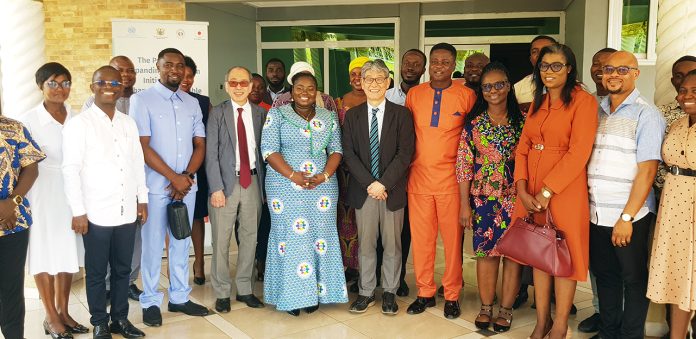
Miss Margaret Ansei, Chief Executive Officer of GEA in a group photograph with participants
Miss Margaret Ansei, Chief Executive Officer of the Ghana Enterprises Agency (GEA), says the agency has positioned itself well, ready for the implementation of the 24-hour economy policy.
She highlighted the potential of the 24-hour economy, saying the agency through its Business Advocacy Centers (BACs) was supporting and empowering, and providing standardized business development services for Micro, Small and Medium Enterprises (MSMEs) to improve production and packaging to meet international standards for export.
“So, the 24-hour economy comes because if you are doing, you will fill your capacity and you will need more numbers. So one job, three people, three shifts and it helps export, promotion, create employment, help the economy to grow and stabilize our currency,” Ms Ansei stated.
She was speaking in an interview with the media on the side-lines of the opening session of a-10 “Kaizen On-the-Job-Training” workshop underway at Dumasua in the Sunyani West Municipality of the Bono Region.
The United Nations Industrial Development Organisation (UNIDO) is organizing the training being attended by managers of the BACs and some MSMEs in line with the GEA partnerships project tilted “Project for Expanding the Kaizen Initiative by Enhancing Sustainable Agribusiness’’
It is being implemented by UNIDO with funding from the Japanese government with the focus of Kaizen in sustainable productivity and quality improvements through elimination of waste and efficient cost management.
Ms Ansei said the project implementation fitted the government’s efforts in boosting production through the 24-hour economy and accelerated export development initiatives, saying MSMEs development formed a key part in the ‘reset agenda’ of President John Dramani Mahama.
“As we seek to promote, modernise and accelerate MSMEs development, the strategy will anchor on leveraging on technology and digitalization as a catalyst in the promotion and development of the MSMEs
“We further seek to provide standardised business development services through a service providers’ certification regime where quality can be guaranteed, which is currently lacking in Ghana’s business ecosystem.
“Mediocrity in service delivery cannot lead us to achieve the vision of the 24-hour economy and we are aligning with development partners and private sector on key MSMEs development priorities through effective engagement and mutual adherence to corporate values.”
The concept of the Kaizen project, Mr Kipo Dari, the National Project Coordinator, UNIDO, explained focused on sustainable operational efficiency with emphasis on productivity and quality enhancement whiles “promoting workers welfare is a perfect fit for any policy prescriptions aim at boosting production capacity.”
UNIDO Kaizen Expansion Project has incorporated a digital solution known as UNIDO Smart Performance Analytics with Real Time Kaizen (U-SPARK) as a tool for sustainable enterprise performance management, he explained.
Mr Dari said he was optimistic that with effective collaboration “we can little by little make significant contributions to the 24-hour policy of President Mahama’s government, your government, our government by leveraging first on the strengths before looking at the opportunities out there”.
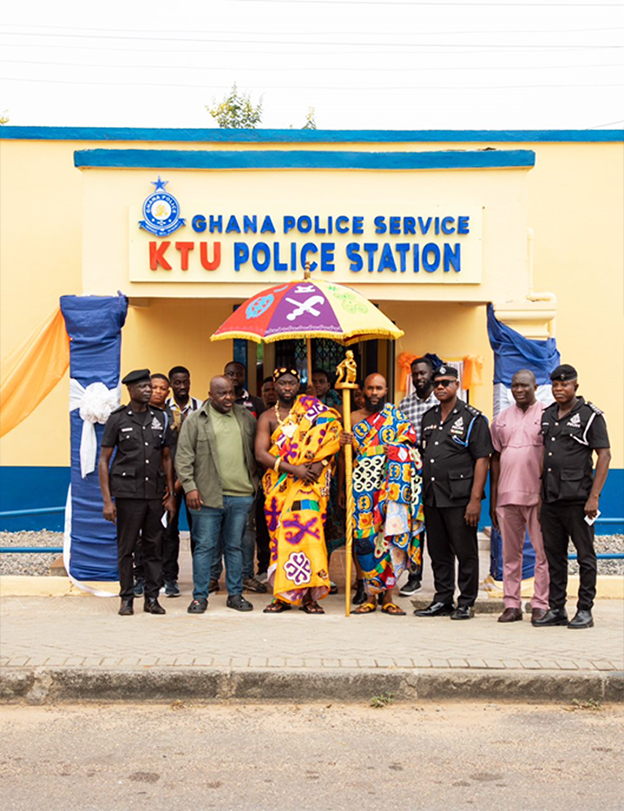
Dr Oseadeeyo Nana Kumi Kodie in front of the new Police Station
Dr. Oseadeeyo Nana Kumi Kodie in collaboration with the Dadaba Group and with the assistance of Michael Okyere Baafi has built and donated a Police Station to the Ghana Police Service.
The newly commissioned Koforidua Technical University (KTU) Police Station, situated in the Adweso District of Koforidua, was inaugurated on February 12, 2025 in a ceremony attended by invited guests and community members.
Dr. Oseadeeyo Nana Kumi Kodie, a visionary leader and philanthropist, has been dedicated to impacting lives through life-changing initiatives in Ghana.
Appreciating the need for security in a nation, he started a process to lay the foundation of the KTU Police Station to enhance law enforcement within the Adweso District and its environs.
It’s his heartfelt belief that safety and security are the very foundation of progress and prosperity.
The commissioning ceremony had the presence of dignitaries such as Deputy IGP COP Christian Tetteh Yohuno, representing the Ghana Police Service, Prof. John Owusu, Vice-Chancellor, Koforidua Technical University, DCOP Emmanuel Twumasi-Ankrah, who joined in celebrating this milestone.
Dr. Kodie emphasised that “the police station should be a symbol of unity in the community and to also help the police in the fight against crime.”
He added that; “This is not just a building, this is a sign of our collective desire to create a better and more secure environment for everybody. I am honoured to contribute to this cause and may this be the beginning of greater things in our district.”
Some of the facilities in the Police Station include state-of-the-art communication systems to enhance response time, comfortable and safe holding facilities for suspects, special offices for officers to go about their duties and human-friendly rooms where they can have a chat with the police.
The Koforidua Technical University, named after the facility, is a symbolic institution that emphasises the close relationship between education and security.
“As the station begins its operations, it stands as a beacon of hope and a reminder that when individuals and organisations come together, they can create lasting change,” Dr. Kodie shared. communities.
Mpraeso St. Paul Roman Catholic Basic Model School will celebrate its 70th anniversary on March 26, 2025 under the theme: “Celebrating the Past, Preparing Future Leaders: The Role of Stakeholders.”
The event will recognise the school’s contributions to education in Kwahu South Municipality and its role in shaping future leaders.
Stakeholders, including alumni, teachers, parents and community leaders will reflect on past achievements and discuss ways to enhance the school’s educational standards.
The headteacher, Mr. Christian Ofosu Ansah, emphasised the importance of collective efforts in preparing the next generation.
The celebration will feature speeches from notable figures and discussions on equipping the school for modern educational demands. Community members and alumni are encouraged to support the event and contribute to the school’s continued growth.
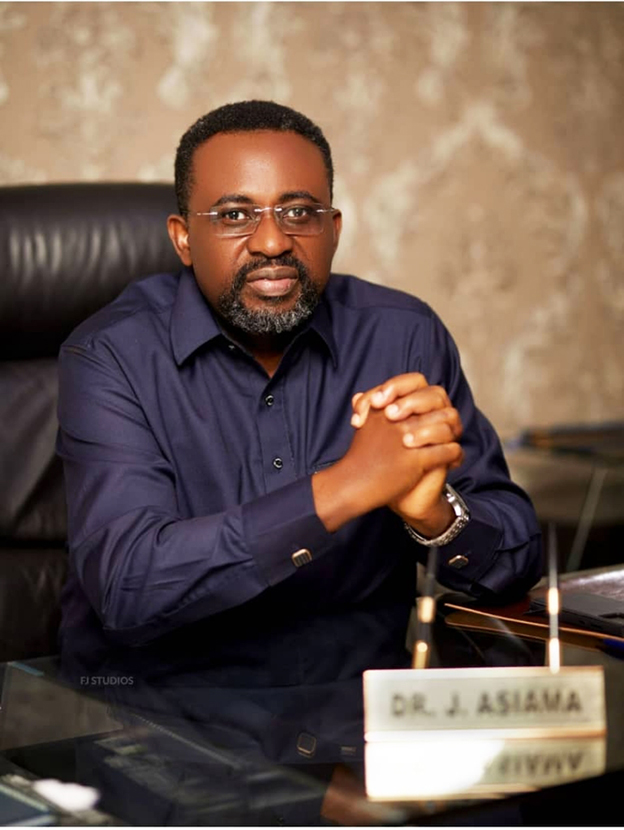
Dr. Johnson Pandit Asiamah, Governor of Bank of Ghana
Dr. Johnson Pandit Asiamah, the newly appointed Governor of the Bank of Ghana, has pledged to embark on Economic Reset to Stabilise Macro-economy, as he assumes office as the Governor of the Bank of Ghana.
Delivering a speech at his swearing-in ceremony to officially takeover as the Governor of the Bank of Ghana, he stated that under the leadership of President Mahama, Ghana is embarking on an economic reset and that the reset is about stabilising the macro economy and addressing key issues such as high inflation, persistent fiscal deficits and excessive debt levels.
According to him, achieving this stability will require monetary and exchange rate policy reforms, fiscal austerity measures and debt restructuring to reduce fiscal risks and create a stable economic environment. He expressed the view that the challenges before us, as a country, require decisive leadership and prudent macro-economic policies to reset the economy.
According to him, the Bank of Ghana is a key institution in the agenda to reset the economy and must remain steadfast in its mission to maintain price stability, ensure a sound financial system and support economic growth. He also reiterated the need to recalibrate our monetary policy strategy and enhance the policy framework to achieve our mandate more efficiently.
He disclosed that under his leadership, BoG policies will be clear, predictable and responsive to emerging threats, and shall adopt a more proactive and precise approach to managing inflation, leveraging on advanced data analytics and artificial intelligence.
He revealed that his outfit shall coordinate policy efforts with other government agencies, for example, to manage food prices and shall be consistent in the policy actions to avoid sending conflicting signals as happened in the recent past and shall work to enhance monetary policy implementation, among others.
He said the BoG shall pursue reforms in the inflation targeting framework to foster more transparency and enhance the effectiveness of monetary policy implementation, discontinue the use of differentiated cash reserve requirements and instead rely on Open Market Operations (OMOs) to manage liquidity conditions.
He indicated that the BoG shall improve their communication regime and ensure regular dialogue with banks on regulatory matters and are confident that current levels of inflation will gradually trend back to target range and within the forecast horizon.
Dr. Asiamah stressed that his second priority is on the need to preserve exchange rate stability and limit excessive volatility in the rates, saying the days of currency speculation and stressed that BoG is poised to ensure exchange rate instability come to an end.
He said the Bank of Ghana under his leadership will engineer a well-functioning and stable foreign exchange market to support economic activity among others, while implementing strategic interventions, including the enactment of a new foreign exchange law to replace the Foreign Exchange Act 2006 (Act 723).
He said the BoG will implement targeted market operations to eliminate leakages of forex and improve our reserves management, deepen their participation in the Pan African Payment and Settlement System (PAPSS), allowing Ghanaian businesses to trade across Africa using local currencies instead of always relying on the US dollar.
He noted that the BoG will implement further reforms in the remittance space and collaborate with Fintech and remittance agencies to harness remittances as a major source of foreignexchange, introduce structured and transparent systems that ensure fair pricing and fair distribution in the forex market.
He said the Bank will leverage their gold reserves and strategic foreign assets more effectively to support the Ghana cedi and reform the Bank of Ghana’s Domestic Gold Purchase Programme to improve efficiency, enhance reserve accumulation and increase transparency in gold transactions.
He expressed optimism that through these measures, a more resilient foreign exchange market that inspires confidence among investors and businesses will be built. He stated that another area of priority is the need to realign their regulatory mandate to promote greater levels of financial intermediation to support economic growth.
The Governor also said banking requires targeted reforms to address legacy challenges to ensure continued resilience. He indicated that under his stewardship, BoG shall enforce strict prudential regulations while fostering an enabling environment for responsible lending and innovation in the banking sector.
He would also tackle the problem of high non-performing loans (NPLs) and weak risk management practices in the industry, by working closely with banks to reduce the high incidence of cyber-security breaches and strengthen capital adequacy requirements, update the Banks and Specialised Deposit.
He also stressed the need to boost financial inclusion and innovation to promote inclusive economic growth, reduce poverty, empower individuals and ensure the stability and competitiveness of the financial system, noting that Ghana is well-poised to become a regional hub for financial technology and digital assets, hence the pursuant of a transformation agenda with appropriate safeguards and policies to ensure financial stability, while fostering innovation in the payment ecosystem.
According to him, they will introduce a digital strategy to adapt to the digital age, improve their operations and better serve the needs of their stakeholders and pledged to continue to support initiatives that expand access to financial services, leveraging fintech and mobile banking solutions to broaden the scope of access, especially in underserved communities, work with banks, start-ups and international partners to build a stronger digital finance ecosystem, one that supports secured transactions, faster cross border payments and financial accessibility for all.
He said the BoG will work towards a clear regulatory framework for digital assets, ensuring that new financial innovations are introduced in a safe and structured manner.He indicated the need to promote greater fiscal and monetary policy coordination while maintaining their operational independence.
“The scientific name for guinea grass plant, which previously was called Urochloa maxima then to Panicum maximum, was, in 2003, changed to Megathyrsusmaximus to reflect the result of a genetic (DNA) analysis, which showed that guinea grass is more closely related to the species within Megathyrsus than to species in the genus, Panicum”, stated by Simon and Jacobs (2003) in their article titled, “Megathyrsus, a new generic name for Panicum subgenus Megathyrsus”.
Take a cursory look at, for example, some intriguing questions which first-year high-school students often ask teachers during agriculture or science lessons: “Sir, is it that pastors are the ones mostly into it that is why it is called pastoral farming? Sir, is Panicum maximum same as Megathyrsusmaximus for guinea grass? Sir, is it that the house of the crops is green that is why it is called greenhouse? Sir, is it true that genetically modified foods are unsafe for human consumption? Sir, how true is it that crops produced from using fertilisers are not wholesome for human consumption?
Sir, can this microscope be used to see microorganisms like viruses and bacteria?” These and other questions are often asked by learners during learning sessions and during conversations with teachers. Getting learners to ask questions during lessons is a laudable thing for all stakeholders, especially the teacher, to support to happen at all times. The teacher uses varied instructional strategies to cause students to be active, challenged to think hard, share views on things being learnt and be able to ask questions of the teacher and of one another for understanding (National Teachers’ Standards for Ghana Guidelines, 2017, page 21).
As parents, individuals and organisations support the state to provide classrooms, laboratories, textbooks and digital tools as well as relevant facilities such as furniture, electricity, bore holes, lavatories and changing rooms, the teacher’s task in facilitating learning and preparing learners for life becomes easy. Learning can be fun, and it is impactful when all variables and conditions needed to have the learning needs and aspirations of learners met are readily available and used properly.
Using generic teaching skills such as resourcefulness, good communication, good eye contact with learners, good interpersonal values, good leadership, and proper time management, the teacher is able to address questions and concerns of learners for improved learning outcomes.
The fact is that no society would want to be static or be seen to be static. Life and the way that things are done in it change or are made to change over time. Sharing useful knowledge gained from research or from experienced persons (who are often referred to as resource persons) with learners is key to enabling a society to develop.
Any society would be proud of citizens that are critical thinkers with good team spirit, communication skills, creativity, digital knowledge and interpersonal values as well as citizens with the ability to identify and to solve problems of life.
Until an education system is able to address some critical gaps in knowledge dissemination, including those of factual inaccuracies, misconceptions and misrepresentations, it would be difficult, if not impossible, for any society to experience the kind of progress it desires. The relevance of the teacher in ensuring that knowledge gaps are identified and fixed is, again, pronounced when Varghese (2023), for example, observed agriculture and biotechnology as fields with some ethical issues relating to sustainable farming practices, genetically modified organisms, and climate change versus food security, and which, most often, attract diverse, conflicting opinions, campaigns and interests.
Where does the teacher fit in this crucial exercise of having to set the records straight for learners to be free from any confusion of which is which? This question of the high-school student, “Sir, is it that pastors are the ones mostly into it that is why it is called pastoral farming?”, therefore, comes to the fore. Can this student be said to have asked a wrong or silly or funny question?
And listen to the response of the student when asked by the teacher what influenced this question: “I know ‘pastoral’ is an adjective of ‘pastor’ and so, I think that ‘pastoral farming’ has to do with a farming system involving pastors and religious leaders.” After the teacher led the class to define the “pastoral farming” as a system of keeping only farm animals mostly on cultivated pastures, the student, again, asked, “Please, sir, if it has to do with producing farm animals mainly on cultivated pastures, would it not be appropriate to call it ‘pastural’ farming rather than using ‘pastoral’?” This is how learning can be interesting.
It is not and should not always be the case that learners take what teachers give to them hook, line and sinker. Students should be encouraged to make concerted efforts through questioning and discussions to better appreciate every detail in lessons. Misconceptions in various fields of study, including agriculture and related fields, can be dissipated by giving hands-on projects to learners and encouraging them to seek knowledge from resource persons/experts and from trusted digital, online sources (Professional Learning Community Handbook on Agriculture, Year One, n.d.a).
The writer is an educationist and a trained counsellor in the Ghana Education Service and also a visiting lecturer of the College for Distance and e-Learning of University of Education, Winneba.
The Ministry of Foreign Affairs, according to a myjoyonline.com report, is urging all Embassies and High Commissions in Ghana to put in place appropriate and humane conditions at their Embassies. According to the ministry, the move forms part of remedial measures to the numerous complaints by the public, on how Ghanaian citizens are treated when they visit Foreign Missions in Ghana for visa applications.
“The complaints cover issues such as not providing conducive waiting areas, non-availability of emergency services, long waiting times for appointment dates, as well as challenges in using visa application,” the website quoted the ministry as saying in a statement.
To address these concerns, the Ministry disclosed that it had dispatched an official communiqué to all Embassies and High Commissions urging them to put in place appropriate and humane conditions at their Embassies, High Commissions and visa centres. The Ministry expects that Foreign Missions will respond positively and appropriately to the request.
First of all, The Chronicles thanks the Foreign Ministry for bringing this important issue to the attention of the Embassies and High Commissions in the country. Indeed, the way some of these foreign missions treat our people is very appalling. When Canadians, Americans, British, French and citizens of other developed countries want to apply for visa to visit Ghana, most of them do not even visit our Embassies.
They only send their passports and other vital documents via courier to the Embassies and the latter also send the approved visa back to them through the same medium. They do not go and queue during odd hours looking for our visa. Regrettably, though these countries are the very ones that preach human rights to us in Africa, they, in most of the cases, practice the opposite.
Look at the way America, under Donald Trump, is deporting illegal migrants – they sometimes chain them to their seats on the plane and fly them (illegal migrants) long hours to their countries. If Ghana or any African country had arrested an American and deported him in such inhumane way, hell would have broken loose. But hey, this is America, the world’s only super power and you dare not challenge them or retaliate.
However, the issue that Ghana’s Foreign Ministry had raised is happening here in Ghana. The question then is – if we are not going to be accorded courtesies in their countries – should we be denied same in our own country? Much as Ghanaians have overwhelmed them with visa applications, does not mean that they should be treated like animals.
There must be proper appointment time and where possible all visa applications should be online. There is no need for human contact as Ghana is doing for their citizens when they want to visit our dear country. This would avoid the current embarrassment where large numbers of visa applicants have to queue in these embassies just to submit their visa applications or collect the visas.
Failure to provide proper washroom and waiting rooms for visa applicants and also forcing them to stand in a queue for long hours would have been a big issue in both United States of America and Europe, if some of these human rights violations had happened there.
The fact that we are black and poor does not mean we are no more part of the human race. It is, therefore, our fervent hope that this letter from our foreign ministry to the Embassies will be accorded the courtesy it deserves. Ghanaians are also human beings, period!