Home Blog Page 799

The Deeper Meaning Of His Suffering

0
Dr. Joyce Rosalind Aryee, Executive Director, Salt and Light Ministries

“Surely He took up our pain and bore our suffering, yet we considered Him punished by God, stricken by Him, and afflicted. But He was pierced for our transgressions, He was crushed for our iniquities; the punishment that brought us peace was on Him, and by His wounds, we are healed. We all, like sheep, have gone astray, each of us has turned to our own way; and the LORD has laid on Him the iniquity of us all.” –  Isaiah 53:4-6 NIV

Introduction

As we step into Good Friday, the reality of the weight of Jesus’ suffering comes sharply into focus. This is not just a historical event; it is a divine moment that changed the course of humanity forever. Over two thousand years ago, Jesus Christ endured a brutal crucifixion—one of the most excruciating forms of execution. But more than the physical agony, He bore the spiritual weight of the world’s sin.

His suffering was not an accident. It was intentional. It was redemptive. And it was for you and me.

WHY DID HE SUFFER? WHAT DOES HIS DEATH MEAN FOR US?

The Cross of Christ is more than a religious symbol. It is the intersection where divine justice, mercy, love, and power meet. Jesus’ death was not just the tragic end of a good man—it was the triumphant climax of God’s eternal plan to redeem a broken world.

Let us reflect on the manifold significance of His suffering:

1. The Cross Reveals God’s Unfailing Love

“But God demonstrates His own love for us in this: While we were still sinners, Christ died for us.”Romans 5:8 NIV

The love that drove Jesus to the cross is beyond human comprehension. He didn’t wait for us to be good enough. He came while we were lost, broken, indifferent—even rebellious. The Cross is God’s ultimate “I love you” to humanity.


2. The Cross Satisfies Divine Justice

God is holy and just. Sin cannot go unpunished. But instead of pouring His judgment on us, He placed it on His Son. “God sent Jesus to take the punishment for our sins and to satisfy God’s anger against us… He did this to demonstrate His righteousness.”Romans 3:25-26 NLT.

Through Jesus, we are no longer condemned. We are declared not guilty—justified—through faith.


3. The Cross Demonstrates God’s Wisdom and Power

To the world, the Cross seems like failure. But in God’s economy, it is the very power that saves. “To those who are being saved, the message of the cross is the power of God… This foolish plan of God is far wiser than the wisest of human plans.”1 Corinthians 1:18, 25 NLT

Where human wisdom ends, God’s wisdom begins. The Cross defies logic, yet it liberates souls.


4. The Cross Declares Victory Over Evil

“He forgave all our sins. He canceled the record of the charges against us… He disarmed the spiritual rulers and authorities.”Colossians 2:13-15 NLT

Satan’s accusations no longer have power over us. On the Cross, Jesus didn’t just die—He won. He crushed every chain that kept humanity bound.


WHAT DID THE CROSS ACHIEVE FOR US?

The impact of Jesus’ suffering goes far beyond forgiveness. It transforms every aspect of our spiritual life.

1.        Forgiveness of Sins

No sin is too great. No past is too dark. Through Christ, we are forgiven—completely and permanently. “God made you alive with Christ. He forgave all our sins.”Colossians 2:13 NLT

2.        Justification and Peace With Go

We are no longer enemies of God. Through Jesus, we have peace, not panic; closeness, not separation. “Since we have been justified through faith, we have peace with God through our Lord Jesus Christ.”Romans 5:1 NIV


3.        Reconciliation and a New Mission

We are not only reconciled to God—we are now agents of reconciliation in a hurting world.  “And God has given us this task of reconciling people to Him.”2 Corinthians 5:18 NLT


4.        A Name Above Every Name

Because of His obedience, Jesus has been exalted above all. His name carries authority over every circumstance. “At the name of Jesus every knee should bow… and every tongue confess that Jesus Christ is Lord.”Philippians 2:10-11 NLT


HOW SHOULD WE THEN RESPOND?

Jesus didn’t go to the Cross so we could carry on with life as usual. His suffering calls for a response—one that touches how we live, think, speak, and serve.

1.        Live in Purity and Truth

“Christ, our Passover Lamb, has been sacrificed for us. So let us celebrate… with sincerity and truth.”1 Corinthians 5:7-8 NLT

Let’s walk in truth—not just believe it. Let’s forsake hypocrisy, bitterness, and sin, and embrace the new life Jesus purchased for us.


2.        Approach God with Confidence

You are no longer an outsider. You can now enter God’s presence freely—not because of your perfection, but because of Christ’s.

“So let us come boldly to the throne of our gracious God. There we will receive His mercy…”Hebrews 4:16 NLT

CONCLUSION

The Cross is the turning point of human history—and of our personal stories. Jesus’ suffering was not a sign of defeat, but the beginning of victory for all who believe. His pain purchased our peace. His wounds won our healing. His death gave us life.

So as we remember His suffering this week, let’s not rush past it. Let it sink deep into your heart. Let it humble you. Let it fill you with gratitude. And let it move you to live for Him who died for you.

Stay blessed!

Please note that the preaching program on Sunny 88.7 FM – Tuesdays at 5:30 am has been temporarily put on hold. However, please continue to join us on Asempa 94.7 FM – Sundays at 5:30 am and YFM 107.9 – Sundays at 6:30 am for our Radio Bible Study, as well as on Sunny 88.7 FM every Sunday at 3:30 pm for Hymns and Their Stories

Hossana

0
Africanus Owusu Ansah (Hot Issues)

There’s no art to find the mind’s construction in the face – Macbeth

Hossana! And we enter the Triduum (three days of Jesus’ Last Supper of Thursday evening; the Friday Vigil and ending on Easter Sunday) marking Christ’s Passion, Death and Resurrection. It is a period of reflection and remembrance of the key events of the Paschal Mystery (Life, death, resurrection of Jesus).

So why not concentrate on Christology (nature and work of Jesus) or the transubstantiation (bread and wine changing into the body of Christ). So given the millions of Churches in the world, Jesus’ presence is felt everywhere? Let us not pretend to be as savvy in religion as Dr. Mensah Otabil who avers that “…about 95% of people who call themselves prophets in Ghana are “quacks, charlatans, crooks, psychists, necromancers. . . “Somebody starts a church has a few cockroaches and lizards… and puts chairs and tables for them.

The quacks have saturated the market…  I say this with the pure love of Jesus Christ. “ OR we don’t have to mimick the Bible – quoting ex-Finance Minister (name withheld), and urge people to read the synoptic gospels, and do penance for our multitudinous sin?

Let us go mundane, and do the quotidian, and ask what is happening between Lawyer Maurice Ampaw and Reverend Pastor Dr. Owusu–Bempah, A “mellowed” Maurice Ampaw will say: “Asofuo By their fruits ye shall know them”. Don’t worry if you can’t readily get the source of this quotation. Just look at the first gospel of the New Testament (Matthew 7:15-20 “Beware of false prophets, which come to you in sheep’s clothing but inwardly they are ravenous wolves.”

Lawyer Maurice Ampaw accuses Dr. Owusu-Bempah and his “boys”, including Kwame Amoh of allegedly flirting with all the girls in their church, eii.? He adds: “If these are the kinds of people Mahama (President) has put his government under, then Ghana is doomed.” One of the “boys” of Dr.  Owusu-Bempah has called Maurice Ampaw FOOLISH (and he spelt the word in capitals).  No, let us pause here; except to hint that Prophet 99 alleges that Maurice Ampaw was living in a kiosk at Sukura, and at birth his head knocked the ground … and other things too dastardly to even write.

On the political scene, you will find that the NPP ship is like a vessel in unsteady hydrodynamics. The turbulence is simply explosive. Owusu-Bempah (NPP), not the pastor but the Deputy National Communications Officer of the NPP, calling

Dr. Bawumia a “bad candidate” who caused the defeat of NPP.  On Oyerepa FM, he stated that the NPP’s decision to pick Bawumia as the candidate for the last election  was a major factor in the disappointing voter turnout among the members: “For the first time, I met a taxi driver who is a member of NPP who told me that he voted for the NDC in the last election; he showed me  his party card, and the reason is that we didn’t take the right candidate for him to come and vote.

Go down there with a hidden camera and ask the ordinary people why they refused to vote. 2.1 million distance from voting because they did not approve of the Presidential candidate…” You will be tempted to ask: What research did Owusu-Bempah do to come to this conclusion?” Perhaps, this shows clearly that his pet candidate, Kennedy Agyapong is still on his mind.

Was it not Owusu-Bempah who would go round the country with Bawumia to campaign for him, in his capacity as Deputy Communications Officer? Have we forgotten that in March 2012 he was charged for publishing false news about the First Lady, Naadu Mills (as a member of Friends of Nana Agyemang Konadu – Rawlings FONKAR)? Bawumia would say with Prince Hal (Henry V to King Henry IV) – “Hide not thy poison with such sugar’d words; lay not thy hands on me; forbear, I say! Their touch affrights me as a serpent’s sting.”

Do we need to remind Ken Agyapong, as a soothsayer told Caesar: “Beware the Ides of March”?

This position is contradictory to Adwoa Safo’s (Dome Kwabanya ex-NPP MP) who exonerates Bawumia and rather blames the NPP for neglecting its own stronghold, particularly concerning road infrastructure as a major factor for the poor performance. Have people forgotten the Solomonic advice of Otumfuo to Nana Akufo-Addo when as President he went to Manhyia to “pay homage”.

As the lovable Otumfuo said in April 2017 Ghanaians voted during the 2016 election, based on how hungry and angry they were with the Mahama-led government that is why he lost the election. If you don’t perform to the expectation of Ghanaians, you will be kicked out … I know your competence: you will deliver … at this point in your life, you don’t need wealth – only fame – and legacy, but be careful with persons surrounding you, they are capable of undermining you… ” What better admonition did anyone need, for God’s sake!

But, if we say Dr. Amoako-Baah of the Political Science and History Department of KNUST is a great NPP icon, people may not understand us. Go to him at the Department; and he will pick a book authored by Dr. J. B. Danquah and lavish praises on him. Such a man, and because of his honesty, he will not have “cash” to distribute, NPP neglected him, disregarded his contribution, ignored his advice.

Other NPP stalwarts who come to mind are Dr. Frimpong- Boateng who insists: “I’m clean …” over the Report on Galamsey submitted to the government, and declined to come out openly on “Galamsey”… and also Dr. Nyaho-Nyaho Tamakloe who on the NPP’s overwhelming loss stated: “The people of this country have chosen clearly that they are sick and tired of this government and that is what brought the results …”

Dr. Amoako-Baah on TV3 stated: “We want to fix the party but those involved in the wrongdoing are the ones in charge. Do you think they will willingly give you a chance to chase them out? No, they won’t. Just leave the party for them and form a new one. The shortest way around this thing is to form a new party … If I was the chairman, I would have thrown him (Akufo-Addo) out of the party.

Because no president should be given any power to do such a thing. Campaign against your own party members… does the party belong to him…? Dr. Amoako-Baah slammed the NPP for “thievery corruption”… increase in money supply… destroyed the economy—President Addo selecting his own MPs, and would not sack Ofori Atta even though over 88 NPP MPs were advocating that cause of action… arrogant Akufo-Addo would not listen…

Dr. Amoako-Baah urges NPP members to leave NPP for the “corrupt people” and join a new party he intends to form, called the “New Patriotic Front”. Yes, we know of the “National Democratic Party” formed from the National Democratic Congress, which, thus maintained “National” and “Democratic”, is that the reason for retaining “New” and “Patriotic”? Well, “Patriotic” sounds good: “patriotic” to Ghana, not an individual, but wouldn’t “National” or “United” be better substitutes for “New”? — Just thinking aloud.

And the question is: what happens to the Prof. Mike Oquaye’s Committee Report? Compare – Maafo’s Report of 2020.

Thinking of wooing all the “defected” NPP members back? How many “mea culpas” will heal the wound?  Alan Kyerematen’s “Afrafranto” on our mind.!

Holy Thursday and The Institution of the Holy Eucharist

0
Feature

Today is Holy Thursday, another significant day for our salvation. That night, almost 2,000 years ago, during the Last Supper, Jesus, offered His Body and Blood to us, to consume, for our salvation. In the Roman Catholic Church, this is the Institution of the Holy Eucharist, the greatest of all the Seven Sacraments.

The literal eating and drinking of Jesus’ Body and Blood in the formof bread and wine, is highly valued in the Catholic and Orthodox churches, however, the Protestants do not accept this, believing it was a one-time event in the partaking of ordinary communal meal.

Protestants generally understand the Holy Eucharist, also known as Holy Communion, as a mere memorial of Christ’s death and resurrection, rather than the sacrifice of the literal body and blood of Christ as in the Catholic and Orthodox traditions. 

While some Protestants, like Anglicans and Lutherans, believe in a real, though not literal, presence of Christ in the elements, most view the bread and wine as symbolic representations.

The Protestants differ with Catholic and Orthodox traditions on 1). The Interpretation of Jesus’ Words, “This is My Body… This is My Blood”: Protestants interpret these words of Jesus symbolically, rather than the literal transformation of the bread and wine into His Body and Blood, something Catholics call transubstantiation and the Orthodox call hypostasis. 2).

Sacrifice vs. Memorial: Protestants view the Eucharist as a memorial meal, a remembrance of Christ’s sacrifice on the Cross. Catholic and Orthodox traditions, however, consider the Eucharist to be both a memorial and a sacrifice, an unbloody re-presentation of Christ’s sacrifice on the cross, and 3). Sola Scriptura and the Bible: Protestants, emphasizing the authority of Scripture (sola scriptura), often cite the lack of explicit biblical support for the literal interpretation of the Eucharist, particularly transubstantiation.

What happened in the Upper Room during the Last Supper is very significant for our salvation. Jesus is the Lamb of God, who takes away the sins of the world (John 1: 29) and He does this by offering His Body and Blood to us to consume.

In John 6: 22-65, Jesus gave a sermon emphasising that it was only through the consumption of His Body and Blood that man can enter into Heaven, ending with these words:“The words I have spoken to you are spirit and life. But there are some of you who do not believe.”As a result of this, many ofHis disciples returned to their former ways of life and no longer accompanied Him. (John 6:66). Does 666 remind us of something?

Placing great emphasis on His discourse, we read: “… I am the Bread of Life; whoever comes to Me will never hunger, and whoever believes in Me will never thirst. (John 6:35); “I am the Bread of Life.” (John 6: 48); “This is the Bread that comes down from Heaven so that one may eat it and not die.”

(John 6:50); “I am the Living Bread that came down from Heaven; whoever eats this Bread will live forever; and the Bread that I will give is My Flesh for the life of the world.” (John 6:51);“…. Amen, amen, I say to you, unless you eat the Flesh of the Son of Man and drink His Blood, you do not have life within you. Whoever eats My Flesh and drinks My Blood has Eternal Life, and I will raise him on the last day. For My Flesh is True Food, and My Blood is True Drink. Whoever eats My Flesh and drinks My Blood remains in Me and I in him.

Just as the Living Father sent me and I have life because of the Father, so also the one who feeds on Me will have life because of Me. This is the Bread that came down from Heaven. Unlike your ancestors who ate and still died, whoever eats this Bread will live forever.” (John 6: 53-58). So, what is not authentic here about the taking of Jesus’ Body and Blood? Jesus Christ was very serious about this very important thing that He was even ready to lose any more of His disciples who would not believe in Him on this matter (John 6: 67).

In the Jewish culture, only women carry pitcher of water and only women go into the upper rooms during a celebration at home; but with the opposite taking place before the Last Supper, (Luke 22:10 & 12) it signified something out of the ordinary was about to happen. God was going to institute the literal consumption of His Body and Blood by man for our salvation, which must be done regularly for the remission of sins, for salvation is a process not an event. And later the next day, God was going to be crucified by man, also for our salvation.

That flesh and blood are essential for redemption of man can be found in the Bible. God allows innocent flesh and blood to be used to cleanse sinful man just as clean water is required to wash dirty things clean.

In the Bible, animal sacrifice was a ritual practice, serving as a symbolic act of atonement for sin and a way to establish a relationship with God. Ultimately, these sacrifices pointed forward to the perfect sacrifice of Jesus Christ, who is described as the ultimate “Lamb of God”.

During the night of the Passover, each Israelite family was told to slaughter a lamb, use its blood to paint the lintel and door posts of their homes and consume the flesh of the lamb with unleavened bread. Blood, flesh and bread! Which they did and they were saved, passing over from slavery to freedom. (Exodus 12: 1-28). Jesus Christ was born in Bethlehem, the House of Bread and was placed in a manger (an animal feeding trough). He came to this world as the Bread of Life, to be consumed by us, so that we can pass over from sin to salvation.

The Passion of Christ is the new Passover, where the Blood of the Lamb is poured out for the reparation of sin and the reconciliation of God and man. Like the Passover which God ordered that it should be celebrated as a remembrance, Jesus also ordered that the Last Supper is to be celebrated as a remembrance or in memory of Him. In both cases the Hebrew word was zāḵārwhich means to celebrate the occasion in its real presence. It means celebrating that occasion as if one was celebrating it when it first occurred. The Greek word closest to meaning of zāḵār is anamnasinwhich is loosely translated into English as remembrance or in memory.

The Protestants on the other hand, believe that everything is just symbolic and everything that was done was done only once. The animal sacrifices were not done once but as often as required. Asman continues to sin, since we are always sinners (1 John 1: 8-10) and God always wants us to come to Him, so, in His Divine Wisdom, He changed the substance of Jesus’ Body and Blood into Bread and Wine in what is called transubstantiation, for us to consume.

How wrong were Protestants to think that transubstantiation is not found in the Bible. The word, of course not, is not there in print, however when Jesus held up the bread and said “This is my Body and the cup and said “This is my Blood,” those two species underwent transubstantiation changing their substance into the Body and Blood of Jesus, even though they tasted bread and wine, to be consume for our salvation.

Its importance was emphasised again by Jesus Christ on the evening of Easter, when He said blessing over bread and broke it and gave it to the two disciples who were on their way to Emmaus (Luke 24: 30).

The early Church placed great importance on the Holy Sacrifice of the Mass and never joked with the breaking of bread, which unfortunately the Protestants believe to be an ordinary meal. How then, can they explain Paul’s letters to the Corinthians? In 1 Corinthians 10:16, St. Paul talked about the importance of breaking bread in relation to the Body and Blood of Jesus and in 1 Corinthians 11: 23-34, the apostle who never walked with Christ, revealed that Christ gave him instructions on the Holy Eucharist to be given to the followers. They were to take Jesus’ Body and Blood with great reverence and warned of dire consequences should anyone partake in this meal, unworthily.

This should be enough to make Protestants believe that partaking in the Body and Blood of Jesus, is an instruction from Him.

When Jesus Christ says to us, “Receive the Holy Spirit,” they accept that, but when He says to us, “Receive my Body and my Blood,” they claim they are not genuine. Are Protestants not walking the path of those disciples who abandoned Jesus in John 6:66?

Protestants’ Communion Service where they use soft drinks instead of alcoholic wine is a mockery of what happened during the Last Supper. Christ used alcoholic wine.

Catholics and the Orthodox consume the Real Body and Blood during Holy Mass, because the Holy Sacrifice of the Mass is not a symbol of Calvary, it is Calvary. “The Holy Mass is a continuation of Calvary” -(Archbishop Fulton Sheen).

And when Christ said “This is….,” He meant, It literally IS. He did not speak in parables.

By Hon. Daniel Dugan

Today’s UEFA Europa & Conference League Fixtures & Preview

0
Ruben Amorim, Manchester United coach

Man United, Lyon lock horns in Europa second leg

A week on from their action-packed 2-2 first-leg draw in France, Manchester United and Lyon lock horns once again in the second leg of their Europa League quarter-final at Old Trafford on Thursday night.

The winners of this contest on aggregate will take on either Rangers or Athletic Bilbao in the semi-finals at the beginning of May.

After being embroiled in a war of words with Nemanja Matic in the build-up to last week’s first leg, Andre Onana did little to hit back at claims of being one of the worst goalkeepers in Man United’s history, as he was at fault for two goals that helped Lyon rescue a last-gasp draw on home soil.

Man United’s fortunes did not improve last weekend as they were condemned to a heavy 4-1 away defeat to Newcastle United in the Premier League following another error-strewn performance – their 14th loss of the league campaign which has confirmed the club will finish with their lowest points total of the PL era.

Languishing in 14th place with only 38 points after 32 games, Man United are in danger of ending the season as low as 17th, while European qualification via the Premier League is an unrealistic target for the Red Devils as they sit 10 points behind the top eight as well as 17 points behind the top five.

Aware that Europa League glory would seal Champions League qualification for next season, it is simply win or bust for Man United on Thursday.

Man United should throw everything at Thursday’s second leg in front of a fired-up Old Trafford crowd and can treat this fixture as a final, considering the sheer enormity and importance of it to their season.

Credit: sportsmole.co.uk


Frankfurt and Tottenham faceoff in return leg

Eintracht Frankfurt and Tottenham Hotspur lock horns again for the return leg of their Europa League quarter-final tie at Deutsche Bank-Park on Thursday night.

The sides are level at 1-1 after the first leg in North London last midweek, but the pressure is much stronger on Spurs boss Ange Postecoglou, who needs success in this competition if he is to save his job.

Son Heung-Min, Tottenham

Frankfurt built on a morale-boosting 3-0 win over Heidenheim at the weekend, serving as the perfect preparation for the visit of Tottenham this midweek.

That marked a third straight home win for Frankfurt at home, and moved them five points clear inside the Bundesliga’s top four, with Champions League football now looking a near-certainty, even if they do not win this competition.

Frankfurt enter the second leg as favourites to advance to a third Europa League semi-final, which could make them just the third team to achieve that feat, after Sevilla and Manchester United.

History does not bode well for Spurs entering this fixture, because they have lost on six of their last seven trips to Germany in the knockout stages of a European competition, failing to score in four of the last five.

Spurs have been dismal on the road both domestically and in Europe of late, and missed the chance to take an advantage into this return leg, so the odds are certainly stacked against them on an evening which could seal Postecoglou’s fate.

Credit: sportsmole.co.uk


Chelsea has huge advantage against Legia Warszawa

Chelsea take a huge advantage into the second leg of their Conference League quarter-final versus Legia Warsaw at Stamford Bridge on Thursday night.

Enzo Maresca‘s side lead 3-0 following their trip to the Polish capital last week, further solidifying their tag as huge favourites to win this competition next month.

Enzo Maresca, Chelsea coach

An utterly dominant display in Warsaw last Thursday means Chelsea are virtually assured of their place in the semi-finals, barring the most extraordinary comeback in UEFA-competition history.

Chelsea are 15 from 15 when it comes to progressing in Europe after winning the first leg away from home, and this will be one of the most comfortable leads they have had in any of those previous ties.

Reaching the semi-finals is unlikely to bring harmony to the fanbase though, with the Chelsea faithful beginning to turn against Maresca and his style of play, especially after the 2-2 draw at home to Ipswich Town on Sunday.

Champions League qualification is slipping through their fingers, and success in the Conference League will only grant them a spot in the Europa League, a potentially huge failure given the money that has been spent at the club over the last few years.

With Legia already down and out, Chelsea’s kids should be given an opportunity to prove themselves in the first team, and that could encourage a positive performance, which may result in another handsome victory for Maresca’s side.

Credit: sportsmole.co.uk


Lazio looking for a big turnaround against Bodø/Glim

Lazio will be looking for a big turnaround when they welcome Norwegian side Bodo/Glimt to the Stadio Olimpico in the second leg of their Europa League quarter-final on Thursday night.

Nicolo Rovella, Lazio

The visitors stand on the brink of history after a 2-0 win in the first leg, as they could become the first club from Norway to reach the semi-finals of a European competition if they are able to dump out the league phase winners.

At a venue where numerous European giants have struggled in recent years up in the Arctic Circle, notably Lazio’s bitter rivals Roma, who lost 6-1 there in 2021, Marco Baroni‘s men were the next victims to suffer defeat at Aspmyra last Thursday.

Ulrik Saltnes‘s second-half brace means Bodo/Glimt take a two-goal advantage to the Italian capital, and that does not bode well for Lazio, because history suggests they will struggle to overturn the deficit.

What is even more concerning is that in Lazio’s history, they have never overturned a two-goal first-leg deficit on the continent, but they are well placed to create history.

Bodo/Glimt’s recent fairytale rise in European competition has been down to their sensational home form, but they are notoriously poor travellers in comparison.

The visitors have never won in Italy, losing on five of their six visits, and the last of those was also at the Olimpico, when Roma thrashed them 4-0 in the Conference League in 2022.

Credit: sportsmole.co.uk

FIXTURES

Europa League

Athletic Club 20:00 Rangers

Eintracht Frankfurt 20:00 Tottenham

Lazio 20:00 Bodø / Glimt

Manchester United 20:00 Lyon

UEFA Conference League

Fiorentina 17:45 Celje

Jagiellonia Białystok 17:45 Real Betis

Chelsea 20:00 Legia Warszawa

Rapid Vienna 20:00 Djurgården 

KMA Boss Vows To Publicly Flog Kumasi Hawkers … if they disobey orders  

0
Richard Ofori-Agyemang Boadi

Even before he settles down to work as the new Chief Executive Officer for the Kumasi Metropolitan Assembly(KMA), Mr. Richard Ofori Agyeman Boadi, aka King Zuba, has given a stern warning to traders and hawkers who are impeding pedestrians and vehicular movements in the Central Business District of the Garden City to stop the practice or face public flogging.

In his maiden encounter with the media, King Zuba, who was the MCE for Obuasi during Mahama’s first term in 2016 stated that he did not want to witness the past experience where police were involved in driving away hawkers and yet nothing was achieved.

According to him, he has his own ‘military-democratic’ style of governance that he would deploy to make Kumasi regain its lost glory.

The Chief Executive Officer of KMA ,Mr. Richard Agyeman Boadi, aka King Zuba, addressing the media

“There is something we are going to do and that is why I need your support. As for me, I don’t like reporting too many things to the police. I don’t want the situation whereby we put in place a police team, we will arrest people and then we go to the police station and then they (hawkers) find their own means and they are back on the street. That will be a waste of time and resources for me. So I have my own democratic military style, which I will be implementing.

“When we say leave this space and you do not leave this place and I get there, and my boys are with me, there and there we will beat you. There….there in the middle of Adum, we will beat you. If I am alone, you will be lucky, but if I am there and my boys are in their Pick-up with me, with their whips, trust me, we will beat you.”

He told the media that if recalcitrant traders and hawkers did not want trouble, they should avoid selling on the pavements of the CBD.

“If you do not want to experience that kind of situation, do what is right and lawful. This is Otumfuo’s city, this is the Garden City of West Africa. We have to preserve its image and I am here to work for Otumfuo. I want to ensure that this city looks like Otumfuo’s city,” he said.

This militarist style of administration, according to King Zuba, would ensure clean environment in Kumasi.  “Please, it is all aimed at making sure that we have a disciplined city.”

Government Declines To Renew Goldfields Mining Lease

0
Emmanuel Armah-Kofi Buah, Minister for Lands and Natural Resources

The Government of Ghana has formally declined to renew the main mining lease for the Damang Gold Mine, operated by Gold Fields Ghana Limited, marking a major policy shift in the country’s approach to managing its mineral resources.

In an official letter addressed to Mr. Joshua Fraser, Chief Executive Officer of Gold Fields Ghana, the government made it clear that the Damang mining lease, which expires on April 18, 2025 will not be extended.

The directive was issued following a meeting on March 25, 2025 and subsequent communication on April 3, 2025.

“The Government of Ghana will not renew the lease after more than two decades of operation,” wrote Emmanuel Armah-Kofi Duah, in a correspondence that reaffirmed the Minerals Commission’s earlier position.

“The decision is in the best interest of the country and its citizens.”

The letter instructed Gold Fields to begin winding down operations immediately, warning that any mining activity beyond April 18, 2025 would be deemed illegal.

The Minerals Commission has been tasked with ensuring government oversight of the Damang site, effective April 19, 2025 under the authority of the Minerals and Mining Licensing Regulation 2013 (LI 2176) and other relevant laws.

Contributing to the issue on Citi FM yesterday, Isaac Andrews Tandoh, Deputy CEO of the Minerals Commission said the move should not be viewed as a setback, but rather as a pivotal moment in Ghana’s stewardship of its mineral wealth.

“For far too long, our nation has watched as immense wealth is drawn from our soil, yet local communities remain underdeveloped and the benefits to the state fall short of what is just and sustainable,” Tandoh said, adding “This moment gives us the chance to reset those dynamics.”

While the Commission did not disclose specific details, it indicated that the mine failed to meet the necessary criteria for the lease to be renewed.

Gold Fields Ghana has not yet issued an official response to the government’s directive. The company has operated the Damang Gold Mine in the Western Region of Ghana since the late 1990s, contributing significantly to national gold output and local employment.

Despite acknowledging the value of its long-standing partnership with Gold Fields, the government emphasized that the decision is part of a broader commitment to secure maximum value from the country’s mineral resources.

Kusaug Chiefs Grateful To IGP For Visiting Bawku

0
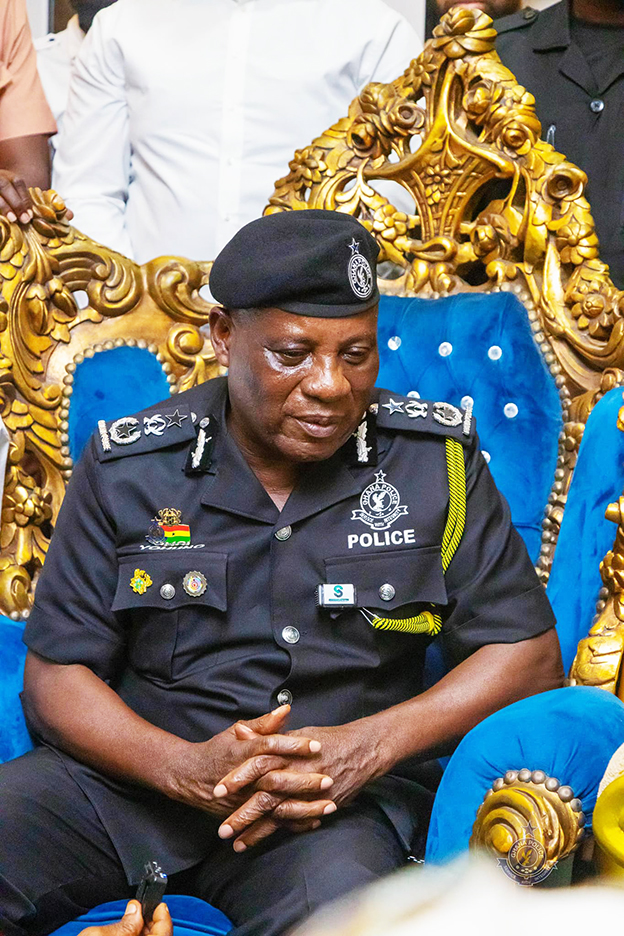
IGP Mr Christian Tetteh Yohuno

The Overlord of the Kusaug Traditional Area, Zug-Raan Naba Asigri Abugrago Azoka II, has commended the Inspector General of Police (IGP), Christian Tetteh Yohuno, for his recent visit to Bawku.

He is, however, pleading with the Chief Constable to instruct the Divisional Police Command to redeploy personnel to the town to restore law and order.

He reaffirmed his unwavering commitment to achieving lasting peace and unity in Bawku and expressed readiness to collaborate with security agencies and other stakeholders to maintain peace and stability.

Bawku has recently been plagued by sporadic violence, resulting in loss of lives and destruction of property.

With the unrest raising broader national security concerns, the Kusaug Traditional Council welcomed the IGP’s recent visit, describing it as a strong indication of the police administration’s commitment to transparency and justice.

In a statement dated April 14, 2025 and signed by the Secretary to the Overlord, David Adoilbs, the Council commended the IGP’s resolve to investigate the latest incident, which claimed one life and left several injured.

The Council noted that this approach aligns with its core values of safeguarding community identity and promoting development through peace.

The statement also emphasied Zug-Raan Azoka II’s long-standing role as a peace advocate in Bawku.

The Council reiterated his consistent appeals for unity and dialogue and urged the youth to remain calm, shun violence, and place trust in the judicial process.

“We believe that dialogue and cooperation are essential in resolving conflict and achieving lasting peace,” the statement read. “Let us work together through peaceful advocacy and meaningful dialogue to ensure justice and accountability.”

Highlighting the need for a collective effort, the Council called on all parties to prioritize peace and unity. It also commended the IGP’s engagement with local leadership, describing it as a step in the right direction.

“By working together and engaging in constructive discussions, we can effectively resolve the conflict and bring lasting stability to Kusaug,” the statement concluded.

Bawku has long experienced periodic ethnic and chieftaincy-related tensions, prompting continuous appeals from traditional leaders and the state for dialogue and restraint.

Togo’s Foreign Minister On A Crusade To Tell Africa’s True History

0
Robert Dussey

An agelong African proverb says, until the lions have their own historians, the history of the hunt will always glorify the hunter. This seems to be the case with African history because, Africans have not written about their past the way it should. As a result, those who colonised the continent, have kept the real history away, and replaced it with what they think of the continent. Against this background, Togo’s foreign minister, Robert Dussey, has embarked on a crusade to tell the true African history.

One such information that Dussey says has for a long time been hidden from Africans, is the fact that, it was the ancient Mali Empire that came up with a codified human rights law in their constitution in the 13th century long before others.

That was more than 500 years before the French’s “Declaration of the Rights and of the Citizen”. Unfortunately, Africa is never credited with the Charter of Manden. Historians say the “Charter of Manden also known as the Charter of Kurukan Fuga, or the Mande Constitution, is a legal and social document that dates back to the 13th century in the Malian Empire, and it outlined the principles for the Malinke clan society, emphasizing social harmony, the sanctity of life, education, food security, and environmental protection.”

Speaking at the “London Conference: 125 Years Later, Pan-Africanism and Dialogue on Reparation,” held at the School of Oriental and African Studies (SOAS) in London on April 9, Dussey said, “it is not true that Africans did not know anything about protecting the rights of their people,” adding that the protection of human rights did not start from France as the history books say.

“For this reason, Africa should start teaching their children the truth about the Charter of Manden that was proclaimed in 1236 on the occasion of the enthronement of Sundiata Keita, which laid down the basic principles of governance of the Mali Empire and consisted of 44 articles which allowed the social life of the empire to be organised in peace,” Dussey said.

He said the Manden Charter is one of the oldest constitutions in the world and was inscribed on UNESCO’s Representative List of Intangible Cultural Heritage of Humanity in 2009, demonstrating its historical and cultural importance of the whole world.

Though the Mali Empire no longer exists, the words of this charter and the rights associated with it, are still passed down from generation to generation in a highly codified form and was replicated in the French Bills of Rights 500 years later.

The conference in London is part of the preparatory meetings that have been held over the past two years to set the stage for the 9th Pan-African Congress to be held in Lome, Togo in
December this year. Dussey said, the Congress will be used to reiterate the legitimate demands of African people for greater justice and equality.

“From Paris in 1919 to Accra in 1958, via Dar es Salaam in 1974 [and to Togo in 2025], each gathering was used to strengthen the determination of African people to demand and end the historical injustices,” adding that, “it should be clear for them that neither time nor contempt will overcome our determination to obtain reparation. Our pain is acute.”

Dussey said, “Togo is committed to working towards reparation and reconciliation with the past and for the advent of a better world. We are deeply convinced that humanity and equality are indivisible and the future of relations between our peoples can only be consolidated by justice.”

On the 125th anniversary  after the first Pan-African Congress in London he said, the visionaries who met at the time,  had “a clear vision to unite the people of Africa, oppose the exacerbated racism, exclusion and oppression suffered by Africans and people of African descent,” adding that, it reminded Blacks of  “the strength of our historical ties, our ability to win great battles when we are united, and the imperative to continue the fight,  despite obstacles and dangers, the struggle of justice and equality for the people of Africa and its diaspora.”

Dussey said “since 1900, a long and arduous road has been travelled, made by challenges, sacrifices, and resilience. Some milestone victories have been achieved, but the decisive victory over the historical injustice remains to be won. Indeed, we cannot be satisfied with the apparent end of slavery and colonisation as the final stage of our struggle.”

He said the London conference was as important as it was 125 years ago, because of the issue of reparation for Black people whether they are from North and South America, the Caribbean, Africa or elsewhere, because ‘it is at the heart of demand of dispossessed, enslaved, deported, and colonised peoples”.

Dussey said, the demand for reparation is not a “violent revolution,” but a dialogue that had to be initiated in a genuine, sincere, and respective manner for the crimes that were committed against the people of Africa.

Akyaaba Addai-Sebo, a Pan-African activist, credited with the recognition of the Black History month in the UK said, “Pan-Africanism is against colonialism, which is nothing else but a serial act of dehumanisation, and for it to succeed, it has to dehumanise every aspect of indigenous life.”

“It starts with, our science and technology is bad. Your language is bad. Your songs and everything is bad,” Addai-Sebo said, adding that, “Pan-Africanism is an act of decolonisation. So, we decolonise to humanise.”

He said, colonisation also started with a doctrine of discovery which mandated the monarchs of Europe to go to Africa and colonise us. Though Africa has its own doctrine of Pan-Africanism, which is the philosophy and ideology of decolonisation and development, it is not taught on the continent.

Barryl Biekman, a commissioner from the Commission on Diaspora Affairs of Africa’s sixth region made up of the Black Diaspora, said despite the end of the system of slavery and states ratifying the UN international convention on the elimination of all forms of discrimination and other European anti-discrimination policies, and measures based on the principle of equality the problem of Afrophobia still persists.

Biekman therefore recommended the declaration of 2026 as a year of remembrance and renewal commemorating the 25th anniversary of the United Nations world conference against racism and the Durban programme of action situating racial justice as the fundamental component of reparatory justice.

Eric Philips, chairman of the Guyana Reparation Committee, said “the real crisis of our time is not memory, but measurement. Not guilt, but accountability. The problem of the 21st century is not colour; it is uncorrected theft.”

Philips said after 125 years, Black people have returned to London, “not as orphans of a stolen continent, but as claimants of an unfulfilled debt. The tools we bring out today were unavailable in 1900, and these are the Durban Declaration of 2001, the UN General Assembly Resolution 77-249, the principles of Just Cogent, and continuing wrongs which makes our claim not only moral, but inalienably legal. “Let us be clear, this generation will not walk away with apologies alone” he said.

Deputy Vice-Chancellor for research and knowledge exchange at SOAS, Laura Hammond, paid tribute to all the Black people that have passed through their walls and championed the cause of the Black race and mentioned, Walter Rodney, whose work was on the slave trade, published in 1970 and was acclaimed for challenging the conventional wisdom on the topic.

Hammond said SOAS engagement with Africa is based on a desire to develop and strengthen equitable partnerships in research, knowledge exchange and teaching, adding that, they recognise “Africa has huge potential in terms of its human resources, its natural resources. It is home to the youngest population in the world, and there is a huge need to support the talent that is coming up, to support education and training of that next generation of political leaders, entrepreneurs, artists and thought leaders.”

She said they are actively developing partnerships with universities across the continent to create opportunities for students from Africa to benefit from jointly designed, jointly taught, and jointly accredited programmes of study. The first of these is with the University of Witwatersrand, which is a PhD in Development Economics, now in its second year. Other programmes are being developed in South Africa, Uganda, Ethiopia, and many other countries.

These programmes give an important opportunity to provide excellent education to students who may not otherwise be able to travel all the way to the UK and may not be able to afford the price tag, which is shamefully high. In research, SOAS is working really closely with universities and think tanks across the continent.

By Francis Kokutse

Man arrested over alleged sale of Ghana’s Diplomatic Mission property in Lagos

0
Handcuff

Bright Mensah Bonsu, the man who received $1.5 million cash and signed documents purporting to sell a prime diplomatic property belonging to Ghana’s High Commission in Nigeria has finally been arrested by Ghanaian security operatives.

Mr. Samuel Okudzeto Ablakwa, Ghana’s Minister of Foreign Affairs made the disclosure in a statement; saying “We got him!”

The Minister noted that the said Bright Mensah Bonsu describes himself as a special aide to former Ghana High Commissioner to Nigeria, the late Alhaji Rashid Bawa.

“It is important to emphasise that the US$1.5million cash was not paid into Government accounts, neither is there any record at the Ministry of Foreign Affairs that the cash was officially declared,” Mr. Ablakwa said.

He said documents reveal that Bright Mensah Bonsu and his collaborators had valued the prime Lagos beachfront diplomatic property at $5.3million and considered the $1.5million payment as the first installment.

The Minister said the outcome of the 2024 elections must have thwarted their plans.

“We are also investigating the circumstances under which Bright Mensah Bonsu was issued a diplomatic passport on October 18, 2023 by the Akufo-Addo/Bawumia government, when from all assessments he could not have been eligible for a diplomatic passport,” he stated.

“Bright Mensah Bonsu was not a staff of the Ministry of Foreign Affairs or the Ghana High Commission in Nigeria even though he was often seen in the company of the High Commissioner.”

He noted that as they await criminal prosecution shortly, it would be interesting to see how Bonsu would back his claims that he acted on the instructions of his superiors, and that those superiors gave him access to documents on the property.

Mr. Ablakwa said this latest significant development should send clear assurances to Nigerian government officials and the Nigerian attempted buyer who had all desperately petitioned the Mahama Government, demanding their intervention, that is consistent with what they had always said, that “we take this matter very seriously and will do everything in our power to bring the notorious criminals to justice and recover the US$1.5million.”

The Minister said the Mahama’s administration would not shield anyone who played a role in this grand conspiracy not only to commit crime, but to dent Ghana’s enviable international image.

He said the Government of Ghana was equally determined not to allow this condemnable incident to mar their great and ancestral bilateral relations with Nigeria.

“We promised that justice will be done, we are keeping our word,” he stated.

“Let me state for the umpteenth time, no diplomatic property belonging to the people of Ghana is for sale – severe consequences await anyone who tests our resolve.”

GNA

24-Hour Economy to provide on-lending support to agribusinesses

0
24-Hour economy

The Government of Ghana is to provide between eight and 12 per cent interest rates loans to small-medium-sized enterprises (SMEs), especially to agribusinesses to expand for export.

The SMEs On-lending facility would be jointly managed by the 24-Hour Economy Secretariat under the Office of the President and the Bank of Ghana, Development Bank of Ghana and some private financial institutions.

The facility part 24-hour Economy Policy electioneering promise by the governing National Democratic Congress (NDC) ii the run-up to the 2024 general elections.

Dr Ishmael Nii Amanor Dodoo, Head of Innovative Finance, Markets and Partnership at the 24-Hour Economy Secretariat, announced the proposed facility during the media launch of the 2025 Horticulture Expo in Accra, on Tuesday.

Dr Dodoo said the unique financing model for agribusinesses and exporters was designed by government to enable those enterprises to deal with forex fluctuations and be competitive on the international market.

For agri-enterprises to access the SMEs On-lending facility, one has to belong to a recognisable association such as the Federation of Association of Ghanaian Exporters (FAGE) to de-risk investment payments to ensure loan recovery and sustainability of the facility.

The facility would also include provision of seed capital, extension services and technical capacity-building opportunities for agribusiness farmers to expand and add value to their products and services.

“This is not politics but a citizen-led initiative to grow agricultural-based businesses to take charge of our economy,” Dr Dodoo stated.

The 24-Hour Economy Policy, he explained, was about ensuring partnership with the private sector to unlock financial investments for agribusinesses, promoting food sufficiency and accelerating job creation opportunities for the Ghanaian youths.

Dr Dodoo said: “So, the 24-hour Economy Policy intends to increase our outputs, add value to our raw materials and ensure robust productivity.

“Ghanaians must take control of the US$77 billion GDP of our economy and that required us to deal with structural deformities in the economy and ensure strategic value chain.

“For instance, we need to take charge of the US$1.2 billion textile industry and ensure supply chain efficiency.”

Mr. Davis Narh Korboe, President of Federation of Association of Ghanaian Exporters, in his welcome remarks, expressed the Association’s determination to exceed five-billion-dollar export of non-traditional exports.

The second edition of the Horticulture Expo will take place at the Accra International Conference Centre (AICC) from June 11 to 13, this year.

The expo is expected to attract over 400 exhibitors and 5,000 participants both locally and internationally, to engage in business-to-business meetings, networking and seminars.

It is to aid Ghanaian exporters to connect to the international markets and forge partnerships for expansion of their businesses.

It would also enable exporters to be competitive on the global markets, adopt innovative approaches in doing business and adding value to their products.

Some of the key commodities that would be promoted and highlighted during the expo include coconut products, mango, pineapples, sweet potatoes, onions and growing of chilies.

GNA


The Ghanaian Chronicle