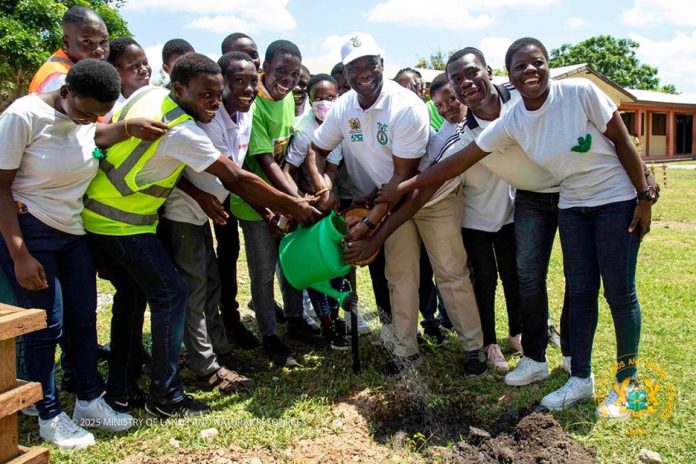
Minister for Lands and Natural Resources, Emmanuel Armah-Kofi Buah and the students watering a tree
Ghana is targeting the planting of 30 million trees by the end of 2025 as part of a nationwide reforestation effort under the government’s ambitious ‘Tree for Life’ initiative.
The move is aimed at restoring degraded landscapes, increasing forest cover and building long-term environmental resilience.
The initiative, officially launched in March, this year, by President John Dramani Mahama in Nkawie, in the Ashanti Region, is a key pillar of the government’s broader strategy to combat climate change and biodiversity loss.
It was brought into renewed focus during a tree-planting exercise on World Environment Day, June 5, at Kwabenya Community Senior High School.
Speaking at the event, President Mahama commended the Minister for Lands and Natural Resources, Emmanuel Armah-Kofi Buah, for his leadership in spearheading the initiative, which he said had the potential to transform Ghana’s environmental outlook.
The event also marked the rollout of the ‘One Child, One Tree’ campaign, a school-based component of the programme.
Minister Armah-Kofi Buah, in an earlier address to Parliament, called on all Ghanaians to rally behind the initiative.
“The ‘Tree for Life’ campaign is running from June 5 to June 30, 2025 and every Ghanaian will have the opportunity to participate.
“I urge Members of Parliament to take active roles in their constituencies to ensure the programme’s success,” he said.
The Ministry of Lands and Natural Resources is working with stakeholders to distribute a variety of free seedlings—including timber, fruit, and ornamental species—suited to local climates. These will be available at the Ministry, selected Regional Coordinating Councils, other ministries, and all District and Regional Forestry Commission offices.
The campaign also includes a new educational model dubbed ‘Child Beyond Academic Skills’, aimed at teaching young people about environmental stewardship, responsibility, and practical life skills such as tree planting and creative arts.
Minister Buah stressed that the success of the reforestation agenda depends on collective national effort. “We cannot afford to treat this as just another government programme. It is a call to action for schools, religious institutions, corporate organisations, and individuals to secure our ecological future,” he said.
With the goal of planting 30 million trees by year’s end, the ‘Tree for Life’ initiative represents one of the most ambitious reforestation campaigns in Ghana’s history, with far-reaching implications for climate mitigation and sustainable development.
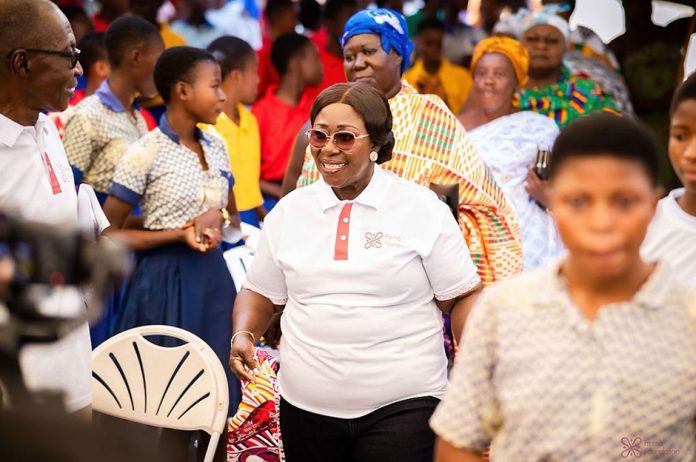
The Frema Foundation has officially launched the first phase of its impactful new initiative, the ‘Dignity in Bloom’ Period Pad Project, aimed at supporting young girls with sustainable menstrual hygiene solutions while promoting dignity, equality, and opportunity.
The two-day launch took place on Thursday and Friday at Wiamoase and Jamasi, located in the Afigya Sekyere East Municipality in the Ashanti Region.
Students displaying some of the sanitary pads
As part of the project, the Foundation donated 1,200 reusable sanitary pads to Junior High School (JHS) girls from ten schools in Wiamoase, as well as to girls at the Ashanti School for the Deaf in Jamasi. All students received free, eco-friendly, reusable period pads, along with assorted drinks, food, chocolate, and other items. The pads, which are environmentally friendly and can last for up to three years, are intended to ensure that no girl misses school due to a lack of access to menstrual products.
At the Ashanti School for the Deaf, additional donations were made to support students with special needs. These included bags of rice, sugar, soap, washing powder, cooking oil, tinned fish, drinks, bottled water, disinfectants, exercise books, pens, and other essential supplies.
Students who were at the launch
“This project is about more than menstrual hygiene. It is about dignity, opportunity, and equality,” a representative of the Frema Foundation stated. “Every pack donated is a promise to a girl that she deserves a future full of possibilities.”
The event also featured menstrual health education and awareness sessions, led by ECO-ME Africa, and included interactive engagements with students, teachers, and community leaders. Attendees also enjoyed a vibrant music and dance session, which created a fun and empowering atmosphere.
The ‘Dignity in Bloom’ initiative marks a strong commitment by the Frema Foundation not only to addressing period poverty, but also to helping young girls realise their full potential through confidence, support, and sustained education.
President John Dramani Mahama has announced the Government’s plan to ban the importation, manufacturing and use of Styrofoam plastic takeaway packs in the country.
The President made the announcement when he formally launched the One Tree Per Child Initiative at the Kwabenya Community Senior High School in Accra, as part of activities marking World Environment Day.
The impending ban of Styrofoam, a non-biodegradable material, is in response to the growing problem of waste accumulation, especially in urban areas, such as Accra.
He said the fight against illegal mining, the wanton destruction of the nation’s forest and pollution was important in order that they could hand over a good environment to their younger brothers and sisters and their children who are yet unborn.
He reiterated that one of the other things they intended to do was to ban Styrofoam as a food packaging material.
“One of the most pernicious polluters is Styrofoam plastic. When you go to buy your food and they put it in that white plastic something, and then you finish eating, you just dump it, that is one of the biggest polluters,” he said.
“And so, we are going to ban the importation of Styrofoam plastics. We have to use paper packaging or aluminium foil for packaging our food.”
The President said he was informing the manufacturers and importers of Styrofoam of their decision, stating that in collaboration with the Ministry of Environment, Science, Technology and Innovation, they were going to ban the importation of Styrofoam and production of Styrofoam in Ghana.
President Mahama said food packaging in the country would be made from paper and from aluminum material.
As the world marks World Environment Day 2025 with the theme “Beat Plastic Pollution,” Ghana, like many coastal countries, is facing a silent emergency that threatens not just its marine ecosystems but the very survival of communities and the planet.
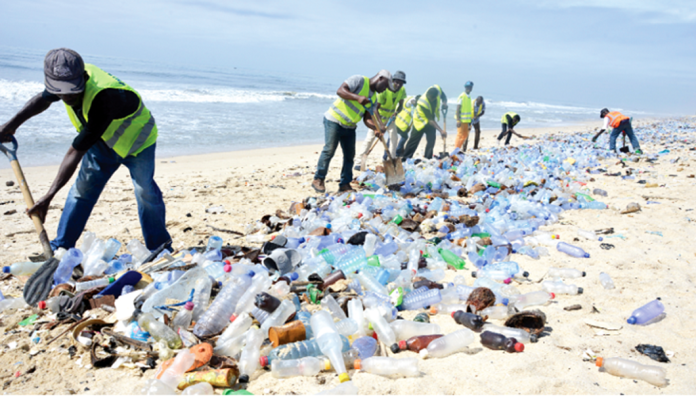
Marine plastic pollution is escalating, turning the ocean from a life source into a potential death trap. This problem is alarming along the coastline of Ghana, where tonnes of plastics are seen floating on the surface of the sea, with most beaches being taken over by marine litter, especially plastics.
The plastics are replacing fish stocks, endangering food security and livelihoods, as indicated in a report from the UN Environment Programme titled “From Pollution to Solution: A Global Assessment of Marine Litter and Plastic Pollution.”
The report reveals that plastic accounts for 85 per cent of all marine litter. It further revealed that by 2040, the figure will triple, churning out 23–37 million metric tonnes of waste into the ocean per year. “This means about 50kg of plastic per metre of coastline,” the report said.
In the eyes of a marine researcher
Mr. Jens Otto Krakstad, Senior Researcher with the Institute of Marine Research in Norway and cruise leader for the research vessel Dr Fridtjof Nansen, in 2024 revealed that plastic is now a constant presence in the marine waters of Ghana and Côte d’Ivoire.
Mr. Krakstad led a team of researchers on the vessel Nansen to carry out marine research in Ghana’s and Côte d’Ivoire’s waters, stressing that, “there is a clear need to do something about the pollution of plastics; we see the plastic is almost everywhere in Ghana and Côte d’Ivoire. We are catching it in almost every tour, and it is certainly a big problem for the whole region, not just for Ghana.”
He said: “When I first came here in 2004, there was already a lot of plastic debris in the catches.
“Over time, this problem has increased significantly,” revealing that the plastic comes from both land and sea – respectively washed into the ocean from poor waste disposal systems and dumped directly by vessels whose crews flout maritime regulations.
Why the ocean matters to human survival
According to the United Nations (UN), the ocean covers over 70 per cent of the planet. It is humans’ life source, supporting humanity’s sustenance and that of every other organism on earth.
The ocean, the UN noted, produces at least 50 per cent of the planet’s oxygen, is home to most of Earth’s biodiversity, and is the main source of protein for more than a billion people around the world. It is also key for economies with an estimated 40 million people being employed by ocean-based industries by 2030.
The ocean also absorbs about 30 per cent of carbon dioxide emissions and regulates the planet’s climate, while its biodiversity supports the food chain and medicine, among other things.
With the ocean acting as a global food source, particularly for coastal populations like Ghana, the health risks cannot be ignored.
Pollution of the ocean by plastics
With all these benefits, when the ocean is polluted, its ability to perform these life-sustaining functions will be compromised. Plastic pollution reduces the productivity of marine ecosystems and threatens species that maintain the delicate balance of ocean life.
The cost of plastic pollution
The concern of plastic pollution in the ocean stretches far beyond marine species and fishermen. Plastics in the ocean pose a direct threat to human health and survival.
According to fish scientists, as plastics break down into microplastics, they are ingested by fish and shellfish and eventually make their way into human food chains. Studies worldwide have already found microplastics in salt, drinking water, and even in human blood and lungs.
Researchers have found the toxic chemicals used in plastic manufacturing, such as BPA, phthalates, and flame retardants, being linked to cancer, hormonal imbalances, and reproductive disorders, among others.
According to Seas At Risk, an association of environmental organisations from across Europe, “Degrading macro plastics release greenhouse gases, thus contributing to climate change in complex ways.
“Sea surface plastic degradation alone has been estimated to release 76 metric tonnes of methane annually worldwide. Methane is 36 times more potent than CO₂ in producing greenhouse effects, and it directly contributes to climate change.”
It added that “microplastic pollution directly hinders the ocean’s climate mitigation power by interfering with the flow of carbon in the ocean. That “biological carbon pump” sees microscopic plants (phytoplankton) and animals (zooplankton) capture carbon on the ocean surface and transport it into the deep ocean, preventing it from re-entering the atmosphere. Laboratory experiments suggest that phytoplankton contaminated with microplastics are less able to fix carbon through photosynthesis. Similarly, contaminated zooplankton have lower metabolic rates, reproductive success, and survival rates.”
In Ghana, where thousands depend on fishing for income and nutrition, plastic pollution is also a socioeconomic issue. Fisherfolk now spend more time disentangling plastic waste from nets than harvesting fish. Some even incur costs to repair gear damaged by debris, deepening poverty in vulnerable coastal communities.
As the world is celebrating World Environment Day, and World Oceans Day approaches (celebrated annually on June 08), plastic pollution must be tackled with a concerted effort from all stakeholders. Indeed, this is also in line with the “Wonder: Sustaining What Sustains Us” theme for World Oceans Day 2025.
The ocean sustains us. Protecting it is not just an environmental duty; it is a fight for our survival.
The way forward
To collectively achieve this aim, there is a need to enforce maritime regulations against illegal dumping of waste into the ocean, both from land and from vessel crews at sea.
We must also stop paying lip service to waste management and invest in waste collection and recycling infrastructure. National campaigns to reduce single-use plastics must also be intensified while encouraging sustainable ocean use through education and policies.
Allowing the ocean and our seas to suffocate under the weight of plastics means there will be no food security, no clean air to breathe, and no future for humanity, as there is no climate stability without healthy oceans.
General Kutu Acheampong, one of Ghana’s rulers, was reputed to have declared that “Ghana will not concede an inch of her territory to anyone.” I guess the General was, at that time, thinking about British Togoland, fearing that Ghana might lose her.
I think this declaration was followed almost immediately by the introduction of the repressive Supreme Military Council Decree of 1976(SMCD20). But, frankly speaking, no country seems to be claiming the territories of Ghana; not even Ghana’s neighbours, Cote d’Ivoire, Burkina Faso or Togo.
Ghana’s (former Gold Coast) territories have always been safe and intact. It was, however, unfortunate that Ghana was, more or less, “coerced” by Britain to illegally annex or occupy the former UN Trust Territory of British Togoland (British Togoland) without any credible constitutional and democratic process.
“Coerced” because the Gold Coast did not take part in the May 1956 Plebiscite to determine the union issue. Nor was it ever officially or formally consulted on the Ghana-Togoland Union issue. Because of that, to date, no one can tell what the views of the Gold Coast on the Union are.
It is interesting and ironical that the General would not concede an inch of Ghana’s territory while at the same time Ghana had illegally occupied the whole of British Togoland, and not only an inch! Why illegal? What, for instance, is there to show or what legal instrument(s) or constitution is there to prove that British Togoland is in ‘union’ with Ghana? Absolutely none!
The Attorney General of Ghana (2008) summed it up thus “I am not sure there was a Union Document.” But political unions are expected or supposed to be supported by written Documents, Agreements or Deeds. In fact, the nearest written document to a union is UN Resolution 1044(XI) that approved the Ghana-British Togoland Union, not integration, between Ghana and British Togoland.
Unfortunately, this indispensable foundation Resolution has never been part of Ghana’s Constitutions. The Constitution Review Committee (CRC) should correct this anomaly by amending the Constitution to find a dignified and honorable place for UN Resolution 1044(XI). Perhaps, the 1957 Ghana Independence Act could be cited. But it is a known fact that that document was/is wrong, inappropriate and irrelevant to the Ghana-British Togoland Union.
There is nowhere in that Act where a mention or reference is made to the Ghana-Togoland Union. Check. Ghana was made by Britain to occupy British Togoland under the 1957 Ghana Independence Act which Dr. Nkrumah and the CPP described as an “imposition.” The fact is that the people of Togoland, on 9th May 1956, voted to join their territory in a UNION, not integration, with Independent Gold Coast (Ghana), not the Gold Coast.
This historic decision was supported by UN Trusteeship Council Resolution 1496(VIII) and approved by UNGA’s Resolution 1044(XI). The 9th May 1956 vote of British Togoland was never meant to be end in itself. It should have been consummated or concretized by a constitution, but that did not happen.
A Union should have been established, but surprisingly Britain imposed integration on British Togoland under the inappropriate and wrong 1957 Ghana Independence Act. The decision for a Union was clear and straight forward and should have been accepted, recognized and implemented without any quarrel or doubt, but for the insincerity and double standards of Britain, the Administering Authority, of Togoland.
It must be noted that Union is not the same as integration. It makes all the difference in political life as to which of the two, union or integration, is adopted. The distinction between the two is too obvious to be mixed up, taken for granted or exchanged. The integration imposed on Togoland by Britain was wrong, unfair and unjust, in fact, immoral. It must be rectified or corrected and replaced by a Union, which the people of Togoland voted for, supported by UN Trusteeship Council Resolution 1496(VIII) and approved by UN Resolution 1044(XI).
Inexplicably and sadly, instead of changing the illegal integration into legitimate union, successive governments of Ghana have been in denial. They have unfortunately introduced obnoxious and repressive laws like Preventive Detention Act (PDA) and Supreme Military Council Decree (SMCD20) to intimidate the people and support and sustain the integration.
General Kutu Acheampong should not be worried that the territories of Ghana are being contested or claimed by Ghana’s neighbours; because they are not. What he and other rulers of Ghana should worry about is Ghana’s illegal occupation of the UN Trust Territory of Togoland (British Togoland).
CRC should help to correct this anomaly. Where there is an understanding and goodwill, this illegal occupation could easily be corrected through diplomacy, negotiation and dialogue. It is the task of the Constitution Review Committee (CRC) to bring about this understanding and goodwill and, in fact, effect the necessary changes in the Constitution.
No, no and no, British Togoland is not asking or fighting for separation or secession from Ghana as it is being peddled by her detractors and enemies! Note that she voted for Union! Her main aim in the struggle is to ensure that she gets what she voted for on 9th May 1956, that is, Union with independent Gold Coast (Ghana).
Further to this, British Togoland also wants to ensure that the Ghana-British Togoland Union, as prescribed by UN Resolution 1044(XI) and supported by UN Trusteeship Resolution 1496(VIII), is properly and legally established and a Union Document enacted for it.
It is being suggested here that the CRC should take this Ghana-British Togoland Union case more seriously, especially, as the UN Office of Legal Affairs(2008) claims there is no record of the Ghana-Togoland Union Document in their database; the Attorney-General of Ghana(2008) admits that he is not sure if there is a Union Document; His Lordship the Chief Justice(2020) claims the Union issue is not a judicial question; the Constitution Review Commission(2010/11) advised government to provide another avenue to offer political solution to the problem and the British Government has stated that the matter is under the sovereignty of Ghana.
A passionate appeal is, hereby, made to the conscience of Constitution Review Committee (CRC) to find ways to include or accommodate UN Resolution 1044(XI) in the Constitution(s) of Ghana in order to provide written evidence that there is, at least, a ‘union’ between Ghana and British Togoland. That is what Conventional Wisdom is saying. At any rate, “Conscience is” said ”to be an open wound, only truth can heal it.”
The views expressed in this article are the author’s own and do not necessarily reflect The Chronicle’s stance.
Ghana’s cocoa producer price, according to myjoyonline.com report, is expected to see a significant upward adjustment in dollar terms, ahead of the next crop season. The anticipated increase comes as part of efforts to align local prices with gains in the global cocoa market, which has seen record-high prices in recent months.
According to the report, the Ghana Cocoa Board (COCOBOD) has, however, raised concerns about the sharp appreciation of the Ghanaian cedi, saying it may affect the real earnings of farmers, despite the dollar hike.
The website quoted the Chief Executive Officer of COCOBOD, Dr Randy Abbey, as having acknowledged that while the price per ton is set to rise substantially in dollar terms, the relative strength of the cedi could dampen the expected benefits for cocoa farmers when converted to local currency.
“The truth is that we are convinced and it is going to happen. On the dollar side, we will see in its impact. Based on the strength of the cedi, in cedi terms, you may not see anything significant. What we are seeing now is a situation where global prices are high and that would normally translate into higher incomes for our farmers. But with the cedi appreciating sharply, the gains could be reduced when translated into Ghana cedi,” Dr Abbey explained.
Though no official producer price of cocoa has been announced, The Chronicle commends COCOBOD for conceiving the idea of increasing the price of the commodity in the local market. In recent years, production of cocoa has been going down in Ghana, which used to be the leading producer of the commodity in the world.
The situation has been exacerbated by the constant smuggling of the produce to neighbouring countries – Ivory Coast and Togo. About three years ago, the former Chief Executive of the COCOBOD, Joseph Boahen Aidoo, complained bitterly that almost all the cocoa produced in the Volta Region had been smuggled to Togo. But after the security agencies had turned their attention to the region, the smugglers devised a new strategy to bring the produce from other parts of the country and smuggle them through the same region to Togo.
Intelligence we have picked up indicate that cocoa produced in Eastern Region and other parts of the country are being smuggled through the Volta Lake, via the Volta Region to Togo. This smuggling business is obviously being motivated by differences in prices of the commodity in Ghana, Togo and Ivory Coast.
Though the National Investigation Bureau (NIB) has intensified its operations in the Volta Region to stop the smuggling, the best method, in our opinion, is the adjustment of the price to be above or at par with what pertains in the neighbouring countries.
This is why The Chronicle is happy that COCOBOD is going to adjust the producer price, but what Dr Randy Abbey failed to disclose to Ghanaians was whether what Ghana is going to offer her farmers will be higher than what both Togo and Ivory Coast are currently paying to their farmers. Since we are all selling the cocoa beans at the same world market, Ivory Coast and Togo shouldn’t be paying higher than what we offer our gallant farmers.
Unfortunate, this has been the problem, resulting in the continuous smuggling of the produce to these neighbouring countries. We believe Dr Randy Abbey and his team are aware of this and will do everything possible to ensure that the yet to be announced producer price in Ghana will be slightly higher than what both Togo and Ivory Coast are paying their farmers.
With regards to the fear that the producer price that is going to be announced may not be enough to the Ghanaian cocoa farmer due to the appreciation of the Cedi against the US Dollar, The Chronicle does not see why COCOBOD should panic over this development. It is instructive to note that the cedi is not only appreciating against the US dollar, but all the world major currencies including the CFA as well.
This means if the right producer price is announced, there will not be any motivation to smuggle the produce to the Francophone countries because the CFA equivalent these smugglers will get will obviously be whittled down when it is changed into Ghana Cedis.
The appreciation of the cedi is good news that every fair minded Ghanaian should be happy with and not the other way round. We insist that the right producer price and stable Cedi will be enough to demotivate the smugglers and also make the farmers very happy here in Ghana.
The Kings Assemblies of God Church at Offinso in the Ashanti region has held an installation and Ordination ceremony in honour of Rev. and Mrs. Collins Kusi Ababio for their dedication for the work of God.
Rev. Samuel Nana Kessie, Ashanti Regional Secretary of the Assemblies of God Church, during the ceremony lauded Rev. Kusi Ababio for his commitment and dedication.
According to him, the memories that Rev. Kusi Ababio is creating on people is so important for him to continue to have tolerance.
Rev. Nana Kessie appealed to members of the church to be submissive and support Rev. Kusi Ababio to lift high the image of the Church.
Rev. Kusi Ababio thanked all the members of the Church for the honour done him and his spouse.
He also thanked his parents for the good upbringing and training in his enfant days culminating in his present position in society.
Rev. Kusi Ababio presented citations to some individuals who had supported him in his pastoral duties.
King Zuba poses with the leadership of Ahmadiyya Muslim Mission
The Chief Executive Officer of Kumasi Metropolitan Assembly (KMA), Richard Ofori Agyemang-Boadi, popularly known as King Zuba, last Friday joined the Ahmadiyya Muslim Mission to celebrate this year’s Eid Ul-Adha at T.I. Ahmadiyya Senior High School premises.
Addressing the gathering, the Mayor noted that Eid Ul-Adha, also known as the Festival of Sacrifice, was about “dedication, commitment and love” and therefore, a special day for all believers for which President John Dramani Mahama has taken steps to facilitate the practice of their “beliefs” with convenience and ease.
A section of Muslims at the gathering
He said as a result of the Presidential intervention, the Hajj package fee had been adjusted to less than GHC70,000 to help relieve pilgrims of some financial burdens and that an ultra-modern Hajj Village is being constructed to address the “accommodation problem” amongst other challenges, as well as the establishment of the Hajj Task Force to implement the policies of the Hajj Board.
King Zuba further disclosed the vision of the President to train Muslims, especially females, to become doctors and nurses to cater for female Muslim patients, to help uphold the laws of Islam.
The Mayor further disclosed that the President had taken measures to ensure that all Islamic hospitals and schools in the country are provided with equipment and/or resources required to ensure their effective operations.
As a result, a request by the Islamic Senior High School, at Bantama, for the construction of an Assembly Hall has been granted by the President, who has looked at all documents to that effect.
Richard Ofori Agyemang-Boadi advised that the Eid Ul-Adha should not just be a celebration, but to ensure that its core values – commitment, dedication and love – reflect in the lives of Muslims to facilitate the developmental growth of the nation.
Nicholas Osei-Wusu – Regional GJA Vice chair Hopeful
The impending Ashanti Regional Ghana Journalists Association elections will be keenly contested by all standards.
Five contestants had filed their nominations by the close of Friday, May 27, 2025 to vie for the four available positions – Chairman, Vice Chair, Secretary and Treasurer.
Environmental journalist and News Editor with the Multimedia Group, Kofi Adu Domfeh and Georgina Ama Ankumah of the Ghana Broadcasting Corporation, and the incumbent Regional Secretary, will be locking horns for the chairmanship slot.
The Vice chairman position looks like the preserve of Nicholas Osei-Owusu, the Regional Correspondent and an Editor in-Chief of the Ghana Broadcasting Corporation.
Ms. Beatrice Spio-Garbrah, a staff of Media General, is aspiring to be the Regional Secretary of the Ashanti GJA in the upcoming 2025 GJA elections, while Dr. Neta Kris Abiana Parsram goes for the position of the Regional Treasurer.
The forerunners in the upcoming election are Kofi Adu Domfeh and Beatrice Spio-Garbrah, who have pledged to transform the Ashanti GJA.
Mr. Domfeh, with over two decades of experience in the media landscape is widely respected for his dedication to socially responsive journalism, capacity building and thought leadership in media.
His decision to run as Chairperson of Ashanti GJA is premised on his deep-seated conviction that journalism must be a catalyst for community transformation.
“I believe in journalism that is ethical, transformative and anchored in truth,” Mr. Domfeh remarked, adding that his bid is not only to uplift the standards of the profession in the region, but to position Ashanti GJA as a beacon of integrity, innovation and inclusiveness.
Kofi Adu Domfeh – Ashanti GJA chair hopeful
Kofi Adu Domfeh says his leadership is based on empathy, accountability and results-driven advocacy, will focus on four strategic pillars namely: Professional Development through prioritising continuous learning and skills upgrading for members; Journalist Welfare through advocacy for improved safety and mental health support; Institutional Innovation to enhance organisational responsiveness and Unity and Inclusion to foster collaboration across media sectors and platforms towards excellence, relevance and collective progress
Affable Beatrice Spio-Garbrah, on the other hand, intends to resuscitate the Ashanti GJA by helping to disseminate information timeously to members of the Association.
Ms Spio-Garbrah, as a beacon of journalistic excellence within the media landscape of Ghana has earned numerous awards and aims at ensuring that the welfare, freedom and rights of journalists in the region are highly protected.
Before joining Media General, Beatrice had worked with Kapital Radio and was the Ashanti Regional Correspondent for Metro TV.
She is a product of Christian Service University (CSU) in Kumasi, mastered in Communication Studies, majoring in the practice of science reporting.
She is currently the Host of the Akoma FM’s Flagship Afternoon Social Program – Akoma Mu Ns3m – which delves into relationship, health, land and legal issues among others, sticking to high standards of professionalism.
Her years of professionalism and high journalistic standards earned her selection by the US Embassy in Ghana to participate in the prestigious IVLP three weeks Exchange Programme in the United States of America in September 2024.
Editor-in-Chief Nicholas Osei-Owusu of the GBC promises to complement the team to help a capable leadership champion progress and total transformation.
The Federal Government has declared Thursday, 12th June, 2025, as Public Holiday to commemorate this year’s democracy day celebration.
The Honourable Minister of Interior, Olubunmi Tunji-Ojo, who made the declaration on behalf of the Federal Government, congratulated Nigerians on this occasion of 26 years of an uninterrupted civil rule.
This was contained in a statement signed by the Permanent Secretary of the Interior Ministry, Magdalene Ajani, and released on Sunday.
“June 12 represents our historic journey to building a nation where truth and justice reign and peace is sustained and our future assured,” the statement quoted the minister as saying.
“The last 26 years tells the story of our resilience, strength and courage and a hope Renewed than ever.”
Noting that Democracy is sustained with open doors for further improvement, the Honourable Minister reiterated the commitment of the Renewed Hope government of President Bola Ahmed Tinubu (GCFR) to the universal value of democracy that is based on freely-expressed will of the people in determining Nigeria’s political, economic, social and cultural systems.