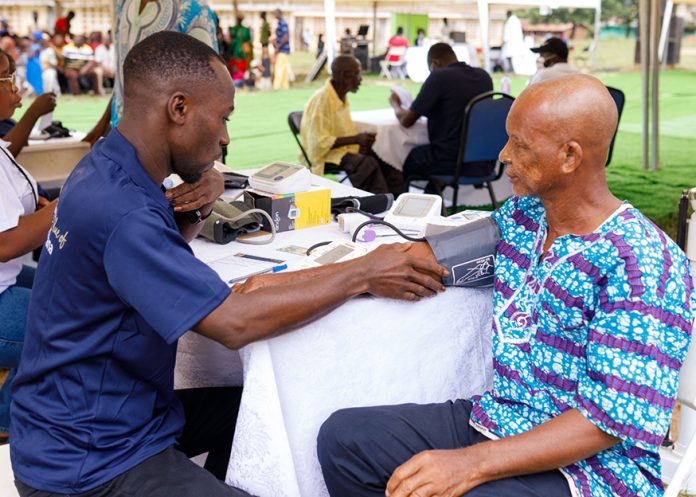
A beneficiary having his vitals taken at the outreach programe
The third quarter edition of Gold Fields Ghana Foundation (GFGF) medical outreach programme took place last Saturday at Koduakrom, one of the host communities of the mining giant. A total of 732 individuals made up of the young and the old were screened at the programme.
Termed Community Medical Outreach Programme (CMOP), the quarterly initiative is aimed at providing medical care and health education to the residents, promote health awareness among others.
As part of the exercise, an education session that focused on hepatitis B awareness creation was held to mark world hepatitis day.
The medical outreach provided a comprehensive suite of medical services, including blood sugar and blood pressure checks, eye examinations, body mass index (BMI) assessment, breast cancer screening, dental care, ENT (Ear, Nose and Throat) assessments, malaria screening, among other conditions.
A range of free medications were made available, based on individual screening outcomes.
About 60% of the health practitioners who carried out the exercise were current and former beneficiaries of the Foundation’s scholarship programme reflecting the Foundation’s ongoing investment in local capacity building.
In partnership with Unilever Ghana, the Foundation shared dental toothpaste with all attendees of the programme.
The Foundation also partnered with the National Health Insurance Scheme (NHIS) to register and renew 708 community members’ insurance cards ensuring participants could access long-term healthcare.
The event reaffirmed the Foundation’s enduring commitment to sustainable community development and public health advancement.
Ayishatu Muhammed Aubyn (Mrs), Project Coordinator announced that, to date, the Gold Fields Ghana Foundation had invested over US$4.9 million in health and wellness initiatives, reaffirming its long-term commitment to enhancing the quality of life in its host communities.
Dr. Antoinet Attah Hasord, Snr. Medical Officer at Gold Fields Mine hospital, admonished beneficiaries to check their Hepatitis status in other to know whether they have the disease or not.
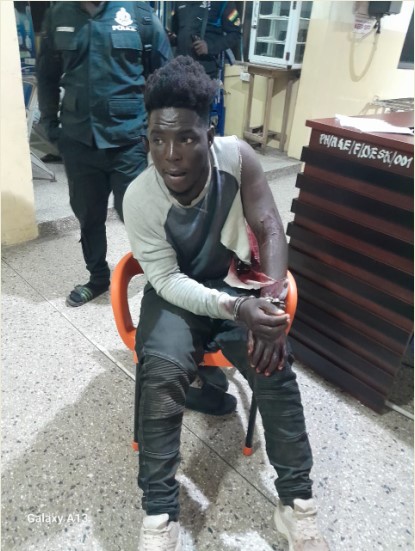
A 23-year-old man, Francis Debrah, was arrested in the early hours of Monday following a robbery incident near the Klagon-Ashaiman underbridge by the Community 18 District Police of the Baatsonaa Division.
According to a police source, the arrest occurred at approximately 4:00 a.m. after a patrol team, with the assistance of the complainant, Reuben Ayiku, apprehended the suspect.
Debrah, who sustained a gunshot wound to his left arm during the arrest, was found in possession of a long sharp knife and two Royal motorbikes believed to have been used in the robbery.
The incident began around 3:20 a.m. when the patrol team observed Ayiku being attacked by four armed men on two motorbikes.
The assailants forcibly took his mobile phone and wallet, which reportedly contained an unspecified amount of money, before fleeing the scene.
The patrol team immediately pursued the robbers and intercepted them at a location known as Shalom Spot.
While three of the suspects managed to escape, Debrah refused to surrender and allegedly threatened officers with a knife. Police say they were forced to fire a shot to disarm and subdue him.
Debrah was subsequently taken to the Police Hospital for treatment under guard. The victim’s stolen phone and money have not yet been recovered, and efforts are underway to locate the remaining suspects.
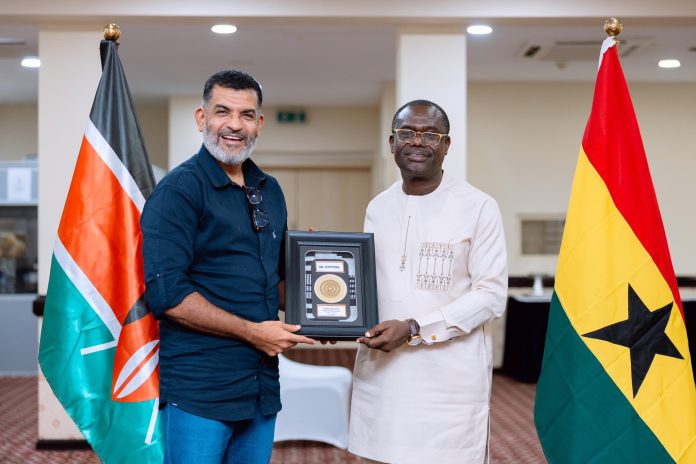
Dr Siaw Agyepong presneting a gift to the head of delegation
To find solutions to pressing sanitation and youth unemployment challenges, the County of Mombasa, Kenya, has turned its attention to Ghana’s Jospong Group of Companies for succour.
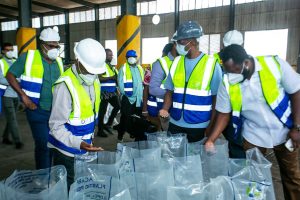
The delegation being briefed at one of the Jospong faciities
A 26-member high-powered delegation, led by Governor H.E. Abdullswamad Sherrif Nassir, embarked on a four-day (July 29 – August 1, 2025) working tour of Ghana, seeking to study and potentially replicate Jospong’s successful sanitation blueprint.
The visit marked a continuation of strategic engagement, following the July visit of Jospong Group’s Executive Chairman, Dr. Joseph Siaw Agyepong to Kenya, where he promoted Pan-African collaboration for sanitation transformation.
Faced with growing challenges in managing solid waste, sewage and medical waste, Mombasa’s leadership is exploring how to convert these burdens into opportunities for sustainable growth and youth empowerment.
The Ghanaian model, led by the Jospong Group, has proven to be a successful example of such transformation. “We came here because we believe in African solutions to African problems. What we’ve seen here is not only innovative, but inclusive turning waste into a resource while creating real jobs for young people,” Governor Nassir said.
The delegation, comprising Kenyan MPs, administrative officials, technical staff and sanitation experts toured several of Jospong’s leading facilities in Accra and Kumasi.
These included the Accra and Kumasi Compost and Recycling Plants (ACARP and KCARP), the Kumasi Wastewater Treatment Plant, the Pantang Transfer Station, the Kpone Landfill Site and the Universal Plastic Product and Recycling Plant.
The Kenyan officials were visibly impressed by Jospong’s use of cutting-edge green technologies to handle waste at scale.
Members of the delegation being briefed about Jospong Group oprrations
They lauded the company’s ability to not only manage waste efficiently, but to turn it into job creation avenues, particularly for youth.
“This is a model that transforms communities. It’s not just about sanitation—it’s about dignity, employment, and environmental sustainability,” said Mohamed Faki Mwinyihaj, Senator and a member of the delegation.
Back home, Mombasa County has initiated a bold new waste strategy of its own. According to Governor Nassir, the county will be divided into 600 sanitation units.
Each unit will be manned by local youth who will be salaried to manage waste collection and delivery to a central transfer station.
“In the past, waste was dumped haphazardly due to the lack of structure. Now we’re introducing order and giving jobs to our youth. This eliminates illegal cartels and puts dignity back into sanitation work,” he said.
Farida Abdallah, Chairperson of the Mombasa County Public Service Board, highlighted the potential of the Jospong model to significantly reduce unemployment.
“What Jospong has achieved here is remarkable. The number of youth employed across various facilities is something we aspire to. This model is worth replicating,” she said.
Members of the delegation testing some of the Jospong Group products
Other Parliamentarians including representatives from Likoni, Mvita, Kisauni, Changamwe and Mishi Kuma Mboko constituencies echoed similar sentiments, applauding the emphasis on job creation and environmental sustainability.
“The Jospong sanitation model aligns with our development priorities. It demonstrates that economic empowerment and climate action can go hand-in-hand,” said one MP.
Jospong’s Executive Chairman, Dr. Joseph Siaw Agyepong, reaffirmed the company’s commitment to collaborating with African governments to scale sanitation innovations continent-wide.
“We believe in partnerships that empower local talent. We are ready to work with the County of Mombasa to conduct feasibility studies, establish training regimes, and ensure knowledge transfer to build local capacity,” Dr. Agyepong stated.
He revealed that a team from Jospong will travel to Kenya to further engage stakeholders and flesh out implementation strategies.
This visit was not an isolated event. It follows earlier engagements in July when officials from Kenya’s Cabinet Secretary for Environment, Climate Change and Forestry, as well as the National Environment Management Authority (NEMA), visited Ghana to explore sustainable waste management collaborations.
The convergence of interest from different arms of Kenya’s environmental and governance sectors signals a coordinated push toward sanitation reform, using the Ghanaian experience as a model.
“This is more than just a visit. It’s part of a long-term vision. We’re building partnerships that will help Kenya transition to a circular economy and this model gives us a clear roadmap,” said the Minister for Blue Economy, Agriculture, and Livestock in Mombasa County.
The Officer in Charge of Water and Sanitation in Mombasa put it succinctly: “The Jospong Waste Management Module is a game-changer. It’s a solution that turns liabilities into assets. We believe this can be the future for Kenya and Africa.
“Mombasa has suffered for too long from the consequences of unmanaged waste, the health hazards, the environmental degradation and the social inequalities. Now we see a clear path forward. We’re grateful to the Jospong Group for showing us what is possible when innovation meets vision,” H.E. Nassir said.
With the groundwork laid, both parties now anticipate the next phase converting words into action. If successful, the partnership between Mombasa County and Jospong Group could become a continental example of how locally developed solutions can drive sustainable change, economic development, and youth empowerment across Africa.
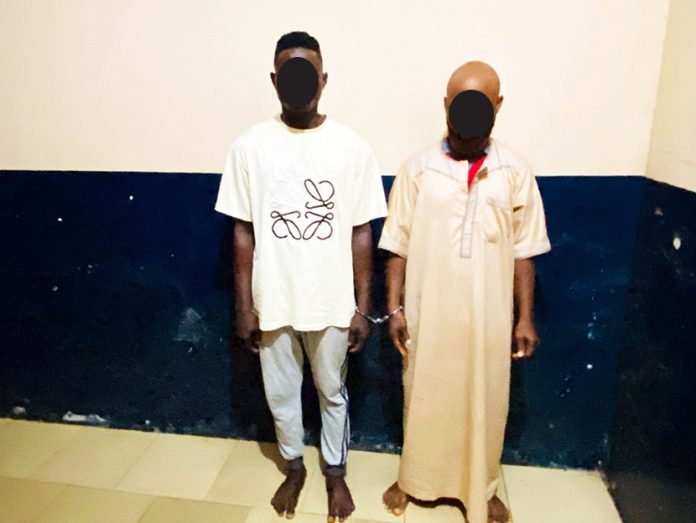
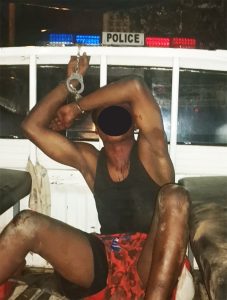
Suspects Christian Kporfor(L) and Yusif Nyarko who allegedly snatched the motorbike at gun point in Ho
The Police Administration has embarked on a silent crusade to combat the surge in violent crimes, with the Police Intelligence Directorate (PID) and operational wings at the forefront of the campaign.
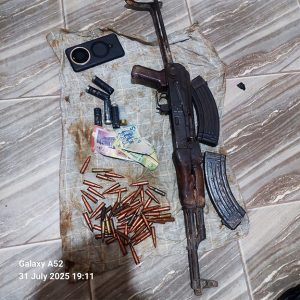
Weapons seized from some of the suspects
Through a series of strategic operations and intelligence-led interventions, they have lately recorded notable successes in their encounter with the criminal elements in the3 country.
Ongoing investigation by The Chronicle has revealed that the police have been working tirelessly behind the scenes to adopt a robust trend in tackling sophisticated crimes.
The PID, according to The Chronicle investigations, has been instrumental in gathering and analysing intelligence, enabling the police to anticipate and disrupt the plans of criminal groups.
One of the arrested suspects
On the other hand, the operations wings – Special Weapons And Tactics (SWAT), Formed Police Unit (FPU), Anti-Armed Robbery Unit (AARU), Rapid Deployment Force (RDF) and the Counter Terrorism Unit (CTU) – have also been proactive, conducting targeted operations to apprehend suspects and dismantling criminal networks.
The administration has shown the willingness to engage with criminal elements and recent encounters have resulted in the arrest of several high-profile suspects.
Asawase
Latest report The Chronicle gathered from Asawase, under Manhyia Division in Ashanti Region, is that the men on the ground with the slogan ‘no retreat, no surrender’ have, in the first two days of this month, chalked remarkable successes in their bid to eliminate the miscreants.
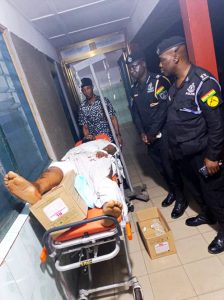
One of the injured suspects at the Hospital
That, on Friday, August 1, 2025 at about 8:35pm personnel at a Snap checkpoint nabbed one Issah Ibrahim for carrying forty-three (43) rounds of 5.7.15mm of ammunition and One (1) Phoenix Ontario-CA pistol and eleven (11) rounds of 5.7.15mm ammunition retrieved from his Toyota salon car with registration number GE 9143-18.
At Unity Oil, Sawaba Junction Snap checkpoint, the men intercepted twelve (12) Bore S.B. PA Shot Gun and twelve (12) cartridges from a certain KwadwoAgyapong.
Both suspects are currently assisting the police in their investigation to unravel the sources of the munitions.
One of the injured suspects at the Hospital
On same Friday, the Ashanti Regional Police Commander, Deputy Commissioner of Police (DCOP) Mr Emmanuel Teye-Cudjoe, led a team on a Snapcheck inspections and community engagements atAsawase and the surrounding areas.
The team engaged the Kusasi community, encouraging cooperation and commended them to be restrained. The regional commander’s team also visitedthe Mamprusi Chief in SabonZongo.
Volta Region
In Ho, Volta Region, our intelligence picked up reliable information that on Wednesday July 2, 2025 at about 11pm, an ‘Okada’ operator, Reuben Adzo, was engaged by a man to transport him to Taviefe for an agreed fee.
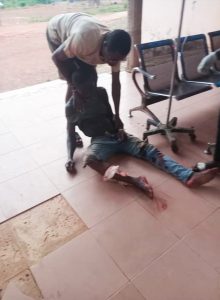
An injured suspect
On reaching a section close to the final destination, the pillion rider requested the biker to stop, and when he did, another man emerged from the bush, wielding a pistol, pointed it at him and threatened the rider to either surrender his Sonlink motorbike and money or be killed.
Though Reuben resisted, the two men overpowered and robbed him of the bike and an amount of GHC 150.00 (One hundred and fifty Ghana Cedis).
Police investigation yielded fruition when on July 27, 2025 the PID in the Volta Region arrested one of the suspects, Yusif Nyarko (39), from his hideout at Nudu, near Juapong.
Prior to committing the crime that night, while on the bike, Nyarko requested that he should be taken to a Pharmacy, where he went to buy some drugs.
Fortunately, a Close Circuit Television (CCTV) camera captured him.He named his accomplice as one Christian Kporfor (32) of AlavanyoWudidi and then latter was lured to Kpando and also apprehended.
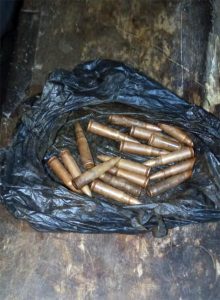
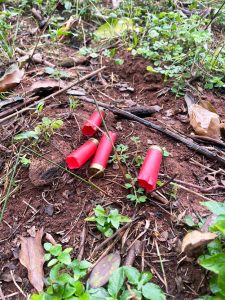
Discharged catridges at the crime scene
In the cause of interrogation, both admitted to committing the act and that the bike was sold at GHC 6000.00 (Six thousand Ghana Cedis) to a certain Obosom at Achimota.
Police proceeded to Achimota, but Obosom, who had a hint of the policearrival abandoned the motorbike and fled, but the officers retrieved the bike.
Ashanti Bekwai
On Thursday July 31, 2025 The Chronicle understands police in Ashanti Bekwai responded to a distress call that a group of armed gangsters had blocked a road leading to a mining site – Alex Mining Co. Ltd-and shot an AK47 assault rifle through the front windscreen of a Toyota Hilux, with registration number GW 4366-16 driven by Roger Abarika, carrying gold concentrate from the site.
The debris of the shattered windscreen hit the chest of a worker, William Opoku Asamoah, who was on board the vehicle, injuring him in the process. A security man accompanying the driver, armed with a pump action gun, returned fire killing the gunman instantly.His two accomplices bolted into the bush.
Police, upon arrival at the scene, retrieved AK47 assault rifle number AZ 7115 1999, two magazines loaded with 30 and 27 rounds of ammunition respectively, anxmage Huawei mobile phone, a driver’s license bearing the name Abeyoo Abdulai and an amount of GHC 185.00 (One hundred and eighty-five Ghana Cedis), five spent BB cartridges.
Esiama Division
FromEsiama Division in the Western Region, The Chronicle was told that on Thursday, July 31, 2025, the Assemblyman for Anwiah and Teleku Bokazo communities sent a distress call tothe police that robbery had occurred at a gold buying shop at Teleku Bokazo.
At the scene, police was informed that the robbers fled and headed towards Salman community wielding AK47 assault rifle and machetes.
As police pursued, and on seeing the crime fighters, the robbers opened fire and escaped into the bush.The officers returned fire and followed up only to realize that one of the robbers who mentioned his name as Abdul Rahman (34), was critically injured. He mentioned a certain Mohammed and others as his accomplices.
He was arrested and sent to St Martin De Porres Hospital, Eikwe, for treatment but died shortly after admission.
Investigation at the gold buying shop reveals that the robbers numbering six inflicted cutlass and gunshot wounds on the two attendants who were rushed to the same hospital for treatment.
The victims were Samuel Appiah (29) with cutlass injuries to his right thigh and Kwame Nketiah (45), who was shot at the right thigh.
Fifteen (15) rounds of ammunition for AK47 assault rifle belonging to the robbers were retrieved.
Atebubu
From Atebubu in the Bono East Region, this reporter gathered that on Wednesday July 30, 2025, gunmen blocked and robbed commuters between the Amantin and Atebubu highway.
Two of the robbers who, even though were wearing face mask, were identified by a victim as Baba and his brother, Manu. The robbery victim stays with these identified robbers in the same community at Afrefreso.
When the Police closed in on the suspects, Baba rushed to the room and picked up a machete and together with suspect Manu attacked the police who were left with no option, but to fire at them fatally.A search conducted on suspect Manu, including a waist bag that he was carrying uncovered a locally manufactured pistol.
Further search in their room led to the discovery of talismans and gods believed to be for their spiritual fortifications. Also the PID deployment from the headquarters in Accra and Bono East Region respectively during one of their joint patrols and escort of commuters between Kwame Danso and Atebubu came under fire in their unmarked vehicle.
The armed bandits numbering about eight incidentally ambushed some vehicles and were robbing the occupants. When the police car was approaching the scene, the officers were signalled to stop amidst sporadic shooting.
Police returned fire hitting two of the suspects who fell and died instantly.
The rest, however, bolted into the bush and a search conducted on the deceased led to shotgun, live cartridges, four spent cartridges and a machete found by their side.
Their bodies were deposited at the Holy Family Hospital in Techiman for autopsy.
Col Festus Aboagye (rtd) in a telephone conversation lauded the efforts of the police in keeping the miscreants at bay.
According to him, the police’s action needed to be sustained in all parts of the country.
He stated that, what the police needed now was logistics to be proactive and unsettle the criminal elements.
He appreciates the fact that His Excellency the President, John Dramani Mahama has promised to retool the police to enable them to meet the challenges.
Dignitaries present at the launch in a group photo with copies of the New Guide
The Media Foundation for West Africa (MFWA) launched their “Guide for Journalists on Illicit Financial Flows, Progressive Taxation, Reserved Based Lending and Domestic Revenue Mobilisation,” to assist journalists in reporting on economic justice.
The New Guide, which was funded by the Norwegian Agency for Development Cooperation and OXFAM in Ghana was unveiled on Friday, August 1st, 2025 at the British Council in Accra.
The 14 chapter document includes investigation approaches, case studies and ethical guidelines. The guide offers concise definitions, real-world case studies, investigative tips, ethical guidelines, and resource checklists.
Its development was supported by NORAD and Oxfam in Ghana under the “Tax for Development: Strengthening Civil Society and Media for Fiscal Justice” project.
In a speech delivered on behalf of Sulemana Braimah, Executive Director of MFWA, by Senior Programme Manager, Rosemond Ebi-Adwo Aryeetey, he highlighted the critical role of the media in demanding accountability, especially around financial crime.
Mr. Braimah noted that IFFs cost Ghana millions of cedis, resources that could otherwise support essential social services.
“Yet journalists often face knowledge gaps and resource constraints when investigating these complex issues,” he said.
He further explained that the guide includes critical checklists and resources to help journalists navigate the challenges of reporting on sensitive financial crimes.
The Vice President of the Ghana Journalists Association (GJA), Rebecca Ekpe, on her part urged journalists to take a more active role in exposing illicit financial flows and improving domestic revenue mobilisation.
Addressing the gathering, she emphasised that the media must play a central role in advancing economic justice. She described the guide as a “valuable resource” that equips journalists with the tools and best practices to investigate financial crimes and tax evasion issues she said are depriving the country of vital resources for development.
Sharing a personal observation from her hometown of Tema, Madam Ekpe questioned the disappearance of market vendors who appear at night and vanish by morning, raising concerns over uncollected taxes.
“That’s a lot of money going down the drain,” she said, stressing the need for accountability at the local level.
She commended MFWA and Oxfam for the collaborative effort and called on journalists to use the guide to expose wrongdoing, inform public discourse, and amplify the voices of the marginalized.
“Together, we can build a more transparent, equitable, and prosperous Ghana,” she concluded.
A 30-year-old forest guard, George Nii Quaye, has been arraigned before the Accra Circuit Court for allegedly possessing prohibited substances, including unregistered pharmaceutical drugs and suspected narcotics.
The case, presided over by Her Honour Halimah El-Alawa Abdul-Baasit, saw Quaye charged under Section 29 of the Pharmacy and Drug Act, 1961 (Act 64) for unlawful possession of dangerous drugs. He pleaded not guilty to the charges.
According to the prosecution, led by Chief Inspector Kwadwo Abongye, the incident occurred on July 25, 2025, at the VIP Bus Terminal at Kwame Nkrumah Circle in Accra.
The complainant, a driver’s mate at the terminal, became suspicious when the accused attempted to dispatch a parcel to Dormaa Ahenkro, claiming it contained clothing.
Upon inspection, however, the package was found to contain 55 sachets of dried leaves suspected to be narcotics, 20 sachets of a drug identified as “Amnezia”, four sachets of Tapentadol (RED) 250mg, and 16 sachets of Timaking 120mg — all drugs not registered by the Food and Drugs Authority and prohibited for sale.
Quaye was immediately arrested and handed over to the police. A caution statement was obtained from him during preliminary investigations, and the seized items were sealed in his presence for laboratory analysis.
Following submissions by counsel for the accused, the court granted bail in the sum of GH¢10,000 with two sureties, both to be justified.
In accordance with Article 19(2)(c) of the 1992 Constitution, Quaye is required to deposit his Ghana Card with the court registry and report to the police every two weeks until further notice.
The prosecution is expected to file disclosures and witness statements ahead of the Case Management Conference, scheduled to commence on September 1, 2025. Investigations into the matter are ongoing.
The Dansoman Circuit Court has granted bail to a businessman, Desmond Theke, who is facing a felony charge of stealing GH¢490,600 from his employer, Nigerian businessman, Solomon Okechukwu.
The accused, who pleaded not guilty to the charge, is accused of misappropriating funds and goods entrusted to him while managing a clothing business in Accra.
The court granted Theke bail in the sum of GH¢500,000 with two sureties, one of whom must be justified with title deeds equivalent to the bail amount.
As part of the bail conditions, Theke is also required to deposit his Ghana Card at the court registry and report to the police every two weeks until further notice.
The prosecution, led by Chief Inspector Emeila Mensah, informed the court that all disclosures and witness statements will be filed by August 25, 2025, to enable the court to commence Case Management Conference (CMC) proceedings.
Due to the felony nature of the offence, the court emphasised that the case cannot be referred to Alternative Dispute Resolution (ADR).
However, the parties may still attempt an out-of-court settlement if both sides are willing.
Background
According to court documents, the complainant, Mr. Okechukwu, operates a second-hand clothing business across Accra, Togo, and other African countries.
In 2024, he employed Theke to manage his Accra operations. During that period, he reportedly shipped 240 40-foot containers of used clothes to Ghana and also transferred funds to Theke for procurement purposes.
However, upon visiting Ghana on June 11, 2025, for stock-taking, Okechukwu discovered significant discrepancies in both goods and finances. Theke allegedly failed to account for the inventory and funds, leading the complainant to lodge a formal complaint with the Dansoman Police.
Both parties were subsequently advised to undertake a joint audit with neutral witnesses. The resulting audit revealed a total misappropriation of GH¢490,600, a figure confirmed in a signed document by the complainant, the accused and their respective witnesses.
The accused was arrested on the same day the complaint was made and later charged under Section 124(1) of the Criminal Offences Act, 1960 (Act 29), which relates to the offence of stealing.
The case is being investigated by Detective Chief Inspector Godwin Kenny Quarcoo.
Ismail Abass Iddrisu, a 53-year-old Businessman accused of defrauding the President of the Greater Accra Regional House of Chiefs, King Professor Odaifio Welentsi, to the tune of GH¢4 million, has been granted bail by the Dansoman Circuit Court.
The accused was remanded for nearly a week before Her Honour Halimah El-Alawa Abdul-Baasit granted him bail on Tuesday.
The bail amount was set at GH¢3 million with stringent conditions: three sureties, two of whom must be salaried workers earning no less than GH¢3,000 monthly and residing within the court’s jurisdiction. The third surety is required to justify the bail sum with valid title deeds.
Additionally, Mr Iddrisu must deposit his Ghana Card with the court registry and report to the police every two weeks, as part of his bail conditions.
The case has been adjourned to September 10, 2025 for further hearing. Chief Inspector Portia Nuarko is prosecuting the case on behalf of the Republic.
Alleged Fraud Scheme
According to the facts of the case, the incident dates back to 2018. The complainant, King Professor Odaifio Welentsi, who is also the Paramount Chief of Nungua, claims he was lured by Mr. Iddrisu into investing in a purportedly thriving forex trading business, known as Tycoo Forex, located in Nungua and Abossey Okai.
Based on the accused’s representations, the chief allegedly invested substantial sums – $400,000 and €40,000 and a cheque of GH¢2 million into the business under a written agreement signed on December 11, 2015.
However, investigations later revealed that the accused, who also owns a construction firm, Is Abid Company, had allegedly diverted the invested funds into his private construction ventures.
The court heard that Mr. Iddrisu used the money to purchase heavy machinery, including four tipper trucks and a wheel loader, to execute projects under a contract with Ghana First Company Ltd, valued at GH¢1.3 million.
Despite receiving over GH¢4 million in investment, the accused is said to have only paid back GH¢60,000 in 2020 before becoming evasive. The complainant subsequently filed a report with the Teshie Police in 2023, leading to Mr. Iddrisu’s arrest.
Charges
Mr. Iddrisu is facing charges of fraudulent breach of trust, contrary to Section 128 of the Criminal Offences Act, 1960 (Act 29). Prosecutors allege he dishonestly appropriated the complainant’s funds entrusted to him as a business partner.
The court will resume the case on September 10, 2025, as investigations and legal proceedings continue.
It is said in politics; one does not have a permanent friend but permanent interest. For, people can use others to get what they want and then dump them.
Tho seat the top have lots of followers who will be willing to do anything for them, but when they drop down, that will be the end of loyalty.
H.E. Nana Akufo-Addo, always rewarded for loyalty and so, he got many people around him, who continuously sung his praises and were ready to do anything for him, even if it meant killing their love ones.
After January 7, 2025, when H.E. John Dramani Mahama became president, some of Nana Addo’s sycophants started saying foul things about him. And these are people who never rose to counter anything Nana Addo said or did, when he was in power. But now that he is out, they are educating the world about how Nana Addo was the wrong kind of president.
For example, Ernest Owusu Bempah, a political orphan, who was brought into the NPP by Nana Addo and awarded a top appointment in Ghana Gas, for eight years, could today come on air and tell Ghanaians that he had advised Nana Addo severally, to remove IGP Dr. Dampare from office, but all his pleas fell on deaf ears. If indeed he did, why did he not come public when Nana Addo was president? He went on to congratulate H.E. John Mahama for terminating the appointment of the police chief.
He has also been saying that picking Dr. Bawumia, Nana Addo’s choice, as flagbearer was very wrong. And no one heard him say so, when Nana Addo was president.
And then, there is this retired captain of the Ghana Armed Forces, who used to worship Nana Addo. This guy would attack anyone who held counter opinion to Nana Addo’s or spoke about wrong things he did.
On group platforms, he was all out, praising Nana Addo and condemning Alan without any provocation. Then he started attacking Nana Addo. Whatever went wrong?
Let me begin from what he posted when one Kofi Owusu Nkansa declared support for Fadi Dabbousi on his Facebook page.
This retired captain, in 649 words, went on about how in 2017, he was invited down from the US for a taskforce job at one of ministries. For six months in Ghana, nothing came for him until he was informed that Nana Addo had discontinued the taskforce.
He claimed he was promised a job in NPA and was assured he would start in a month. To satisfy US immigration requirements, he asked permission and flew back to the States for a week and came back home, awaiting the job. Unfortunately, after three more months, nothing came up. He claimed in 2018, Fadi accompanied him to the north on government assignment. But was it not this Fadi Dabbousi who said he cut ties with Nana Addo and government in 2017? Who is speaking the truth here?
The retired captain said he was given another offer where he was to work under a police inspector. But being a retired captain, he declined it, since he was going to work under someone lower in rank than him. He left back to the States after he was given GH¢5,000.00 which was $1,000.00 in 2018. He had to rush back in July 2020 when he was given another offer, which he claimed, turned out to be a fiasco.
Well, well, well, what he claimed turned out to be a fiasco was about a job appointment he had with the National Security. He brought this up on another platform and said he was posted to a galamsey site and was later withdrawn and dismissed. And so that ended his relationship with Nana Addo. Since then, he started condemning Nana Addo and his government, without provocation. What he hid from us was why he got sacked. Apparently, instead of stopping the illegal miners, he demanded bribe in gold to allow them have their way.
At least, he was offered a job and but was corrupt and got dismissed. So, why is he blaming Nana Addo?
This retired captain, has a way of lying so that he looks innocent and draw sympathy to himself. And so, I do not want to believe in his 649-word narration. I am sure that the people he mentioned would come out with different versions.
I feel sorry for Nana Addo. He has this strong dislike for people with diverse opinion to his and classifies them as disloyal, hence he will not work with them. This is rather unfortunate, because it is such people who love him most, and would always tell him the truth, no matter how bitter.
Most of his loyalists may only be pretending, seeking selfish interests, and are now abandoning ship, when the captain was gone. This is politics and here, Nana Addo was no exception. I know how he will be feeling now; very disappointed in some people he lifted up in life, but are now rejecting him. People who destroyed other people’s image to him for him to hate them, are now destroying his image. This is sad, very sad. This ingratitude is very bad.
I will continue praying for him. He will not get this opportunity again, but he can educate the young ones on life’s moral lessons.
Hon. Daniel Dugan
Editor’s note: Views expressed in this article do not represent that of The Chronicle
The Ghana Police Administration has launched an intensified and largely silent operation across several regions aimed at curbing violent crime. Spearheaded by the Police Intelligence Directorate (PID) and various elite operational units, including the Special Weapons and Tactics (SWAT), Formed Police Unit (FPU), Anti-Armed Robbery Unit (AARU), Rapid Deployment Force (RDF) and Counter Terrorism Unit (CTU), these efforts have begun yielding significant results.
In our center page of today’s issue, we carried a story about how the Police has embarked on a nationwide ‘war’ to combat violent crimes. In the Ashanti Region, arrests were made at snap checkpoints in Asawase where arms and ammunition were seized, while in the Volta Region, two armed robbers were arrested through CCTV footage and intelligence tracking. In the Western Region’s Esiama Division, police foiled a robbery at a gold-buying shop, leading to the arrest and eventual death of a suspect.
In Ashanti Bekwai, armed robbers attacking a mining vehicle were met with force, leading to the recovery of weapons and arrest of suspects. In Atebubu (Bono East), police responded to highway robberies and neutralised multiple gunmen after they opened fire on patrol units. This coordinated, intelligence-driven approach shows a committed police force working tirelessly to suppress crime, reclaim public trust and ensure safer communities nationwide.
For far too long, crime in the country has grown in both boldness and sophistication. Reports of highway robberies, residential thefts and gang activities have plagued communities all over the country.
The crackdown on violent crime by the Police Intelligence Directorate and operational units marks a new era of policing in Ghana. This could not have come at a better time.
Over the past year, Ghana has witnessed an upsurge in crimes involving firearms, armed robbery and organised criminal groups, especially in mining regions and along major highways.
What makes this development commendable is not just the success of arrests and recoveries, but the strategy behind it. Intelligence-led policing, a globally acknowledged best practice, is finally taking root in Ghana’s law enforcement structure. It ensures that police officers are not merely reacting after crimes are committed but are now disrupting criminal plots before they unfold. That is the mark of a professional force and it is working.
But beyond the tactical victories, there is something more powerful at play – deterrence. Crime thrives where there is impunity. When criminals believe that the police are absent, under-resourced or incapable, they act without fear.
However, the recent wave of arrests and encounters, some of which ended in the neutralisation of armed attackers has flipped the narrative. Fear is now where it belongs, in the hearts of those who plot violence against society.
Retired security experts like Col. Festus Aboagye have rightly emphasised the need for more logistical support from surveillance technology to protective gear and communication infrastructure.
President Mahama’s commitment to retool the service must translate into quick and tangible resourcing. Ghana cannot afford to have a demoralised or under-equipped police force in this critical hour.
The police should continue engaging local leaders, chiefs, youth groups and neighborhood watch committees, especially in volatile areas. Trust breeds cooperation and cooperation makes intelligence work easier.
To the men and women in black, risking their lives quietly and consistently, The Chronicle says ‘ayekoo’ to you. You have chosen action over excuses and professionalism over publicity.