Home Blog Page 538

Is South Africa Trying To Muzzle The Lion Of Limpopo?

0
Opinion

“When the Drumbeat of Truth Gets Too Loud, Power Tries to Silence the Drummer”

In South Africa, that drummer is Julius Malema, a firebrand leader whose bold calls for justice, equality, and land reform have now landed him in the crosshairs of the law. But is this truly about justice, or is the system trying to silence the rhythm of revolution?

On 1st October, 2025, the East London Magistrates’ Court delivered a guilty verdict against Economic Freedom Fighters (EFF) leader, Julius Malema, for multiple firearm-related charges. These stemmed from a 2018 incident during an EFF rally in Mdantsane where Malema was filmed firing a semi-automatic rifle into the air in front of thousands of supporters. Despite the political and legal storm surrounding him, Malema remains defiant, supported by thousands across South Africa and the continent who believe his conviction is more about silencing his revolutionary voice than justice.

The court found Malema guilty of five charges: unlawful possession of a firearm, unlawful possession of ammunition, discharging a firearm in a built-up area, reckless endangerment, and failure to take reasonable precautions. The charges fall under South Africa’s Firearms Control Act, which carries a minimum sentence of 15 years in prison. His co-accused, Adrian Snyman, was acquitted.

Malema’s legal team has vowed to appeal, and the matter has been adjourned to 23rd January 2026 for pre-sentencing proceedings. Malema, unfazed, told supporters outside the court: “Going to prison or death is a badge of honour… We will never retreat.”

For many ordinary South Africans and fellow Africans, this is yet another example of a system intent on suppressing a leader who speaks uncomfortable truths to power.

Julius Malema has long been a controversial figure in South African politics. Yet, beyond the fiery rhetoric and dramatic public moments, there is a consistent thread in his political career: unwavering advocacy for African unity, economic justice, and land redistribution. His call for land expropriation without compensation is not a call to sow division, but a call for correcting historical injustice.

Malema has also been one of the few political leaders to take a firm stand against xenophobia in South Africa. While many remained silent or evasive during outbreaks of violence against fellow African migrants, Malema publicly condemned the attacks and reaffirmed that “no African is a foreigner in Africa.” These are not the words of a criminal, but of a pan-Africanist committed to the upliftment of the continent.

His political persecution is not a new phenomenon in Africa’s post-colonial landscape. Throughout history, those who fight for the oppressed, be it Kwame Nkrumah, Patrice Lumumba, Thomas Sankara, or Steve Biko, have often found themselves vilified, criminalised, or eliminated. Malema’s legal battles, including this latest conviction, are viewed by many as part of a larger agenda to dismantle a rising leader who challenges the status quo and threatens entrenched interests.

Let us not forget: Julius Malema is no ordinary politician. He is a son of the soil who rose from humble beginnings in Limpopo to become a national force, now recognised across Africa and globally. He has given a voice to the voiceless, hope to the marginalised, and pride to a generation of young Africans yearning for justice.

His courage and consistency make him a leader many believe is destined for even higher office, including the Presidency of South Africa. His critics say he is radical and dangerous. But what is dangerous about wanting land for the landless? What is radical about wanting wealth shared more equitably? What is criminal about defending fellow Africans from hate and violence?

The verdict against Malema may be the state’s attempt to weaken him, but it is unlikely to break him. If anything, it has only strengthened the resolve of his supporters and widened his base across Africa. He is not alone. From Cape Town to Cairo all the way to Abuja and Accra, Africans who believe in justice, equality, and unity stand in solidarity with Julius Malema.

Malema must stand tall, and he must never give up. He is not fighting for himself, he is fighting for generations yet to come. Every good man, every revolutionary, faces trials. But as history has shown us, you can imprison the man, but you can never imprison the idea.

Julius Malema remains a vital asset not only to South Africa but to the entire African continent. In this defining moment, Africans must rally behind him and not just for his sake, but for the sake of a future built on freedom, fairness, and dignity for all.

The fire of a true Revolutionary doesn’t die in the dark, it spreads.

If the aim was to extinguish Malema’s influence, it has backfired. This judgment has only poured fuel on the fire of resistance, and his supporters are more determined than ever. The Gavel has fallen, but the struggle marches on.

This may be a courtroom decision, but for Malema and his movement, the real verdict lies in the hearts of millions who still believe in the cause he champions.

By Evans Mawunyo Tsikata  

Credit: myjoyonline.com

The views expressed in this article are the author’s own and do not necessarily reflect The Chronicle’s stance.

Editorial: Accra Is Dark! Where Are The Street Lights?

0
Editorial

Street lighting is not a luxury, it is a fundamental element of urban infrastructure that enhances public safety, prevents accidents, deters crime, and fosters a sense of security. It supports economic activity, extends the usability of public spaces after dark and signals a government’s commitment to citizen well-being and smart urban planning.

Yet, in Accra, the national capital and gateway to the country, darkness continues to consume major roads at night, endangering lives and exposing a shocking level of administrative neglect. This is especially alarming as the country gears up for the full implementation of the 24-hour economy, an ambitious initiative championed by President John Mahama to expand economic activity across all sectors and time zones.

But how can a 24-hour economy thrive when the very roads people must use are engulfed in pitch darkness? Nobody needs to remind us that street safety in Accra has deteriorated due to non-functioning or absent street lights. The reality is visible to every driver, pedestrian and commuter in the city.

The Chronicle has consistently highlighted this issue. In March, we reminded the Greater Accra Regional Minister, Linda Obenewaa Akweley Ocloo, of her promise to address the problem. That promise remains unfulfilled. On July 3, 2025 we published an editorial titled “24hr Economy In The Midst Of Non-Functioning Streetlights,” in which we urged President Mahama to take a night drive through Accra to witness at firsthand the peril on our roads, after he (Mahama) had applauded the regional minister for fixing streetlights in Accra.

We cited specific stretches such as Tetteh Quarshie to Adenta, where only a few bulbs between the Ghana Standards Authority and Okponglo function. The story is no different along Liberation Road, Achimota-Ofankor and the George Walker Bush Highway.

On September 5, 2025 we again raised alarm in an article titled “Accra Roads Turn Death Traps At Night”, highlighting dark zones including the Achimota Overhead, Achimota School area, John Kufuor Avenue, Tema Motorway, Agyiriganor and Ashaley Botwe, among others. These are not rural backroads, they are major urban arteries that carry thousands daily.

Just yesterday, our staff witnessed a horrific accident involving three cars on the George Walker Bush Highway, an entire stretch left in total darkness. The absence of light made it nearly impossible for oncoming drivers to detect the wreckage ahead in time.

Meanwhile, in June 2025, Energy Minister John Abdulai Jinapor assured Ghanaians at an international forum that the country’s power supply is now stable, with surplus energy even being exported. He claimed progress was being made toward universal electricity access.

So, what explains this disconnect? If there is sufficient power, why are street lights across the capital non-functional? Is it a logistical failure, a financing gap or sheer incompetence? The Chronicle finds it deeply troubling that public safety can be compromised this way—with no accountability.

We also question how seriously the 24-hour economy policy is being pursued. How can such a transformative policy take root in an environment where basic infrastructure is neglected? A city that cannot guarantee visibility at night cannot support a safe, functional, round-the-clock economy.

We call on Jubilee House, the Greater Accra Regional Coordinating Council and all relevant authorities to stop taking Ghanaians for granted. Street lighting is not a political favor; it is a right, a necessity, and a duty owed to every citizen. The safety of Ghanaians must be treated as a national priority—not as an afterthought.

This issue will not be allowed to fade into the shadows. The Chronicle will continue to shine a light on the darkness in Accra – until our streets are safe again.


For more news, join The Chronicle Newspaper channel on WhatsApp: https://whatsapp.com/channel/0029VbBSs55E50UqNPvSOm2z

Cocoa farmers still trapped in poverty despite record prices -Cocoa Barometer   

0
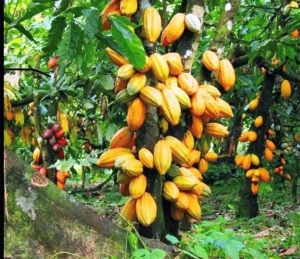
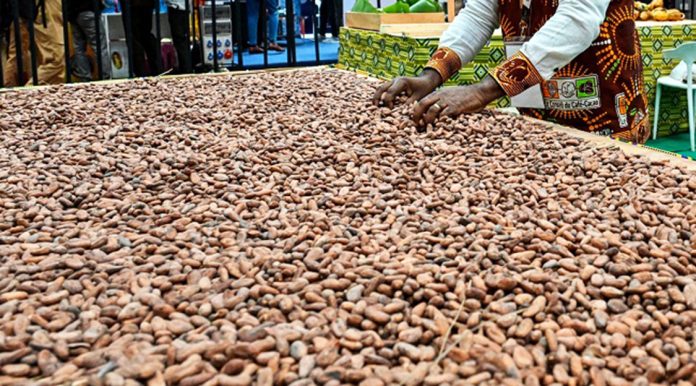
Cocoa beans

The cocoa sector has experienced heightened volatility in recent years, driven by market volatility, environmental degradation, and human rights challenges.

“As cocoa prices soar to record highs, millions of smallholder farmers in Côte d’Ivoire, Ghana and Nigeria, who produce most of the world’s cocoa remain trapped in poverty”.

The Cocoa Barometer 2025 in a statement signed by Nana Yaw Reuben and copied to the Ghana News Agency in Accra revealed that West Africa’s producers continued to bear the heaviest burdens of climate shocks, governance gaps, and unfair value distribution.

“Three things are happening simultaneously in the cocoa sector: it is bad, it is better than before and there is a lot of room for improvement.

Cocoa

“Côte d’Ivoire and Ghana together produce more than 60 percent of the world’s cocoa, shaping global prices and policy, while Nigeria is emerging as a major player, projected to produce 350,000 tonnes in the 2024/25 season. Yet despite this dominance, most farmers have not benefited from the recent price surge”.

Mr Reuben said forward-selling mechanisms had delayed price increases, while yields continued to decline due to aging trees, crop diseases, and erratic rainfall linked to climate change.

The Cocoa Barometer also highlighted that farmer poverty was at the root of virtually all problems in the cocoa sector, from deforestation to child labour and gender inequality.

“Paying farmers fairly is both a moral and legal obligation, thanks to new human rights and environmental legislation. But political resistance in Europe is threatening the hard-won progress in regulation.

He said high prices were driving a boom in cocoa production, while deforestation due to cocoa was currently spreading to new regions in West Africa.

“Within a few years, this boom will lead to oversupply and falling prices, just as in 2016. Cocoa-growing communities remain in the grip of climate change, deforestation, and human rights violations. 1.5 million Children still work in dangerous conditions in cocoa farming in Ghana and Côte d’Ivoire. Women, who do the majority of farm work, remain excluded from decision-making and profit sharing”.

The Cocoa Barometer said Farm workers and tenant farmers, vital to cocoa farm years were consistently overlooked in discussions about farmers and cocoa cultivation, even though they were crucial to cocoa cultivation and are the most vulnerable.

“At the same time, new regulations and stronger collaboration in the sector show that systemic change is possible.

On governance and accountability the Cocoa Barometer attributed much of the sector’s fragility to weak governance and policy gaps.

It indicated supply management remained largely absent, leaving farmers vulnerable to volatile markets, and the lack of transparency in cocoa sales, including farm gate pricing, continues to limit accountability.

Mr Reuben of the 2025 Cocoa Barometer emphasized that despite the challenges, change was possible and called for stronger collaboration within the sector among farmers, governments, companies, and civil society toward systemic change.

The barometer also called for urgent action from the entire sector, including: Fair pay: committed to a living income for farmers, Protecting forests: a global moratorium on deforestation from cocoa cultivation, Farmers, women and men, to be recognised as co-decision makers and to be transparent: to implement transparency and accountability mechanisms throughout the supply chain.

The Cocoa Barometer is a state-of-sustainability overview of the sector published by a consortium of civil society organisations.

It highlights current challenges and progress and offers a long-term overview of major developments over the past decades, while sketching potential future developments and emerging risks.

GNA

My Resignation Not Admission Of Guilt, Says Ex-Minister Nnaji

0
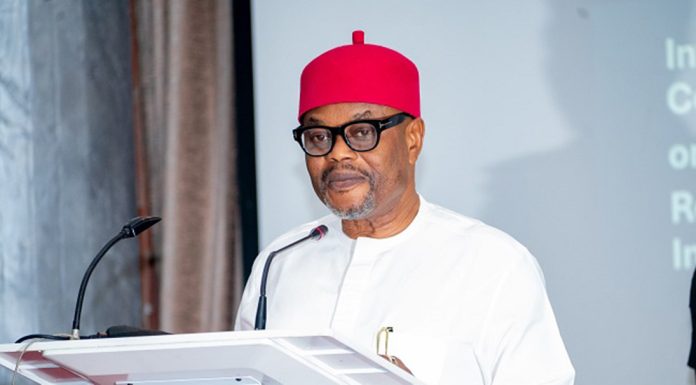
Former Innovation, Science and Technology Minister, Uche Nnaji

Former Minister of Innovation, Science and Technology, Uche Nnaji, has said that his resignation from office was not an admission of guilt.

Nnaji resigned on Tuesday following the controversy surrounding his certificate, said to have been obtained from the University of Nigeria, Nsukka (UNN), Enugu State, as well as his National Youth Service Corps (NYSC) discharge certificate.

While he maintains that he graduated from the University of Nigeria, Nsukka in 1975, a report indicates that the institution could not verify his academic records.

In a statement on Tuesday night, Nnaji admitted that the decision to resign from his position “did not come lightly.”

“My decision to step aside is, therefore, a personal choice, not an admission of guilt, but rather a principled decision to respect the sanctity of due process and to preserve the integrity of the judicial proceedings currently before the court. In the end, justice will prevail, and history will vindicate the just,” he said.

The former Minister also claimed that the certificate scandal was politically motivated by his opponents.

“Over the past week, an orchestrated and sustained campaign of falsehood, politically motivated and malicious attacks have been waged against my person, integrity, and office across print, electronic, and social media platforms,” he said.

“These unfounded allegations and media distortions have not only caused personal distress but have also begun to distract from the vital work of the Ministry and the Renewed Hope Agenda of Mr. President.”

He thanked President Bola Tinubu for the opportunity to serve in his cabinet and assured the President of his continued loyalty.

Credit: channelstv.com

Alleged Terrorism: Absence of Medical Report Stalls Nnamdi Kanu’s Trial

0
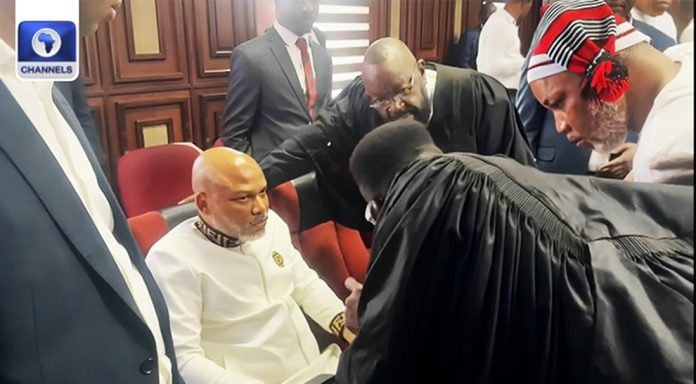
Nnamdi Kanu in court

Justice James Omotosho of the federal high court Abuja, has adjourned the trial of the leader of the Indigenous People of Biafra (IPOB), Nnamdi Kanu on alleged terrorism, to October 16th.

The trial was adjourned following the inability of the Nigerian Medical Association to present its report on the health status of Kanu to the court.

At the last adjourned date, Justice Omotosho ordered the President of the Nigerian Medical Association (NMA) to constitute a board of medical experts to investigate the alleged deteriorating health of the defendant and to determine whether the medical facility at the Department of State Services (DSS) headquarters is adequate for his care or if he should be moved to a private ward at the National Hospital.

The report is also to determine whether Kanu is fit to stand for the continuation of his trial.

At the day’s proceeding, Counsel to the FG, Suraj S’aad, informed the court that the medical board had contacted them that the report was not ready for presentation as directed by the court.

The senior lawyer, therefore, applied for a week adjournment to enable the NMA medical board conclude its investigation.

Following no objection to the adjournment request, Justice Omotosho fixed October 16th for the board to submit its report.

Kanu is being prosecuted by the DSS on a seven-count charge bordering of his alleged involvement in terrorism activities. On September 26, the court rejected the no-case submission of the IPOB leader.

Credit: channelstv.com

‘No Nigerian Is A Street Urchin,’ Obi Decries Insult On Supporters

0
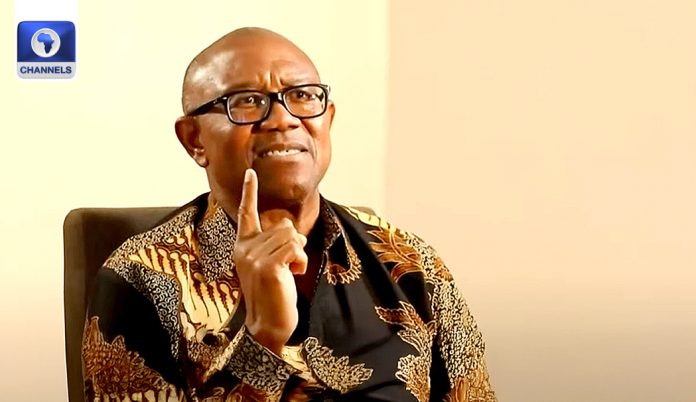
Peter Obi

The Labour Party’s presidential candidate in the 2023 elections, Peter Obi, has condemned the growing tendency among some Nigerians to look down on their fellow citizens, describing it as deeply unfortunate.

Obi was reacting to recent comments which, he said, referred to some of his supporters as “street urchins” and “people of no value.”

According to the former Anambra State governor, such statements are degrading and reflect a troubling mindset.

“Lately, I have heard a few people say that those who follow Peter Obi are low-class Nigerians, and some have even gone as far as calling them ‘street urchins’ and people of no value.

“It is deeply unfortunate that in today’s Nigeria, citizens now look down on fellow citizens in such a degrading manner,” Obi said.

He emphasised that he has never looked down on anyone, except in an effort to lift them up, stressing that his political journey is rooted in identifying with the ordinary Nigerian.

“My involvement in politics has never been about associating with the so-called high and mighty, but about standing with ordinary Nigerians whose voices have been silenced and whose resources have been stolen by the same ‘big names’ who now parade themselves with all sorts of titles and names.”

Obi asserted that no Nigerian is without value and criticised the growing tendency of some leaders to speak condescendingly about struggling citizens.

“No Nigerian is of no value. No Nigerian is a street urchin. It speaks volumes about the state of our nation that everyday Nigerians, battered by poverty and hardship, are now referred to by their leaders as being of no value — and as urchins,” he said.

He added that every Nigerian deserves dignity, opportunity, and care.

Credit: channelstv.com

Court orders IGP to arrest Mahmood Yakubu, ex-INEC chairman

0
Mahmood Yakubu, ex-INEC chairman

Despite his exit as the chairman of the Independent National Electoral Commission, INEC, the Federal High Court sitting in Osogbo, the Osun State capital, has again ordered the Inspector General of Police, Mr Kayode Egbetokun, to arrest the former INEC chairman, Prof Mahmoud Yakubu, for an offence relating to contempt of court.

The Court order came a few hours after Yakubu left office as the INEC chairman.

The Action Alliance, AA, had instituted a case before the court challenging INEC and its former chairman, Prof Yakubu, over their non-compliance with the judgment of the Court delivered by Justice Funmilola Demi-Ajayi in suit number FHC/OS/CS/194/2024.

In the said judgment, the court ordered INEC to put the names of the National Chairman of the Action Alliance, Adekunle Rufai Omoaje, and other members of the party’s National Executive Committee, NEC, on the INEC portal.

The Court also held that the names of all the state chairmen of the party be uploaded on the INEC portal.

The court held that the elective convention of the party held on the 7th of October, 2023 which produced Omoaje as the national chairman of the party and other NEC members of the party was authentic as it was properly monitored and supervised by officials of INEC in accordance with the party’s constitution and the electoral acts.

However, INEC claimed to have complied with the court judgment, but the party disagreed with the commission, as the name of Omoaje was yet to be uploaded on the commission’s website despite the orders of the Court.

Credit: dailypost.ng

Africa Needs Clear Roadmap for Digital Economy Transition –GAB CEO   

0
Mr. John Awuah, Chief Executive Officer of the Ghana Association of Banks (GAB)

Mr. John Awuah, Chief Executive Officer of the Ghana Association of Banks (GAB), has urged Africa to approach its transition into the digital economy with a clear, well-coordinated plan that combines ambition with strong safeguards.

He said the continent stood at a defining moment in the transformation of global finance and must “walk across the digital economy bridge being built with boldness, clarity and protection.”

Mr. John Awuah gave the advice at the Digital Assets Summit Africa (DASA) 2025 in Accra, held on the theme: “Unlocking Africa’s Digital Economy Through Innovation and Regulation.”

He noted that the global financial landscape was undergoing rapid and irreversible transformation not driven solely by traditional banks or government policies, but by the emergence of digital assets.

Built on blockchain and related technologies, these assets include cryptocurrencies such as Bitcoin and stablecoins pegged to fiat currencies, tokenized real-world assets and central bank digital currencies (CBDCs).

“Digital assets redefine how value is stored, transferred, and owned, creating new possibilities for cross-border trade, investment and financial inclusion,” he said.

Mr. Awuah observed that for Africa, with its young connected population and untapped potential, digital assets offer an opportunity to leapfrog several stages of financial development that took other regions decades to achieve.

However, he cautioned that such innovations also come with significant risks, including consumer fraud, money laundering, monetary policy disruptions, and threats to financial stability.

The GAB CEO said Africa’s success would depend on a blend of regulatory clarity, institutional adaptation, technological investment, and massive public education.

“To succeed as a continent, we must collaborate across banks, regulators, fintechs, and investors while investing in cybersecurity, compliance, and talent. We must legislate wisely, protecting stability without suffocating innovation,” he stated.

“If we get this right, Africa will not only keep pace with global trends but also shape them,” Mr. Awuah added.

Mr. Kwame Oppong, Head of Fintech Company Ltd., also highlighted the risks associated with digital assets, citing the volatility of unbanked digital currencies, unregulated trading platforms, cybercrime exposure, and illicit financial flows.

He said these challenges required structured, forward-looking policies built on five key principles: consumer and investor protection, financial stability and integrity, regulatory innovation and adaptability, regional harmonization, and international cooperation.

“If Ghana and Africa succeed in building robust, harmonized frameworks, digital assets could become catalysts for inclusion, economic integration, and sustainable growth,” he said.

He cautioned that fragmentation, delays, or uneven policy responses could multiply risks to economies and citizens, stressing that “securing the future of digital assets in Africa requires political will, regulatory foresight, and regional solidarity.”

Mr. Mensah Thompson, Deputy Director-General (Finance) of the Securities and Exchange Commission (SEC), Ghana, announced that licenses would soon be issued for entities to operate within the virtual assets ecosystem.

He said the initiative would cover virtual asset exchanges, wallet service providers, payment processors, tokenization platforms, investment and brokerage services, and other innovative digital asset businesses.

“These licensing frameworks will open opportunities for innovation, job creation, and responsible participation in the digital economy,” he said.

GNA

Cocoa Farmers commend Government for cocoa price hike

0
Nana Alhaji Alhasan Bukari, Chief National Cocoa Farmer

The National Association of Cocoa Farmers has expressed gratitude to the government for the recent cocoa price increment.

Nana Alhaji Alhasan Bukari, Chief National Cocoa Farmer, commended the government for increasing the producer price of cocoa to 70% of the world price, with an additional GH¢400.

Nana Alhaji Alhasan Bukari, during a forum in Kumasi, advised cocoa farmers to depoliticise the industry, emphasising that their priority should be the progress of their work, not party affiliations.

According to him, the government has also promised to improve cocoa roads, deliver solar touch lights, weighing stones and mosquito nets, pay fees for first-year tertiary students and supply free fertilizer and cocoa seedlings.

The Chief Farmer expressed appreciation on behalf of cocoa farmers following the government’s efforts in increasing the cocoa price.

Members of Cocoa Farmers Association

He expressed the view that the government’s support was expected to boost cocoa production and improve the livelihoods of cocoa farmers.

The National Association of Cocoa Farmers has urged district Chief farmers to work with agricultural officers to ensure the effective distribution of logistics and chemicals.

Mr. Sam Jorome, the Public Relations Officer of COCOBOD at the engagement said the meeting was at the instance of the National Association of Cocoa Farmers to find solutions to issues affecting cocoa farmers.

Mr. Sam Jorome mentioned that COCOBOD is supplying over two million fertilizers nationwide, with a significant portion going to the Ashanti region, as the leading Cocoa producer.

He stated that the organisation is also providing agrochemicals to farmers, although the distribution is done at specific points.

He also stated that COCOBOD is working with security agencies to address issues of illegal activities, such as cocoa smuggling and destruction of farmlands.

He reiterated that COCOBOD has been supporting the cocoa industry since its inception and is taking responsibility very seriously, while collaborating with the various stakeholders to ensure the growth of the industry.

The public Relations officer disclosed that the meeting between COCOBOD and the National Association of Cocoa Farmers is expected to strengthen the relationship between the two parties and find solutions to challenges facing cocoa farmers.

He stressed that the supply of fertilizers and agrochemicals is expected to boost cocoa production and improve the livelihoods of farmers.

For more news, join The Chronicle Newspaper channel on WhatsApp: https://whatsapp.com/channel/0029VbBSs55E50UqNPvSOm2z

Kwadaso Municipal Assembly Re-launches Solar Installation

0
Eric Assibey addressing the gathering.

The Kwadaso Municipal Assembly (KwMA), in partnership with the local authority of the city of NeuIsenburg, Germany, has re-launched the installation of solar system (photovoltaic) at 24 public schools and three Health Centres, within the municipality.

The three-year (2023-2026) project, dubbed: “Municipal Climate Mitigation Adaptation”, which includes the planting of 40,000 trees of varying species and funded by FKK Corporation is estimated to cost €500,000.

A group picture of partners and dignitaries

Some of the beneficiary institutions are Apatrapa Health Centre and Nyankyerenease JHS. The re-launch, which took place at the Assembly Hall of Yaa Asantewaa Girls’ Senior High School (YAGSHS) on Tuesday, was presided over by Nana Antwi Agyei Brempong II, a Chief from one of the Atwima towns.

Addressing the forum, Eric Assibey, Chief Executive of KwMA, expressed his gratitude to the local authority of the city of NeuIsenburg for their generous facilitation for such a transformative project.

He noted that the solar project (photovoltaic system) was aimed at providing renewable and uninterrupted energy supply to some basic and second-cycle public schools as well as Healthcare Centres within the municipality.

One of the Photovoltaic system (5 kilowatts of solar) control setup.

The Chief Executive indicated that the project signified the hope for a better teaching and learning environment, as well as strengthening of the primary Healthcare delivery in the municipality.

According to him,  the project would provide a reliable electricity supply to the schools, which will  promote teaching and learning, including functional computer labs as well as extend hours of study, when the national grid goes off.

This, he argued, would enhance education and expand opportunity for students, ensure the integrity of vaccines and medicines; functioning diagnostic equipment, reliable lighting for emergencies and others.

The Chief Executive noted that this would reduce dependency on the national grid at the lowest cost of operation, and most importantly contribute to global efforts to mitigating climate change, stressing that the project would also offer job opportunities and skills development for the youth.

He indicated that trainees attached to the project are offered technical skills of installation and maintenance,  disclosing that the project demands “sustained ownership”, hence the need  to train a maintenance team to conduct regular inspections as well as provide preventive maintenance and rapid response to faults.

The MCE noted that in-house technicians of the beneficiary institution have been trained to conduct routine operations and also handle minor faults effectively.

A section of the participants at the relaunch

Mr. Karim Abdullah Adam, Deputy Director, Regional Coordinatoring Council, who represented the Ashanti Regional Minister, indicated that the project dovetail into the visions of President John Dramani Mahama.

He noted that the central government alone cannot provide all these social amenities to the people and that the project would go a long way to augment the efforts of government in providing socio-economic facilities.

Mr Adam indicated that the project would provide financial support for implementation and installation of renewable energy for Photovoltaic system for some public schools and healthcare Centres, as well as expanding to other places within the municipality.

Touching on the adverse effects of Climate Change, Mr. Adam indicated that the continuous use of fossil fuels are the reason why Ghana could no longer rely on hydro-carbons as her main source of energy and expressed   gratitude to the partners  for their efforts.

Mr. Adam, therefore, urged other Metropolitan, Municipal and District Assemblies (MMDAs) to emulate KwMA, so that together they could build a better Ghana for prosperity.

From Oswald P. Freiku, Kumasi

For more news, join The Chronicle Newspaper channel on WhatsApp: https://whatsapp.com/channel/0029VbBSs55E50UqNPvSOm2z

The Ghanaian Chronicle