Thomas Partey has been named in Arsenal’s squad for their pre-season tour of America despite reports claiming the midfielder was set to be left out.
Partey, 29, did not travel to Germany for the Gunners’ 5-3 win over Nurnberg on Friday, one week after he returned from a thigh injury to take part in a friendly against Ipswich.
According to The Times, the Ghanaian midfielder had been omitted from their US tour and would instead remain at London Colney along with Bernd Leno and Folarin Balogun, where the trio will step up their fitness ahead of the new campaign.
However, Partey has since been named in Arsenal’s 33-man squad alongside both Leno and Balogun, making the trip Stateside ahead of their outing against Everton in Baltimore, Maryland, on Sunday.
Arsenal’s other US fixtures come against Orlando City and Chelsea in Orlando, Florida, over the next six days. They will then return home for a final pre-season clash against Sevilla in the Emirates Cup on July 30.
Partey will be keen to rebuild his match fitness in the weeks leading up to the 2022-23 campaign, having missed the final two months of the previous one due to injury.
The New Patriotic Party (NPP) goes to the polls on July 16 to elect national executives to round off its internal elections. The National Chairman, Freddy Blay, on Wednesday June 8, 2022, inaugurated the National Elections Committee and a National Planning Committee for the conduct of the party’s 2022 National Annual Delegates Conference.
However, some few days to the elections, concerns have been raised about the shortfalls in the register of voters. The album for the impending National Delegates Congress is suspected to be defective. Observers have noted that the detected shortcomings, if not corrected, could be a recipe for election malpractices and irregularities, and would mar the Congress scheduled to be held in Accra, from July 15 to 17, 2022.
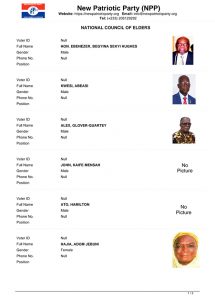
The Chronicle has sighted extracts of the said Register of Voters (album) in which pictures, as well as Voter ID numbers and contacts of some of the National Council of Elders and founding fathers of the party, are missing. For instance, not only do Messrs John Kaife Mensah, Ato Hamilton, Obeng Appiah and Osei Nyame have no pictures, but their voters ID numbers and contacts are not showing.
Founding members without pictures, voter’s ID numbers and contacts
The Chronicle sources have pointed to extracts, which explicitly show pictures of Professor Bawuah, Dr. Akuamoah Boateng, Rt. Hon. Prof. Aaron Mike Oquaye, but their contacts and voter IDs are indicated as “null”. Prof. Dominic K. Fobih, Prof. Wayo Seini, Muhammed Aminu Amadu and Stanley Nii Adjiri Blankson have their pictures embossed in the album, but no indication of their voter’s ID numbers and contacts similarly marked as “null”.
Also affected in the same way are Ebenezer Begyina Sekyi Hughes, Kwesi Abeasi, Alex Glover- Quarter and Hajia Adam Jebuni.
An extract of founding members sighted by The Chronicle has revealed that the under-listed, among several others, have not provided their voter’s ID numbers and contacts, as well as their photographs. The affected in this category are Catherine Tedam, G.K. Osei Bonsu, Nana Sonful Akwatia, A.E.A. Asiamah, Mary Nartey, Salifu Mahami, Daniel Kwasi Adusei and Alberta Cudjoe.
Concerned members of the party have complained about the development and called on the National Elections Committee of the party to address the shortfalls before the conduct of the election is affected.
An extract of national council of elders
The National Elections Committee, which is chaired by Mr. Peter Mac Manu, shall superintend over all the election-related activities of the Conference, including sale of Nomination Forms and Vetting of Aspiring Candidates in line with the Party’s Rules and Regulations for the conduct of the Conference. The elections shall be supervised by the Electoral Commission of Ghana in line with Section 17(2) of the Political Parties Law, Act 574.
Other members of the National Elections Committee include Oboshie Sai Coffie, Amin Anta, Ambassador Edward Boateng, Lawyer Gary Nimako Esq., and Ing. Kwesi Abease, Mrs. Mawusi Nudekor Awity, Evans Nimako, Alhaji Bismi Hussain, Dr. Kwaku Agyemang-Budu Esq., Eric Ntori and Emmanuel Darkwa Esq.
On the other hand, the National Planning Committee is chaired by Mr. Sekyere Abankwah, and shall be responsible for coordinating the activities of all the conference subcommittees to ensure the smooth organisation and conduct of the National Annual Delegates Conference.
Reconstruction of the 33.4 km Ofankor-Nsawam road into six lanes carriage way starts on July 20, 2022 and expected to be completed within 24 months at the cost GH¢341.48 million.
The Ministry of Roads and Highways through Ghana Highway Authority awarded the contract to Messrs Maripoma Enterprise Limited with Associated Consultant Limited as the consultant.
The scope of work includes reconstruction of the existing asphaltic concrete pavement, expansion of the main carriageway from 2-lanes to 3-lanes including service lanes and provision of 11 safe pedestrian crossing facilities.
4 interchanges
The rest are provision of four interchanges, provision of adequate drainage structures, provision of streetlights and provision of traffic signs and road markings.
The Ofankor – Nsawam Road, despite its strategic importance is in a deplorable condition; characterised by severe depressions, potholes and drainage problems thus creating severe traffic congestion within this portion of the road.
The project objectives include reduction in travel time, reduction in vehicle operating cost, reduction in waiting time for public transport and reduction road crashes within the section
Backgound
The Ofankor-Nsawam Road, which forms part of the National Route 6 (N6), is the most economic road in Ghana connecting the capital city, Accra to the second largest city, Kumasi.
It also serves as a major arterial for communities in the Ga West Municipality, namely; Pokuase, Amasaman, Medie, Sarpeiman among others. The strategic location of the Ofankor-Nsawam Road makes it one of the most important links in Ghana’s network as it serves the northern, central, western, and southern parts of the country thereby generating a huge band of influence on the transportation for the people of Ghana.
In addition, it is also a vital link for trade between Ghana and its neighbouring landlocked countries (Burkina Faso, Mali and Niger) and for transit cargo to move from the Ports of Ghana to these countries. Government recognizes the importance of road transport in facilitating socio-economic development of the country.
It is in this decision that the National Transport Policy of the Ministry of Roads and Highways set out objectives to create an integrated, efficient, cost-effective and sustainable transport system in response to the needs of society, supporting growth and poverty reduction.
Project description
The existing 2-lane dual carriageway is to be developed into 3-lane dual carriageway with service lanes and interchanges. The scope of the work includes preliminary engineering design and detailed engineering design.
The Students Loan Trust Fund (SLTF) has released a total of Gh12 million cedis as loans to students in tertiary institutions across the country.
About 10,000 students from 148 tertiary institutions in the country benefitted from the release, which is the first payment being made after the official launching of the “No Guarantor Loan Scheme” on June 9, 2022.
The Chief Executive Officer of SLTF, Nana Kwaku Agyei Yeboah, who disclosed this to the media in Accra on Friday said, the amount covers payment to only first-time applicants for the first semester of the year.
First-time applicants from the University of Education, Winneba recorded 1,523 as the highest recipients, followed by the Kwame Nkrumah University of Science and Technology (KNUST) which had 787, the University of Ghana had 511, with Koforidua Technical University recording 488 students, and Takoradi Technical University with 371 respectively.
He stated that the lowest amount received by each student ranged from G H¢1,500 being the lowest and GH¢3,000 as the highest depending on the needs of the students after a means-testing assessment by the SLTF before disbursement to the students.
Nana Agyei Yeboah said the payment would go a long way to ease the burden of students as they continue their education on various campuses across the country. The CEO explained that all continuing students who are beneficiaries of the Students Loan Scheme in the country were paid in March this year. He stated that everything possible would be done to ensure that payment of funds to students would be made timeously to the beneficiaries to ensure that the students do not have challenges with funding.
Nana Agyei Yeboah appealed to beneficiaries of the scheme to ensure that they voluntarily pay back their loans to ensure that the government gets enough funds at all times to run the scheme for the benefit of others.
The CEO said the only people who have so far not been paid were those who have applied, but have not completed the submission of the required information to the scheme and urged them to expedite action in the completion of their documentation and take their biometrics so they could be paid.
He appealed to those who have not yet applied to the scheme to do so since they could also benefit from the loan, which was readily available to all qualified students irrespective of political, social, religious and ethnic orientation.
Background
The difficulties involved in getting people to guarantee for students loans applicants used to be a major challenge to many students in tertiary institutions in the country.
This prompted the Nana Addo Dankwa Akufo-Addo-led government to introduce the No Guarantor scheme to ensure that tertiary students are able to secure loans to support their education without much difficulty.
Many Ghanaians have commended the government for the successful rolling out of the no guarantor scheme which had brought about much relief to students, parents and the institutions of study.
To ensure that beneficiaries received their funds without much challenges, they are required to have E-zwich cards (a smartcard issued by the Ghana Interbank Payment and Settlement System Limited (GhIPSS) for easy payment.
Local unions of the Ghana Port and Harbour Authority (GPHA) say they intend to demonstrate against the Meridian Port Service (MPS) and GPHA concession agreement, which was signed in 2015 and the impact it was having on the workforce, and the country as a whole.
The Union Chairman, Mr. Emmanuel Arhin Young, told journalists that the Maritime Dockworkers Union, which was not happy with the way the content of the agreement, petitioned the Presidency over the issue.
Cabinet, after deliberation on the petition, according to Young, directed the sector Minister, Kwaku Ofori Asiamah, to engage both parties (MPS-GPHA) to ensure that the demands of the GPHA were adhered to by MPS.
These demands are: (A) GRA compliance to remove all refrigerated containerised cargo volumes from MPS to GPHA Reefer Terminal, (B) GPHA to implement its intention of leasing Harbour Mobile Cranes for its containerised vessel operations, (C) GPHA be allowed to handle 20% of containerized cargo traffic during the ten year exclusivity period.
Mr. Arhin regretted that though these directives have been duly communicated to MPS with several reminders, the latter has still failed to adhere to the directive of cabinet especially on the 20% container volumes since 2019.
The MPS non-adherence, which he attributed to the inaction of the Sector Minister, Kweku Ofori Asaimah, necessitated the local unions to engage both management of the GPHA and the sector Minister.
Mr. Arhin Young said the local unions viewed this as gross disrespect by MPS to Cabinet, and by extension the President, for disregarding his Cabinet-led directive over this period.
To Mr. Arhin this situation is unacceptable because of its daring consequences, which is currently impacting negatively on the entire workforce and financial sustenance of the organization in general.
According to the Union leader, they now have no option than to embark on a massive demonstration in the coming days to ensure that MPS implement the directives of cabinet and by extension the president.
The Founder and Leader of the All People’s Congress (APC), Dr. Hassan Ayariga, has urged government to embrace all inclusive governance model practices to bring about diversity to grow the country’s economy. Additionally, he insisted that government could revive the fortunes of the economy through the adaptation of best economic models that drive value for money outcomes and avoid investments with negative returns.
Speaking at a press conference dubbed “The Way Forward for Our Nation,” Dr. Ayariga charged President Akufo-Addo to be bold to sack non-performing ministers from his government and hold others accountable for their stewardships.
Economy
Touching on the economy, he explained that the future of the country looked bleak, because the economy had taken a nose dive, with high cost of living, massive hardship, and unsustainable levels of inflation. He said: “Fuel prices and other utilities tariffs are on the rise almost every day; transport fares are increasing every day and thereby worsening the plight of the citizens.”
“The future of our country is that if we don’t take care, we will destroy our nation from within, and the future generation will have nothing to build on when they take over… Ghanaians are suffering; many cannot even afford three square meals a day. The hardship is killing people slowly,” he charged.
The economy, he said, looked terrible, alleging that the government owed every sector, while the citizenry faced tougher financial conditions, with many in deplorable situations. “Salaries are still the same; foodstuffs and groceries are increasing every hour and every day. A ball of kenkey is now sold for three Cedis, which cannot even feed an eleven-year old child,” he alleged.
Debt Stock
He explained that Ghana’s public debt stock was at the highest peak with a staggering 81% to GDP while inflation stood at 27.6% making Ghana the sixth worse economy in the world.“Ghana’s fiscal deficit in 2018 and 2019 were the highest in the entire West African sub-region…2020’s fiscal deficit of 15.7%, again was the highest in the West African sub-region and the second highest in the entire Sub-Sahara African region behind Seychelles,” He stated
Following government’s decision to seek a bailout from the IMF, which has added up to 17 the number of times the country has visited the Bretton Woods Institution, Dr. Ayariga indicated that both the New Patriotic Party (NPP) and the National Democratic Congress (NDC) were the same.
“Ghana’s swift journey to the IMF collaborates the fact that both the NPP and NDC have nothing to offer our beloved Country Ghana.”
Responding to government’s position that the economy was performing terribly because of COVID-19 and the Russia’s evasion of Ukraine, he stated that the two external factors could not be solely blamed for the poor state of the economy. He said, “Ghana’s Economic downturn started even before the arrival of Covid-19 and both the IMF and the World Bank have echoed it in their reports”.
“I, however, wish to ask: is the impact of COVID-19 and the Russian war against Ukraine exclusively a situation against Ghana? How can a global phenomenon skip Côte d’Ivoire and all the surrounding countries and only attack Ghana, how, how does it happen?”
To overcome the socio-economic challenges that have bedeviled the country, which has necessitated government’s call on the IMF for support, he indicated that government must concentrate on price control systems among other factors.
Engagement
He charged on Members of Parliament to put aside their partisan and “selfish interests” and rather put the national interest first in the discharge of their duties in Parliament.“The current hung Parliament provided a good opportunity for Parliament to showcase its strength in seeking the interest of the people,” he said.
He advised President Akufo-Addo to setup a second Economic Management Team comprising key stakeholders, including captains of industry, labour and political parties.
The team, he said, would “provide a second view to the government’s own Economic Management Team. That way, the country would be gaining more knowledge and expertise from a non-partisan body to guide it in its policies and programs”.
As a country, he said, “we must shift from importation to production and manufacturing to salvage the Cedi. We cannot continue to be importing everything at the cost of local production and expect that life would be easier for Ghanaians.”
President Akufo-Addo says all countries around the world are working to return themselves to a state of normalcy following the devastating impact of the pandemic of COVID-19, whose effects have been exacerbated by the Russian invasion of Ukraine.
According to President Akufo-Addo, “Economies have been plunged into recessions, businesses have collapsed, and lives and livelihoods have been disrupted. Food and fuel prices have escalated dramatically, as global and domestic inflationary pressures mount. Hopefully, sooner rather than later, the world will make up on lost time.”
Swearing in 10 Ambassadors and High Commissioners at Jubilee House, on Thursday, 7th July 2022, the President stated that “in our case, we have decided to seek the collaboration of the International Monetary Fund (IMF) to repair, in the short run, our public finances, which have taken a severe hit in very recent times as a result, whilst we continue to work on the medium to long-term structural changes that are at the heart of our goal of creating a Ghana Beyond Aid, that is building a resilient, robust Ghanaian economy.”
He was confident that “determination, hard work, unity and the proverbial Ghanaian sense of enterprise, we will make it, we will succeed. Indeed, this too shall pass.”
President Akufo-Addo told the Ambassadors and High Commissioners that the twin events of COVID-19 and the Russian invasion of Ukraine have emphasised the need for stronger ties of co-operation and bonds of friendship around the world.
“No country can afford to go it alone, we either succeed together or we perish together. And this is where your work as Ambassadors and High Commissioners will be needed the most,” he added.
The President, thus, urged them to familiarise themselves with the objects of the Ghana CARES ‘Obaatampa’ Programme, which sets out Ghana’s roadmap towards the strong revitilisation of the Ghanaian economy.
Part of their responsibilities, at the multilateral level, President Akufo-Addo added is for them to work with the governments of their accreditation to assist in the prosecution of their common agenda in the fight against the scourge of armed conflicts, terrorism and violent extremism, the threats of climate change, and the illicit flow of funds from Africa.
“Whilst at it, you also have the onerous responsibility of promoting the image of a country whose reputation amongst the comity of nations continues to be high. You represent a country that, as a result of the commendable conduct of the Ghanaian people, is regarded as one of the most stable on the African continent,” he said.
President Akufo-Addo continued, “At your respective duty posts, you must strive to develop cordial working relations with the professional Foreign Service officers you will find at your duty posts. They have invaluable experience and knowledge of the terrain, which should help you work effectively. You will need their assistance, and they will need your guidance and leadership.”
Ambassadors and High Commissioners
The High Commissioners sworn-in by the President include Mrs. Worwornyo Agyeman, High Commissioner to the Republic of Sierra Leone, and Mrs. Florence Buerkie Akonor, High Commissioner to the Federation of Malaysia.
The rest are Mrs. Merene Benyah, Ambassador to the Republic of Italy; Mr. Mohammed Nurudeen Ismaila, Ambassador to the State of Qatar; Ms. Mavis Esi Kusorgbor, Ambassador to the Republic of Angola; Mrs. Lydia Ofosua Amartey, Ambassador to the State of Israel; Ambassador Emmanuel Kwame Asiedu Antwi, Ambassador to the Swiss Confederation; Mrs. Emma Mensah, Ambassador to the Republic of Senegal; Ambassador Ahmed Hassan, Ambassador-at-Large; and Mr. Henry Tachie-Menson, Ambassador-in-Situ.
President Akufo-Addo noted that “they have distinguished themselves in their various fields of endeavour and in the public service of our country, and are eminently fit to represent Ghana in their respective places of accreditation, which have expressed satisfaction at their appointments. I congratulate each one of you warmly on your well-deserved appointment, and I am confident you will make our nation proud.”
Acting Assistant Preventive Tettey addressing the personnel
Captain Dawaye explains some of the training rudiments to his guests
The Customs Division of the Ghana Revenue Authority (GRA) has boosted the strength of its Counter-Terrorism Unit with 60 more personnel who completed a three-week advanced military training at the Asutsuare Training Camp of the 64 Infantry Regiment last Friday.
The Customs Counter-Terrorism Unit (CCTU) was formed in 2017 in the wake of threats and attacks from terrorists in the West African sub-region.
Therefore, the Customs Division, a frontline state security service that mobilises revenue for the state at the land borders, the most fragile entry point for such bandits, needed advanced military training to enable their personnel perform dual roles at the borders, which includes fighting any threat of terrorism at Ghana’s borders.
In the 64 Infantry Regiment camp, the 60 personnel, including five females, were taken through rigorous combat fitness training and tests from June 21, this year.
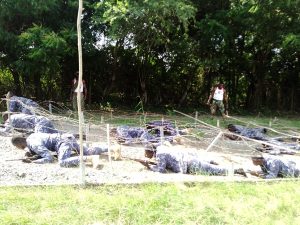
Some trainees crawl with their rifles to safety under an obstacle
The fitness training included mountaineering exercises of 1.6 kilometres above sea level with a 10kilogramme load pack, crossing water bodies, crawling underneath obstacles and jumping down from heights.
Additionally, the personnel were taught through map reading and basic navigation, safety precautions on the handling of the AK47 rifle, close-quarter drills, tactical combat care and physical fitness and discipline to improve self and group confidence.
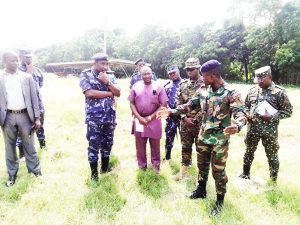
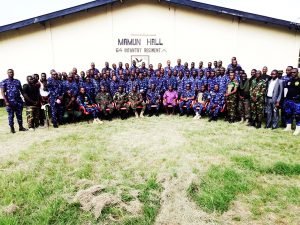
The Acting Assistant Commissioner Preventive, George Tettey, a Principal Analyst from National Security, Dr. Baba Sayuti, and other officers from the Customs Division of the GRA and Ghana Immigration Service, led by Captain Peter Kojo Dawaye, Officer Commanding of the Asutsuare Training Camp, who briefed his guests on the tough training and fitness level of the personnel.
To demonstrate their readiness as combatants, Captain Dawaye further led his guests to witness some demonstrations of the rigorous training the personnel underwent.
A group picture of trainers, guests and CCTU personnel
In his closing remarks, Captain Collins Nkansah, on behalf of the Commanding Officer (CO) of the 64 Infantry Regiment, Lieutenant Colonel Frank Agyemang, commended the personnel for enduring the training and the demonstration of readiness to defend the state, especially when the threats to security had changed, given the insurgencies of terrorists in Ghana’s neighbouring countries.
He said Ghana was not insulated from such threats, hence, the need for the CCTU to give its personnel the right training to protect the country’s borders.
He said: “Soldiers are not always the first respondents in such attacks. They (soldiers) only come in to augment the strength of the front lines when the need arises for a backup.”
The personnel were encouraged to keep training on their own to avoid becoming rusty, revise their notes and apply everything they had been taught in the field.
Dr. Baba Sayuti, Principal Analyst at National Security, on his part, urged the personnel to attach professionalism and intelligence in perform their duties.
Dr. Sayuti explained that as the personnel were going out to perform dual roles – gathering intelligence and revenue generation – they should not let their guards down.
“The work in the field is going to test your skills and knowledge and so you need regular practice,” he admonished the CCTU personnel.
Lastly, the Acting Assistant Commissioner Preventive, George Tettey, also the Guest of Honour, urged the personnel to be vigilant and gather and share information and intelligence with the front-line sister security agencies in these fragile times.
More importantly, he charged the personnel to close their ranks with their sister security agencies, as Ghana continues to prepare itself against any threat of terrorism.
Mr. Tettey announced the introduction of the use of drones by the Customs Division of the GRA as another means of gathering information at the borders.
“The Drone Unit will soon be ready after personnel have completed their training on the use of the technology. Besides that, the Customs Division will continue providing such advance military training to its personnel because we need it,” he said.
George Tettey said Customs believed in the competencies of the CCTU and expressed the confidence that the Unit would not disappoint the nation.
The Greater Accra Regional Minister, Henry Quartey, has served notice that illegal structures at the Tema, Sakumo Ramsar Sites core zone would be demolished.
Addressing the media last week Thursday, the Minister said: “We will go back from here to be guided by the experts to tell us which area, the distance they want between the transition and the core. If they want to create a new core that will be up to them, but, certainly, I can say that some houses will go down.”
This was after an inspection tour, led by the Minister, in collaboration with the Managing Director of TDC Development Company Limited, Alice Abena Ofori-Atta, Chief Executive (MCE) of the Tema West Municipal Assembly, Anna Naa Adukwei Addo, the MCE for the TMA, Yohane Amarh Ashitey, and members of the Regional Security Council (REGSEC), to ascertain the level of destruction caused to Ghana’s Ramsar Site at Tema, in the Greater Accra Region.
The globally recognised Ramsar Site was designed to collect water from various regions of the nation and channel it into the sea. However, the majority of it has been encroached upon by developers, leading to flooding in nearby communities.
Buffer, Transition and Core land make up the Ramsar. Out of the 1,200 acres of core land, a whopping 700 acres have been invaded, and the remaining 500 acres have been filled with sand for development. In total, the Buffer and Transition areas have all been overtaken.
If the Ramsar Site is not safeguarded, the regional minister for Accra worries are that flooding would spread to further communities and with devastating effects.
“It means that those who are living in East Legon sooner or later, will be submerged. Adjei Kojo and Ashaiman is likely to be submerged and at Adjriganor should there be any heavy rainfall it will be affected,” he noted.
The Greater Accra Regional Minister gave the assurance that government would not relent in its effort to demolish buildings constructed on the wetland.
He described as ironic, injunction orders secured by some of the encroachers against state agencies such as the Forestry Commission, TDCL, the Tema West Municipal Assembly and the Tema Metropolitan Assembly to prevent them from performing their mandated duty of preserving the wetland.
According to the Technical Advisor to the Chief Executive Officer of the Forestry Commission, Rev. David Kpelle, the government of Ghana acquired 4,200 acres of the Ramsar site in 1998.
He said Ramsar sites were very important, particularly as habitat for migratory birds and also serves as a control system for excessive floodwaters coming from uplands such as Aburi, Madina, Kpone Katamanso and beyond.
He indicated that he had led a demolition team to the place, but “The Assemblyman, the Presiding Member, the chiefs and land guards came to stop us. Security people came with us and they brought a court injunction. We went to court to put an injunction on the building and the Judge refused us and rather put an injunction on Forestry Commission.”
According to him, there was still an opportunity to salvage the Ramsar site, stressing that the government should go ahead and demolish structures on watercourses, dredge the lagoon and open up the dysfunctional sluice gates to allow for the exchange of sea water and lagoon water.
To him, wetlands were set aside not to be inhabited or developed as residential areas, since such structures were susceptible to flooding. In addition, the Municipal Chief Executive of Tema West, Anna Adukwei Addo disclosed that the over 4000 houses sitting on the Ramsar site are developed without permits and pay no revenue to the government.
Kofi Asare, Executive Director of Africa Education Watch
The Executive Director of African Education Watch (Eduwatch), Mr. Kofi Asare, has advised Ghanaians not to blame the Education Minister, Dr. Yaw Osei Adutwum, for the seeming food shortages in some Senior High Schools (SHS) in the country.
According to him, the current food shortage challenges were a result of the Ministry of Finance refusing to release enough money to pay suppliers of food to the schools.
Responding to questions on the AM SHOW on JoyNews on Monday via Zoom, Mr. Kofi Asare said the Education Ministry and the National Food Buffer Stock Company (NAFCO) had put in place prudent policies and cash flow projections to ensure that the SHSs keep running without challenges.
He explained that the Finance Ministry’s refusal to release the right amount of funds to pay the food suppliers made it difficult for them to have enough money to buy and supply to the schools.
“Look until the Finance Ministry makes it a point of releasing funds to the suppliers regularly and on time, it would be difficult for this shortage issue to end since they cannot continue borrowing money to buy food stocks at huge sums for supply in the schools,” the ex-Director said.
Mr. Asare suggested that the feeding component of the Free Senior High School should be looked at critically and make parents who could afford to pay. The ex-Director’s call follows recent media reports of food shortages in some SHS in the country leading to many parents getting worried about how their children and wards would be fed while in school.
But the Spokesperson for the Education Ministry, Mr. Kwasi Kwarteng, in a Facebook post over the weekend said the government has met the leadership of the Conference of Heads of Assisted Secondary Schools (CHASS) to find a lasting solution to the issue. He said the Ministry and the leadership of CHASS have resolved the issue and food would be supplied to the affected schools by Tuesday.