Home Blog Page 2212

Former Ministry of Housing Chief Director wheeled to court

0
Court hammer

A former Chief Director at the Ministry of Works and Housing, Alhaji Ziblim Yakubu, has been brought from Yendi in the Northern Region to Accra in a wheelchair to face 43 criminal charges. The former Chief Director is currently incapable of moving on his own due to ill-health, but was ordered on Monday to appear before the Economic and Financial Court ‘1’ yesterday.

Alhaji Yakubu, together with others – Alhaji Collins Dauda, a former Housing Minister and Member of Parliament (MP), Dr. Kwaku Agyeman-Mensah, also a former Minister, Andrew Clocanas, Executive Chairman of Construtora OAS, and Nouvi Tetteh Angelo, Engineering, Procurement and Construction (EPC) – have been charged with a total of 70 counts.

The counts are wilfully causing financial loss to the Republic; issuing false certificate and intentionally misapplying public property. However, Alhaji Yakubu is facing 25 counts of causing financial loss to the Republic.

Although the two former ministers, as well as Andrew and Angelo’s pleas of not guilty had since been taken, Alhaji Yakubu’s plea was taken yesterday. The latter pleaded not guilty to all of the counts. His plea delayed due to his ill-health, which allegedly hampered his appearance before the trial court previously.

The five are being tried for allegedly leading the country to lose $200 million in the Saglemi Affordable Housing Project. The Accra High Court, presided over by Justice Dr Ernest Owusu Dapaah, granted Alhaji Yakubu’s application for the trial to be conducted in his absence, due to the same reason of his ill-health.

The application generated quite a heated legal argument between the prosecution, led by Hilda Craig, and Godwin Tamekloe, defence counsel for Alhaji Yakubu. Before the suit was adjourned to June 12, the court ordered the prosecution to put its house in order regarding other witnesses they were yet to file their witness statements.

Gold exports rake in $6.6bn in 2022

0
Gold bars

The Minister for Lands and Natural Resources, Samuel Abu Jinapor, has indicated that gold exports contributed some US$6.6 billion to the economy in 2022. Despite several loopholes, the mining industry continues to be the bulwark of the Ghanaian economy, the minister said.

He acknowledged that the energy sector has also helped the economy greatly, but swiftly observed that the nation has not benefited optimally from those two sectors.

Mr. Jinapor was speaking at the fifth Ghana Mining and Energy Summit held on Wednesday, June 7, 2023 in Accra, on the theme: “Harnessing Mining and Energy Potential for Sustainable National Development.”

ISSUES

In his address, the Minister outlined some loopholes in the energy and mining sectors of the country, denying the state the actual returns from these mineral resources. He argued that Ghana has not had good negotiations in the past for the extraction of its mineral resources.

According to him, some policies and contracts have “unfortunately resulted in extraordinary profits to mining companies,” at the expense of the country.

He lamented over the failure to compile a proper framework to the benefit of the nation, adding the overdependence on the export of raw minerals, which has denied the nation of the needed benefits.

Referring to data, the Minister could not exonerate actors in the extractive industry for short-changing the country.

“Is it not alarming, as the data shows, which the extractive sector continues to be the major contributor to illicit financial flows from the continent? Illegal exploitation, tax evasion, trade mis-invoicing, transfer pricing, under-declaration, are just a few of the practices contributing to this menace,” he mentioned.

According to a report by the Africa Centre for Energy Policy (ACEP) on illicit financial flows from Ghana, which the Minister referred to, the nation loses about US$1.44 billion per year.

This is through trade mis-invoicing “with export under-invoicing and import over-invoicing accounting for almost another billion dollars. We obviously cannot sustainably develop if these continue.”

OPPORTUNITY

Nonetheless, Minister Jinapor was of the view that the summit presented the country, its energy, and mining sectors with a unique opportunity to build a sustainable and prosperous nation using clean energy and responsible mining practices.

He called on participants to unlock the full potential of the mining and energy sectors for local industrialization in a manner that ensures energy efficiency, environmental protection, and responsible ecosystem management for climate action.

He advocated for collaboration with the government and other stakeholders towards a common goal, adding that “we must prioritize sustainable practices and adopt an approach that balances economic growth, social equity, and environmental stewardship.”

GREEN MINERALS 

He indicated that the Akufo-Addo led government remains committed to working with all stakeholders to ensure compliance with stringent environmental regulations, the protection of local communities, and the fair distribution of benefits.

Since 2017, the government has prioritized value addition and local content and local participation in the mining industry.

The Minister explained that the measures were being taken through policies such as the establishment of the Ghana Integrated Aluminium Development Corporation (GIADEC) and the Ghana Integrated Iron and Steel Development Corporation (GIISDEC), and the progressive revision of our local procurement list.

The Ministry of Lands and Natural Resources, he remarked, remains committed to working with the Ministry of Energy to accelerate their efforts in renewable energy development.

Prosecution witnesses in Opuni’s trial can’t be located – Court told

0
Court

The trial of the former Chief Executive Officer (CEO) of Ghana Cocoa Board (COCOBOD), Dr. Stephen Kwabena Opuni, and two others has taken a new twist, as the prosecution, for the second time, has asked for a further adjournment to chase witnesses.

According to the prosecution, it was having a difficult time in locating some of its witnesses.

The prosecution had earlier expressed its inability to get witnesses to testify, after the court held that the six years old suit should start ‘De Novo’.

The prosecution, led by Chief State Attorney (CSA) Evelyn Keelson, informed the Land Division of the Accra High Court of their challenge yesterday.

She, therefore, prayed the court, presided over by Justice Kwasi Anokye Gyimah, to adjourn the case to enable them put their house in order.

The court granted the prayer and adjourned proceedings to July 12, this year.

Court of Appeal hearing

In a related case, an appeal filed by the Attorney General (A-G), Godfred Dame Yeboah, against the ruling of the High Court was also called at the Court of Appeal yesterday.

However, the appellant court has given June 14, 2023, to rule on some legal objections that were raised by the counsel in the trial.

According to Samuel Cudjoe, counsel for Dr. Opuni, the appeal filed by the A-G had missing pages, as well as words.

He said the practice of the Court of Appeal was that they gave the full complement of the records to parties, then the Registrar would write to the parties to go through, after which they would send their comments that the records were aligned.

He added that it was the responsibility of the Registrar to ensure that the entire record brought to court was not half, as they had done in this case.

Mr. Cudjoe urged the appellant court to order the Registrar of the High Court to properly compile and resubmit the entire records.

“This act we submit in the Court of Appeal not having the full records to make an informed decision with respect to the appeal,” he said.

Benson Nutsukpi, counsel for the second and third accused persons – Seidu Agongo and Agricult Ghana Limited – associated himself with the concerns raised by the first accused’s lawyer, Mr. Cudjoe.

According to him, he had also seen a series of mistakes in the proceedings, and per the practice, they were to be served the full records of the proceedings.

But Mr. Dame, on the other hand, opposed the application, arguing that it was totally unsupported by any rule of procedure so far as proceedings were concerned.

He said the court would note that the conduct of criminal cases by the Court of Appeal was regulated by Constitutional Instrument (CI) 19, for which it drew a distinction between proceedings of civil and criminal appeals.

He explained that whereas in a civil appeal there was the involvement of parties in determining what ought to go into the record, the court would note that same was completely omitted when it came to the conduct of a criminal appeal.

“Parties are wholly excluded in determining what goes into the records of determining the appeal,” he added.

“Rules 11 and 14 which are in the civil rules of C.I.19 and those rules show clearly that the parties first have the liberty to determine what goes into the records and they can even suggest to the Registrar an exclusion or inclusion of which documents in the records.”

He stressed that the constitutional provision that deals with fair trial was Article 19, and except where an act by a person, whether the Registrar or the prosecution, infringes on Article 19, that act could not be said to be a violation on the right of an accused person.

Mr. Dame said the application by counsel for the accused was unknown to the court, and the luxury entendres to them by serving them with the record of proceedings.

He added that the record contains over 4,000 pages, therefore, the omission of about 25 pages cannot be said to be of substantial prejudice to the case of the respondents or accused persons.

AGL, school pupils mark World Environmental Day

0
A farmer weighing his product on the newly commissioned Weighbridge

Abosso Goldfields Limited (AGL-Damang Mine), together with school pupils drawn from its host community, last Friday marked World Environment Day on the theme: “Beat Plastic Pollution.”

The event saw the school pupils debate on the subject: “Should government ban single use plastic to reduce plastic pollution?”

The event was attended by workers from the Damang Mine, chiefs, Assembly members and some members of the community.

Speakers at the event raised concerned about how plastic had become a menace and suggested alternatives such as the re-introduction of paper bags.

Samuel Hadjor, Acting Operations Manager of Abosso Goldfields Limited, noted that materials that had proven to be a cause for concern and a threat to the environment were plastics. Plastic pollution is one of the most pressing environmental challenges of our time.

“Ghana generates around one million tonnes of plastic waste each year, but only recycles about 5% of it, while the rest end up in landfills, oceans, rivers, and ecosystems, harming wildlife, human health, and the climate.”

Today, he added, plastic clogs sewages and causes floods and our landfills leaches into the ocean. Micro-plastics find their way into the food we eat and the water we drink. Many plastic products contain hazardous additives, which may pose a threat to our health.

He, therefore, encouraged stakeholders to adopt a circular economy approach that minimizes waste and maximises reuse and recycling. “We need to support innovation and investment in alternatives to single-use plastic packaging and products, as well as raise awareness and educate consumers about the consequences of their choices and actions,” he said.

He said the governments, businesses, and individuals must collaborate to develop comprehensive waste management systems that prioritise recycling and the circular economy.

“Additionally, we must recognise the significance of community engagement and involvement in beating plastic pollution. Initiatives such as beach clean-ups, waste segregation programmes, and promoting sustainable lifestyles can have a profound impact on reducing plastic waste.

By fostering a sense of environmental responsibility and stewardship, we can inspire future generations to cherish and protect our planet,” Mr. Hadjor underscored.

He added that “as we celebrate World Environment Day, let us remember that we are the custodians of this planet, entrusted with the responsibility of preserving its beauty and diversity for future generations.

Beating plastic pollution demands our immediate attention, unwavering commitment, and concerted action. Together, we can create a world where plastic pollution is but a distant memory.”

NEIP launches maiden edition of Innovation and Entrepreneurship Week

0
Journalists seated at the launch

The National Entrepreneurship and Innovation Programme (NEIP), one of the government flagship programmes, has launched the maiden edition of its Innovation and Entrepreneurship Week. The NEIP is mandated to serve as a leading enabler for start-ups and innovations in Ghana.

Addressing the media at the press launch in Accra yesterday, the Chief Executive Officer of NEIP, Kofi Ofosu Nkansah, said the celebration would be a platform to bring together innovative ideas, and various opportunities that lie within their innovation and entrepreneurial ecosystems.

Officials of NEIP at the launch

“This will include many engaging programmes and initiatives designed to inspire, educate, and connect aspiring innovators and entrepreneurs with the resources they need to grow,” according to Mr. Nkansah.

He disclosed that his outfit had developed a five-year strategic plan, which outlined NEIP’s focus on being the enabler for innovation, start-ups, and entrepreneurship in Ghana.

“The innovation and start-up ecosystem is significantly different from the Micro, Small and Medium Enterprises (MSME) ecosystem, requiring a tailor-made framework to make meaningful impact in the Innovation Space,” Kofi Ofosu Nkansah stated.

He again indicated that throughout these celebrations, participants would have the chance to take part in interactive workshops, engaging panel discussions, and thought-provoking keynotes delivered by industry leaders and experts.

“They will get the opportunity to sharpen their skills, broaden their horizons, and gain valuable insights into various facets of Innovation and entrepreneurship.”

He stated that the programmes for the celebration would include Senior High School Innovation Challenge, which would bring together students from second cycle schools across Ghana to develop innovative solutions to real-world problems, enhancing their critical thinking abilities and nurturing their entrepreneurial mindset.

Also, Innovation and Entrepreneurship Symposium, Mr. Nkansah noted, would host stakeholders from academia, innovation space, investors, entrepreneurs and Policy makers and others from the innovation and Entrepreneurship ecosystem.

The CEO added that the Hackathon Competition, as part of the celebration, would be an event for participants to engage collaboratively, using technology over a short period of time to produce solutions for sector specific problemes.

He concluded by saying: “NEIP Innovation and Entrepreneurship Showcase: This will be a vibrant marketplace where Innovators and entrepreneurs can exhibit their innovative products and services.”

Background

The NEIP is the government’s special purpose vehicle for providing integrated National support for start-ups and small businesses. NEIP is mandated to serve as a leading enabler for start-ups and innovation in Ghana.

It provides direct and indirect funding support to third party institutions such as tech-hubs, incubators, accelerators, and other business development service providers, who provide business support for innovation-based start-ups.

Remove taxes on sanitary pads to promote menstrual hygiene -Chief

0
The Volta Regional Director of the Department of Gender, Mrs They will Eyra Kpe speaking at the forum at Kpalime-Duga

The Asafoatse of Kpalime-Duga, Ebenezer Osai Amoaku, has appealed to the government to remove taxes on sanitary pads to ensure a reduction in the prices of the product to enable parents buy them regularly for their teenage girls.

According to the Chief, it was about time the government showed commitment to efforts being made to promote gender equality and the empowerment of women, prevent child marriage, teenage pregnancy and gender-based violent programme to address problems relating to gender in the country.

Togbe Amoaku was speaking at a Community Parent Advocacy Support Groups (CoPAGS) monitoring and sensitisation forum at separate functions at Kpalime-Duga and Todome- Kpeyiborme in the South Dayi District of the Volta Region.

The programme, which was a collaboration between the Government of Ghana (GoG) and UNFPA through the Ministry of Gender, was under the theme: “End Sexual and Gender Based Violence, Child Marriage and Teenage Pregnancy.”

According to the Chief, the modern sanitary pads were more hygienic, but very expensive, compared to the traditional materials used in the past, which were very cheap and easily acquired, but seen as hygienically unsafe.

The Volta Regional Director of the Department of Gender, Mrs. Thywill Eyra Kpe, said the programme was geared towards the promotion of good communication approaches between parents and their children to foster healthy bonds between them.

Mrs. Kpe asked parents to network effectively, and regularly interact with other groups in other communities to deliberate on the welfare and well-being of their children, especially the girl child, to reduce to the barest minimum teenage pregnancy, early marriage and child birth.

Speaking on the topic: “Adolescent Sexual Reproductive Health” a Resource Person and a nurse from the  Ghana Health Service, Miss Senam Fiagbenya, advised parents to always engage their children on effective communication to enable parents to easily identify challenges confronting them.

Mrs. Fiagbenya said adolescents were cautious and experience-driven in life, therefore, needed care and attention from parents to draw them closer. This would enable the children to discuss issues bothering them with their parents.

She urged parents to intensify their efforts on sexual health and moral education with their children at home, and asked that they should be prepared at all times to supply the needs of their wards.

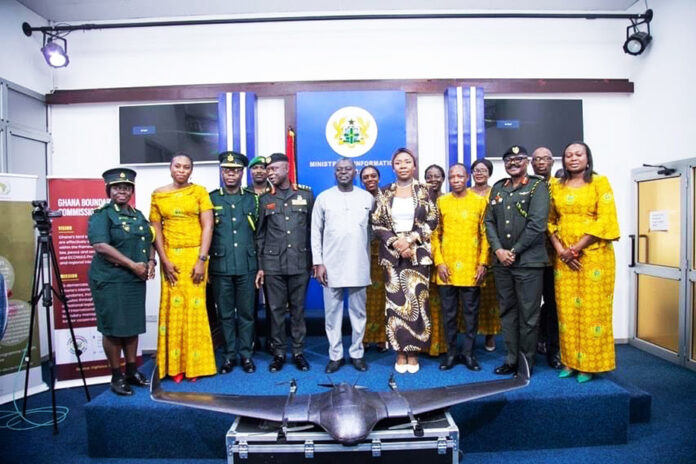
Boundary Commission working assiduously to secure Ghana’s maritime & land boarders

0
Dignitaries at the programme

The Deputy Minister for Lands and Natural Resources, Benito Owusu Bio has commended the Ghana Boundary Commission (GhBC) for exceptionally carrying out its duties over the past three years.

Addressing a news conference at the Ministry of Information, Tuesday, this week, the deputy minister said “The Commission has been very active over the past three years in parading the length and breadth of Ghana’s boundaries.”

According to Benito Owusu Bio, despite the numerous activities undertaken by the Commission, most Ghanaians are still not aware of its existence. He, therefore, called on all and sundry to promote the good works of the Ghana Boundary Commission.

“You have all been invited to help promote the Commission as a relatively new institution, most Ghanaians do not know of its existence and how different it is from other border management institutions.”

The National Coordinator of the GhBC, Major General Emmanuel W. Kotia, said the Commission has for the past years made significant efforts towards the reaffirmation, demarcation and delimitation of Ghana’s international land and maritime boundaries to ensure the territorial sovereignty of the Republic.

“The Commission also advises the government on international conventions in relation to the boundaries of Ghana and the signing and ratification of treaties related to land and maritime boundaries,” he added.

He continued that the overall goal of the Commission is to protect and secure the territorial interest of Ghana as a trusted partner with Ghana’s neighboring states.

On some of the activities undertaken by the Commission, Major Emmanuel W. Kotia noted that his outfit carried out consultative meetings with neighbouring Boundary Commissions.

Also, he said his outfit engaged Togo on maritime negotiations and implemented a mutually agreed Service, Vigilance and Partnerships.

On achievements, Major Emmanuel W. Kotia told the journalists that the Commission has also constructed the Land Boundary (Pillar 1) between Ghana and Togo.

“The Commission undertook joint maritime boundary inspections with the Ghana Navy along the eastern and western frontiers to evaluate maritime assets and assess cross-boundary violations and activities at sea that affect Ghana’s territorial integrity”, he said.

The Commission also established a systematic Geo-Database to manage Ghana’s International Boundaries.

Major General Emmanuel W. Kotia concluded by saying that the Commission relies on the expertise and skills of people in various agencies in advancing their mandate.

He again assured that his outfit would continue to receive unflinching support from partners and stakeholders (MDAs), Neighboring Countries and development Partners who have worked tirelessly with us in the course of the past years.

Background

The Ghana Boundary Commission was established by Act 795 of Parliament in 2010. The vision of the Commission is to ensure that Ghana’s land and maritime boundaries are effectively secured and managed within the framework of international law, peace and security and the AU and ECOWAS protocols of African and regional integration.

Climate change is a fundamental threat to our development -Jinapor

0
University of Ghana Business School

The Minister for Lands and Natural Resources, Samuel Abu Jinapor, has disclosed that climate change is a fundamental threat to the development of the country.

“The climate crisis remains one of the most fundamental threats to our development, our survival and the subsistence of planet earth,” he complained.

The minister was speaking at the Forty-Third (43rd) Management Day Celebration of the University of Ghana Business School in Accra yesterday.

Addressing the gathering on the theme: “Accounting for Climate Change and Environmental Sustainability: Our Collective Responsibility”, Mr  Jinapor said with less than seven (7) years to the attainment of the 2030 Sustainable Development Goals (SDGs), climate change has been identified as the most significant impediment to the realisation of these Goals, dragging millions of people into poverty.

Quoting experts, he said temperature rise above two degrees Celsius (2oC) can have catastrophic and irreversible consequences on people and the planet.

Meanwhile, at current rates, there are fears that average global temperature could be in excess of three degrees Celsius (3oC) by the end of the century, Mr Jinapor stated.

The impact of this looming disaster, the minister bemoaned, is already being felt across the globe, including extreme weather conditions that produce cyclones, hurricanes, sea-level rise, flooding, droughts and irregular rainfall patterns among others.

“Unfortunately for us, here in Africa, due to the agrarian nature of our economy and our low adaptation capacities, we are more susceptible to these impacts,” he said.

As a result of this, Abu Jinapor advised that the country’s response to climate change must be urgent, inclusive and comprehensive, in a way that strengthens the resilience of our ecosystems, and it must involve both individual and collective actions from the youth, Civil Society Organisation (CSOs), political and traditional leaders, local communities, public and private sectors actors, as well as the academia.

He continued that fighting anthropogenic climate change requires the need to establish a long-term path for environmental sustainability that caters for the needs of today’s generation and that of tomorrow’s, with healthy ecosystems of fauna and flora.

“Government continues to adopt policy measures geared towards environmental sustainability and socio-economic development, both at the micro and macro levels”, the minister asserted.

According to the minister, the 2012 Climate Change Policy articulates different sectoral policies and interventions across the forestry, transport, energy, waste, agriculture and other sectors needed to mitigate and adapt to climate change.

In addition to the policy, he noted that the updated Nationally Determined Contributions (NDCs), recently submitted to the UNFCCC, contains thirty-four (34) mitigation measures and thirteen (13) adaptation measures to address climate change towards a potential reduction of sixty-four million tonnes of Carbon Dioxide equivalent (64,000,000 tCO2e) of Greenhouse Gases by 2030.

“These mitigation and adaption measures are drawn from five (5) key sectors, and include a shift to renewable sources of energy at a larger scale, the promotion of electric vehicles, adoption of technologies that produce energy from waste, climate smart agriculture and reduction in deforestation and forest degradation,” he explained.

These Nationally Determined Contributions, Abu Jinapor told the gathering, are divided into conditional targets, which are to be achieved from Government funding with support from the international community and private sector, and unconditional targets, which are targets to be achieved from Government funding.

This, the minister added, clearly underscores the need for a concerted effort from different stakeholders to achieve climate solutions at scale.

On policies and programs the Forestry Sector had adopted to address Climate issues, the minister said the Intergovernmental Panel on Climate Change’s Fifth Assessment Report (IPCC AR5) estimates that deforestation and forest degradation contribute about twelve to fifteen percent (12%-15%) of the global Greenhouse gas emissions.

But if it is well managed, forests, and other nature-based solutions will have the capacity to contribute about a third of global climate solution.

His outfit is also implementing the Forest Plantation Strategy, under which some six hundred and ninety thousand hectares (690,000 ha) of forest was cultivated between 2017 and 2022, through initiatives such as, forest plantation, enrichment planting and trees-on-farm.

All these national efforts, the minister is optimistic will feed into global concerted actions to halt climate change.

He also urged the private sector to provide the financial and technical support needed; local communities must be ready to uptake innovation that fosters positive climate action.

“Also, civil society must continually engage in outreach to engineer broad level understanding of climate trends; academia and research institutions must continually research and publish new information about climate vulnerability and impacts; and, of course, the media must engage in dissemination of accurate information to educate the wider populace on all these actions.

“And to ensure compliance, experts are required to assess corporate entities, Environment, Social and Governance (ESG) impacts in their supply chains. This provides a rare opportunity for academia, including the University of Ghana Business School, to train and equip business experts with the rudiments of these assessments and how to conduct them, benchmarked against international best practices”, he reinstated.

Henry Quartey supports Circle – Tip-Toe lane fire victims

0
A trader receiving her money

Member of Parliament for Ayawaso Central and Minister for Greater Accra, Henry Quartey, has supported Tip-Toe Lane fire victims at the Kwame Nkrumah Circle.

The minister gave each of the victims GH¢2,000 to help resuscitate their businesses. The victims, who are mainly traders, lost their wares in an inferno that engulfed a portion of the Tip-Toe Lane market on May 21, 2023. Mr Quartey made the donation yesterday during a working visit.

Mr Henry Quartey talking to the media

Addressing the traders, the minister said the funds were drawn from the District Assembly Common Fund and the total amount donated was GH¢880, 000.00 to cover 44 victims.

He told the victims that he earlier opted to rebuild their container stalls, but later declined, upon complaints of rejection by their members.

Minister Quartey further stated that although some of the constituents often complain that he is too reluctant in disbursing the Common Fund, emergencies like fire outbreaks are some of the reasons he is slow to release the funds.

Subsequently, the fund is released quarterly and the amount is GH¢100,000, therefore, needed to be utilised judiciously.

Additionally, the minister said there are plans in advance to upgrade most of the markets with modern facilities in the region. He stated that the Tip-Toe market is to be transformed.

Big relief for over 800 rubber farmers as GREL brings weighbridge to their doorstep

0
Nana Essuakor Trepor (3rd left) commissioning the GREL Weighbride. looking on is Lionel Barry (2nd right)

Rubber plantation farmers in the Komenda Edina Eguafo Abirem Municipal (KEEA) in the Central Region can now heave a big sigh of relief following the construction and commissioning of a new weighbridge to take care of the scaling of their product.

Hitherto, the rubber farmers, located in the Abrem Agona Plantation and numbering about 800, had to travel to Agona-Nkwanta in the Ahanta West District of the Western Region to have their rubber weighed.

With the construction and commissioning of the new standard weighbridge by Ghana Rubber Estate Company Limited (GREL), a rubber plantation company, the risk of travelling several kilometres and spending money on transportation to cart their rubber for weighing is now a thing of the past.

What is assuring is that, in the likely event the number of the rubber farmers in the Abirem Plantation increase to about 1,000 and over, they would be entitled to a treatment plant in the plantation.

At the formal commissioning, the Managing Director of GREL, Lionel Barry, pointed out that until the construction of the weighbridge, “Our cherished rubber farmers in Central Region were trekking several kilometres to deliver their produce to our processing factories. This came with its own burdens, with high transportation costs being the foremost for the rubber farmers in this region.”

“As a company that prioritises and values our farmers, management engaged in consultations and discussions on ways to bring the services of GREL further to the doorsteps of their farmers.

“Management, therefore, decided to construct a new weighbridge to cater for Abrem Agona plantation.”

Lionel Barry added that the commissioning brought to seven the number of rubber weighbridges operated by GREL in the Western and Central regions.

Apart from the Abrem Plantation weighbridge, GREL has another weighbridge at Assin Edubiase, also in the Central Region.

Additionally, five other weighbridges are also in operation at Apimanim, Tsibu, Awudua, Subri, and Allabokazo all in the Western Region.

The weighbridges, according MD Lionel Barry at the above-mentioned locations, including that of Abrem, were all calibrated, certified, and constantly regulated by the Ghana Standards Authority.

As a result, Abrem Agona Plantation farmers and elsewhere were assured of the same quality of scale and services, in line with ISO Certification and Standards.

Lionel Barry, however, made it evidently clear that the Abrem Plantation weighbridge would significantly improve the economic fortunes of this community and the Municipality in diverse ways.

Food vendors would increase sales, because farmers would patronise their wares on their way to and from weighing their rubber. Persons in the transportation business would benefit.

“Over the few years that GREL started operations in some communities in this Municipality, we have always acted responsibly, and at every step of the way. This is in line with our values and international standards.

“We pledge to continue this path. To our cherished farmers, rest assured of our commitment to listening to you and providing the best services we can. As the pioneers in the rubber industry, we will stand with you to ensure that you maximise the gains that this industry brings to you, your families, your communities, and the entire national economy.”

Mr. Simon Tetteh, Head of Rubber Outgrower, said the purpose for constructing the weighbridge was to be in proximity with the farmers. Describing the location as safe ground, he expressed the hope that the farmers would capitalise on the weighbridge and increase their output.

Present at the commissioning were Nana Essuakor Terpor V, Chief of Abrem, Nana Gyan Dadzie, Chief of Eguafo, Obaahema Ampema Doku, Nana Aba Akyere, Chief Supt. Abraham Bansah, and the Municipal Police Commander amongst many others.

Addressing the farmers, Nana Essuakor Terpor applauded GREL for considering the plight of the rubber farmers by constructing a weighbridge to ease the trouble of travelling several kilometres to sell their produce to GREL.

The Chief advised the farmers to reciprocate the gesture by selling their produce to only GREL and avoid outside buyers.

The Ghanaian Chronicle