Home Blog Page 2155

20 Medicinal Benefits of Coconut Husks and Shell

0
Coconut husk

Coconut coir or coconut husk is the natural fibre extracted from the outer and the middle layer of the coconut. It is mostly used for doormats, brushes, and mattresses in Africa but it possesses some great medical values.

The coconut coir or coconut husk is an old age cure for several ailments back in the stone age and still can be used to cure those. Some of the diseases are:

  1. High Blood Pressure
  2. Kidney Stones
  3. Kidney Gonorrhoea
  4. Chronic candidiasis
  5. Syphilis
  6. Asthma
  7. Severe Stomach Pain not sure if it is an ulcer
  8. High cholesterol
  9. Mildness
  10. Boil
  11. Heart pains
  12. Menstrual crumps or pains
  13. Waist pains
  14. Blood flow when passing stool
  15. Jaundice
  16. Diabetes
  17. Enhance retentive memory
  18. Hair loss

How to Use Coconut Husks for Medicine

If you are suffering from any of these sicknesses, all you will need to do is to boil a cup of water, tear a handful of the coconut husk or coir, add it to the boiled water, and allow it to cook for 20 – 30 minutes. And then, you can be drinking it 3 times daily.

Or you can chew the coir ( if the coconut is fresh ) and swallow the nap (  water ) and throw the chaff away. A normal teacup is good for the measurement of drinking it.  Thanks.

Other Medicinal Benefits of Coconut Husks [ Fibre ]

The coconut husk and its shell have tonnes of benefits for humans and our natural environment. Most people don’t know about this because people are just afraid to try new things until found them verified by the big blogs or pharmaceutical companies. So l will tell about this with proofs as in the people who discovered them so you can check them out.

So, let us look at the benefits you can derive from coconut shells.

Uses of Coconut Shell

  1. It can be used as raw material for activated charcoal. And the ash from the burnt shell is an active ingredient in cosmetic skin care.
  2. You can also use half coconut shell for flower or plant pot, candles holder, bowl, ladles even plate for food when well polished.
  3. You can also get creative with the shells, and transform them into beads and or jewellery for yourself or dash.

More Uses Coconut Husk

  1. They are used as a planting medium that helps plants retain moisture and resist fungal growth.
  2. It is used for mattresses and floor tiles.
  3. Some people chew the husk in place of chewing sticks. And according to an old boy, it must teeth stronger as well as your gum and also removes bad breath.
  4. In some villages, the husk is burnt in the evening to shoo away mosquitoes during ‘at the fire side’ sessions. It does produce undesirable smoke or fumes

This article is based on research and doctoral education. We will be glad to receive any add-up, testimony or exclusion.

Source: https://globecalls.com

Feature: Ghana’s external debt restructuring: China in Perspective!

0
Finance Minister Ken Ofori-Atta with Stephane Roudet, IMF Mission Chief for Ghana

China’s Belt and Road Initiative (BRI) is an ambitious program aimed at building global infrastructure and enhancing China’s influence worldwide. Launched in 2013, it has become the largest transnational infrastructure project ever undertaken by a single country.

While the BRI has brought significant benefits, such as improved transportation and power infrastructure in various countries, it has also raised concerns about debt sustainability and the influence China wields over debtor nations.

Most of the countries that participated in the BRI were developing nations with weak credit ratings like Ghana. China’s cumulative engagement in the project has reached a staggering $932 billion, comprising $561 billion in construction contracts and $371 billion in investments. This immense scale of lending has both positive and negative consequences.

On the positive side, important infrastructure projects have been completed under the BRI. For example, a railway line in Ethiopia has significantly reduced travel time, while hydropower dams in Uganda have provided electricity and boosted tourism.

Road and pipeline constructions across Central and Southeast Asia have also spurred economic growth.

However, alongside these successes, there have been instances of wasteful projects, corruption, and poorly planned and over-priced projects that burden countries with unsustainable debt level in Ghana’s case.

In recent years, many developing countries that borrowed from China, including Ghana, have faced financial distress exacerbated by economic mismanagement, monetary inflation, and excessive fiscal dominance.

As a result, China has reduced its lending activities, transforming from a source of capital for emerging market growth into a “global debt collector.” This shift in China’s lending approach has raised concerns about the repayment capacity of debtor countries and the challenges they face in negotiating debt relief.

A recently published paper by Horn, Parks, Reinhart, and Trebesch sheds light on China’s extensive bailout operations and its new system of international rescue lending. The study reveals that between 2000 and the end of 2021, China provided $240 billion in rescue loans through 128 bailout operations in 22 debtor countries.

This approach significantly differs from the traditional debt relief mechanisms employed by institutions like the International Monetary Fund (IMF) and the Paris Club. The Paris Club, an informal group of creditor nations, offers coordinated debt relief to debtor countries based on negotiated terms.

In contrast, China prefers private negotiations with countries struggling to meet their debt obligations, avoiding participation in the Paris Club. China’s insistence on full repayment makes it difficult for other lenders to provide debt relief or offer low-interest loans to debtor countries, as the money would simply flow back to China.

China’s bailout loans also differ in terms of interest rates compared to those offered by the IMF. While the IMF typically provides rescue loans with a 2% interest rate, Chinese rescue loans carry an average interest rate of 5%. This disparity, along with the lack of coordination among creditors, has prolonged debt crises in countries like Sri Lanka and Zambia.

The paper highlights that China’s rescue loans primarily serve as a bailout for its banks, which have played a significant role in financing the Belt and Road Initiative. By extending emergency loans without demanding improvements in economic policy discipline or coordinated debt restructuring, China aims to protect its banks from losses. However, this approach has raised concerns about the opacity and fragmentation of the global financial system.

Furthermore, the study emphasizes the use of swap lines, a facility where the renminbi (Chinese Yuan) is exchanged for domestic currency, as a tool for crisis management. These swap lines have become crucial for bolstering gross reserve holdings and addressing short-term liquidity needs in countries experiencing financial distress.

However, the lack of clarity on how the funds are used, particularly in servicing external debts to China, complicates debt monitoring and reporting.

The implications of China’s growing role as an international crisis manager and its influence on the global financial architecture require further research. It raises questions about the sustainability and transparency of China’s lending practices and the potential long-term consequences for debtor nations.

In the case of Ghana, the country has experienced a significant increase in its external debt in recent years, partly due to its participation in the Belt and Road Initiative.

Ghana’s debt distress has been exacerbated by the economic challenges brought about by excessive borrowing, including a decline in revenue and increase in debt repayment needs. China is one of Ghana’s largest creditors, and as the country faces difficulties in servicing its debts, discussions around debt restructuring have emerged.

Debt restructuring involves renegotiating the terms of existing debts to alleviate the burden on debtor countries. This can include extending repayment periods, reducing interest rates, or even partial debt forgiveness.

The process of debt restructuring can be complex and often involves negotiations between debtor countries and their creditors. In the case of China, the lack of participation in the Paris Club and its preference for private negotiations makes the process more challenging.

The terms of debt restructuring with China may differ from those offered by traditional creditors, such as multilateral institutions like the IMF or bilateral lenders.

Debt sustainability is a critical consideration in the restructuring process. It involves assessing a country’s ability to meet its debt obligations without compromising its economic stability and development prospects. Debt sustainability analyses take into account factors such as the country’s debt-to-GDP ratio, debt service-to-revenue ratio, and external financing needs.

For Ghana, debt sustainability is a pressing concern. The country’s external debt-to-GDP ratio has increased significantly in recent years, reaching over 100% in 2022. High debt levels can crowd out public investment, hinder economic growth, and limit fiscal space for essential social and development programs.

In navigating debt restructuring with China, Ghana needs to carefully assess the terms and conditions of its existing debts. It should prioritize sustainable and transparent debt management practices to ensure that any restructuring efforts contribute to long-term economic stability and growth.

This may involve engaging with other creditors, including multilateral institutions and traditional bilateral lenders, to secure favourable terms and achieve a comprehensive debt restructuring plan.

Additionally, enhancing domestic revenue mobilization, improving public financial management, and promoting inclusive and sustainable economic growth are crucial for Ghana’s long-term debt sustainability. These efforts can help reduce reliance on external borrowing and create a more resilient and self-sufficient economy.

n conclusion, Ghana’s external debt restructuring efforts, particularly concerning its debts with China, are complex and require careful consideration of debt sustainability and long-term economic stability.

The influence of China’s lending practices and its role as an international crisis manager adds further complexity to the situation. Addressing these challenges will require close collaboration between Ghana and its creditors, along with robust domestic economic policies, to ensure a sustainable and prosperous future for the country.

By Korsi Dzokoto

Source: citinewsroom.com

 PSG unveil Luis Enrique as their new manager 

0
Paris Saint-Germain have confirmed the appointment of Luis Enrique (left) as manager

Paris Saint-Germain have confirmed the appointment of former Barcelona and Spain boss Luis Enrique as their new manager.

It comes after the club earlier confirmed the sacking of Christophe Galtier after just one season.

Enrique has been out of work since leaving Spain at the end of the World Cup, and it is his first job in club management since his departure from Barcelona in May 2017.

Speaking to the club’s official website, he said: ‘I’m delighted to be joining Paris in order to enjoy a new experience.

‘It’s so exciting to meet new people, to live in this city, to learn a new language and, above all, to manage PSG.’

Enrique had also previously been on the shortlists of both Chelsea and Tottenham since he left Spain following their last-16 defeat to Morocco in Qatar.

His spell at Barcelona was a massive success winning the LaLiga title, a Champions League trophy and the Copa del Rey on three occasions.

Galtier lasted just a season in charge after being hired in July 2022. His sacking comes despite guiding PSG to Ligue 1 and the Trophee des Champions double.

The Frenchman was reportedly dismissed soon after the end of the season, with the club linked with replacements throughout much of June.

The club acknowledged his success and professionalism’ during his season in charge.

Credit: dailymail.co.uk

Man United make £34m offer for Inter Milan goalie Andre Onana

0
Andre Onana

Manchester United have made a verbal proposal of £34million plus add ons for Inter Milan goalkeeper Andre Onana.

Erik ten Hag is eager to get his desired number one in before the start of pre season and talks are now underway with Onana keen to move. Although, they don’t anticipate it being a quick process.

United have not yet made their offer in writing as they assess the Italian club’s demands but the opening gambit is understood to consist of £34m plus a further £5m in add ons.

United have been looking at cheaper alternatives including the likes of Feyenoord’s Justin Bijlow and Kevin Trapp at Frankfurt, but Onana is Ten Hag’s preference having worked with him at Ajax.

Manchester United’s goalkeeping situation is up in the air after long-term No 1 David de Gea was allowed to let his contract run down and expire.

He had been in talks over an extension on lower than his previous £375,000-per-week wages but, though an agreement at one stage appeared close, it ultimately remained unsigned and the Spaniard is currently a free agent.

A reviving of those talks has not yet been ruled out depending on the progress United make elsewhere in their attempts to bring in a new goalkeeper.

Ten Hag is hoping for a reunion with his former Ajax goalkeeper Onana who is also keen on a move to Old Trafford this summer.

Credit: dailymail.co.uk

NDC MPs Plot To Boycott Parliament

0
Dr Cassiel Ato Forson, Minority Leader

The Minority National Democratic Congress (NDC) Group in Parliament has served notice that their continuous cooperation with the Majority New Patriotic Party (NPP) Group will be compromised should the government continue to unjustifiably hunt and persecute its members, in an attempt to reduce their numbers.

To do so, they said they will boycott all parliamentary business on days when the re-elected Member of Parliament (MP) for Assin North, James Gyakye Quayson, will appear in court.

They also intend to do same for their other colleague MPs, including the Minority Leader, Cassiel Ato Forson and Collins Dauda, who are currently being tried at the courts.

This comes after Mr Quayson was sworn in as MP for Assin North on Tuesday, July 4, 2023.

Addressing the Parliamentary Press Corps at a press conference, moments after swearing in of James Quayson, the deputy Minority Leader, Emmanuel Armah-Kofi Buah, said “the verdict of the Assin North people is a stark reminder to the Akufo-Addo/Bawumia NPP government that, at all times whilst exercising the power and authority of the state, they must do so fairly and without ill-will, affection or malice, as they are enjoined to do by the constitution”.

He added, “As a united 137 Minority Group, restored and re-energised by the good people of Assin North, we wish to serve notice that from here, we shall march with our colleague, James Gyakye Quayson, to the High Court, to lend our unwavering support to him in his criminal trial.

“We shall continue to attend every court hearing with him in the full complement of our strength in the house and this, we shall extend to the court hearings of the Minority Leader, Dr. Cassiel Ato Forson, Collins Dauda and any other member of the Minority who is currently being persecuted by the Akufo-Addo /Bawumia NPP government.”

According to him, until the persecution of their members stop, cooperation will suffer during all such occasions, stressing that “If you touch one, you touch all of us”.

Earlier on the floor of parliament, the Minority Leader, Ato Forson, noted that their decision was aimed at protesting what they perceive as persistent persecution against Mr Quayson.

Touching on the victory of Mr Quayson in last week’s by-election, the Ajumako-Enyan-Esiam MP said the win sends a powerful message to all politicians, asserting that Ghanaians cannot be swayed by monetary inducements for votes.

“The people of Assin North have sent a clear message to all politicians and the government of the day, especially that they cannot be lured with money, not be intimidated by threats and it is the same message that Ghanaians are sending to us that, in the year 2024, they will exercise their franchise based on their conscience and no amount of threats will dissuade them from voting out the administration that we are witnessing.”

Stories by Stephen Odoi-Larbi

I will pay all NPP Execs salaries, I insist -Alan Cash

0
Mr Alan Cash in a group photograph with the delegates

Alan Kwadwo Kyerematen, one of the forerunners of the New Patriotic Party (NPP) presidential primary, has reiterated that national executives of the party would be paid salaries and also enjoy social security benefits under his leadership.

He made this known at the start of his tour of the Greater Accra Region yesterday. In what many have described as a major innovation in internal partisan elections, Alan met with delegates of three constituencies in an open mini durbar at the Suu Astro Turf in the Ablekuma Central Constituency in Accra.

Delegates from Ablekuma South and North also attended the durbar. The often cited concern of NPP executives, members and supporters has been the neglect of the party and its structures when they are in administration.

It’s a narrative that has often led to apathy within the rank and file of the NPP, and in the estimation of Alan Kyerematen, this is the time for the burden carriers of the party to enjoy the full benefits of their sweats and labour that have helped the NPP to win two general elections in the country.

That explained his open declaration to put executives on salary and also pay their social security. Many who have known Alan are not the least surprised about his determination to run the party as a disciplined corporate entity and not as the usual sacrificial job without reward.

All his life Alan has carved a unique niche as a corporate maestro both in private and public. His record in both private and public enterprise creation has been a major landmark of reference.

Alan’s mini durbar campaign was also a major topic during the meeting. It fed into his position that campaign is a joint partnership agreement between delegates, party supporters and by extension, the larger Ghanaian people.

Delegates felt a part of the Alan dream of running an all-inclusive government when elected as NPP nominee and subsequently, as Ghana’s president.

The peoples’ assembly concept also gave a foretaste of how Ghanaians will enjoy a participatory government under an Alan Kyerematen administration.

Among party stalwarts who accompanied Alan on the first leg of his Greater Accra tour were former Attorney General, Ayikoi Otoo, minister of Railway and Rail Transport, Peter Amewu, NPP chairpersons of the three Ablekuma constituencies, Hopeson Adorye, among others.

Akoto: NPP needs a strong & united front to win 2024

0
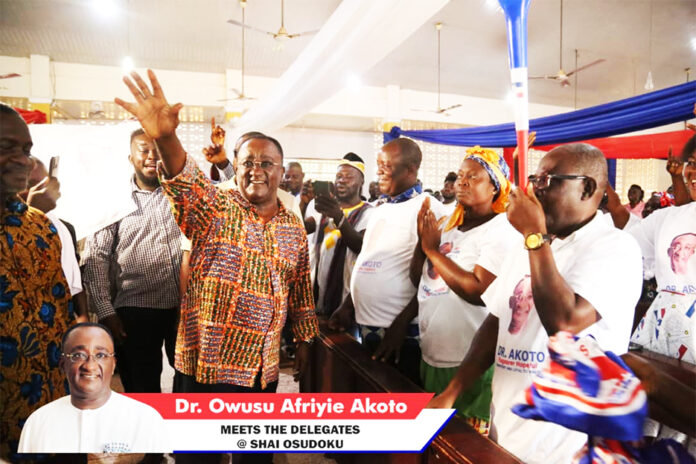
Dr Afriyie Akoto acknowledging cheers from the delegates

A flagbearer hopeful of the New Patriotic Party (NPP), Dr. Owusu Afriyie Akoto, has told party delegates to build a strong formidable and united front in order to win the 2024 general elections.

He said presently, the party is riding on a limping leg due to the level of apathy within the rank and file of the party, as there have been several complains by party people that they have not reaped the benefits of their efforts that helped the party into power in the 2016 and 2020 general elections.

He has, therefore, assured them that he will work tirelessly to address all their concerns and build a formidable front in order to win the 2024 elections, should he be elected as the flagbearer of the NPP.

“Due to the hard work of the Polling Station Executives and Electoral Area Coordinators, as well the Constituency Executives among others, President Akufo-Addo won the 2016 Presidential elections with more than 1.5million votes.

In the Parliamentary elections we won 167 seats out of the 275 seats. Was the story the same in 2020? In the presidential elections, our numbers dropped and in the parliamentary elections, we lost 32 seats. This should send a signal that we need a new direction and focus as a party”, he noted.

He added: “When I became the Minister of Food and Agriculture, I decided to visit all the 16 regions every year to see if how the programs and policies the Ministry is implementing is impacting on the lives of the people, except 2020, during the outbreak of the COVID-19.

“During those times, every region I visited, I found time to interact with party faithful if all was well with them. To be honest with you, what I heard wasn’t pleasant at all. Almost everybody is crying that they have been abandoned; they don’t have any work to do, they are starving, their children are not able to go to school. We can’t go into the 2024 general elections with this situation we find ourselves in”.

The former Minister of Food and Agriculture made this observation while addressing party delegates, made up of polling station executives, electoral area coordinators, constituency executives and council of elders on his nationwide campaign tour, which begun in the Greater Accra Region on Monday, June 3, 2023.

Among the constituencies Dr. Afriyie Akoto visited are; Shai-Osudoku, Ningo-Prampram, Ashaiman, Domeabra-Obom, Ayawaso East and Ayawaso West constituencies.

He was accompanied by his two co-Campaign Chairmen, Alfred Boye, a former Greater Accra NPP Regional Chairman and KEN-WUUD Nuworsu, also a former NPP Volta Regional Chairman, the National Coordinator of the Campaign Team, Peter Oteng Darko and the Campaign Spokesperson, Dr. Prince Sodoke Amuzu.

Speaking further to the issue, Dr. Afriyie Akoto, who is also a two-term Member of Parliament (MP) for Kwadaso, said the current state of the party is not the best to enter into the 2024 general elections with, underscoring the importance of building a strong and formidable united front to break the eight-year governance cycle.

Determined to change the situation, Dr. Afriyie Akoto assured the delegates that he will endeavor to explore options to address all their welfare concerns when they give him the nod to be the party’s flagbearer for the 2024 general elections.

“I am pleading with you not to despair but to keep hope alive. A vote for Dr. Afriyie Akoto will ensure that things are changed for the better. Your welfare has always been my topmost priority and will continue to be when you vote for me as flagbearer of the NPP”, he underscored.

Ghana Gas boss woes stakeholders to new markets

0
Ben K.D. Asante, CEO, Ghana National Gas Company

The Chief Executive Officer (CEO) of the Ghana National Gas Company (Ghana Gas), Ben K.D. Asante, has emphasised the importance of embracing new gas markets in the energy transition discourse during a stakeholder round table discussion held on Tuesday, July 4, 2023.

With the theme “Embracing New Gas Markets in the Energy Transition Discourse, the Role of Stakeholders,” the event gathered key industry players to discuss the crucial role of stakeholders in Ghana’s energy transition journey.

During the discussion, CEO Ben K.D. Asante highlighted the need for a balanced approach to the energy transition that considers both environmental responsiveness and economic impact.

He emphasized that the transition should be gradual rather than abrupt and should be driven by factors such as fuel type and location.

“Gas should be the preferred transitional fossil fuel choice based on low carbon emissions and cost,” stated Asante, emphasising the benefits of natural gas as an intermediate energy source.

“Gas provides a cleaner alternative to traditional fossil fuels, contributing to lower carbon emissions while being cost-effective,” he said.

Mr. Asante also stressed the importance of Africa looking within itself for financing capital projects during the transition period.

He urged the continent to explore internal funding sources and build the necessary intellectual capacity to manage these projects effectively.

“Africa needs to tap into its own resources to finance capital projects and should strive to develop the requisite intellectual capacity to manage these projects,” Dr. Asante further stated, highlighting the potential for Africa to become self-reliant and drive its own energy transition.

Akufo-Addo refurbishes Nkrumah Memorial Park

0
The Nkrumah Memorial Presidential Library (right)

The President, Nana Addo Dankwa Akufo-Addo, has inaugurated the redeveloped Kwame Nkrumah Memorial Park (KNMP), which had not been renovated since its establishment in 1992.

The redevelopment was initiated by the Akufo-Addo administration at a cost of GH¢30 million and renovated in a year since the commencement of work in July 2022.

President Akufo-Addo, in his address at the commissioning on Tuesday, July 4, 2023, bemoaned the lack of renovation of the park, which led to its deterioration.

He added that it was “for this reason, that I instructed the Minister for Tourism, Arts, and Culture, Ibrahim Mohammed Awal, to close it down temporarily for renovation to be undertaken.”

He observed with gratitude that the Park was now befitting of the status of the resting place of the first President of Ghana, Dr. Kwame Nkrumah.

President Akufo-Addo further remarked that, as the outstanding Pan-Africanist of his generation, the burial site of Dr. Nkrumah must be appropriate to his status and exceptional contribution to the liberation of Africa from colonialism and imperialism.

He remarked that the modernisation was in line with plans by the government to make the Park one of the best tourism and heritage attractions in West Africa.

According to him, the Park, which attracted some 90,000 annual visitors, was now expected to increase to one million, and charged the sector Minister to work toward achieving the target.

DETAILS

The redevelopment and modernisation of the Park has introduced an architecturally picturesque reception centre, which houses a host of offices, a modern library, an eatery, a gift shop, an infirmary, and conference facilities that are digitally controlled.

The Park also introduces an audio-visually synchronized fountain, which immerses it at night in a variety of colorful lights.

There is also a mini-amphitheatre for lectures and performances for small groups, as well as a picnic area for the youth.

The museum has not only been expanded, but been aesthetically fitted with digital audio-visuals that chronicle the life of the first President of Ghana.

REVENUE

The Minister for Finance, Ken Ofori-Atta, indicated that the Park is expected to generate some US$3.2 million this year.

He gave the assurance that his ministry would find innovative means to provide financial support for the five million tourist ambitions set by the government.

The daughter of Dr. Kwame Nkrumah, Samia Nkrumah, who represented the family, said she was proud of Ghana and its people for coming together to honour “one of our own.”

She commended President Akufo-Addo in particular for renovating and modernising the facility, “so thank you for the support.”

According to her, the KNMP, beyond the material gains, was a “place where we draw inspiration and strength to carry forward and accomplish the unaccomplished mission of our independence. For us, we gain spiritual strength from visiting this place.”

The Minister for Tourism, Arts, and Culture, Dr. Ibrahim Mohammed Awal, thanked the President for his leadership, and indicated that the Osu Castle and the Du-Bois Centre would be modernised next year to attract more tourists.

The World Bank Country Director, Mr. Pierre La Porte, expressed happiness on the part of the Bank to have contributed to the project.

ABOUT THE KNMP

The Park used to be a polo grounds for the British and other European nationals during colonial days. On the eve of Ghana’s Independence in 1957, Dr. Nkrumah chose the same polo grounds as the venue for the independence declaration.

Presently, it is the third burial place for Dr. Nkrumah since his death on April 27, 1972, in Bucharest, Romania. He had early on been buried in Conakry, Guinea, and at Nkroful, in the Western Region of Ghana.

The KNMP occupies an area of 5.4 acres and has a personal museum dedicated to Dr. Nkrumah and an imposing Mausoleum where his mortal remains and those of his beloved wife, Fathia, are interred.

Editorial: FDA must descend heavily on some sachet water producers

0
Editorial

The Food and Drugs Authority (FDA), according to a story carried by the Daily Graphic yesterday, has suspended the operations of ‘Anointed Family Water’, a registered sachet water brand, with registration number FDA/WT22G-595 produced at New Bortianor.

The state-owned newspaper quoted the FDA as describing the sachet water brand as “a risk to public health and safety”, and that the company was operating under unhygienic conditions. Quoting a statement signed and issued by the Chief Executive Officer of the FDA, Dr. Delese Mimi Darko, it explained that the decision to suspend the operations of the company followed a recent inspection of its facility by officials of the Authority.

“During the inspection, the FDA team also found several pieces of Rena Aqua sachet water, an unregistered brand, on the premises, which were seized,” the statement added. “The public is hereby advised to refrain from consuming Anointed Family Water and the unregistered Rena Aqua brand,” the FDA was quoted as saying.

The Authority also instructed retailers and distributors to remove all stocks of Anointed Family Water as well as Rena Aqua in the trade until further notice.

“The FDA remains committed to its mission of safeguarding public health, by ensuring strict adherence to regulations and standards in the food and beverage industry,” the Authority assured the nation.

If Ghana is to move forward as a country, its constitutionally created agencies must be seen to be working.

The Chronicle is, therefore, happy that the FDA officials are not sitting in their cosy offices, but moving to various parts of the country to do jobs assigned them by the Constitution. Because of the desire to eke a living, people who have no business ideas have all of a sudden become business executives and churning out products that are dangerous to consumers.

One of such industries is sachet water production. The creation of jobs should ideally be welcome news, but the way and manner some of the sachet water producers go about their work leave much to desire. The environment, as noted in the latest FDA report, is simply filthy.

This has gone to confirm a survey report we carried in August last year, that some of the sachet water products were contaminated with faecal matter. Unfortunately, consumers cannot go round inspecting the working environments of sachet water producers before patronising their products. The onus, therefore, rests on the FDA to conduct such inspections on their behalf, which they are doing.

But whilst congratulating the FDA for the good work they are doing, it does not mean they should recoil into their shell as if they have finished the job. Some of the water producers will still be out there producing water an unhygienic environments, and it will take regular inspections as they are doing now to expose them.

Sachet water, as we all know, is patronised by millions of Ghanaians, especially those living in the urban areas. The health implications will, therefore, be dire if some of the producers do not keep their environment clean.

Also, The Chronicle does not support the idea of only naming and shaming those operating in filthy environments. They must as well be prosecuted to serve as a deterrent to others, since we are talking about public health and safety here. One’s desire to maximise profits should not come at the expense of the public.

The Ghanaian Chronicle