Home Blog Page 2152

Please vote for me, I’ll win 2024 for NPP -Alan

0
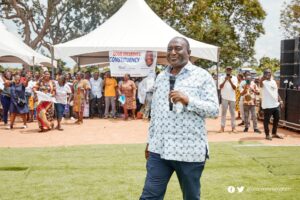
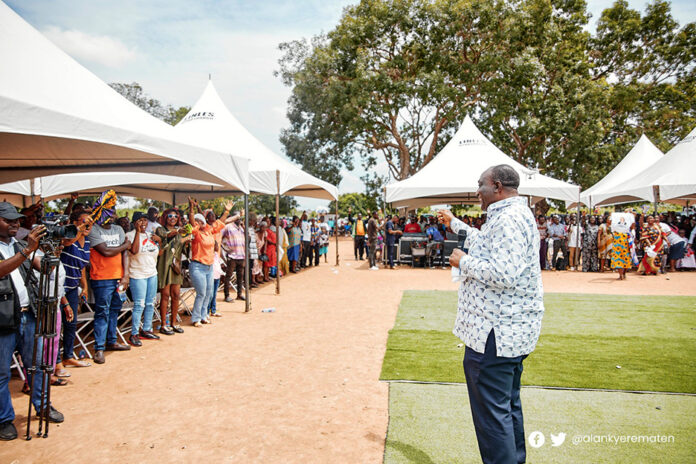
Mr Kyerematen speaking to the delegates

A former Minister for Trade and Industry and the New Patriotic Party (NPP) presidential hopeful, Alan Kwadwo Kyerematen, has told delegates in Accra that he stood the chance of winning the presidency for the party in 2024, and that he should considered for the position.

Speaking to party delegates drawn from Dome-Kwabenya and Ayawaso West Wuogon, all in Accra yesterday, he argued that with the great work he did for the party and governments he had served placed him far ahead of his other competitors.

The former Trade and Industry Minister cited his innovative works that gave birth to the Presidential Special Initiatives and the 1D1F programme as evidence of the transformation that he could bring to the nation when given the nod.

Alan speaking to the delegates

The industrial expert mentioned his unblemished personality in political life and hardworking as some of the features that stood him apart from the others. He, therefore, appealed to the enthusiastic delegates to look at the above track record and vote for him to lead the party.

The presidential hopeful is currently touring Greater Accra Region to convince the delegates to vote for him at the Super Delegate Congress and the main congress in November this year.

The Chronicle understands after touring the Greater Accra Region that, Mr. Kyerematen, popularly known as Alan Cash, would move to other regions to solicit for votes from the delegates.

He is being accompanied on his tour by Mr. Peter Amewu, Minister for Railway Development, and other prominent party members.

Lepers grateful to Bawumia for giving them Ghana Card

0
Veep Bawumia interacting with some of the cured lepers and their family members

Lepers of the Weija Leprosarium in Ghana have composed a song to express their heartfelt appreciation to Vice-President Mahamudu Bawumia for his instrumental role in facilitating their enrolment and acquisition of the National Identification Card, widely known as the Ghana Card.

This follows their registration at the Leprosarium onto the Ghana Card and an announcement by Dr Bawumia to extend this registration to the residents of all the other leprosaria across the country, so they also get registered and get issued with Ghana Card.

Dr Bawumia stressed that the lepers, who often face social exclusion and marginalisation, will find new hope and inclusion through this initiative.

“Congratulations to all my friends at the Weija Leprosarium and my thanks to the Executive Secretary and staff of National Identification Authority for making this possible. God bless our homeland Ghana,” Dr Bawumia stated.

Dr. Bawumia is noted for supporting lepers in Ghana and he is also their chief patron. He has contributed immensely towards their sustainability.

Appreciation

The lepers indicated that: “We are immensely grateful to Vice President Bawumia for recognizing our plight and ensuring that we are included in the Ghana Card programme. This card has given us a sense of identity and belonging. It has opened doors for us that were previously closed. We finally feel like valued members of society. We finally feel like valued members of society”.

One of the significant challenges they faced was the absence of proper identification documents, limiting their access to essential services and benefits.

Recognising the importance of ensuring the rights and inclusion of all citizens, Dr Bawumia has taken a personal interest in addressing this issue.

Passage of anti-gay-bill: Biz interests of western powers will suffer if…

0
Samuel George Nettey

The Member of Parliament for Ningo-Prampram, Samuel George Nettey, has served notice that they would thwart the business interests of entities in Ghana belonging to western powers. if they sanction the Speaker or any Member over the passage of the anti-gay bill.

The notice, with the backing of his fellow Legislators, followed sanctions imposed on the Speaker of the Ugandan Parliament after the African country passed a bill against homosexuality.

Commenting on the report by the Constitutional, Legal, and Parliamentary Affairs Committee on the bill, of which he is one of the proponents, Sam George dared the western world to try that on Ghana’s Parliament.

“And I want to use this opportunity with the support of my fellow Members of Parliament since we all support this bill to serve notice to the Western powers that we have taken judicial notice of what they have done to the Speaker of Uganda after Uganda passed the bill.

“We will also serve notice that if they replicate the same with our Speaker and Members of Parliament, we will also take action against their business interests in our country because they sell in this country, make money from here, and take it back home. They cannot take us for ransom.”

He used the opportunity to celebrate the Speaker, Alban Sumana Kingsford Bagbin, for his stellar leadership in ensuring the bill got the needed attention.

He cited that Italy dedicated the month of June to family and advocated for the same in Ghana to celebrate the family values of the country.

NO VIOLATION

On his part, the Ranking Member of the Committee, Bernard Ahiafor, could not fathom why Ghanaian men should be forced to sideline “soft-bodied women for stiff-bodied men.”

Contrary to claims of human rights, he argued that the bill, if passed into law, would not violate Article 108 of the 1992 constitution of Ghana, adding that Section 100 of the Financial Management Act would also not be violated.

He added that no international treaty had also been violated in the bill and indicated that those against its passage had not cited one.

CULTURE AND VALUES

The MP for Asante Akim North, Andy Appiah-Kubi, in his debate to support the passing of the bill said man was born with an automatic and natural right, determined by sex from birth and, therefore, any “attempt to change” that is an attempt to do that which is unnatural.


The MP for Asawase, Muntaka Mubarak Mohammed, argued that European countries are afraid to push human rights advocacy for LGBTQ+ in Saudi Arabia, because of the benefits they get from the oil there.

He indicated that should the western powers cease their support for Ghana after the passage, “we [Ghanaians] are happy to eat grass, but we will keep our values and culture.”

The MP for Bekwai, who is the Second Deputy Speaker, Joseph Osei Owusu said in all societies, there are means of dealing with minor deviance and argued that the anti-gay bill seeks to do the same in the interest of the greater populace, adding that “Mr. Speaker, this bill allows us to be the Ghanaians we are.”

In her submission, the MP for Ablekuma West, Ursula Owusu-Ekuful, indicated that the MPs were aware of homosexuality in the various communities, which is why there is a description of it in the languages of the country.

However, she added that “it is incumbent on us as MPs to craft a piece of legislation that is not in conflict with our constitution or existing legislation.”

She commended the “Committee for the extensive work they have done to clean up the bill.”

Other MPs, including Rev. John Ntim Fordjour, Rockson-Nelson Dafeamekpor, Dan Botwe, Cletus Avoka and Ahmed Ibrahim also contributed to the debate.

NPP activists in deadly clash ahead of primaries

0
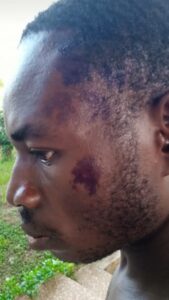
Dimalya spotting bruises on his body

An activist of the New Patriotic Party (NPP), Anthony Dimalya, is on admission at the Tepa Government Hospital following a clash between supporters of two parliamentary aspirants in the Ahafo Ano North capital of Tepa.

Dimalya of the Ward 3 branch of the party is awaiting surgery on his right leg to correct an injury or risk amputation.

Anthony Dimalya – victim of assault

He had earlier on during an electioneering campaign sustained an injury for which a metal implant was administered in the right leg to save the limb from being severed.

But, while he was recuperating from the said surgery he, together with one Agya Owusu, a teacher, were assaulted by a group believed to be supporters of Mr. Eric Nana Agyeman Prempeh, the Director-General of the National Disaster Management Organiser (NADMO), who intends to contest the NPP primaries.

The assault is premised on the pretext that the victims were supporters of one Kwaku Fosu Frimpong, another aspiring parliamentary candidate, and that they had campaigned against the NADMO boss, thus instigated the alleged insults on Nana Prempeh Agyemang.

The Chronicle gathered that the victims (Dimalya and Agya Owusu) had gone to the Chief’s Palace on June 18, 2023 to witness an arbitration following an alleged complaint by the NADMO boss that some persons had insulted him.

As soon as Dimalya and his colleague stepped out of the Palace, one Baba Lion, “8080”, and Casia ambushed them.

The assailants reportedly pounced on the two and brutally assaulted them.

Dimalya complains he was hit against a wall resulting in further injuries to his right leg making it necessary for the metal to be removed upon medical advice or risk amputation.

A formal complaint has been lodged with the Tepa police, who have launched a manhunt for the three suspects (Baba Lion, “8080” and Casia) to help in investigations.

Dimalya has called on the NPP hierarchy to bring the culprits to order to save the image of the party in the constituency.

The NADMO boss has dissociated himself, saying tersely in his reaction to The Chronicle enquiries via WhatsApp, that the allegations, including complicity in the assault were false.

No arrests have been made at the time of filing this report, but police sources have confirmed that the Tepa police were investigating a case of assault lodged by Dimalya and Agya Owusu and was pending full scale investigations.

Meanwhile, Mr. Kwaku Fosu Frimpong, a philanthropist and business man, has volunteered to foot the medical bill of Dimalya.

Fire Officer jailed for beating Bailiff

0
Court

A serving Fire Service Officer, Emmanuel Ayitah Quansah, has been sentenced to two days imprisonment for beating up a court bailiff.

The convict pounced on the bailiff while attempting to serve court processes on him, which he refused to accept and was, therefore, thrown at him.

He was sentenced for being in contempt of court by an Accra High Court, presided over by Justice Sarah Aryee. Emmanuel is a respondent in an ongoing case and refused to accept the process being served on him because the Bailiff should have served him at his office.

The court held that counsel for the Judicial Service had informed them (courts) about how bailiffs were constantly assaulted.

“This canker has to be nipped in the bud. The respondent is found guilty of contempt of court, since he failed to purge himself when the court gave him the opportunity to do so before the court.

“The respondent is sentenced to a Custodial Sentence of two days imprisonment,” the court rules. The substantive matter is adjourned to July 24, 2023.

Editorial: Rising incidences of student suicides on campuses must be checked

0
Editorial

The increasing number of student suicides in Ghana is a deeply concerning issue that demands immediate attention. The loss of young lives is a tragedy which affects, not only families and friends, but also the entire society at large.

Taking into account the three recent alleged suicidal incidents at the University of Ghana and Kwame Nkrumah University of Science and Technology (KNUST), it is obvious the victims involved were completely or partially out of the reach of societal bonds.

The rising incidence of student suicides in Ghana is a distressing concern that demands immediate attention from all stakeholders. School management plays a crucial role in creating a safe and supportive environment for students, thereby curbing the escalating attempts of self-harm.

A few weeks ago, a Level 300 student of the KNUST allegedly committed suicide in her hostel. Also, a second year student of the Kwame Nkrumah University of Science and Technology fell from the fourth floor of a private hostel and died instantly. It took the benevolence of a commercial vehicle driver to get him to the KNUST Hospital after several drivers refused to come to his aid.

Do the universities lack counseling departments? If no, what measures are being put in place to make sure that these students are given help? What could be the actual cause of students attempting to commit suicide? All these questions are lingering in the minds of the public.

It is very important to note that suicide is highly volatile, and everyone could be a potential victim. Everyone is capable of it. There is the need for the school management to put measures in place to curb the cases of students attempting suicide.

The school management must educate themselves on the warning signs of distress and suicide. These signs may include withdrawal from social activities, sudden decline in academic performance, expressions of hopelessness or despair, giving away possessions, or changes in behavior or appearance.

The schools should foster a culture that prioritises mental health and well-being, help to promote a sense of belonging, inclusivity and mutual respect among students and staff, and encourage open communication and understanding.

We suggest that we should establish peer support networks within the school. Peer mentors or student-led support groups can provide a safe space for students to share their challenges, seek advice and support one another.

The Chronicle has picked reports that on the campuses of the University of Ghana and Kwame Nkrumah University of Science and Technology, the authorities have banned the celebration of Hall Weeks and processions. It should be noted that the students use these extracurricular activities to overcome the boredom and stress from the books.

It is crucial to prioritise the emotional well-being of students by creating an environment where they feel supported, understood and valued. Together, we can protect the lives and future of Ghana’s young generation.

Kaneshie traders, beggars impede movement on footbridge

0
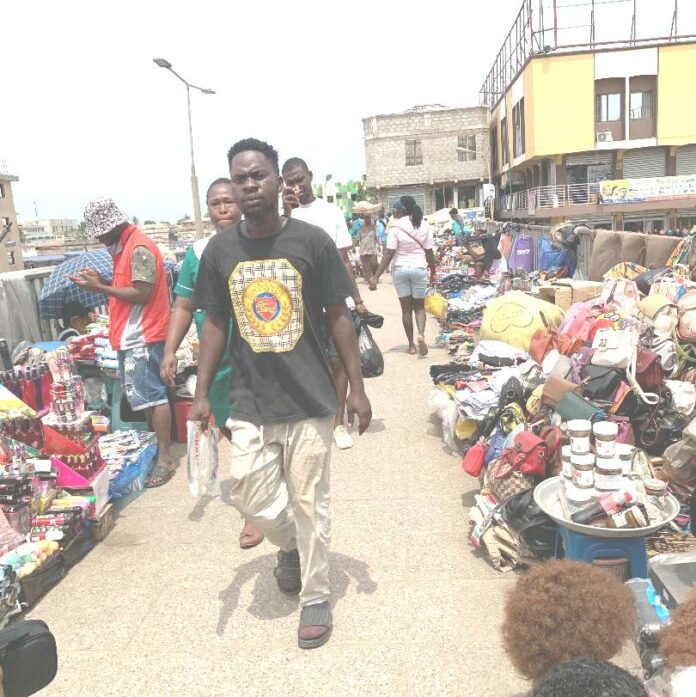
Traders displaying their wares on the footbridge

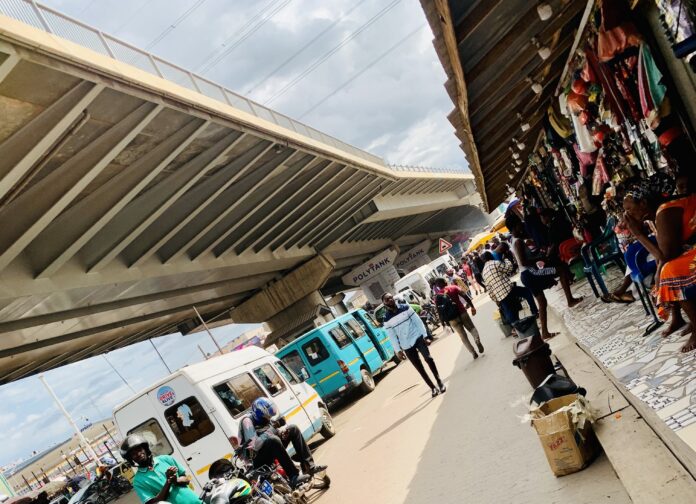
Free movement on the Kaneshie station footbridge by pedestrians is being impeded by some traders, who have deserted the designated market to sell on the bridge.

Some traders have taken their activities onto one of the footbridges linking Kaneshie to the Odorkor Highway at the busy Kaneshie Market in the Greater Accra Region.

The Chronicle visited the place on Wednesday, July 5, 2023, and observed that business was booming for these traders, who had displayed their wares on the footbridge, narrowing the walkway with pedestrians compelled to meander on the tiny space left.

These traders had displayed merchandise, including clothing, food items, toiletries, footwear, wigs, and handbags, among many others, on the busy footbridge designed to facilitate easy and safe crossing of the busy Kaneshie-Odorkor Highway by pedestrians.

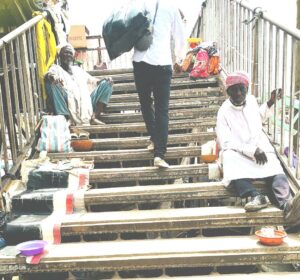
Some of the wares on sale were seen hanging on the railing of the footbridge, while beggars were also spotted seated on both sides of the stairs with their containers, begging for alms.

Beggars on the stairs of the footbridge

On very busy market days, pedestrians are usually seen struggling to move side by side on the footbridge, because both sides have been occupied by traders.

Self-styled pastors, on the other hand, were seen with mounted sound systems and megaphones on the bridge preaching.

Some pedestrians described the activities of the traders as a nuisance, saying they made their movement very difficult.

A pedestrian, Stephen Odai, expressed his displeasure with the activities on the footbridge, saying there were instances where pedestrians accidentally stepped on some of the items displayed on the floor for sale, and the owners get very confrontational, blaming them for such accidents.

He said: “These acts do not speak well of us as a nation, and sell us short to foreigners who visit the country for sightseeing and [for] other various reasons, and they must be stopped now.”

A 38-year-old woman, Madam Mercy Acheampong, lamented that to avoid bumping into other pedestrians, one needed to walk very cautiously and slowly.

A Police Officer, who spoke on condition of anonymity, explained how disturbing the situation was, adding that it was sad that the market authorities always looked unconcerned, while some traders openly disregard the set rules and regulations.

He said the traders confidently carried on with the unacceptable activities because they paid daily taxes to officials of the Accra Metropolitan Assembly (AMA).

He also acknowledged the fact that occasionally, officials from the AMA embarked on exercises to remove the traders, halting all activities on the footbridge, but they (traders) always return as soon as the AMA taskforce team left the area.

He, therefore, appealed to the city authorities to make a firm decision on restoring discipline among traders in the area.

When contacted, an official of the Kaneshie Market Complex declined to comment on the matter, but rather asked the reporter to bring an official letter in that regard.

By Stephanie Birikorang

Circle trotro drivers abandon station to load by the roadside

0
Drivers waiting in line for their turn to pick passengers at the station

Some commercial vehicle operators, popularly known as “trotro drivers”, at the former Kwame Nkrumah Circle, have abandoned the well-structured station to pick passengers alongside the Interchange.

This situation, The Chronicle noticed, has hindered the effectiveness of the main station, as some passengers rather patronise vehicles parked by the roadside without having to enter the station.

This reporter visited the rather busy business center on Tuesday, July 4, 2023, and observed that some of these drivers had parked their vehicles on the shoulders of the streets very close to the rail lines linking Circle to Kaneshie in the Greater Accra Region.

This worrying development is not only being perpetuated by intra-city vehicles, but some cars picking passengers to nearby Kumasi and other distant destinations.

The paper observed further that despite the closeness of well-structured stations, managed by transport unions, for commercial vehicles, these drivers appear to have thrown all caution to the wind.

They brazenly flout the laws by parking their vehicles and picking passengers and loading goods to various destinations.

The Chronicle, during the visit, interviewed some pedestrians who preferred patronising the vehicles by the roadside to the ones at the prescribed stations, with the excuse that the former set off early.

One Jacob Ansah, who was waiting by the roadside to board a vehicle instead of going to the station, told this paper that he preferred the roadside because of the fares.

He explained that those on the roadside do not charge flat fares, unlike the vehicles at the station, regardless of the passengers’ destinations charge a flat rate.

Another passerby, who only gave her name as Aunty Joyce, added that walking from her office to the main station was quite a distance, so she ends up boarding the available vehicle on that stretch of road.

Meanwhile, reacting to the development, the Station Officer of the Kwame Nkrumah Circle, Odawna Branch of the Ghana Private Road Transport Union (GPRTU) of the Trade Union Congress (TUC), Mr. Henry Quansah, told The Chronicle that most of these commercial vehicle drivers were trained by drivers at the main station, and were expected to continue working with them once they acquired their driving licenses and a vehicle to work with.

But, instead, they decided to load at the roadside, abandoning the well-structured stations with the excuse that loading passengers at the station took longer.

These drivers, he said, forget the fact that once they all come together to work at the main station, it would compel passengers to patronise there and reduce the time for the vehicles to fill up.

However, he cautioned passengers to patronise vehicles at the stations, as they could have their items left in those vehicles returned. But, since vehicles at the roadside were not known, tracing them was not possible.

The Station Master also explained “that most times, when some passengers forget any of their valuables in a commercial vehicle they boarded at the roadside, they seek assistance from the station’s office in finding the particular vehicle for their items, but we are unable to trace such commercial vehicles, because they are not known to us. But, if you forget any valuables in any of the vehicles at our stations, getting your items back intact is guaranteed.”

Mr. Quansah stressed his advised to the general public on the need to patronize commercial vehicles at the station for their own safety, because all vehicles, drivers and conductors are known.

Commenting on what the station officers to do to stop the menace, he indicated that, there was little his outfit could do end drivers loading on the shoulders of the roads.

His reason was that the very people they send to stop drivers from loading at such places allegedly take monies from the drivers and allow them to operate.

He called on the Motor Traffic and Transport Department Unit (MTTU) and other responsible authorities to come to their aid to help salvage the situation, to build the transport business, as this had become a common practice among some commercial drivers, not only at Circle.

By Stephanie Birikorang

Ato Essien to ‘cough up’ GH¢12m before July 27

0
Court

William Ato Essien, Chief Executive Officer (CEO) of the defunct Capital Bank, is expected to ‘cough up’ GH¢12 million before the 27th of this month (July), or risks going to jail.

Mr. Essien, who was convicted on his own plea of guilty in December 2022, is expected to make the payment of GH¢20 million in every four months of 2023, but had since paid only GH¢8 million.

The convict, per the agreement reached between him and the prosecution, was to pay GH¢60 million to the state by the end of the year. The amount in question was spread over 12 months to enable him make the payments.

However, at the last two adjourned dates,  Justice Eric Kyei Baffour, a Court of Appeal Judge with an additional duty of the High Court, was told that the accused had made payment up to GH¢5 million, leaving the total outstanding balance of GH¢55 million.

The convict’s lawyers, in May, applied to the court to give them more time, as Essien was expecting huge inflows from his investments to defray his indebtedness to the state.

Based on this plea, and the prosecution not opposing the application, the court adjourned the case to June 4, expecting the convict to finish paying the first GH¢20 million.

His counsel, Thaddeus Sory, represented by Baffour Gyawu Bonsu, appealed to the court to grant them more time to make the payment.

According to him, the convict was expecting about US$300,000 by this July from an arrangement executed between Essien Swiss and Anarico Company Limited.

Mr. Bonsu added that GH¢2 million had been transferred to the state, as well as an attached cheque of GH¢1 million.

He said the convict’s difficulty to make prompt payment was due to the seizure of his passport, and, therefore, applied for the release of it, which was declined.

His Lordship Baffour cautioned that the debt owed by the convict did not emanate from a civil case, but a criminal one, making it difficult to appreciate the convict’s commitment to settle it.

Justice Boffour disclosed that the court had been informed by a letter written by a lawyer to the Registry that one of the assets listed by the convict to be sold to settle the debt at Prampram, had already been attached to be sold in a different case.

The court was, therefore, not clear about how much it could offer the convict to complete the payment, particularly when there was no assurance of inflow coming from somewhere. Mr. Gyawu responded, saying, the Prampram property was not the only asset they had been listed.

Ghana economic transformation declines below Africa average -ACET

0
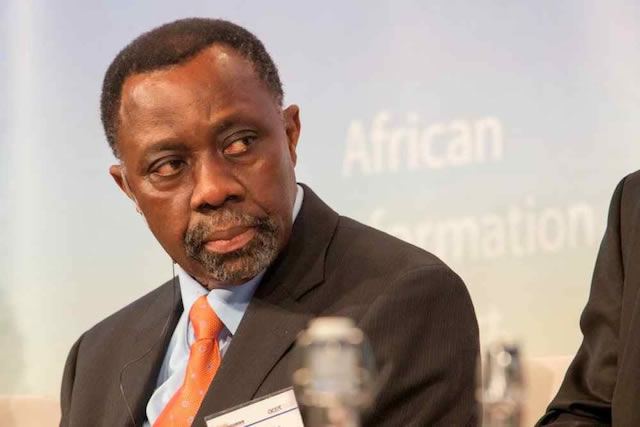
Dr. Kingsley Y. Amoako, President and Founder of ACET

Not far in the distant future, the African Centre for Economic Transformation (ACET) will release an index indicating that Ghana’s economic transformation has declined below the African average. The decline was measured in all critical areas of the economy minus human capital building by the ACET.

Dr. Kingsley Y. Amoako, President and Founder of ACET, disclosed this at the 2nd K.B. Amissah-Arthur Economic Forum, held under the theme: “Economic Policy making in Ghana: Lessons learnt and the way forward,” at the University of Ghana, Legon, in Accra last week’s Friday.

According to him, “An updated Index will be released this summer. And it will show that Ghana’s economic transformation is in decline, below the African average in all the areas used to measure success, such as diversification of products and exports, technology, and labor productivity.”

Hitherto, Ghana, between 2000 and 2020, enjoyed 13 years of rapid growth, including six years of very rapid growth. “But growth alone is not enough to sustain long-term development. Countries must transform their economies.

Despite that strong growth rate, Ghana’s economy has suffered from falling prosperity in the manufacturing sector and high vulnerability to global markets and commodity price shocks. Its development has been marred by debt and energy crises, large trade and fiscal imbalances, and a lack of consistent long-term planning,” he stressed.

While, he strongly believes that Ghana must not only solve its economic problems to enable transformation, it must focus on safeguarding its democratic traditions and institutions.

Addressing the forum, he linked part of the country’s problem to lack of collectiveness and apathy in building consensus for national development, as well as lack of political will to adopt the same.

Dr. Amoako made reference to the Senchi Consensus and what became of it years after, adding that there was lack of political buy-in.

Meanwhile, the challenges that existed leading to the Senchi stakeholders engagement continuously remain, saying, “So the conversations and the agreements we made ended up as a footnote in history, rather than a long-term strategy. The situation we face today may be even worse.”

It was, therefore, not a surprise to him that Ghana had made its way back to the International Monetary Fund (IMF) in the midst of high stakes, worsening political polarisation, and civic disengagement.

To provide some hope, he centred the latter part of his delivery on the outlook of Ghana in 2050, which marks the end of the first half of 21st Century.

He talked about how the ACET and its partners were pushing to use the Compact for Ghana’s Political and Economic Transformation to usher the country into the half of the 21st Century.

Importantly, the Compact Ghana envisaged a true deliver of Ghana’s ambitions to achieve its greatest potential needed to build a social contract between the citizens and the government.

This, the government, must set a long-term vision for economic transformation that delivers dividends for the people.

Philip Abradu-Otoo, Director of Research at the Bank of Ghana (BoG), on his part, debunked the notion that the 3-day Senchi Consensus was left to collect dust on the shelves, saying it was put to work and residues could be traced in the current IMF deal.

He said this by acknowledging the importance of consensus building in economic development, and urged all in the political divide to join.

A call was made during the panel discussion that the National Development Planning Commission (NDPC) should be strengthened to serve as referee for national development.

Mavis Owusu-Gyamfi, Vice President of ACET, added that for Ghana to experience transformation, it needed to diversify its trade and production.

Similarly, it must also fill in the missing link between policy, development and transformation, with implementation and continuation.

She said growth must be seen from agriculture to manufacture, technology, export competitiveness, productivity -infrastructure, and human wellbeing.

“If your economy is growing and your people are not benefiting, it is pointless exercise,” she added.

To make the day memorable, two graduate students of the Economics Department of the University of Ghana received GH¢60,000 from the K.B Amissah-Arthur Foundation.

The beneficiaries were Deborah Annan, a Master of Philosophy student in Economics, who received GH¢20,000, while Ms Josephine Baako-Amponsah, a Doctoral candidate in Economics, received GH¢40,000.

The forum was held in honour of the late Vice President, Paa Kwesi Bekoe Amissah-Arthur, and the donation was to ignite his passion for higher education and research.

The Ghanaian Chronicle