Demolition crews continue to move into full force along the Takoradi–Cape Coast Highway corridor, pulling down structures and clearing sites to make way for the much-anticipated dualisation project under President John Dramani Mahama’s “Big Push” infrastructure initiative.
From Pipe Ano through Tanokrom and Effiakuma to Shama, structures like kiosks that once stood close to the main road have been pushed aside, in what officials describe as a decisive step toward easing traffic congestion and improving road safety, along one of Western Region’s busiest transport routes.
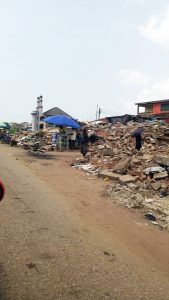
A tour of the stretch by journalists revealed extensive clearing activity, with heavy-duty equipment deployed at multiple points.
Another cleared sites for the Big Push
Concrete structures, wooden kiosks, metal containers and boundary walls that previously encroached on the road reservation have either been marked for demolition or completely removed.
In several areas, the expanded corridor is already visible, signaling the scale of the planned dual carriageway.
The contractor on site appeared determined to meet project timelines, with engineers and workers coordinating the systematic removal of obstructions.
Earth-moving machines could be seen levelling portions of the cleared land, while debris from demolished buildings was being carted away.
Officials of the Sekondi-Takoradi Metropolitan Assembly (STMA) and the Effia-Kwesimintsim Municipal Assembly (EKMA) had earlier undertaken sensitisation exercises to notify property owners affected by the expansion.
The assemblies engaged residents and business operators along the corridor, urging them to relocate voluntarily to avoid last-minute confrontations.
Residents who spoke to the media acknowledged the prior notices, but expressed mixed feelings about the demolitions.
While some business owners lamented the loss of structures and temporary disruption to their livelihoods, others welcomed the development, describing it as a necessary sacrifice for long-term progress.
“This road has become too narrow for the volume of traffic we experience every day,” a commuter at Effiakuma said adding, if this expansion will reduce the traffic and accidents, then it is worth it.”
The Takoradi–Cape Coast Highway serves as a major economic artery, linking the Western Region to the Central Region and facilitating trade, tourism and industrial activity.
Over the years, rapid urban growth along the corridor has led to heavy congestion, frequent accidents and delays, especially during peak hours.
City authorities say the dualisation forms part of a broader national infrastructure agenda aimed at modernising critical road networks and boosting economic activity.
Under the ‘Big Push’ programme, government has pledged accelerated investment in roads, bridges and other public infrastructure to stimulate growth and create jobs.
The ongoing clearing exercise marks a significant milestone in the implementation phase of the project.
With the right-of-way gradually being secured, attention is expected to shift to major construction works, including drainage expansion, lane development and pedestrian safety installations.
For now, the sound of bulldozers and falling concrete has become a familiar echo along the corridor, a visible reminder that the long-talked-about road expansion is no longer a promise on paper but a project taking shape on the ground.
As the dust settles on the cleared sites, residents and commuters alike are watching closely, hopeful that the disruption of today will soon give way to smoother journeys and a transformed highway befitting the region’s growing economic stature.
WR Minister Joseph Nelson (in fugu) inspecting sea defence work progress
For generations, the sea has been both a friend and foe to the people of Axim. At dawn, it offers sustenance. Fishermen push their canoes into the Atlantic, trusting the waters to provide for their families.
By nightfall, however, the same sea can turn hostile crashing against the shore with a force that eats away at land, threatens homes and leaves families awake in fear.
For many residents, especially those living closest to the coastline, the anxiety has become a way of life.
“When the rains come and the tide rises, you don’t sleep peacefully,” a resident near the shoreline recounts adding “you just pray the water does not enter your room.”
For years, tidal waves and persistent erosion have crept steadily inland, weakening structures and swallowing sections of the coast.
Axim Sea Defence wall taking shape
Flooding caused by poor drainage has compounded the problem, turning heavy rains into a recurring nightmare for households and shop owners. But today, there is a visible shift in both the landscape and the mood of the community.
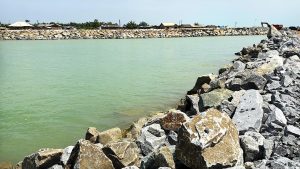
The Axim breakwater and sea defence project, now 45 per cent complete, is gradually reshaping the coastline and restoring hope and confidence among residents.
Heavy equipment moves steadily along the beachfront. What was once a vulnerable stretch of land is beginning to look fortified.
The project’s second phase includes the construction of a 550-metre breakwater and reinforced sea defence structures designed to shield the town from further coastal erosion.
It will also provide a secure landing base for fishing activities, a development that fisherfolks say could significantly improve their work.
For the fishing community, safety at landing has long been a challenge. Rough waves often make it difficult to dock canoes, damaging equipment and increasing the risk of accidents.
“With the breakwater, landing will be safer. It means less damage to our nets and boats. It means we can work with more confidence,” one fisherman told The Chronicle.
Beyond protecting the shoreline, the project directly tackles another longstanding issue – chronic flooding. Eleven culverts are being constructed to improve drainage and channel storm water away from homes and streets.
For residents who have repeatedly watched rainwater invade their living rooms and shops, this intervention offers relief.
“When it rains heavily, some of us move our things onto tables. Sometimes the water carries goods away. If the drainage improves, that alone will change our lives,” a local trader said.
Work on the project initially began in 2024, but was temporarily halted due to technical and financial challenges.
The pause raised concerns within the community, with many fearing yet another uncompleted coastal intervention. However, construction resumed earlier this year with renewed momentum.
Project Engineer for Makam Plant Hire (MPH), Benjamin Ammissah, told this reporter that steady progress has been made and assures residents that the project will be completed within the eighteen-month timeline.
According to him, the engineering design is focused not only on immediate protection, but also long-term sustainability.
The breakwater will reduce the intensity of wave action along the shore, while the improved drainage system will minimize flooding during heavy rainfall.
The economic impact is already being felt
The construction phase has created employment opportunities for local workers, providing income for families and stimulating small businesses in the area. Food vendors, transport operators and petty traders are seeing increased activity as workers patronize local services.
Western Regional Minister, Joseph Nelson, during a recent inspection of the site, expressed satisfaction with the progress made so far.
He reaffirmed government’s commitment to ensuring the completion of the project, stressing its importance in safeguarding livelihoods and protecting the environment.
For the indigenes of Axim, however, the significance of the project goes beyond infrastructure.
It represents security, the assurance that homes built over decades will not be claimed by the sea.
It represents stability, the confidence that businesses can operate without the constant threat of flooding.
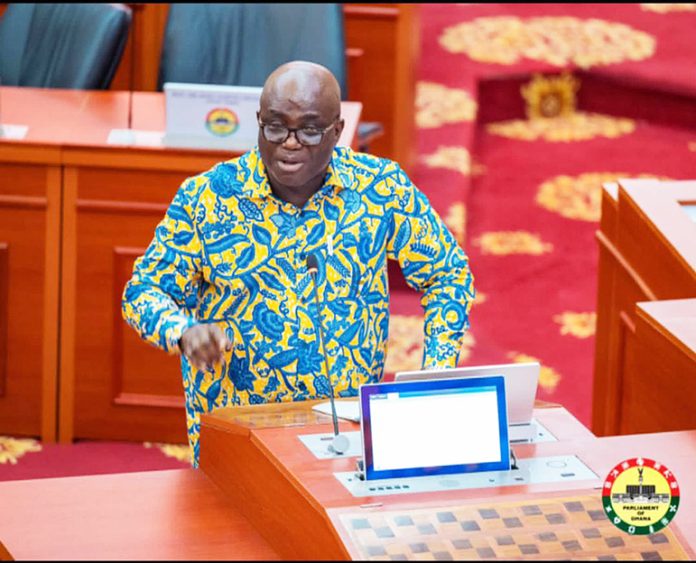
The Minister for Food and Agriculture, Eric Opoku, has debunked claims that there is food insecurity in the country.
According to him, food is in abundance, and the ministry, through buffer stock, is in the process of buying these excess foods.
Answering questions about his ministry on the floor of Parliament on Tuesday, February 10, 2025, the minister urged his colleagues to share details of people who are food insecure for the ministry to go to their aid.
“As a nation, we are building food buffers. If you say that you have conducted a survey, and the findings include the fact that some people are food insecure, indicate to us the locations so that we can go to our stores and make food available to them, and they will be fed. That’s all.
“We’ve also spoken to ECOWAS. This time around, we are not going to borrow rice. We are not going to borrow maize. Rather, we are asking them to come and buy from us here,” he said.
The minister continued that a lot of mechanisms were being put in place to draw out the excess food, “and that is why I’m worried about our colleagues who, in spite of this situation, are saying that there is food insecurity. Is it because they are living in a different world or what? That’s the problem I have.”
INSECURITY
Some members of the minority had raised concerns about the fact that farmers were complaining that people were not buying their farm produce.They variously asked the minister what steps he was “going to take to solve this very problem?”
The MP for Bimbilla, Dominic Nitiwul, indicated that farmers take their produce to the market, but people are not buying, “and they will have to take it back.”
“They will take it the next week, people will not buy, and they will take it back. Whether it is turmeric, whether it is rice, whether it is maize, whether it is pepper, whether it is dry okra, they are not buying. How are you going to make sure that, that problem is resolved for farmers?”
VALUE
The minister in his answer said the government would champion value addition, thus launching the Feed the Industry programme, under the ministry of Agribusiness.
“Just last week, we sent our (Techiman market) team there to go and buy maize, and it’s around 500 Ghana cedis,” he said, adding that the farmers are worried that they are not getting the prices they want.
“And that is the situation. In the face of abundance, certainly, price will collapse. But we have to put in place mechanisms to protect the interest, the investment of these farmers.
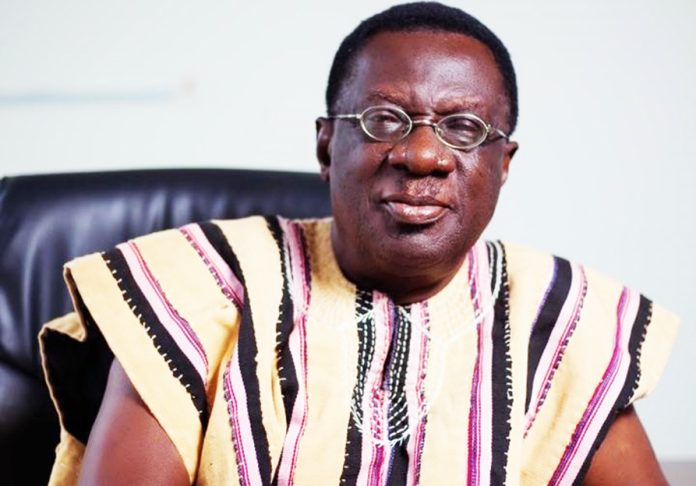
A former Board Member of the Ghana Infrastructure Investment Fund (GIIF), Yaw Odame-Darkwa, has challenged the former board chairman of the Fund, Prof Ameyaw Akumfi, to produce board minutes approving the disbursement of a US$2 million capital injection into the Accra Sky Train project.
Mr Odame-Darkwa, who is the Prosecution’s first witness (PW1), threw the challenge while under cross-examination by Yaw Acheampong Boafo, counsel for the embattled former board chairman, before an Accra High Court presided over by Her Ladyship Audrey Kocuvie-Tay on Monday.
Sky Train
He told the court that there are no board minutes capturing any approval by the GIIF Board for either the Sky Train project or the release of funds at the time the US$2 million was disbursed.
According to him, the project was still at the Investment Committee stage and had not reached the board for approval.
Under questioning, Mr Odame-Darkwa confirmed that the GIIF Board developed a disbursement policy pursuant to Section 16 of its governing framework. He said the policy was adopted on April 11, 2017, and that he was present at the meeting.
He told the court that under the resolution, all payments of GH¢500,000 and above were required to be jointly signed by the Chief Executive Officer and the Board Chairman, with processing done by the Fund’s finance department.
He identified key finance officials at the time, including Reginald Okai, then Chief Finance Officer; Benjamin Abrakwa, a Senior Finance Officer; and Seth Nana Kwame Osei, also of the finance department.
He confirmed that none of them were board members and could only process disbursements supported by board approval evidenced by signed minutes. Asked whether the finance department would disburse US$2 million without the requisite documentation, the witness maintained that no board approval existed in this instance.
Counsel for the second accused person referred the witness to portions of documents tendered in evidence, including Exhibit 4, which stated that the Chief Executive had informed the board of approval for a US$2 million investment in the Sky Train project.
Mr Odame-Darkwa, however, rejected that interpretation, explaining that the reference was merely an update by the Chief Executive and not a substantive board approval.
Heated Legal Exchanges
The cross-examination triggered a series of objections from the Deputy Attorney-General (DAG), Dr. Justice Srem-Sai, who argued that some of the questions were confusing, irrelevant, and misleading.
He contended that the core issue before the court was whether government funds were disbursed without board and parliamentary approval, not whether GIIF was responsible for constructing the Sky Train.
Dr Justice Srem-Sai , Deputy Attorney-General
Counsel for the defence countered that they were entitled to lead evidence to show that GIIF was not responsible for funding the construction of the project and that the questions were relevant to the charge.
After hearing arguments from both sides, the court overruled the objections and allowed the defence to continue with its line of questioning.
Questions (Q) and Answers (A)
Q. At the last court date you asked permission to refresh your memory as to whether the board of GIIF had developed a disbursement policy pursuant to section 16. Have you now refreshed your memory?
A. Yes, my Lady
Q. Did the board develop a disbursement policy?
A. Yes, my Lady. The board at its early stages put in place a resolution guiding how all disbursement have to go. And this guideline would normally spell out which limit each official can sign off.
Q. The date on which the board developed the disbursement policy was 11 April 2017. Was it not?
A. Yes, my Lady
Q. Were you present at that meeting?
A. I’m sure I was.
Q. And you would recall that as part of the resolution for disbursement, the board decided that payments from GH¢500,000 and above must be jointly signed by the Chief Executive Officer and the board chairman?
A. Yes, my Lady
Q. And the processing of disbursement was to be done by the finance department of GIIF?
A. Yes, my Lady
Q. Do you know Mr. Reginald Okai who at the time was the chief finance officer at GIIF?
A. Yes, my Lady
Q. And do you also know Benjamin Abrakwa, the senior finance officer?
A. Yes, my Lady
Q. Do you also know an official at the finance department known as Seth Nana Kwame Osei?
A. Yes, my Lady
Q. And these persons are the principal officers who handle the process of funds at GIIF
A. Yes, my Lady
Q. And none of these three persons were board members of GIIF?
A. Yes, my Lady
Q. And you know that they can only comply with a disbursement request if it is supported by an approval of the board and the evidence would be signed minutes to that.
A. Yes, my Lady that is how they are supposed to work. But in this instance they had no board approval.
Q. It is not correct that the whole finance department of GIIF would proceed to disburse the sum of $2 million without the requisite documentation?
A. I disagree with him because I have shown to this court how board approvals are done at GIIF. Board approvals are not in any document, they are written clearly in the board minutes. If counsel has that approval which was used to disburse that money he should show it to the court.
Q. The transfer instruction from GIIF to the bank to pay any beneficiary must include these documents Is that not so?
A. I’m not exactly sure about that one.
Q. Are you aware that during the investigations at the NIB those working with the finance department were invited for questioning and statements taken from them?
A. Yes
Q. Exhibit 4 item 7.7. Read item 7.1.
A. The chief executive informed that the following the approval by the board that the sum of US$2 million be invested in the Accra sky train project.
Q. And you were present at this meeting?
A. Yes, my Lady. This is not bias approval. This is merely an update by the chief executive on the Sky train project because at the time the project was still at the investment committee.
Q. Look at items 8 A,B,C?
A. Sky train.
Q. 24 D?
A. GIIF is seeking board approval to take up the offer to acquire 10% stake in the project development at the…
Q. Go to page 5, the portion titled conclusion and recommendations
A. Conclusion… impactful project for the country, government and its people.
Q. Page three of exhibit 24. You see six corporate entities had come together to develop and implement huge project?
A. That is what is there.
Q. And GIIF is not mentioned as part of that consortium?
A. Yes.
Q. Have a look at exhibit 26 A, page 4, Item 5. It is clear that the Accra sky train project was not to be financed by GIIF.
Deputy Attorney General (DAG): objection. Counsel wishes to confuse the witness. Relevance; my lady, council is asking the witness to confirm whether the sky train project was finally end by GIIF.
The law on what constitutes government money, which is also the subject matter of the offence of causing financial loss is that whether government as government of Ghana money or money belonging to any of the institutions of government are all considered as government money.
This question is of moment to the determination of the issue whose money is lost by the actions and decision of the accused persons. That is to say the payment of $2 million without board approval and without parliamentary approval.
Secondly, the page which the witness is being directed to read and rely on in order to answer the question continues to another page and contains so many statements none of which would lend itself to an answer who is funding the project.
The problem with such a question is that it confuses even the court, let alone the witness.
It’s a different thing if counsel is asking the witness without limiting him to a particular document to answer the question. But in this case the witness is being asked to rely on this page to answer this question.
We therefore pray that a proper foundation be laid to indicate the relevance of the question 2. That the question be rephrased to a specific or definite part of the page or be completely disallowed.
Counsel Boafo: The deputy attorney Gerald is now stating that a document already in evidence no question can be asked from them. The witness could accept that by his reading of that portion of the exhibit he disagrees with the question or not. That is all that he is entitled to do.
On the question of relevance I want to draw the DAG to the particulars of offence… we are entitled to ask question to show that the building of the system was not to be undertaken by GIIF. But this was for a specific purpose and we are entitled to lead evidence that we were not responsible for that purpose.
GIIF was not responsible for the funding of the construction of the Accra Sky Train project.
DAG. I leave the distinction between Sky train development and Sky train project for counsel to do. Except to say that the 10% is not the 10% of the project cost as counsel seems to be misconceptualising. It is 10% of a Mauritian company something. A company’s values as measured in shares is not the same at the cost of a project.
Court: at this stage I will decline the temptation posed by counsel for A2 as to distinctions in the charge. That appear to be premature at this stage. I will however overrule the objections and allow the question.
Q. Have a look at exhibit 26 A, page 4, Item 5. It is clear that the Accra sky train project was not to be financed by GIIF.
A. I disagree.
Q. Look at item 6 of exhibit 26A. It explains why the consortium of the six corporate bodies were selected over possible others. Is that not so?
A. From the document it looks like no institution came forward because when the call was made that is the impression that I observed.
Q. Do you know the meaning of the word consortium.
A. Yes. That when a group of companies with different backgrounds come together to undertake a certain transaction.
Q. And you see the word consortium in the diary line under item 6. Is that not correct
A. Yes.
Q. So it cannot be correct that nobody responded to the call.
A. No my lady, I disagree. When I said no other company came forward, I’m not necessarily saying just one company. Because no other consortium came forward.
Q. Line 7 of the same exhibit. Item 12. I want you to read everything to the court.
A. Total project cost. $2.6 billion. 384,000 total riders per day.
Q. At the time that this document was presented to the board, pre-feasibility studies had been done.
A. I’m not aware of that.
Q. Item 5 page 4 of exhibit 26A indicates to options available to the government of Ghana as to how the project was going to be funded. Is that correct?
A. Yes
Q. And paragraph 3 of item 5 clearly shows that it was the competition that has the responsibility to finance the Accra sky train project.
A. Yes, my Lady. But this is not a documents that we will rely on to make an investment decision at GIIF. We rely on investment memos to make investment decisions or not to make and this questions and answers document came about when I think a newspaper reported that the Accra sky train project was to be undertaken and I think people were making noise about it and then the board and management decided to do this questions and answers document so what people were talking about. So, it is not an investment memo.
Q. Exhibit 24 D is an Investment committee memo dated September 2018.
A. Yes.
Q. Exhibit 26 page 1. It says November 2018.
A. Yes.
Q. Look at the top part of that page. It has both the logo of the ministry of railway development and GIIF. Is that correct?
A. Yes.
Q. So, this document was prepared by the ministry of railway development and GIIF.
A. I have no way of verifying it.
Q. So every statement here is reflective of the government of Ghana’s position on the project. I’m pitting it to you.
A. I have no evidence to show that this is the position of the government of Ghana.
Re-examination by DAG
Q. Counsel showed some documents to you and suggested to you that part of their content amounted to board approval of the sky train project. Now tell the court, did any of those documents amount to a board approval of the project?
Counsel Boafo objects: The purpose of re-examination is to clear ambiguities. When a document is tendered in evidence that documentary evidence in the hierarchy of evidence is rated as one having the highest probate value and the content of the document will literally speak for itself. No ambiguity arises.
The document will prove for which purpose it was tendered. If the document was tendered to show there was approval for the Accra sky train project it will clearly indicate in the document. So there will be no ambiguity in that documents.
DAG. The objections are unfounded. A knife or a dagger is a more potent evidence than any document to prove that a person stabbed… so it is not true when counsel said that document is at the top of hierarchy of evidence.
Secondly, there is no document in evidence which shows that the board approval has been given for the sky train project or for the transfer of the $2 million. Therefore, the claim by counsel for A1 that where the documents speaks for itself conflicting oral testimony cannot change what the document says. There is no document in evidence to contradict the prosecution’s case that no board approval was obtained.
To my question, the question did not say that there is a document which said that there is board approval. My question was clear and it says that…
By Court: It is the opinion of this court that prosecution has to satisfy the court on the ground for re-examination. The question and answer condensers to procedure would be clear on the face of the evidence so far received. Prosecution has to been able to point out which question and answer is exactly is ambiguous. I will accordingly decline and sustain the objection.
Six of the victims were found dead at Tumbler Ridge Secondary School, making it Canada’s deadliest school shooting in decades. A seventh person died en route to hospital, while the bodies of two people were found at a home in the town, which has just 2,400 people.
The alleged shooter was also found dead at the school with a self-inflicted injury. Police did not give further details and declined to say if they were a child.
Canadian Prime Minister Mark Carney has told people in Tumbler Ridge “the nation mourns with you,” as Canadians wake up after a “difficult day” that saw its worst school shooting in decades.
“This morning, parents, grandparents, sisters, brothers in Tumbler Ridge will wake up without someone they love. The nation mourns with you. Canada stands by you,” Carney said at Parliament Hill in Ottawa early yesterday.
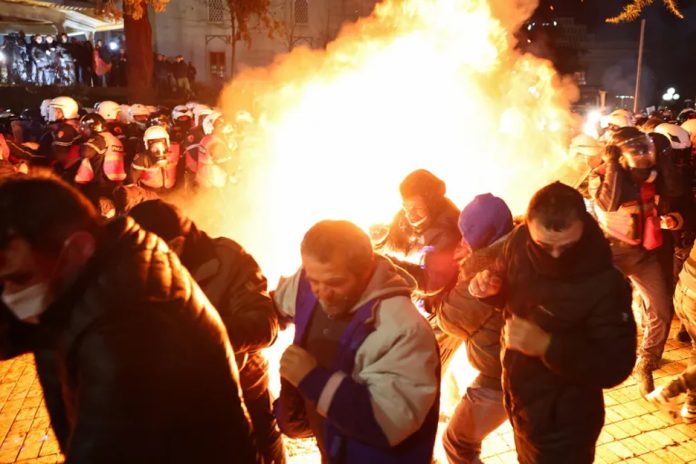
Protesters and police officers clash in front of the Parliament in Tirana, Albania
Police in Albania have fired water cannon and tear gas against protesters outside Prime Minister Edi Rama’s office in the capital, Tirana, as the demonstrators called for his resignation following a major corruption scandal.
Protesters threw Molotov cocktails and flares at police on Tuesday night, who sprayed water cannon and tear gas on the crowds. Clashes also occurred near Albania’s parliament building, according to media reports.
At least 16 people were injured and sent to hospital, and another 13 people were arrested at the scene. Media reports conflict over whether the number of injured represents just police officers, protesters, or both.
The protest is the latest in a series of antigovernment demonstrations in Albania in recent months.
Political discontent has been brewing since November, when prosecutors alleged that Deputy Prime Minister Belinda Balluku, who is also Albania’s minister for energy and infrastructure, had interfered in the procurement of government construction contracts.
She was briefly suspended from office before she was reinstated the following month at Prime Minister Rama’s request.
Protesters say they want both Rama and Balluku out. They have also called for parliament to suspend Balluku’s immunity so she can face prosecution.
More than 1,300 police were deployed at Tuesday’s demonstration, just two weeks after another violent rally in Tirana.
Both protests were called by Sali Berisha, leader of the opposition Democratic Party and a former prime minister.
He said on Tuesday that the protests were a sign that a “peaceful uprising” is under way in Albania, according to the Associated Press (AP) news agency.
Berisha has also faced corruption charges in the past.
Political analyst Mentor Kikia told AP that Albania’s leadership and opposition offered similar disadvantages.
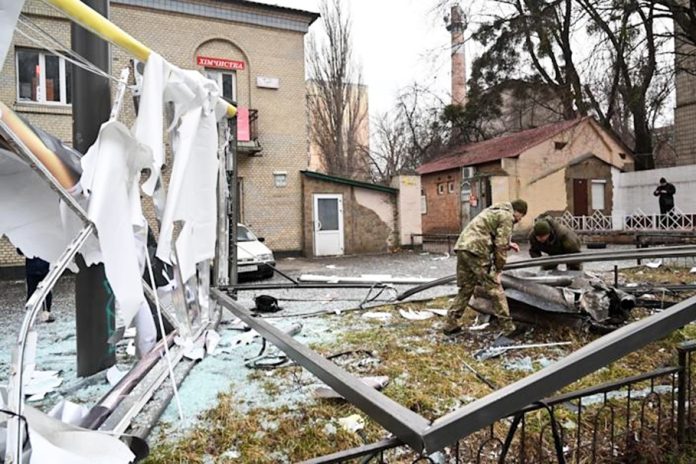
Five people, including three young children, have been killed in the latest overnight Russian attacks on Ukraine, President Volodymyr Zelenskyy has said, as United States-led efforts to end the nearly four-year war continue to progress at a slow, bogged-down pace.
The Ukrainian leader said on Wednesday that a Russian drone had struck a private family home in the town of Bohodukhiv in Ukraine’s northeastern Kharkiv region late on Tuesday, killing four and injuring their pregnant mother, the sole survivor.
The Kharkiv regional prosecutor’s office said the strike completely destroyed the house, trapping the family beneath the rubble.
It said three children were killed – twin boys aged two and their one-year-old sister – along with their father, 34.
The children’s mother, who is 35 weeks pregnant, was pulled alive from the rubble by rescue teams, suffering from blast injuries, a traumatic brain injury, burns and hearing loss, prosecutors said.
Images released by Ukraine’s emergency service showed firefighters battling a blaze in a destroyed house, with smoke rising through the beams of the shattered roof.
Volodymyr Bielyi, the mayor of Bohodukhiv, about 22km (14 miles) from the Russian border, announced on Facebook that the town would observe three days of mourning.
“We have lost what is most precious – our future,” he said.
“There are no words to console the family; there is no prayer that could heal the heart of a mother who has lost her children,” he said.
Kharkiv’s regional governor, Oleh Syniehubov, said the family had been attacked during their first night in the house, after having moved to the town in an attempt to escape constant Russian shelling.
The mother was released from hospital after receiving treatment for her injuries and minor burns, he said.
President Donald Trump will host Israeli Prime Minister Benjamin Netanyahu
President Donald Trump will host Israeli Prime Minister Benjamin Netanyahu at the White House on Wednesday, as tensions continue to rise across the Middle East and negotiations intensify over curbing Iran’s nuclear weapons programme.
Netanyahu is expected to press Trump to pursue a deal that would not only halt Iran’s uranium enrichment, but also cut its ballistic missile programme and support for proxy groups like Hamas and Hezbollah.
“I will present to the president our outlook regarding the principles of these negotiations,” he said before leaving for the US.
Iran has suggested it is ready to limit its nuclear programme in return for sanctions relief, but it has rejected the other demands.
Ahead of the White House meeting, Iranian President Masoud Pezeshkian warned that his country would “not yield to their excessive demands”.
Netanyahu’s visit on Wednesday marks his sixth trip to the US since Trump’s return to office – more than any other world leader.
A close Trump ally, Netanyahu has long argued that Iran represents an existential security threat to Israel and has pushed the US to curb Tehran’s influence in the region.
“The prime minister believes that any negotiations must include limiting ballistic missiles and ending support for the Iranian axis,” Netanyahu’s office said in a statement ahead of his trip.
After arriving in Washington on Tuesday, Netanyahu met Trump’s special envoy Steve Witkoff and son-in-law Jared Kushner. The pair “provided an update on the first round of negotiations they held with Iran last Friday”, according to the prime minister’s office.
Netanyahu’s visit comes as the US increases its military presence in the Middle East, with Trump warning Tehran of strikes if it fails to reach a deal on its nuclear programme and to stop killing protesters.
With proper care, your teeth and gums can stay healthy throughout your life. The healthier your teeth and gums are, the less risk you have for tooth decay and gum disease.
How Should I Care for My Teeth and Gums?
There are four basic steps to caring for teeth and gums:
Brushing
Flossing
Rinsing
Eating right
Visiting the dentist
Tips for Brushing Your Teeth and Gums
Brush teeth and gums at least twice a day. If you can, brush 30 minutes to 1 hour after every meal. Brushing removes plaque, a film of bacteria that clings to teeth. When bacteria in plaque come into contact with food, they produce acids. These acids lead to cavities. To brush:
Place a pea-sized dab of fluoride toothpaste on the head of the toothbrush. (Use a soft toothbrush.)
Place the toothbrush against the teeth at a 45-degree angle to the gum line.
Move the brush across the teeth using a small circular motion (if using an electric toothbrush, hold it at the same angle against the teeth and gum line and let it do the work). Continue with this motion cleaning one tooth at a time. Keep the tips of the bristles against the gum line. Avoid pressing so hard that the bristles lie flat against the teeth. (Only the tips of the toothbrush clean the teeth.) Let the bristles reach into spaces between teeth.
Brush across the top of the chewing surfaces of the back teeth. Make sure the bristles get into the grooves and crevices.
Use the same small circular motion to clean the backside of the upper and lower teeth — the side that faces the tongue.
To clean the inside of the bottom front teeth, angle the head in an up-and-down position toward the bottom inside of the mouth and move the toothbrush in a small circle.
For the inside of the top front teeth, angle the brush in an up-and-down position with the tip of the head pointing towards the roof of the mouth. Move the toothbrush in a small circle.
Give your tongue a few gentle brush strokes, brushing from the back of your tongue forward. Do not scrub. This helps remove bacteria and freshens your breath.
After brushing your teeth for two to three minutes, rinse your mouth with a mouthwash.
Replace your toothbrush with a new one every three to four months.
Tips for Flossing Your Teeth
Floss your teeth at least once a day and ideally after each meal you consume. Flossing gets rid of food and plaque between the teeth, where your toothbrush cannot reach. If plaque stays between teeth, it can harden into tartar, which must be removed by a dentist or hygienist. To floss:
Remove about an 18-inch strip of floss from the dispenser.
Wind the floss around the middle fingers of each hand, leaving a 1-inch section open for flossing. Floss the top teeth first, then the bottom.
Place the floss in your mouth and use your index fingers to push the floss between the teeth. Be careful not to push too hard and injure the gums.
Move the floss up and down against the tooth and up and around the gum line. The floss should form a C-shape around the tooth as you floss.
Floss between each tooth as well as behind the back teeth.
Use a clean section of floss as needed and take up used floss by winding it around the fingers.
Also, antibacterial mouth rinses (there are fluoride mouth rinses as well) can reduce bacteria that cause plaque and gum disease, according to the American Dental Association.
Tips for Rinsing Your Teeth & Gums
The third part of your daily oral care routine should be mouthwash — but not just any mouthwash.
Rinse daily with an antiseptic (also known as antibacterial) mouthwash to help kill bacteria that cause plaque, early gum disease, and bad breath.
Fluoride-containing mouthwash helps prevent tooth decay. Some mouthwashes have both antibacterial ingredients and fluoride.
Swish the rinse around in your mouth for 30 to 60 seconds.
You can use a mouthwash before or after you brush and floss.
Eating Right and Dental Health
For good dental health, eat a variety of foods, avoiding those that contain sugars and starches. These foods produce the most acids in the mouth, and the longer they stay in the mouth, the more they can damage the teeth. Hard “sucking candies” are especially harmful because they stay in the mouth a long time.
Snacking on sugary foods can lead to tooth decay, because most people don’t brush after snacks. Starchy snack foods, like potato chips, stick to the teeth. Avoid snacking on:
Pop superstar Britney Spears has sold the rights to her entire music catalogue, the BBC has learned.
Spears, 44, is said to have sold to independent music publisher Primary Wave on 30 December for around $200m (£146m).
The singer – whose protracted conservatorship long dictated her personal and professional life – is known for the hits …Baby One More Time, Oops!… I Did It Again, Toxic and Gimme More.
Primary Wave did not immediately respond to the BBC’s requests for comment. Representatives for Spears declined to comment.
In January 2024, the singer said she would “never return to the music industry”. Her last song was a duet released with Elton John in 2022.
Primary Wave has also acquired rights to the estates of Notorious BIG, Prince and Whitney Houston.
Details of the sale and the exact price of Spears’ catalogue have not been made public.
High-profile artists such as Bruce Springsteen, Justin Bieber, Justin Timberlake, and Shakira recently sold their catalogues too.
Springsteen sold his back catalogue to Sony in 2021 for $500m, and Bieber reportedly signed a $200m deal with Hipgnosis Songs Capital in 2023.
The publisher was founded 20 years ago by music executive Lawrence Mestel after purchasing 50% of Kurt Cobain’s portion of the Nirvana catalogue.
Spears is one of the best-selling female artists, with more than 150 million records sold worldwide. Her catalogue includes nine studio albums since her debut in 1999.
The sale comes after a tumultuous few years for the singer, who in 2021 ended a 13-year-long conservatorship – a legal guardianship that saw her finances and personal life controlled by her father.
The singer published her memoir in 2023 titled The Woman in Me, which detailed her struggles living under the conservatorship.