The Member of Parliament-elect for the Assin North Constituency, Mr. James Gyakye Quayson, has described his success in Tuesday’s by-election as a victory for justice.
Mr James Gyakye Quayson casting his vote
The victory, he said, was the clearest message delivered by the good people of Assin North about the direction that they wanted Assin North and the country to take.
The opposition National Democratic Congress (NDC), on Tuesday, retained the Assin North parliamentary seat after James Gyakye Quayson emerged victorious in the fiercely contested by-election.
He polled a total of 17,245 votes representing 57.56% of total valid votes cast while his main contender on the ticket of the New Patriotic Party (NPP) garnered 12,630 votes representing 42.15%.
A third force, Sefenu Bernice Enyonam, who represented the Liberal Party of Ghana (LPG) as a candidate, recorded an insignificant 87 votes, which stood at 0.29 percent.
Quayson’s message of appreciation
The Member of Parliament-elect, Mr. James Gyakye Quayson, in an emotional message of appreciation, said: “This is a victory, not just for me and the NDC but also for justice.”
He especially thanked the flag-bearer of the NDC, the former President John Dramani Mahama, for his encouragement and invaluable support.
“The people of Assin North have spoken. They have said without equivocation that they want me to represent them in the 8th Parliament… I am deeply humbled by the confidence the people have expressed in what I stand for and what I have done,” he said.
He explained that he sought the position following his deep commitment to the Assin North development agenda, and remained determined to mobilising resource to prosecute the agenda.
Expressing his gratitude to the voters, he said: “I am also fully aware of the reciprocal responsibilities that this massive show of confidence imposes on me.”
“I thank the good people of Assin North for coming out to deliver the clearest message about the direction that they want Assin North and the country to take,” he said.
He expressed his profound gratitude to his family, which had stood by him in both best and the worst times when his legal tussle began, right from 2017, when he was to be sworn in as a Member of Parliament.
He again thanked the voters who turned out in their numbers and voted massively for the resounding victory the party chalked saying, “I am grateful to all others who have reached out to me to express support, empathy, encouragement.”
“My solemn pledge is to work as hard as I can for the people who have made tonight possible…Let us come together to build a better Ghana for our posterity,” he stated.
He also thanked the NDC hierarchy, the Parliamentary Caucus, Central Regional executives and Assin North Constituency executives, as well as the polling agents, and all other members and officers of the party who stood with him through thick and thin.
The Bekwai Circuit Court in the Ashanti Region has sentenced a 35-year old mechanic, Akwasi Owusu, to 18 years imprisonment in hard labour for defiling a nine years old girl through her anus.
The action of the convict, according to a medical report, had left “a laceration of about 1.2cm at the five o’clock position of the perianal with a purulent discharge and blood tinge covering the surface.” This indicates that the minor had been defiled.
After a full trial, the presiding judge, His Honour Isaac Apeatu, slapped the jail sentence on Akwasi Owusu for defiling a girl under sixteen years through her anus, which is contrary to Section 101 of the Criminal Code of 1960 (Act 29).
Presenting the case before the court, the prosecuting officer, G/SGT Odum Godfred, explained to the court that the complainant in the case was Martha Boadiwaa, a food vendor, who is the mother of the victim, and resided at Ntuadoum, a suburb of Jacobu, whereas Akwasi Owusu was a mechanic and a resident of Jacobu.
The court heard that on February 23, this year, at about 08:05pm, the victim stepped out to play with her friends a few metres away from her home.
According to him, in the course of play, the accused person (Akwasi) approached the victim and asked her to escort him to take his food from his sister. The victim obliged, and on their way to the place, the convict pulled out a gun and threatened her demanding that she not raise an alarm.
Akwasi Owusu then took the victim to an uncompleted building at Jacobu, laid a cloth on the floor and instructed her to lie on it. He then undressed the poor girl and forcibly had sexual intercourse with the minor through her anus.
G/SGT Odum told the court that after Akwasi Owusu had slept with the victim, he fell asleep.
The victim then left her panties behind and rushed home to inform her mother about her ordeal.
The prosecuting officer further told the court that on February 24, 2023, at about 03:00am, the complainant immediately reported the issue to the police and the victim led them to the crime scene where the accused was deeply asleep.
Akwasi Owusu was subsequently arrested and taken to the police station.
A medical report was then issued to the complainant to send the victim to the hospital for a medical examination. After the examination, it was established that the hymen of the nine year old girl was intact, however, there “was a laceration of about 1.2cm long at the five o’clock position of the perianal, with a purulent discharge and blood tinge covering the surface.”
The prosecutor added that an impression of defilement via anal sex and anal was made and anal laceration, adding that during the police interrogation, the accused person admitted having called the victim to escort him to take his food, but rather had sex with her.
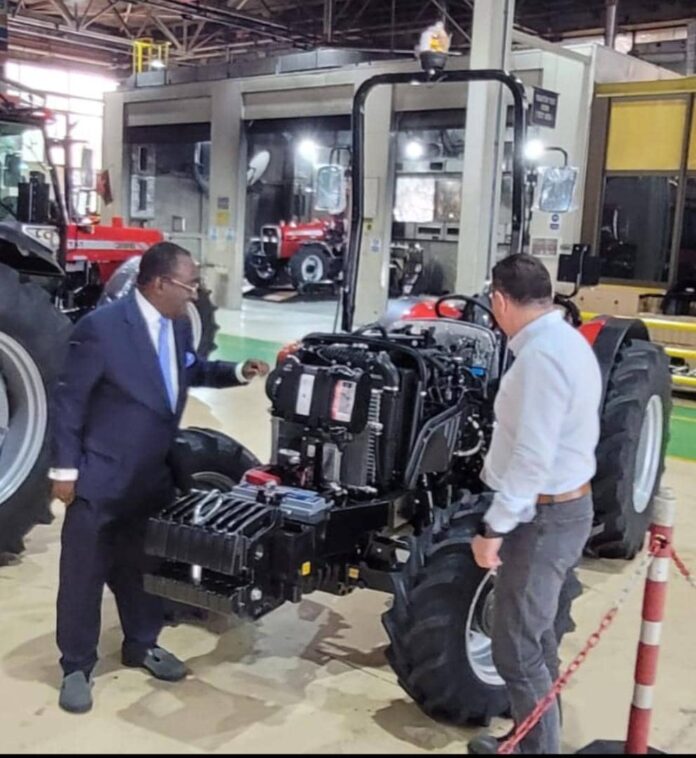
Dr Afriyie inspecting the tractors in the showroom
A flagbearer hopeful of the New Patriotic Party (NPP), Dr. Owusu Afriyie Akoto, has secured a tractor manufacturing plant deal for Ghana to boost mechanised farming and agriculture growth. The deal is also expected to benefit other countries in the West African sub-region.
This follows extensive discussions held between Dr. Akoto, Ghana’s immediate past Minister of Food and Agriculture, and directors of Hattat Traktör during his recent visit to Turkey, where he delivered the keynote address as the Special Guest of Honor at the African Investors Council Forum.
Dr Afriyie Akoto driving one of the tractors in the showroom
The discussions were primarily focused on the provision of an enabling environment for the Hattat Traktör business to thrive, policy formulation aimed at protecting and supporting the business, as well as issues of accessibility and affordability.
After the meeting, Dr. Akoto, who is also a two-term Member of Parliament (MP) for Kwadaso Constituency in the Ashanti Region, was then taken to the showroom of Hattat Traktör for an inspection of their wide range of tractors that were on display.
“It is about time the world sees Africa as the next big destination for investment, especially in our agricultural sector. Available data points to the fact that Africa is going to feed the world by 2050. The directors of Hattat Traktör have this data and got even more convinced during the discussions.
“By establishing their manufacturing plant in Ghana, they will have full access to the ECOWAS community market and that will boost agriculture in Ghana and the West African sub-region,” Dr. Akoto noted in an interview.
Having concluded initial talks on the investment potentials in the West African sub-region, the directors of Hattat Traktör, The Chronicle was told, were preparing a visit to Ghana, where they would officially present their proposal to the government for consideration.
Hattat Traktör, established in 1998, manufactures tractor models with horse power ranging from 50-113. It produces models with advanced technology and low fuel consumption for ergonomic gardens, compact farming, and fields.
Dr Afriyie Akoto standing by one of the tractors
Hattat Traktör has received awards of Tractor of the Year and Cab Design Officer of the Year in Poland in 2010. They were also recognized at the plough champion in Ireland in 2011, in Latvia in 2013, Silver Medal in Moldova Moldagrotech Fair in 2014 and the Tractor of the year in Poland with new T4000 series in 2016.
Available information indicates that Dr. Akoto has already started some preparatory works for Hattat Traktör considering the importance he attaches to the agricultural sector, which he has prioritized in his campaign message as the pivot to developing the other sectors of the economy when the right investments are made into the sector.
Ghana has 3.1 million professional farmers. A few of these farmers are into mechanized farming, with the majority being smallholder farmers. According to the 2021 edition of the ‘State of Ghanaian Economy Report’ by the Institute of Statistical, Social, and Economic Research (ISSER), Ghana’s agricultural sector grew by 8.4% in 2021, the highest recorded in the 4th Republic.
To Dr. Akoto, who has served in the UN systems for 18 years, the West African nation could achieve more if the country prioritises public funding in the agriculture sector, with special focus on mechanized farming while resourcing the majority smallholder farmers.
A study titled ‘Status of Agricultural Mechanization in Ghana: Insight from farmers’ perception, population, and nonagricultural sector growth’ published in the Hindawi Advances in Agriculture Journal has revealed that, “the overall level of agricultural mechanization in Ghana was found to be very low since averagely 77.6% of the farm operations are largely performed manually’. The study also revealed that below 20% of farm operations were mechanized in 2020.
On the modelling of the tractor power availability in Ghana, the study revealed that the number of people in Ghana employed in the service sector, and the population in Ghana, were key factors that affected the level of mechanical power availability for agriculture in the West African nation.
According to the study, the level of tractor power availability increased from 0.0207kW/ha in the year 2004 to 0.0588kW/ha in the year 2020 and is expected to increase to 0.0752kW/ha in 2025.
The study therefore, recommended that agricultural policymakers will have to design policies that help modernize agriculture through the transformation of the level from manual systems to highly mechanized systems where averagely more than 60% of the farm operations will be mechanized.
It further recommended that policy makers in Ghana should consider diversifying employment opportunities away from the service sector while encouraging more growth in the agricultural sector.
Moreover, measures to bring in more tractors while the population of the country is growing should be consciously pursued to help increase the mechanical power availability to levels that can bring about sustainable productivity.
Should the Hattat Traktör deal be sealed and the assembling plant built in Ghana, mechanized farming will rise at an exponential rate, thereby, sustaining food and nutrition security in the country and the ECOWAS community in general.
A 22-year-old unemployed man, Eric Odai, has been accused of hitting a policeman, Inspector Patrick Sasraku, with a hammer on the head.
Odai was also alleged to have stolen handcuffs, a pepper spray, and Gota handset from some police personnel. He has, therefore, been charged with causing harm and stealing.
The accused pleaded not guilty to the offences and was granted bail in the sum of GH¢100,000 with three sureties, who are gainfully employed and one should be justified. The sureties are to deposit certified copies of their Ghana Cards with the court registry.
Her Honour Ellen Ofei-Ayeh, the presiding magistrate, ordered the prosecution, led by Inspector Daniel Ofori-Appiah, to file certified copies of the dairy of action within seven days.
Brief Facts
The prosecutor told the court that the complainant is Insp. Patrick Sasraku, stationed at the Teshie District Police Headquarters, whilst the accused was unemployed and also a resident of Teshie.
According to him, on September 24, 2021, the police received a complaint from Samuel Adjei Mensah that the accused and his cohorts were developing his land located at Teshie Guest Inn.
Samuel Adjei Mensah, together with some other police officers, visited the scene of the crime and met the accused and his cohorts developing the land.
When the police tried to arrest him, Odai pulled out a knife to attack the peace officers.
The accused also managed to pick a hammer on the ground and hit the complainant’s forehead with it, and also took three police handcuffs, a pepper spray, and a Gota handset from the complainant and fled the scene.
The complainant was rushed to the hospital and was treated and discharged. The accused later called the complainant and threatened to deal with him anytime he saw him.
On May 21, 2023, the accused person was arrested from his hideout at Teshie, and after investigations, he was charged with the offences and brought before the court.
The Assin North by-election came off on Tuesday, with James Gyakye Quayson of the National Democratic Congress (NDC) being declared the winner by the Electoral Commission (EC).
The Returning Officer for the election, Kofi Tsibu, declared James Gyakye Quayson the winner after he polled 17,245 votes, representing 57.56 percent of the valid votes cast, with the New Patriotic Party (NPP) candidate, Charles Opoku, coming in second with 12,630 votes, representing 42.15 percent.
The Liberal Party of Ghana (LPG) candidate, Sefenu Bernice Enyonam, had 87 votes, representing 0.29 percent.
Addressing the media after his victory, Mr. Gyakye Quayson stated that his victory was for the conscience of right-thinking Ghanaians who were not misled by money.
First, we extend our congratulations to James Gyakye Quayson on winning the election. Once more, his victory significantly raises the country’s democratic standing.
We advise the NDC to celebrate its triumph with moderation, and the losing parties to return to the drawing board to re-strategise for 2024.
The Chronicle also commends the Ghana Police Service and the Military for ensuring peaceful and violence-free elections.
Despite the pockets of scuffles reported by the media, overall the election was peaceful. Also, in a statement released from Jubilee House, the President, Nana Addo Dankwa Akufo-Addo, also congratulated the NDC for their win, and we think this depicts statesmanship from a leader of an opposing party.
We also congratulate the EC for a good job done, and for organising a smooth and peaceful election. The EC has always risen to the occasion, and we are particularly happy about how logistics were transported to polling stations, as well as the proper management of time.
The Assin North elections might have raised tensions over the period of campaigning, because Quayson decided to stand again, although he is facing criminal charges in court.
It is refreshing to read the congratulatory message from the NPP, which has accepted defeat honorably and has pledged its commitment to work with all stakeholders.
For us, we agree with the MP-elect when he said his victory was for the democracy of the country, a position President Akufo-Addo and the NPP also espoused in their separate statements.
It is our hope that both parties relegate their differences witnessed during the campaign and forge ahead for the development of the constituency.
We think that it will not be proper, and, in fact, it is unconstitutional, to deny the good people of Assin North, and any other part of the country, their share of the national cake for reasons that the seat is for the opposition.
We hope that the various developments that commenced before and during the campaign would continue to completion, because, if the government saw the need to expedite work on projects in the constituency ahead of the polls, there cannot be any justification based on the previous point that work would cease.
A 22-year-old shop attendant, Anthony Ayew, has been sentenced to 15 years imprisonment in hard labour for defiling a 15-year-old teenage girl.
Ayew was sentenced on his own plea of guilt by the Domestic Violence and Victims Support Unit (DOVVSU) court, presided over by Her Honour Dora Eshun Inkumsah, on Monday, June 26, 2023.
He pleaded guilty to two counts of defilement of a child under 16 years of age.
Reading the brief facts of the case, D/C/Insp. Opoku Aniagyet said the complainant was a brother of the victim.
She told the court that Ayew and the victim lived in the same house, and normally he sent her on errands.
But on December 25, 2022, at about 8:00pm, the victim went out with her friend, and while returning home, she met the convict standing at the entrance of his room.
The convict called her to come, and immediately she approached him, the latter got hold of her and dragged her into his room, twisted her hands backwards, pushed her onto his bed, raised her dress upwards, and removed her panty.
Ayew also removed his trousers and boxer shorts, and then inserted his penis into the victim’s vagina and had sexual intercourse with her.
The convict continued to have sexual intercourse with the victim from time to time, particularly from February of April 27, 2023.
The court heard that the secret act was discovered when the lights in the house went out and the victim decided to sleep outside in order to get fresh air. Whiles the victim was sleeping outside, the convict went to lie beside her and started sucking her breast.
The victim began hitting the convict to the extent that the sound woke a neighbor from her sleep to find out what was happening.
It was during this episode that the victim disclosed everything to her brother and the matter was reported to DOVVSU Accra Region.
The complainant was issued with a police medical report form to send the victim to hospital for examination and treatment and a report issued. The convict was arrested and a cautioned statement was obtained from him.
After investigation, he was charged with the offences and put before the court.
In Ghana, a marriage before the age of 18 is considered child marriage. According to a report by United Nations International Children’s Emergency Fund (UNICEF), more than 21% of women aged 20 to 24 in Ghana were married before the age of 18.
In some regions, the numbers are much higher, with as many as 40 percent of girls marrying before they turned 18 in the Upper East, Upper West, and Northern regions. The Ghanaian government recognises the need to address child marriage, and has made efforts to eliminate the practice.
In 2015, the government launched a campaign titled “End Child Marriage” to raise awareness about the harmful effects of child marriage, and encouraged communities to take action.
Several non-governmental organisations (NGOs) are also working towards ending child marriage in Ghana. Plan International, for example, runs programmes that promote girls’ education, provides economic opportunities for families to reduce their dependence on marriage income, and advocates for legal reforms and supportive policies.
Girls in rural areas are more vulnerable to child marriage due to their limited access to information, education, and healthcare. Poverty is also a major factor, with parents often forcing their daughters into marriages as a means of financial support, as well as to reduce the burden of feeding and caring for them.
One typical example of early child marriage in Ghana is the case of 14-year-old Ama (not her real name), who lost her parents at age 10 and was left in the care of her grandmother, who forced her to marry a 48-year-old man, and had her first baby at 13 years.
Ama’s family lived in a small farming village in the Ashanti Region, where traditional practices were highly valued and closely followed. Unfortunately, one of these practices was for girls to be married off at an early age. Ama was born into a poor family, and her grandparent saw her as a burden, as they could not afford to provide for her.
“I wanted to finish my education and become a nurse,” Ama says. “But my grandparents said they couldn’t afford it, and that getting married was the best option for me.”
Ama’s story is not uncommon in Ghana. Girls like her face significant barriers to education and are often forced into domestic duties at a young age. This not only deprives them off their childhood, but also limits their ability to learn and grow to contribute to their communities.
Child marriage also has severe health consequences. Girls who marry early are more likely to have children at a young age, leading to a higher risk of complications during pregnancy and childbirth. They may also be more susceptible to sexually transmitted infections and cervical cancer.
Child marriage also perpetuates the cycle of poverty and inequality in Ghana. Girls who are married at a young age are less likely to receive an education, secure employment, and contribute to their household’s income. They are also more likely to experience domestic violence and abuse.
The effects of early child marriage on the education and development of girls in Ghana
Early child marriage in Ghana heavily affects the education and development of girls. Child brides are often forced to leave school before they complete their education, cutting off their future opportunities for growth and prosperity.
This not only limits their economic opportunities but also prevents them from engaging in activities that can boost their cognitive development and social skills.
In addition, many girls who marry early may be too young to navigate the social and sexual dynamics of a marriage, putting them at risk of physical, emotional, and sexual abuse.
Studies show that early marriages have a higher likelihood of ending in divorce and that child brides are more likely to experience violence than women who marry later in life.
Early child marriage can also lead to health issues such as maternal and infant mortality and morbidity, as underage girls are not physically or emotionally mature enough to bear children.
The education and development of girls in Ghana have improved significantly in recent years, thanks to government-led initiatives. However, early child marriage remains a significant barrier to progress.
To achieve gender equality and women’s empowerment across all spheres of the society, early child marriage needs to be eradicated, and girls should be given access to education to achieve their full potential.
Ways of empowering young girls in the communities against early child marriage in Ghana
Empowering young girls against early childhood marriage in Ghana is crucial to ensuring that they have the opportunity to reach their full potential. Due to various societal and economic factors, early marriage remains a prevalent practice in Ghana, robbing girls of their rights to education, health, and social development.
At the community level, efforts are being made to change cultural attitudes and behaviors that support child marriage. This includes engaging community leaders, traditional rulers, and religious leaders in discussions about the harmful effects of child marriage and advocating for positive norms that support girls’ education and empowerment.
To prevent early childhood marriages and empower girls, the following measures could be implemented:
Education: Education is a fundamental right that every child should have with no discrimination. Girls in Ghana are often prevented from accessing education, reducing their opportunities for growth and development. Educating and empowering girls in Ghana can help break down barriers to gender inequality and ensure they receive an education. Encouraging and enabling girls to pursue their education can offer protection against child marriage.
Provision of Health Services: Poverty and lack of access to healthcare in Ghana can pose a risk to the well-being of girls. Ensuring access to healthcare services, particularly reproductive and sexual health services, can help young girls avoid early conception.
Economic Empowerment: Provision of opportunities for girls to add voice to sustainable economic decisions within their communities or households can reduce the pressure to marry early. When girls’ economic agencies are improved, it leads to their financial stability and independence and has the potential for poverty reduction.
Girl-Child Empowerment Programs through Community Engagement: Encouraging collaborations between institutions, community leaders, policymakers, and development agencies in the implementation of front-line initiatives to empower girls and prevent early childhood marriages is integral. Getting traditional and cultural leaders involved in the conversation can help identify the root causes of early childhood marriage and establish action steps to improve the lives of girls.
In conclusion, efforts need to be made to end early childhood marriages and empower young girls in Ghana.
Education, provision of health services, economic empowerment, and community engagement are area aspects of empowering girls against early childhood marriages.
Once these interventions are implemented and enforced, it will enable the girls to access all opportunities available, ensuring that they participate in the social, economic and political sphere of their society.
In conclusion, child marriage is a significant obstacle to girls’ education and development in Ghana. The country needs sustained efforts at all levels to eliminate the practice and create a more equitable and just society for girls.
This requires a holistic approach that addresses the root causes of child marriage, provides the necessary support and resources to affected communities, and enables girls to achieve their full potential. Only then can we ensure that every girl in Ghana is free to grow, learn, and fulfill her dreams.
The views expressed in this article are the author’s own and do not necessarily reflect The Chronicle’s stance.
The current state of the interchange, couple with the deplorable access route
The first-ever three tier interchange being constructed to control and direct traffic to the central business district appears to have become a burden and an albatross hanging around the necks of residents of Sekondi-Takoradi, most especially commuters, who use the Casuarina belt road to Kwesimintsim, Apowa, Agona-Nkwanta etc.
Following the abandoning of work by the Chinese contractor on the project, the hitherto access route, constructed for drivers and commuters to use as temporary road, is now posing a danger and death trap.
Not that alone, as the access route has developed huge craters making it extremely difficult for drivers to ply.
What is more annoying is that the access route has become even more difficult to use when it rains. The recent four day of non-stop rains, which hit Sekondi-Takoradi, flooded the access route culminating in heavy traffic congestion.
Before construction work begun on the now abandoned three-tier interchange at the PTC Roundabout, the road was in good shape, devoid of potholes and heavy traffic, and it was the expectation of many, including drivers, that the interchange would facilitate speedy flow of traffic.
However, it appears the expectation many had about the project is being eroded, following the abandoning of work on the interchange, culminating in the deplorable access route, traffic congestion and flood.
What has contributed to erase resident’s expectations appears to be the apparent unconcerned attitude of the city authorities to put the interchange access route into good shape.
The 30 months three-tier interchange was expected to be completed in June 2023 until the Chinese contractor abandoned work due to an International Monetary Fund (IMF) conditionality.
The Vice President, Dr. Mahamudu Bawumia, cut the sod for the construction of the interchange, which is estimated to be 65% complete until the contractor abandoned work.
Drivers and commuters the Western File spoke to expressed grave worry over the deplorable access route at the interchange.
A taxi driver, Eric Boadi, described the access route as a death trap. “The road is very bad and is destroying our vehicles. If you are not careful, you may end up driving into the big created artificial pothole.”
He added that a number of drivers have had to resort to avoiding the route because of its deplorable state. In the end “if drivers are resorting to using other roads, the passengers, most especially those going to Apowa, Kwesimintsim, suffer.”
Another driver appealed to the city authorities to save the road from further destruction. “In this rainy season, if the road is not saved, it will mean no car will transport passengers to Apowa, Apremdo etc.”.
For now, driver unions have hinted at embarking on a sit down strike to force the city authorities to put the interchange access route road into good shape.
The drivers had scheduled last week Tuesday and Wednesday to lay down their tools as a form of punishment to force the city authorities to act, but the four-day non-stop downpour which started on Wednesday may have dealt a big blow to the union.
The Ghana Private Road Transport Union (GPRTU) Chairman, Mr. Eshun, was on a local radio station, Sankofo 98.9 FM, where he dropped the hint.
Meanwhile, on Tuesday, executives of the Sekondi Takoradi branch of the Union (GPRTU) embarked on a day’s tour to inspect deplorable roads in the Metropolis.
The executives first stopped at the interchange access route to inspect and gather at firsthand information on its state.
The GPRTU executives explained that their decision to embark on the road inspecting was due to the hue and cry by its drivers and passengers on its deplorable state.
Deputy Minister for Trade and Industry, Dr. Stephen Amoah
The Deputy Minister for Trade and Industry, Dr. Stephen Amoah, says the Komenda Sugar Factory suffered a major setback, due to lack of proper planning and supporting data for its establishment.
Dr. Amoah noted that lack of scientific data backing the establishment of the factory, as well as its location, were some of the contributing factors affecting its ability to operate at full capacity.
According to him, the problem was limited not only to the sugar facture, but nationwide, asking whether if “we really, really know the size of land we can grow onion, ginger, pineapples, maize, [and] apple on, do we know? Have we done all the soil tests? Do we have the data against what we demand? Do we understand the value-chain?
“No wonder we have the Komenda Sugar Factory for two different regimes for so many years, and the problem is sugarcane. Have you heard this thing before? How could we set [up] a factory and the problem is the raw material that we need. So without the availability of land and knowing where you will get it to feed the factory to full capacity, why do you think of setting it up?
“These are serious issues; sometimes it is difficult to talk about, but I think we can no longer sit aloof; we should be ready to face the criticisms and speak the truth…”
The Deputy Minister was speaking at the 2nd Edition of the Financial Economic Seminar-Ghana 2023, dubbed: “Impact of Socio-Economic policies on Trade and Industries in Developing Countries,” yesterday.
He diagnosed that the problem partly stemmed from Africa, and the choices of leaders elected as people, would do everything on earth to become leaders, but wouldn’t do everything on earth to know how to lead.
Dr. Amoah also blamed the government for the stunt growth of industries, explaining that the government was in constant competition with businesses at the capital market, which the latter was always at the losing side.
He added that since the government goes to the same capital market as the private sector to borrow, a lot of the companies could not grow organically, because of inadequate funds.
Additionally, the ration fund given to the private sector by the bank will always have double digit interest rate.
Consequences, he said, are felt in high interest rates, which affect the companies’ ability to expand to employ more, and produce enough to meet demand.
The trickledown effect is also seen in high import rates and the weakening of the cedi against other major trading currencies.
Deputy Minister Amoah stated that although the central bank increased the policy rate with the aim of reducing inflation, the act must be reconsidered, as it unduly affects trade and industry efficiency.
The Guest Speaker for the event, Professor Antinuke Olusla Adebanji, on her part, emphasised the need for a coordinated and accurate data collection, and used for accelerated growth.
She told the gathering that data collection, publication, uptake and impact were relevant in socio-economic policy development.
Prof Adebanji said governments and international bodies are like rely on data to assess the impact of trade policies, measure trade flows, and identify potential trade barriers.
However, she warned against lack of data, poor quality data, infrastructure, policies and resource utilisation, as well as lack of a unified data structure as major challenges to social economic policy development.
There were other speaker such as Maame Awinador-Kanyirige, a policy officer for Trade and Economic Affairs, The Netherlands Embassy in Ghana, and Yaw Amoateng, Deputy Chief Executive Officer (CEO), Ghana Investment Promotion Centre.
The discussants of the theme were Clement Osei-Amoaka, President of the Ghana Chamber of Commerce, Sheela Sakyi Oppong, private legal practitioner, and Dr. Joseph Obeng, President of Ghana Union Traders’ Association (GUTA).
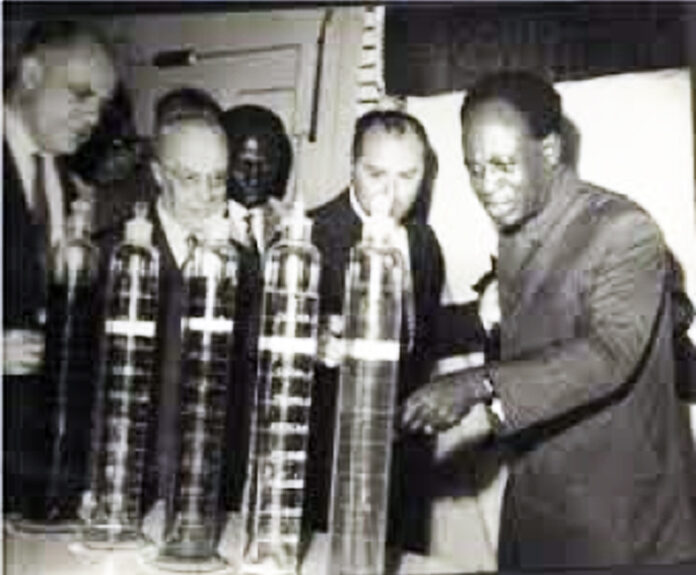
Osagyefo Kwame Nkrumah with ENI executives ahead of TOR’s opening
Two sectors of Ghana’s economy are specifically identified in the country’s recent IMF program for critical attention because of their contribution to the country’s debt debacle: energy and cocoa. The story of Tema Oil Refinery exemplifies what has gone wrong with Ghana’s energy sector.
Tema Oil Refinery has big problems that require hundreds of millions of dollars and sophisticated investors to fix.
Such money and investors will not come unless the country’s leaders are genuinely interested in an above-board transaction, and are willing to spend the taxes they have collected in TOR’s name to clear the muck and give serious investors a fresh chance. It is clear that they are not. They are only interested in a deal that will keep their cronies positioned at vantage points.
So, for many years, various shady deals and shadowy investors have been paraded as saviours of TOR, of which the latest are Decimal, Legacy and Torentco.
None of these entities have what it takes to truly revamp TOR. The opacity, underhand dealings, shadiness and murkiness risk becoming a breeding ground for criminal and underworld activities, destroying what little reputational value remains in TOR. Already, there are fears that some of the partners proposed for the Torentco transaction may be embroiled in sanctions-busting activities.
An open and competitive process should be pursued to bring fresh management not beholden to any political elite factions. The unencumbered management should be empowered to run a totally above-board process to attract investors with deep pockets. Accompanying energy sector reforms, strict use of energy taxes for their intended purpose, and strict price deregulation would need to be in place to assure such investors.
Any shady leasing of assets to shadowy operators will lead to the compounding of TOR’s debts, continued obsolescence of TOR’s infrastructure, and an eventual reckoning in which the company’s situation becomes irredeemable and unsalvageable.
Born of Big Dreams
The Tema Oil Refinery (TOR), located in the country’s coastal industrial base, is a product of Ghana’s post-colonial industrialisation drive that saw the first government after independence engage international investors as strategic partners in a number of vital industrial projects.
The same process that brought foreign financiers and engineers to build, own and run TOR in 1963 also gave Ghana the Volta Aluminum Company (VALCO), Akosombo hydroelectric dam, and Ghacem, still among the most important anchors of Ghana’s industrialisation dream.
A wave of nationalisation, however, swept the country in the 1970s and by April 1977 TOR was fully state-owned. It is a sad testimony to the perennial decline of state capacity in Ghana that since then TOR has lurched from one crisis to another.
The Rude Awakening
From the point of nationalisation onwards, the refinery did not see any serious renovation or capacity boost until 1989. Even then it was widely recognised that capacity expansion and technological retrofitting and upgrading were essential to the ongoing viability of TOR. But then again a long list of state-run industries were in the same boat.
In 1963, when the seven year development plan was launched, several state-run industrial concerns were placed on a list for capacity expansion and upgrading by 1970 at the cost of £1.6 million ($4.5 million), or the equivalent of $45 million in today’s money. By 1992, not a single one of them had seen any serious investment for transformation.
Halting steps to redemption
A $200 million loan from Korean investors enabled the expansion of the Tema Oil Refinery (TOR) to its current 45,000 barrels per day capacity by the late 1990s.
Sample of priority factories targeted for capacity upgrades in the 1963 7-Year Ghana Development Plan
When a new government took over from the Rawlings government in 2000, a long courtship with Korean government and private entities, especially Samsung, ensued.
At stake was a fresh $230 million loan for the long anticipated expansion and addition of modern modules to handle a wider range of crude oil types.
TOR’s precious Residual Fluid Catalytic Cracking Unit (RFCC) was eventually financed by Samsung from the loan package and commissioned in November 2002. By this point, the refinery had racked up debts of over $300 million.
In 2003, the government instituted new taxes to enable the refinery pay off its debts and complete the planned expansion works.
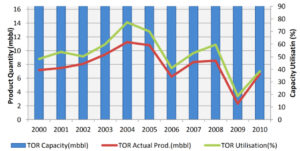
Energy Analyst, Dramani Bukari, estimates that after these expensive technical works, plant utilisation (how much of a factory’s theoretical capacity can be practically used) at TOR ramped up to a high of 80% before beginning a disorganised descent until it hit a rock-bottom of 19% in 2009.
The Imperative of Expansion& the Debt Trap
Clearly, despite absorbing tens of millions of dollars in investment for technical transformation, TOR was still struggling with viability issues, increasing the urgency for a more radical expansion program to improve unit economies. Officials mooted the prospect of adding 100,000 barrels per day of refining capacity at the cost of ~$200 million.
Meanwhile, the debts continued to mount. Politicians continued to interfere in the running of the organisation, only ever appointing cronies and allies to all Board and senior management positions. Management policies grew even more arbitrary.
Underfunded government subsidies ensured that the same year TOR processed the most crude, 2004, it also recorded the highest losses for the decade. Samsung, tired of all this drama, withdrew its interest as a prospective strategic partner.
The bumbling continued. Despite collecting $500 million in TOR-focused taxes by 2008, the government refused to invest any significant amount of money into the facility, even as it toured the globe looking for so-called “partners”. Unwilling to fully let go of a juicy gravy train, open and competitive privatisation was never really placed on the cards.
So, by 2010, the debt had ballooned to $1.4 billion. Confronted with the prospect of total shutdown and hostile creditor actions, the government started to make some payments. GCB, a state-controlled bank and a captive TOR creditor, was on the verge of being pulled down with TOR forcing the government to arrange a $316 million repayment.
That however did not stop the refinery from shutting down.
Facing a loss of public credibility, the government doubled down on efforts to address the fundamental issues.
By 2015, further payments had brought the debt down to a little under $750 million. Yet, frequent announcements of “strategic partnerships” and financing deals had yet to bear fruit. In one particularly striking example, the government announced a $900 million financing package in 2012 to tackle the crushing working capital constraints of the company.
Nothing of note happened.
God bless our hustle
Months later, in 2013, TOR was back to hustling for crude parcels around the world to keep the refinery in business.
The culture of hustling for crude and bits and pieces of working capital was fast becoming the defining hallmark of the TOR story. In 2011, a bizarre drama unfolded in which fake companies popped up from the undergrowth to claim ownership of crude oil delivered to TOR, forcing the intelligence services to step in.
Meanwhile, TOR’s throughput was now the lowest among peer refineries in the subregion.
Turning Inwards
In 2015, another effort was made to raise domestic funding to tackle the TOR debt and capacity juggernaut, but this time in concert with other energy sector challenges.
The Energy Sector Levies Act (ESLA) was passed and, in 2017, a special purpose vehicle created to transform taxes into a more effective financing mechanism for clearing legacy debts and freeing energy sector corporations like TOR to embark on structural reform. Recall that by this time, TOR’s debt was around $750 million.
The ESLA SPV raised a total of $1.6 billion in the three years following setup. The government simply expanded its general spending and devoted nothing to the structural transformation of the refinery. It did however clear a significant portion of TOR’s legacy debt, which thus dropped to $460 million.
TOR revenues, on the other hand, tumbled from a peak of ~100 million in the last decade to less than $25 million in 2020. Accumulated losses over the period exceed a billion dollars.
Today, our sources tell us that TOR’s books have not been properly audited but provisional figures show a debt of nearly $450 million. The spate of shutdowns have intensified over the years leading to a state of near mothballing, with refining activities at a standstill for an unprecedented 26 months now. The organisation is on its fifth or so Chief Executive in five years. The center cannot seem to hold.
The Shadowy Duo: Decimal& Torentco
It is against this background that civil society activists and analysts received with dismay news of the submission to the Public Procurement Authority (PPA) of a proposal by the TOR management to lease the main assets of the refinery to a shadowy entity called Torentco Asset Management (“Torentco”) for six years. To fully appreciate the concerns of the analysts over this matter, it is important to recap the key issues.
It has long been recognised that TOR’s working capital, refurbishment, and debt management require capital in the range of between $500 million and $1 billion to begin to get a handle on the structural viability of the refinery. And that considerable capacity expansion is essential. In fact, the last CEO at TOR to have had anything remotely approaching a normal tenure insisted that $3.5 billion was required to start from a clean slate.
It is also widely accepted that TOR’s simple initial design as a hydroskimming plant requires a substantial overhaul to lower conversion losses and sustain plant utilisation over the medium term. For example, TOR’s current configuration is optimised for heavy distillates hence the criticality of the RFCC. Gasoil and atmospheric residue constitute more than 60% of its output. To produce more of the products most required on the domestic market such as petrol (Premium Motor Spirit) and diesel, a robust RFCC is vital in TOR’s current configuration.
TOR’s adverse managerial and operational history makes it difficult to raise money on good terms, obtain feedstock (raw crude) on reasonable credit, and to respond to market dynamics in a commercially competitive manner.
For nearly two years now, the government and TOR have been promising a major deal with the features needed to tackle these serious challenges. Things seemed to have come to a head when in another of the frequent managerial reshuffles TOR has become famous for, a new CEO took the helm last year and promptly announced a strategic partnership with a little known Kenyan entity called Decimal Capital to turn the refinery around.
Decimal was clearly introduced into the mix by another short-lived CEO of TOR, who was removed following a civil charge by the United States government for various alleged offences. He was subsequently criminally indicted under the Foreign Corrupt Practices Act. Many analysts believe that Decimal was still being teleguided by this former CEO.
This week marks one year since TOR’s management announced to the country that the Minister of Energy has approved a strategic partnership agreement between TOR and Decimal for the former to lease its infrastructure for the use of the latter in order to resume stalled refining operations. Then everything went quiet.
At the time, Vitol was mentioned as the commodity financier. That is to say, Vitol, a large Swiss energy trader, was to provide the raw crude for TOR to refine on flexible financial terms. Nothing was heard of that either.
It is now apparent that there are factions in the highest echelons of the Ghanaian government, each with its own preferred crony arrangement.
Because at the same time the nation was being told that TOR was moving forward with Decimal, another shadowy group calling itself Torentco was also engaged in brisk negotiations with TOR to lease the very same assets supposedly being transferred to Decimal.
As is typical with these crony arrangements, no information was made public about any of these developments even though TOR is a 100% state-owned enterprise under an active tax-supported bailout.
Torentco Ascending
After months of factional infighting, during which more shadowy groups, like a certain “Legacy Capital” based in Dubai and led by a certain Vladimir Palikhata (an occasional name in Russian whitecollar crime sagas) burst onto the scene, the Torentco group suddenly gained an upper hand.
On 13th June, 2023, TOR, presumably tired of dragging its feet, sent an updated proposal to lease certain of its vital assets to the Public Procurement Authority for ratification on a single-sourcing basis, the preferred procurement model when shady things are underfoot.
Torentco’s offer to TOR can be summed up as follows.
Tracking capacity improvements after retrofitting at TOR
▪︎ TOR’s main productive assets will be leased to Torentco for 6 years. Excluded from the transaction are TOR’s creaky laboratory; TOR’s stake in the company (GPMS) that manages the moorings for marine vessels discharging cargo into TOR and the facilities of other bulk oil operators; TOR’s permits to use certain infrastructure it does not own but need for its work (“rights of way” and “tie-ins”); and the RFCC, a secondary plant at TOR that can extract valuable products from leftovers of products made in the primary plant, the CDU. Whilst these auxiliary facilities will not be leased out, and thus TOR will preserve the associated revenues of about $12 million, Torentco will nonetheless have access to them as and when necessary.
▪︎ Torentco is allowed to refine up to 8 million barrels of oil a year by paying $1 million every year as annual rent.
▪︎ There is also an “additional rent” amount of $1.067 million per month. The strategy behind this rent split is obscure, but Torentco argues that it is necessary to protect TOR’s lease revenue from creditors, who apparently have been trying to to attack TOR’s assets for monies owed.
▪︎ If Torentco refines more than 8 million barrels, it pays $0.5 for each extra barrel.
▪︎ So, if Torentco stretches the refinery to its full limit and refines 16.5 million barrels, it pays $17.2 million in rent.
▪︎ Torentco will invest $22 million to revamp the refinery. On top of that, it will assume responsibility for clearing provident fund arrears up to the tune of $2.5 million. To date, TOR has been struggling to pay its SSNIT and pension liabilities.
▪︎ Torentco will furthermore pay $800,000 into a reserve fund plus $0.4 to cover maintenance expenses for every barrel refined, while assuming responsibility for insurance and utility payments. At maximum production limit, Torentco’s maintenance commitments will cost about $7.4 million and insurance expenses will hit about $6 million per annum.
Bright Simons
Beyond the core offer, Torentco has sought to bolster its proposal by name dropping certain partners. Vitol has been mentioned again as a potential bulk buyer of the refined output.
Two local engineering and construction companies have been introduced as technical contractors for the refurbishment activities: ENTTP and Litwin Engineering. Rounding up the list of proposed consortium members is a commodity supplier called Pontus.
The PPA Board convened a meeting on 15th June, 2023, to deliberate on the updated proposal. Rather than comment substantially on the Torentco offer based on its Board’s due diligence findings, the PPA simply took a leaf from the book of the biblical Pontius Pilate when he sent the condemned Christ to Herod Antipas, King of Galilee.
The PPA says that it took note of what it saw as “partnership” elements in the proposed transaction and thus chose to refer the matter to the Ministry of Finance, which under Act 1039 is responsible for scrutinising Public Private Partnerships.
But there was much more to say about the transaction beyond administrative formalities.
What is wrong with the Torentco Deal?
The Torentco deal is anchored on the fact that TOR today is idle for all the reasons and factors this essay has traversed. Given that TOR has been mismanaged into a state of near comatose and its own sole shareholder – the government of Ghana – has publicly announced that most of its frontline management are thieves, Torentco reckons that no serious investor will come in.
In these circumstances, Torentco’s mastermind, Michael Darko, ably assisted by his trusted sidekick, George Antwi, are completely convinced that TOR has nothing to lose if it carves out its productive assets and turn them over to a non-tainted operator to make a bit of money. Money that will be shared with TOR even as the latter continues to waffle around awaiting its salvation.
Despite the cosmetic plausibility, there is serious short-sightedness in such proposal.
First, neither Mr. Darko nor Torentco ring any bells in the energy investment corridors at home and abroad. If the whole strategy hinges merely on hiving off TOR’s assets into a separate legal entity, then TOR might as well create such a subsidiary itself.
The issues of where working capital, a sustainable commodity supply contract, and credible offtaking arrangements will come from can only be properly addressed by a credible entity. TOR may not be one, but neither is Torentco.
None of the companies Torentco has mentioned, except Vitol, ring any bells either. And our sources in Vitol say no conclusive offer is on the table. ENTTP and Litwin are not the heavyweights needed to turn around a contraption as stuck in the swamps as TOR.
ENTTP’s Christopher Hesse-Tetteh has been mentioned in connection with some general logistics and construction works, but nothing remotely approaching the complexity and technical risk presented by TOR.
Litwin Engineering claims to be based in Switzerland but has zero footprint in the energy consulting and financing space except its own scanty self-attestations online.
The most worrying aspect of the Torentco Consortium’s credentials for this activity is its proposed source of crude oil feedstock. After all, it is inability to raise letters of credit to import crude to refine and pay off creditors that began TOR’s spiral of death. Only two entities fit the Pontus profile mentioned in Torentco’s proposals. Both are embroiled in shady oil trading situations, touching on potential fraud, sanctions busting and even terrorism. They are Pontus Trading of Dubai and Pontus Navigation of the Marshall islands.
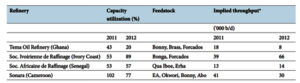
Capacity benchmarking of selected petroleum refineries in the subregion
The last issue goes to the heart of the credibility, transparency, and above-board concerns that civil society activists and analysts have about the whole leasing transaction. Actors lacking mainstream commercial credibility more easily fall prey to the wiles of the criminal and/or unethical underworld.
The bare economics are wobbly
Some have tried to position the proposed Torentco leasing strategy as nothing more than a variant of the tolling transactions TOR has had with the likes of Total, Woodfields and Vitol over the years. Such analysis is wrongheaded.
A leasing contract involves a handover of substantial control. A tolling contract does not. Once Torentco or another party gets hold of the refinery, it retains every right to secure its own commodity supplies, refine, sell, and pay back the supplier the cost of the crude oil, pocketing the full margin.
There is nothing that says that such a company must limit itself to tolling deals with well known commodity suppliers like Total and sell to well known traders like Vitol.
It can seek to maximise its margins by obtaining crude in grey markets to refine and sell back into such grey markets, especially in countries with porous supply chain security that cannot police even unsophisticated gold smugglers.
The sheer amount of money (crude calculations suggest between $250 million and $750 million in the TOR case depending on precise mix of refined products and plant utilisation) that can be made in today’s geopolitically fraught oil market if one can get shady oil to refine, sell and pay back over an extended credit period would be enough to corrupt multiple safeguarding institutions and overwhelm the country’s risk management capacity.
Per Current Proposal, there’s no scenario in which TOR comes up tops
But even if we were to take Torentco’s word for it that they intend to play within the traditional tight-margin refining space by simply cutting through TOR’s bureaucratic inertia and ringfencing the toxic legacy constraints such as debts and bad commercial reputation, the offer as it currently stand does not add up.
The actual guaranteed payments (direct and indirect) to TOR are equivalent to less than $1.5 per barrel, and thus lower than the tolling fee offers previous CEOs refused to accept. It is far lower than the $4.5 that those CEOs believe is the minimum sensible rate given the context.
In a situation where tightness in global oil supply, ahead of the electric car transition in future years, starts to provide support for $15 per barrel average refining margins in the next five years, a refinery operator would be in a good place to secure its commodity supply by whatever means. In such a world, the incentives are heavily skewed in Torentco’s favour.
The risks, on the other hand, weigh heavily against TOR. Its debts will be compounding, since it will not receive anything close to what it needs to service them whilst its productive assets remain encumbered for 6 years. Let us be clear. The kinds of money Torentco is mentioning – $22 million upfront investment, ~13 million in annual rent etc. – do not even begin to make a dent in TOR’s real financing needs. As recounted in the early sections of this essay, TOR requires a solution that yields many times more.
And, should the unthinkable happen, and the refinery find itself enmeshed in some sanctions-evading scandal because of shady suppliers or consortium members, and gets blacklisted, the burden of salvaging the tattered remains of its reputation will also fall on TOR, not Torentco.
There is no point in mincing words here. The Torentco deal as it stands now is not in TOR’s interest. It is absolutely not in Ghana’s interest. A whole load of transparency, open scrutiny, and reworking is required before it can even be taken into serious consideration.




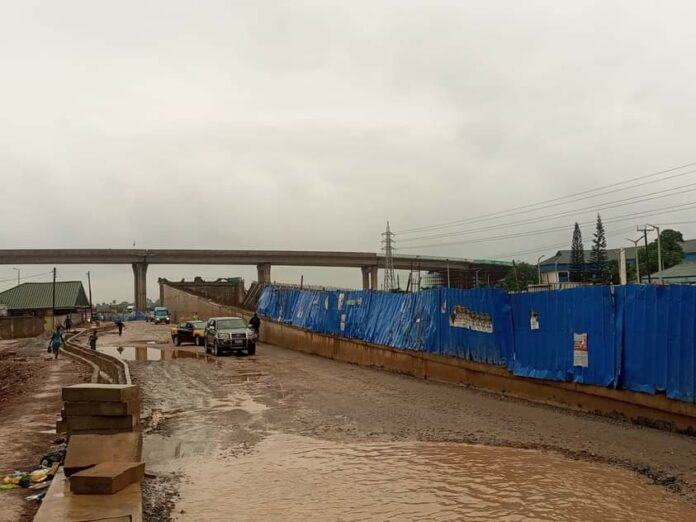
 Following the abandoning of work by the Chinese contractor on the project, the hitherto access route, constructed for drivers and commuters to use as temporary road, is now posing a danger and death trap.
 However, it appears the expectation many had about the project is being eroded, following the abandoning of work on the interchange, culminating in the deplorable access route, traffic congestion and flood.
 A taxi driver, Eric Boadi, described the access route as a death trap. “The road is very bad and is destroying our vehicles. If you are not careful, you may end up driving into the big created artificial pothole.”