As terrorists attempt to expand their nefarious operations in the West Africa sub-region, Ghana has strengthened protocols at her borders to keep these miscreants at bay.
According to the deputy Minister for Interior, Naana Eyiah Quansah, “the sub-region is still troubled by acts of terrorism and political instability driven largely by coup d’états.
In response to these, the Ghana Immigration Service continues to strengthen operational protocols, especially along the borders, to ensure the security of the nation’s borders.”
Repercussions of these security breaches, the deputy Minister stated, is affecting all and sundry across the sub-region.”
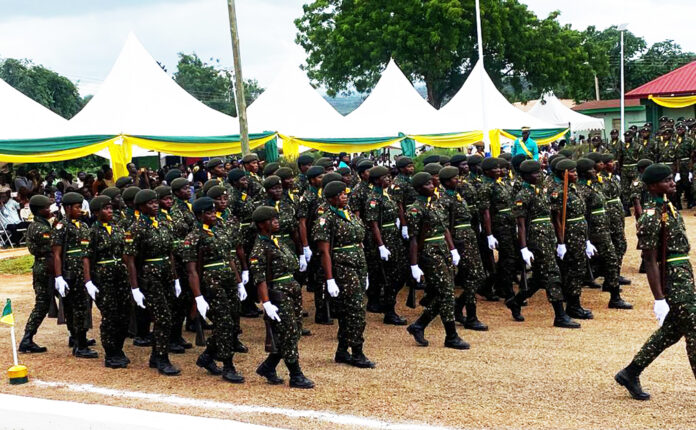
Naana Eyiah Quansah was speaking at the passing-out parade of new recruits at the Immigration Service Mid-Country Training School (ISMTS) at Tepa, in the Ahafo-North Municipality in the Ashanti Region, where 454 officers passed out yesterday.
These recruits were carefully selected and taken through seven months of intensive para-military training, drills, academics and mental preparation.
Among the courses studied by the recruits were; Immigration Laws & Practices, Intelligence & Investigation, Border Security Management, Travel Documents Management and Ethics & Professional Standards, among others.
Naana Eyiah Quansah disclosed that as part of measures to instil discipline, the GIS has interdicted twenty-seven officers over misconduct.
“Twenty-Seven (27) Officers and men have been interdicted for their alleged involvement in various offences against the professional and ethical standards set out in the Service”, she stated.
In an attempt to ensure discipline in the discharge of duties by immigration authorities, Naana Quansah indicated that the GIS has introduced a code of conduct to guide behaviours of immigration officers.
“To the Passing-Out Recruits, I hope you will show a high level of confidence, commitment, and professionalism in your work. I entreat you to exhibit the skills and knowledge acquired through your training and be disciplined in the performance of your duty. You are the frontline officers, so the work ahead is great.”
This direction, according to her, will go a long way to ensure discipline and uphold the professional and ethical standards expected of Immigration Officers.
Mr Alhassan Mahama Sani, the Tema Branch President of the KNUST Alumni presenting a Citation to Prof. Rita Akosua Dickson, the Vice Chancellor, with a section of the Alumni seated.
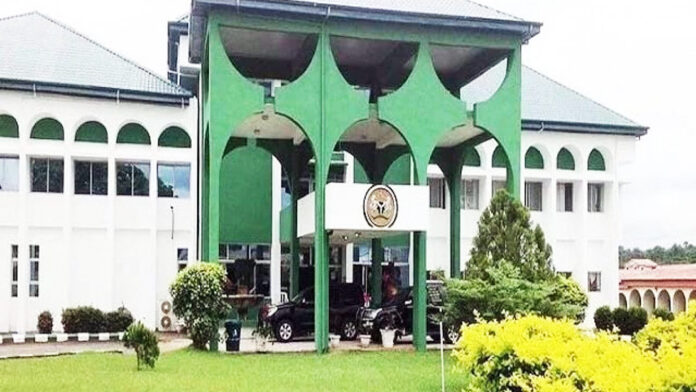
Prof. Rita Akosua Dickson, the Vice Chancellor of the Kwame Nkrumah University of Science and Technology (KNUST) has revealed that some measures are being taken to tighten security in and around the University in order to protect students’ lives and properties.
According to her, the management of the KNUST, in addressing the security concerns on campus, had installed Close Circuit Television (CCTV) Cameras at vantage areas to monitor activities and movement on campus.
At a meeting with the Tema Branch of the KNUST Alumni, held at the Royal Nick Hotel in Tema Community 6, the Vice Chancellor disclosed that she had instructed the over 400 companies providing hostel accommodation for the over 89,000 student population of the University to offer security at their facilities.
That notwithstanding, “the University Management and the Governing Board, with the support of the University Chancellor, His Royal Majesty Otumfuo Osei Tutu II and the Inspector General of Police, Dr. Akuffo Dampare, had put up a new Police Station on the University Campus,” she added. .
Prof Akosua Dickson revealed that all the key stakeholders, including the student body, parents, the Student Representative Council and the leadership of the various halls on campus have been involved in the management and maintenance of the campus security.
“We have also improved some of our internal roads and lightened up the entire campus with streetlights to enhance vehicular and human movements”.
She said though there had been a few security concerns on the KNUST campus in time past, the Vice Chancellor insisted that the atmosphere on campus was now more friendly and secured than ever.
Mr Alhassan Mahama Sani, the Tema Branch President of the KNUST Alumni encouraged the formation of more Alumni Branches in every region and institutions and also encouraged the old students to consider what they could do to support the University in diverse ways.
The KNUST Global Alumni President, Dr. Kwaku Agbesi, congratulated the Vice Chancellor on her appointment and outlined some initiatives undertaken by the Alumni, including the establishment of a Scholarship Scheme to support needy students.
He pledged the commitment of the Alumini in addressing the huge accommodation challenges facing many students of the university and applauded the Tema Chapter for its continuous support to the KNUST Global Association
The Chairman of the meeting, Ing Mr. Richard A.Y. Anamoo, also an Alumni and a past Director-General of the Ghana Ports and Harbours Authority appealed to about 500,000 old students to contribute just 400 a month for 5 months, to enable the University to build 4 more of the hostel to accommodate at least 10,000 students.
The meeting was attended by old students who completed between 1960 and 2020, and was chaired by Mr. Richard A.Y. Anamoo, former Director General of Ghana Ports and Harbours Authority.
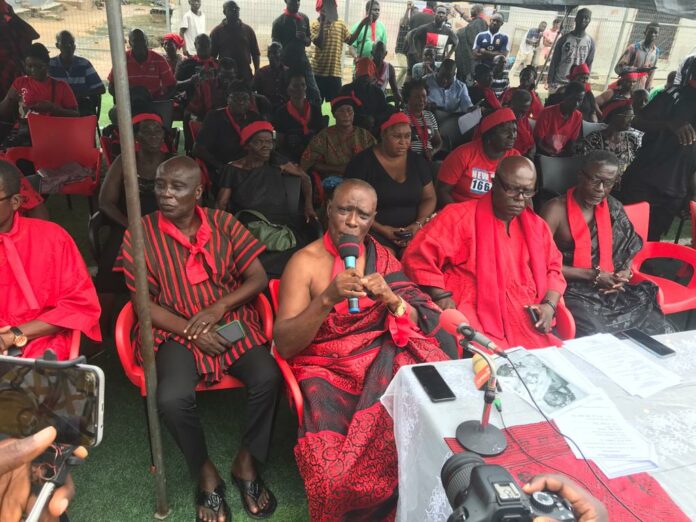
Odehyekronkron Nana Kwabena Agyapong addressing the media during the press conference
A number of people were on the streets of Nsawam-Adoagyiri yesterday (Wednesday) protesting against the installation of a rival chief for the town by the Akyem Abuakwa Traditional Council (AATC).
The protesters, mainly chiefs and their subjects, who were clad in black and red to signify their level of seriousness, walked from the Palace to the Adoagyiri astro turf where they addressed the media.
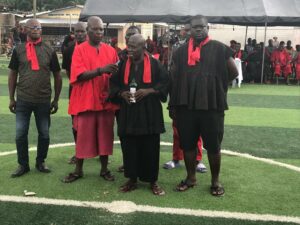
A linguist pouring libation prior to the press conference
The angry chiefs started the press conference with the pouring of libation, where they invoked the spirits of the Densu and Afram rivers deities to kill any person or group of persons who were fomenting troubles in the area.
Addressing the media, Odehyekronkron Nana Kwabena Agyapong stated that, the people of Adoagyiri had lived in peace and harmony without any hitches or scuffles since the enstoolment of Okoanadwo Afutu Dompreh II as Chief of Adoagyiri and Ankobeahene of Akyem Kotoku Traditional some fifteen years ago.
This, he continued, was amply demonstrated during this year’s Odwira Festival and the Fifteenth Anniversary Celebration of the enstoolment of Okoanadwo Afutu Dompreh II, which took place on February 18, this year.
He stressed that the massive participation and the commitment of the people amidst pomp and pageantry to celebrate the noble achievements as a community depicted the acceptance of the Chief of the area.
Giving a historic narrative of the area, Odehyekronkron Nana Kwabena Agyapong disclosed that the people of Adoagyiri belonged to the Akim Kotoku Clan, who traced their ancestry from Akim Oda before migrating to their present place of abode, Adoagyiri.
According to him, the Ankobea Division of Akim Kotoku, headed by Dompreh, the first Chief, predated the 1860s.
He continued that the founding of Nsawam by the Ankobea section of Kotoku was a direct result of the differences between Dompreh, the Ankobeahene of Akim Kotoku, and Agyemang, the Akim Kotoku King, following the Kotoku-Abuakwa war of 1860.
“Unable to tolerate his King, Dompreh withdrew with his subjects to settle at Nsawam. Under no circumstance did Dompreh or any of his successors switched their allegiance to another King, apart from the Akim Kotoku Traditional Council,” he emphasised.
Odehyekronkron Nana Kwabena said in line with customs and tradition, there had been several chiefs since time immemorial until the demise of Nana Adu Korkor II, who reigned for over fifty years.
According to him, available records indicated that all substantive Adoagyiri chiefs had been part of the Akyem Kotoku State, including the records and evidence of Okoanadwo Adu Korkoor II as Chief of Adoagyiri and Ankoabehene of the Akyem Kotoku State with gazette number “No-59” issued on 18th June, 1955 by the National House of Chiefs.
Nana Adu Korkor II was installed Chief at Adoagyiri and sent to Akyem Kotoku to swear allegiance to the then acting President of Akyem Kotoku Traditional Council, Nana Abrokwa Gyampim I (Kontihene of Akyem Kotoku), in 1953 in the absence of the Omanhene of the Akyem Kotoku Traditional Area.
Odehyekronkron Nana Kwabena averred that, regardless of these historical constructs, the assumption to the throne by Okoanadwo Afutu Dompreh II some fifteen years ago had suffered a rival faction.
According to him, the objections by this rival faction to the enstoolment of Okoanadwo Afutu Dompreh II had gone through several arbitrations, all of which upheld the right of Okoanadwo Afutu Dompreh II to the throne.
The most recent case was a judgment delivered on February 2, 2022, by the Judicial Committee of the Eastern Regional House of Chiefs, which upheld Okoanadwo Afutu Dompreh II as Chief of Adoagyiri and Ankobeahene of the Akyem Kotoku Traditional Area.
Odehyekronkron Nana Kwabena regretted that regardless of the available evidence and facts, His Excellency the President of the Republic of Ghana, Nana Addo Dankwa Akufo-Addo, as well as other institutions, had been quiet on the rising chieftaincy matters in the area.
Odehyekronkron Nana Kwabena indicated that the 1992 Constitution had made provision for cultural rights and practices in article 26(1), which states that: ‘Every person is entitled to enjoy, practice, profess, maintain and promote any culture, language, tradition or religion subject to the provisions of the constitution.’
He argued that any attempts by any group of people to impose a rival chief would not only amount to a violation of the rights of the people of Adoagyiri as provided for by the Constitution, but would be met with the same level of violation.
The chiefs and people of the area have, therefore, called on the President, His Excellency Nana Addo Dankwa Akufo-Addo, the Council of State, the Speaker of Parliament, and all well-meaning Ghanaians to, as a matter of urgency, look into these issues to find an amicable solution to it before it degenerates into a conflict situation.
They have further opined that despite the fact that they were peace and law-abiding people, they would rise to the occasion if their temperament was put to test by any person or group of persons.
Background
It would be recalled that, the Akyem Abuakwa Traditional Council, on Saturday, enstooled a parallel Chief at Adoagyiri near Nsawam in the Eastern Region.
The enstoolment of the new Chief, Barima Adu Korkoor III, on August 19, 2023 heightened the growing tension between Akyem Abuakwa and Akyem Kotoku paramountcies over who controls Adoagyiri.
The Youth of Adoagyiri, from the side of the Kotoku Traditional Area, averred that the installation of Barima Adu Korkor III was illegal and had the tendency to create serious insecurity in Adoagyiri if the authorities show no concern about the matter.
“What they have done, they want to turn Adoagyiri into Bawku. We will resist them because Okyenhene thinks his cousin is the President so can do anything. We will fight back,” the leader of the youth group, Barima Nana Arkoh Frimpong, declared.
Impasse between the two traditional councils has led to an injunction on the celebration of the Odwira Festival planned to be organised by Okoanadwo Afutu Dompreh II, Chief of Adoagyiri, and acting on behalf of Kotoku Traditional Council.
The Akyem Abuakwa Traditional Council, earlier at Kyebi on Monday March 13, 2023, told the media, through the State Secretary, D.M. Ofori Atta, that Adoagyiri had since historical time been part of Akyem Abuakwa and fell directly under the Apapam Stool.
I have been reluctant to write yet another Donald Trump-related piece considering the general fatigue with his farcical politics. But America is leaving me and countless others no choice but to pay attention, as the former US president’s shenanigans have once again taken over the American election cycle.
Despite his three indictments, he remains popular, dominating his Republican rivals on the eve of the first presidential primary debate this week and raising the stakes in yet another consequential election for America and the world.
According to the latest surveys, he holds decisive advantage across nearly all demographic groups, regions and ideological wings of the party. His popularity among Republican voters has steadily increased from 43 percent in January to 53 percent this month.
His mostly white conservative supporters are driven by a deep-seated anger, suspicion and resentment of the Democrats and their social liberalism and liberal internationalism. They do not seem moved by Trump’s political follies and legal woes.
If anything, they see his indictments – which include trying to defraud the US government in order to remain in office despite losing the 2020 election – as part of a conspiracy by the Democrat-controlled deep state.
Short of a major surprise, Trump is destined to win the Republican nomination by the middle of next year and face President Joe Biden at the polls at the year’s end.
The election is for the incumbent to lose. Aside from leading in the national vote count, he shows better ratings in the battleground states he won in 2020, like Georgia and Arizona; he could also hope to flip swing states he lost, like North Carolina.
But there are a variety of factors that could put Biden at a disadvantage, including his advanced age. In recent months, his fitness for office has been repeatedly questioned.
Indeed, the prospect of Trump’s return to the White House at the helm of the world’s superpower is very real and it is generating deep anxiety and freneticism, notably among liberals in the US, Europe and beyond. They fear a bitter, vengeful Trump, in denial over his defeat in the last elections, could lash out and do just about anything with the incredible powers of the American presidency.
Trump is surely watching what Israeli Prime Minister Benjamin Netanyahu is doing since his return to the premiership in Israel, in terms of “judicial reforms” that grant him greater authority to do away with his own indictment by an Israeli court.
In fact, various media outlets are reporting that the former president is planning to do what it takes to solidify his power once he is back in the White House, including limiting the independence of federal agencies, deploying the military domestically, and cracking down on his detractors.
Trump appears ready to render the United States less liberal and more autocratic, as Netanyahu is doing now with Israel. The strong checks and balances of the American constitutional democracy may not withstand the vicious assault by Trump and his white nationalist and evangelical conservative allies.
He would also find sympathetic ears in the US Supreme Court that has been dominated by conservatives, three of whom were appointed by him.
Sign up for Al Jazeera
Top of Form
US politics, Canada’s multiculturalism, South America’s geopolitical rise—we bring you the stories that matter.
Bottom of Form
That being said, the international ramification of a Trump 2.0 may be more dramatic than the domestic ones. If he returns to the White House, he would find it less constraining to effect change in foreign policy than domestic policy. Indeed, he would have greater authority as the leader of a superpower to change the world for the worse, than he would have to change America to his liking.
Just as he reversed much of what his predecessor, President Barack Obama, achieved globally, whether on climate change, trade, nuclear proliferation, Russia, Europe or the Middle East, Trump would also seek to erase Biden’s progress on these and other policies.
Under a second Trump presidency, it would be impossible to reach another nuclear deal with Iran, or a more urgent accord on climate change. There would also likely be major cuts in public spending on social protections and renewable energy expansion.
As president, Trump would also act swiftly on the Russia-Ukraine war. He has already claimed that he can resolve the conflict in “24 hours”. Some have speculated that this means he would cut US military aid to Ukraine in order to facilitate a quick end of war in Russia’s favour.
The prospect of this scenario has irked Washington’s European allies, who have been highly supportive of the US efforts against the Russian invasion of Ukraine. They fear that appeasing Russia would weaken NATO, embolden Russian President Vladimir Putin, and force them to search for immediate, radical and costly European alternative to America’s strategic umbrella.
European centrists and liberals are also worried that a Trump victory in 2024 would create a domino effect across the West, strengthening populist right-wing leaders in Hungry, Poland and Italy, and encouraging more far-right electoral victories in France and Germany.
If all of this were to happen, it would weaken America’s own foreign policy push, especially its response to rising China, which is perhaps the only major foreign policy issue – aside from Israel – on which Trump and Biden agree. An emboldened Russia, a weakened NATO, and a divided West, would not help Trump’s haughty attempts at curbing Chinese economic and strategic influence.
Beijing likely does not mind seeing Trump return to the White House, not only because he is a divisive illiberal populist leader, who is ready to abandon US global responsibilities and replace its assertive leadership with pompous bombast, but also because he wouldn’t or couldn’t use the democratic pretext to advance US interests over other more autocratic nations.
Trump has threatened that if he were to become president again, he would give the Chinese government “48 hours” to abandon its “spy base” in Cuba or face severe economic sanctions.
But such bombast has not worked in the past, neither against China, which has grown more powerful militarily and strategically during the Trump years, nor against smaller powers like North Korea or Iran, both of which have expanded their nuclear programmes during his tenure. If anything, Trump’s bravado has failed even against Bashar al-Assad’s Syria.
Biden’s foreign policy hasn’t been exactly successful or responsible either; his foreign policy has been imperialist, interventionist and hypocritical. But Trump’s alternatives are worse than Biden’s globalist prerogatives.
They come in the form of reckless America-first hypernationalism, vulgar racism, apathy towards the environment and the climate crisis, total disregard for multilateralism and universal values, and overall, a dark vision of the world. A Trumpian world, in which no sane person should want to live in.
Source: Aljeezera
The views expressed in this article are the author’s own and do not necessarily reflect The Chronicle’s stance.
Ghana is respected all over the world as a beacon of hope in the West Africa sub-region in particular and the continent as a whole, as far as the acceptance and practice of democracy is concerned.
Ghana has managed to carve an enviable niche for itself in a continent and a region known for its pockets of civil uprisings, bloody changes in governments and a general sense of insecurity. The nation is noted for a burgeoning democracy, peaceful changes in governments between political parties through the ballot box and a strong and respected constitution.
Since the inception of the 1992 constitution which birthed the fourth republic, Ghana has successfully conducted eight general elections and produced five presidents. The country’s enviable achievement as a beacon of democracy for the continent is borne out of the acceptance of multi-party democracy which allows the citizens to freely join political parties of their choice.
On top of this, is the strict adherence to the inherent features of multi-party democracy which include freedom of speech, separation of powers, with free and fair elections. As a matter of fact, these features are not just enshrined in the constitution but they are largely practised which has given rise to citizens being highly active in the democratic processes.
To illustrate this, it is important to emphasise the point that in the current dispensation, democracy is practised in every sphere of all endeavours of Ghanaians.
For instance, unlike the past where teachers at the basic schools handpicked prefects, there has been a paradigm shift from what was the norm, to a new era where the pupils are allowed to elect their leaders.
As far as The Chronicle is concerned, this is a good process as it introduces democracy to the pupils, who are the future leaders, at an early stage of their lives and help them to understand the doctrine of democracy and the use of the ballot to elect leaders.
We, therefore, want to pat those who introduced this laudable initiative on the back and encourage other schools who have not yet adopted this democratic process to emulate it.
However, the paper is particularly worried about a shameful development which characterised and dented the integrity of this highly commendable initiative that seeks to introduce democracy to our kids at a tender age.
We are reliably informed that these kids are also made to read out their manifestos to outline their visions and plans for the various positions they usually contest for, as pertains in the national discourse.
In the process, they campaign to canvass for votes from their fellow pupils and this is a vital ingredient in any democratic dispensation which required voting.
In a rather bizarre twist of events, however, these kids seem to have conveniently developed huge interest in making wild and unrealistic promises just to sway their colleagues to vote for them.
As if this bad deed is not enough, sharing of toffees and biscuits to influence voters has also gained notoriety in the body politic of these pupils who are obviously the future leaders of our beloved country.
The Chronicle sees this development as a set back to our democracy because these are the very kids who would rise to assume the mantle of leadership in the country.
We, therefore, wish to draw the attention of the Ghana Education Service to this development which has the tendency to corrupt the minds of the younger ones.
We call on the GES to as a matter of necessity ensure that this highly commendable democratic dispensation would be strictly practised across the country with good guidelines and modalities to imbue good moral lessons into our kids.
Arguably, corruption has become endemic with its accompanying dire repercussions and consequences which call for systematic efforts to be able to effectively eradicate it.
We must obviously start with orientating the minds of the pupils. The GES must act now!
The youth on street demonstrating over the power barge
The youth of Nzema, on Monday, staged a peaceful demonstration to demand the whereabouts of the Osagyefo Power Barge.
The youth, clad in red, walked through the principal streets of Ekpu ending up at Half Assini, the capital of the Municipality.
The Osagyefo Power Barge, according to the Deputy Minister for Energy, William Owuraku Aidoo, during a recent statement on the floor of Parliaments, said the government had taken steps to decommission the 185MW plant, which had suffered deterioration from excessive corrosion as a result of idleness since 2017.
The statement by the Deputy Minister comes after the Member of Parliament (MP) for Jomoro, Dorcas Affo-Toffey, on the floor of the House, asked the Minister to tell the world the whereabouts of the barge.
In a statement to the House, Dorcas Toffey asked the government to prosecute those involved in the alleged sale of the barge.
At the demonstration, the youth, who carried various placards, alleged that the barge had been sold
The President of the Nzema Youth League, Dr. Patrick Ekye Kwese, threw his support behind the demonstrators, adding that whatever the youth would do to get to the bottom of the issue, he was in support.
He said, the barge could be used for so many things, but its disappearance was strange.
Earlier, the Member of Parliament for Jomoro tweeted a message in support of the demonstration.
The Osagyefo Barge was originally built in 1947 as a cargo ship called ‘MV Volta River’, which served as a vessel for transporting goods along the Volta River. In 1990, Ghana faced severe power shortages and the then Rawlings government sought solutions to address the energy crisis.
The decision was made to convert MV Volta River into a power generating facility. The transformation involved retrofitting the ship with power generating equipment, including gas turbines and generators.
After conversion, the ship was renamed the Osagyefo Power Barge in honour of Ghana’s first President, Osagyefo Dr. Kwame Nkrumah. The barge was towed to its current location in Effasu, on the Western Region, where it began operations in the year 2000.
The barge has played a crucial role in Ghana power generation infrastructure, helping to stabilise electricity supply and meet the growing demand for energy in the country.
The United Kingdom has announced a tariff reduction in over 3,000 products exported from Nigeria under the Developing Countries Trading Scheme (DCTC).
Mr Richard Montgomery, the British High Commissioner, disclosed this on Tuesday at a Workshop on the UK Developing Countries Trading Scheme, in conjunction with the federal Ministry of Industry, Trade and Investment and the Nigerian Export Promotion Council (NEPC).
Montgomery, represented by Deputy British High Commissioner to Nigeria, Ms Gill Atkinson, noted that the scheme came into force in June 2023.
The British government explained that 99 per cent of Nigeria’s exports to the UK, such as Cocoa, Sesame oil, will be duty-free.
“Nigeria stands to benefit more than any country from the changes introduced by the DCTS. It will see tariff reductions on over 3000 products meaning that 99 per cent of Nigerian exports to the UK by value will be duty-free tariffs promoting value addition in essential export items such as cocoa butter and paste, and sesame oil, among others”, he stated.
The Jigawa State House of Assembly has approved fifty more special advisers for Governor Umar Namadi.
Speaker of the House Haruna Aliyu Dangyatin stated this on Wednesday after reading the governor’s request to appoint additional 50 special advisers.
DAILY POST reported that the House had earlier approved the governor’s request to appoint twenty five advisers.
The Governor letter, before the floor of the house, read, ” In line with the provisions of Sections 96 (1) and (2) of Part II of the Constitution of Federal Republic of Nigeria, 1999 (as amended), I write to request for the consideration and approval of the State Legislature for the appointment of 50 Special Advisers of the Jigawa State Government.”
“While Section 91 (1) empowers him to appoint any person as a special adviser to assist him in the performance of his functions, Section 96 (2) said the number of such advisers must be prescribed via a resolution of the House of the Assembly of the state”.
“The request is in line with THE administration’s commitment to implement multi-faceted socio-economic development projects as contained in the 12-point agenda: “Development for Greater Jigawa.”
Dangyatin said the approval will assist in ensuring smooth running of the administration.
Governor Uba Sani of Kaduna State says his government plans to recruit 7,000 youths to support security agencies in the fight against insecurity. Kaduna, in Nigeria’s north-West region, is battling banditry, kidnapping, and a host of other security challenges.
But as part of efforts to stem the tide, Governor Sani, who is about three months in office, says his government would engage youths in combating criminality.
The governor, who said he has been an advocate of state police even as a lawmaker in the Senate, noted that the recruitment process would commence soon.
“Coming to Kaduna, I also revived the Kaduna State Vigilance Service,” Governor Sani said on Channels Television’s Politics Today on Monday.
“As we are speaking right now, in the next week, we are going to recruit at least 7,000 youths who are going to be running our Kaduna State Vigilance Service.”
According to him, the development was further necessitated by the fact that “security agencies are lacking the boots” in their bid to tackle insecurity.
“And of course, they need the support of our local vigilance service. As of today, we have only 2,000 but we are recruiting another 7,000 to make them 9,000,” the former lawmaker explained.
Asides from that, he stated that the state government is working with other stakeholders including religious bodies to ensure the state is rid of criminality.
He said there are also talks with governors in the north to finetune ways of taming insecurity.
The Kaduna State Government has unveiled a comprehensive palliative support programme designed to help cushion the negative impact of the removal of petrol subsidies on residents of the state.
Governor Uba Sani made the disclosure on Tuesday during a joint media briefing, where the initiative was unveiled with the state Chairman of the Nigeria Labour Congress (NLC), Ayuba Suleiman, and other members of the palliative committee comprising representatives of organised labour and civil society organisations.
According to Sani, 210,000 indigent households, totalling 1,050,000 vulnerable persons will benefit from the N2 billion palliative fund so far released by the Federal Government to the state.
The governor also announced that the implementation of the palliatives intervention would be executed in three phases, starting with the distribution of food items to poor and vulnerable households.
The second and third phases will include the procurement of free buses to ease transportation challenges, supporting farmers and micro, small and medium enterprises with fertilisers and incentives to boost their businesses.
According to Governor Sani, the remaining two phases of the palliative intervention will take care of transportation and assistance to smallholder farmers; micro, small and medium-scale enterprises; as well as the resuscitation of train services across the three senatorial districts of Kaduna State, which he believes are key to cushion the sufferings of the people.
In the final preparation for the commencement of the distribution of palliatives to the people of the state, Sani said the government was committed to the effective implementation of measures lined up in the three phases and had, therefore, put all necessary machinery in place to ensure the exercise is hitch-free, transparent and equitable.

 These recruits were carefully selected and taken through seven months of intensive para-military training, drills, academics and mental preparation.
 At a meeting with the Tema Branch of the KNUST Alumni, held at the Royal Nick Hotel in Tema Community 6, the Vice Chancellor disclosed that she had instructed the over 400 companies providing hostel accommodation for the over 89,000 student population of the University to offer security at their facilities.
 Mr Alhassan Mahama Sani, the Tema Branch President of the KNUST Alumni encouraged the formation of more Alumni Branches in every region and institutions and also encouraged the old students to consider what they could do to support the University in diverse ways.