The world was greeted with thunderbolt of shock when on Sunday January 28, 2024 three member states of the Economic Community of West African States (ECOWAS) pulled out of the sub-regional body. They are Burkina Faso, Mali and Niger, all Sahelian states in the block.
A number of factors, ranging from trans-border trade to security matters have come to focus. The formation of ECOWAS in 1975 came to formalise existing cross border trade among these nations and beyond.
These landlocked states have from time immemorial been using their traditional ports in Dakar (Senegal), Abidjan (Ivory Coast), Lome (Togo) and Cotounou (Benin) for the movement of goods from the seaports to the respective countries. Lately, the Ghanaian ports of Tema and Takoradi have been added.
Article 125 of the United Nations Convention states that landlocked states have the right of access to and from the sea for the purpose of exercising the rights provided for this Convention, including those relating to the freedom of the high seas and the common heritage of mankind.
On July 26, 2023 a group of soldiers in Niger staged a coup which ousted the democratically elected President Mohammed Bazoum.
The sub-regional body issued a fiat to the junta to reinstate the deposed leader, which bluff the coupe makers called. The Chiefs of Defense Staff of ECOWAS member states met in Accra and declared ‘war’ against Niger.
This declaration rather incensed Burkina Faso and Mali, whose respective junta leader also came under constant threats from ECOWAS. These three states, therefore, formed alliance to defend themselves against any external aggression.
By this time, ECOWAS slapped sanctions against the three states, which had denounced further dealings with their colonial master, France, and opted for Russia. As biting as the sanctions became, the countries never relented in their desire to achieve a common objective, which is self-dependence, by relying on their own natural resources.
Meanwhile, in September, 2023 these countries went ahead to establish an ALLIANCE OF SAHELIAN STATES and proposed a common currency known as Sahel.
To them, the idea of belonging to a body which allows constitutional coup by way of electoral malpractices, but rejects military takeovers is not worth it.
The question now is, if we needed to persuade them to return to our fold as a sub-regional body, do we start by lifting the sanctions or the reinstatement of democratic dispensation or both.
Already, the Ghana Union of Traders Association (GUTA) in a press release on Monday wants Ghana to by-pass ECOWAS and deal with the three breakaway countries.
Signed by its President, Dr Joseph Obeng, its reads: The withdrawal of Niger, Mali and Burkina Faso from the ECOWAS sub-regional block will, in no small measure, hinder the development of the sub-region as an economic block because there can never be progress without unity of purpose.
Therefore, their withdrawal from ECOWAS will impact negatively on cross border trading activities, especially with Ghana, where we are very much related and intertwined in terms of our economy, history and culture among others.
In fact, Ghana stands to gain immensely when everything is done to bridge our relationship with these countries. There is a list of items that we trade among ourselves such as onions, tomatoes, cola nuts, salt and the list continues.
The exit of the three countries from ECOWAS will cause unnecessary controls at the borders, which will hinder the free movement of people, goods and services within the sub-region.
We should be mindful of the fact that one major reason for the formation of the Regional block is to take advantage of the number of people in the sub-region for the purpose of trading to enhance our economies.
We also know that member states have their own bilateral relations with each other.
Therefore, as a country, the first step or strategy to use is for Ghana to by-pass ECOWAS and rely heavily on the already existing good relationships with the three countries.”
Meanwhile, Security Analyst, Col Festus Aboagye (rtd) is of the opinion that with their departure, the free flow of intelligence sharing will suffer a break and hurt the sub-region.
He was specifically not happy with the infiltration of small arms and weapons and the break in information sharing among the countries of the sub-region must be given a second thought.
At worse, the security expert suggested that without these three states, the body ECOWAS should rebrand to Economic Community of Coastal West African States (ECOWAS), especially knowing too well the present membership of the sub-regional body being coastal countries.
Headline inflation is expected to ease between13% to 17% by the end of 2024, according to the Bank of Ghana (BoG).
The Central Bank says the expectation was as a result of inflation declining sharply by more than 30% in the course of 2023.
It is also expected to trend back gradually to within the medium-term target range of 6-10 percent by 2025.
This was announced by the Governor of the Bank of Ghana, Dr. Ernest Addison, during the 116th Monetary Policy Committee (MPC) in Accra, on Monday, January 29, 2024.
These forecasts, he said, were likely to see upside risks to the inflation outlook and there was
need for strict implementation of the 2024 budget and a tight monetary policy stance to
sustain the disinflation process.
Addressing the media, the Governor said several factors have supported the disinflation process, namely “the tightening monetary policy stance throughout 2023, favourable international crude oil prices which led to stable ex-pump prices and transportation cost and relative stability in the
exchange rate.”
On the monetary policy rate, the committee noted the emerging recovery, but found the need to maintain a strong policy stance to consolidate the disinflation gains.
Under these circumstances, the Committee decided to reduce the Monetary Policy Rate by 100 basis points to 29 percent.
According to him, the decision was taken following a steady decline in inflation from 54.0% in December 2022 to 23.4% in December 2023, though there are downside risks.
The Governor further indicated that the Committee noted that global growth had remained relatively subdued in 2023, while the ease in global inflation had triggered a pause in monetary
policy tightening across key economies.
“Declining energy and food prices, together with tight monetary policy have exerted downward pressures on headline inflation. Although major central banks have paused on their policy rate hikes due to declining inflation, global financing conditions remain tight as the past effects of the restrictive policies continue to keep borrowing costs high,” he added.
The global outlook, he said, remains uncertain with geopolitical tensions and its potential spillovers to the commodities markets acting as a major risk factor to most economies.
On the domestic economy, the governor continued that there are clear indications that the current
Macro-economic framework being implemented with the support of the IMF-ECF programme is yielding positive results.
However, Dr. Addison noted that both headline and core inflation were declining and projected to decelerate further.
On the money market, interest rates broadly trended downward at the short end of the yield curve.
The 91-day and 182-day Treasury bill rates decreased to 29.49% and 31.70% respectively, in December 2023, from 35.48% and 36.23% respectively, in the corresponding period of 2022.
Similarly, the rate on the 364-day instrument decreased to 32.97% in December 2023 from 36.06% in December 2022.
Dr. Addison emphasised that the banking sector remains stable, despite the elevated credit
risks.
Also, he added again that the bank’s liquidity and profitability positions have improved in the aftermath of the domestic debt restructuring and the Bank was closely monitoring the capital restoration efforts of the banks in line with approved plans, including through support from the Ghana Financial Stability Fund.
However, it was expected that early recapitalization and effective risk management by banks will help promote overall banking sector stability and resilience and ensure effective financial intermediation to strengthen the economic recovery efforts.
“The country’s external buffers have increased, providing support for exchange
rate stability. Improved forex inflows from the IMF-ECF disbursements, receipt of the cocoa
syndicated loan, and expected funding from the World Bank’s Development Policy Operations are expected to improve foreign exchange inflows,” he stated.
In addition, he was optimistic that the gold for reserve programme of the Bank, repatriation of foreign exchange from the mining and oil companies and reduction in debt service payments would further support reserve build-up and improve the external sector outlook.
Ghanaians have been advised against allowing themselves to be manipulated by fake prophecies in choosing political leaders as the country prepares towards the 2024 general election.
Those prophecies were self-made from persons who wanted to deceive the citizenry to believe that God had chosen certain leaders for the country, the Rector of Global Theological Seminary (GTS), Rev. Dr Komi A. Hiagbe, stated.
Speaking to the Daily Graphic in an interview on the effect of the prophecies on the nation, especially during elections, the Rector said it was worrying to see certain people claiming to be men of God giving contradictory prophecies during elections which sometimes affected the sense of judgement of the congregants in making the right choices.
Some of these prophecies may cause the country to lose competent leaders, as some people are gullible to these prophecies and may fall for them in taking certain decisions, the head of the Bible and pastoral training institution of the Global Evangelical Church explained.
As Ghana approaches a crucial general election this year, it is imperative that Ghanaians remain vigilant against the influence of fake prophecies in their decision-making process.
The rise of manipulative prophecies has become a concerning trend, with individuals exploiting spiritual beliefs to manipulate public opinion and sway political outcomes.
In recent years, Ghana has witnessed a surge in self-proclaimed prophets who exploit their influence to sway political opinions.
These individuals make audacious claims about the future, including predictions about election outcomes and the fate of political leaders. By capitalising on the trust and faith of the people, they manipulate public sentiment to further their own agendas, often at the expense of the nation’s well-being.
The consequences of succumbing to manipulative prophecies are far-reaching and detrimental to the democratic fabric of Ghana. When citizens base their decisions solely on prophetic claims, they neglect to critically evaluate the policies, track records and qualifications of political candidates.
As the gatekeepers of information, the media plays a crucial role in safeguarding democracy. We must actively counter manipulative prophecies by exposing false claims, highlighting their potential dangers, and promoting critical thinking among citizens.
As we prepare for the upcoming general election, it is paramount that we remain steadfast in rejecting manipulative prophecies. We, the media, have a pivotal role to play in exposing these false claims and promoting critical thinking.
By urging Ghanaians to evaluate political leaders based on their policies, qualifications, and track records, we can safeguard our democracy and ensure that the nation’s future is entrusted to capable and deserving individuals.
Let us unite in our commitment to upholding the principles of democracy and reject the manipulation that threatens the very foundation of our nation.
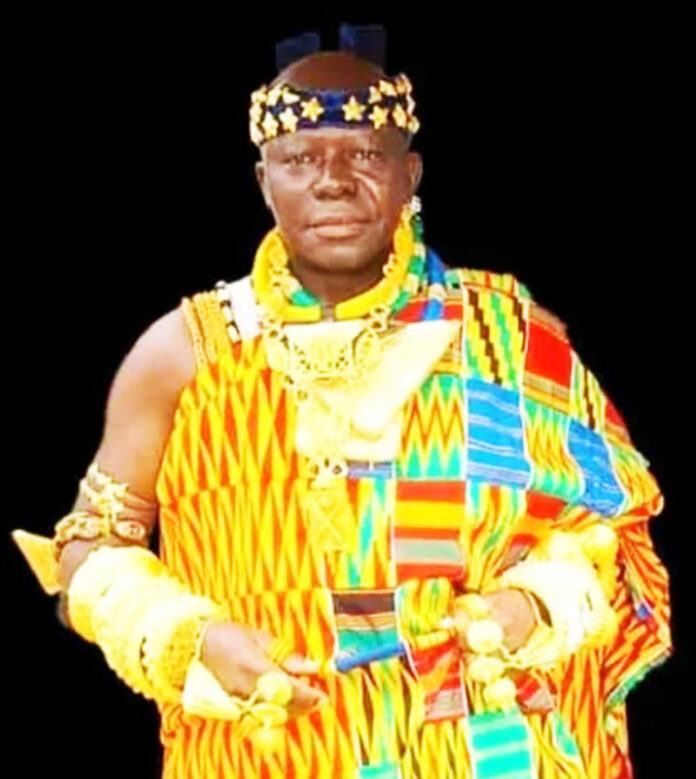
Chiefs from Ekumfi Traditional Area, led by their Omanhen, Odeɛfo Akyin VIII, have described as highly unfortunate and regrettable, a deliberate attempt by President Nana Addo to deny the people of Ekumfi development.
Linguists who attended the press conference
In a recent public reaction, President Akufo Addo explained that he had denied the people of Ekumfi development because they voted out former (New Patriotic Party) Member of Parliament for the area, Mr Kingsley Ato Cudjoe, during the last general elections
The president stated this when a family queen mother and the head of the late Professor Atta Mills’ family paid a courtesy call on him and pleaded with him to assist the family to secure the autopsy report of the late president of Ghana, John Evans Atta-Mills
Response by Nananom
Addressing a press conference on Monday, this week, to respond to the president’s decision, Odeɛfo stated that the people of Ekumfi were extremely shocked by those statements and struggle to believe same.
He said, “We particularly did not believe that the President who is mandated by the Constitution to be responsible for the development of the country could politically segregate the country and treat others with disdain and dislike”
He added, “Per our understanding of the very Constitution which recognises free and fair elections, one of which made His Excellency Nana Addo Dankwa Akufu-Addo the President, there is no provision in the 1992 Constitution which mandates the President to decide who the people of Ekumfi or for that matter any other constituency must elect to represent them in Parliament as their legislator”.
Request for scientific data
The chiefs confirmed that all developmental initiatives in the district have stalled and attributed it to the decision of the president to starve them of development, simply because Mr Ato Cudjoe lost during the 2020 elections.
Ekumfi chiefs trooping to the venue of the press conference
Odeɛfo Akyin, therefore, demanded a scientific and accurate data on how the former MP performed when he was elected as the people’s representative, to illustrate the fact that he should have been maintained by the constituents.
“Our call comes on the heels of the fact that the same Honourable Ato Cudjoe, who is preferred by the President and whose exit from Parliament has become the reason the President has neglected Ekumfi, has once again lost miserably in the NPP’s internal party primaries.
…..If the President’s own party folks could reject Honourable Ato Cudjoe, why must the Chiefs and people of Ekumfi suffer for his exit in 2020?” he quizzed
Odeɛfo and his chiefs noted that the statement made by the President sought to question the people’s democratic “right to vote freely”, adding that the tenets of democracy included the ability of the people to freely elect who they deemed fit to be their representative in Parliament.
According to Odeɛfo, the people of Ekumfi only exercised their democratic right during the last election and this right must never be used as a tool for punishment by the very President who is enjoined by the 1992 Constitution and his own Oath of Office to uphold the Constitution of the country.
Appeal to natives of Ekumfi
On behalf of the Nananom, Odeɛfo Akyin appealed to all natives of Ekumfi, both home and abroad, who have raised various valid concerns about the unfortunate statement by the president to remain calm, not matter the level of pain it has caused them.
He added that Nananom could not have responded in equal measure because though the president’s statement has denigrated them, Nana Addo is still the president of the republic, who must be accorded a high level of respect.
“We, therefore, wish to draw the President’s attention to the unfortunate statements, asking him to revisit his notes and ensure that all stalled developmental initiatives in Ekumfi start in earnest, so we could assume that the President regrets making those displeasing statements,” he stated.
Ekumfi Chiefs have not demanded an autopsy report
Odeɛfo Akyin explained that the chiefs of Ekumfi have not sent anybody or group of persons to the presidency to demand an autopsy report of the late president on their behalf or on behalf the late president’s family.
“To set the records straight, the Paramount Chief Odeefo Akyin VIII has not elected nor delegated anybody or any group of persons to His Excellency the President, Nana Addo Dankwa Akufo-Addo or any other institution to demand an Autopsy of the late Professor Mills for us, or on behalf of the family.
“We, therefore, want to state emphatically that any attempt to link the Chiefs of Ekumfi to any such action is malicious, untrue and mischievous and must be treated with the contempt it deserves.
“Ekumfi Nananom, led by the Paramount Chief Odeefo Akyin VIII, also wishes to send a strong signal to anyone or group of persons purported to come from Ekumfi or elsewhere, and who allow themselves to be used to perpetuate such disgraceful and malicious act may have to prepare to face the wrath of Nananom”.
Yet again, we have scored 43 out of a possible 100 on the Corruption Perceptions Index (CPI). The results are disappointing. Yes, we did not slip. One will muse. Fair enough. But we did not progress either. We did not cross the threshold of an average mark. That is our reality.
On the credit side of the table, we have put in applaudable efforts at tackling corruption – especially the rolling out of the National Anti-Corruption Action Plan and the foresightful creation of the Office of the Special Prosecutor as the flagship anti-corruption institution with the unique four-fold mandate of investigating corruption and corruption-related cases, prosecuting suspected offenders, recovering and managing assets, and taking steps to prevent corruption.
These and other interventions have no doubt kept as afloat above the average score of 32 in sub-Sahara Africa. Yet, that should not be our benchmark – given our higher governance and democratic credentials; and our national psyche of a desire to attain the best of everything.
However, I am afraid I bear no good tidings on where we stand on corruption and justice – the focus of my comment. The results speak for themselves. We are standing at a single spot and spinning around slowly on one foot in a circle – much like a gyroscope.
The conversation is becoming sterile. The fight against corruption is proving to be an unruly bride indeed. She is not lending herself to agreeable domestication and cohabitation. And we are not recording much success. Our progress is hampered. And we are unable to move the needle appreciably to improve our scorecard.
Our story is a rather curious cycle of self-defeat and disappearing acts. We begin by collectively acknowledging that we must fight corruption. That lights a glimmer on the horizon. Then we dim the glimmer by approaching the enterprise of the fight against corruption half-heartedly.
That is to say – we certainly know the cure to the malaise; but we are unwillingly to take the medication fully. It is as if we do not want to actually cure it, though we reckon it is slowly killing us. It is as if we do not know what we want.
I sum up our story, thus – we must fight corruption, but we must not fight it.
Justice, fundamental to any thriving society, cannot flourish in the context of corruption. The scales of justice should remain untainted if the fight against corruption is to attain any notable result. Corruption itself is curtailed through justice. And the absence of justice begets corruption. It is much like light and darkness. The brighter justice shines, the less corruption prevails.
Two factors assure this. The defence of truth and the upholding of integrity. This is our only sure bet. If we stifle truth and we place no premium on integrity, we dim the light of justice and we darken the scourge of corruption. That is to say – the absence of truth and integrity are the bedrocks of corruption.
Our collective behaviour shows that we do not reward integrity and truth is always the first casualty in the reckoning. And the scorecard reflects our lack of faith in corruption fighting and justice delivery institutions.
Citizens view anti-corruption law enforcement institutions as largely hemmed in by political marginalization and thus, part of the problem. This is because the citizens perceive a high incidence of impunity among the elite. And that corruption investigations would invariably amount to nothing and yield no consequences.
The judiciary is not spared either. The results show that citizens see the judiciary as also part of the problem. They hardly separate the judiciary from the government. They see it all as one – and every ill they attach to the government; they extend the same attitude to the judiciary. Further, citizens perceive a deficit of the defence of truth and the placement of little premium on integrity.
True it is – that the results are perception-based and not an outcome of concretely established corruption. However, the measurement of corruption in absolute terms is extremely difficult. Therefore, the next best method is assessing its prevalence from the perception of experts and businesspersons.
On that reckoning, it is observed that countries with a low risk of corruption consistently exhibit notable improvement on the CPI; while those with high risks tend to either regress or remain stagnant.
Even so, it bears pause and reflection. This is because if there is a strong perception that tilts the scale that corruption thrives in this Republic, we cannot dismiss it as unproved and not actually based on hard evidence. We must address the problem frontally.
May I offer my musings in the defence of truth and in the assurance of integrity in aid of repressing and suppressing corruption:
May we assure the entrenchment of anti-corruption law enforcement institutions.
In addition to the Commission on Human Rights and Administrative Justice, may we write anti-corruption law enforcement institutions into the Constitution – especially the flagship Office of the Special Prosecutor.
May we enlarge the powers and mandate of anti-corruption law enforcement institutions.
May we insulate anti-corruption law enforcement institutions from political marginalization.
May we insulate anti-corruption law enforcement institutions from reprisals.
May we include the Office of the Special Prosecutor in the membership of the Judicial Council.
May we assure anti-corruption law enforcement institutions the flow of adequate resources.
May we remunerate judges and officers of anti-corruption law enforcement institutions adequately. They are human after all. Hunger and squalor beget a natural edge to cut a corner or two or three – till it becomes habitual and a culture.
Perhaps I know how to assure my own integrity. But I do not know how to assure personal integrity in others beyond a plea to good sense, morality and fairness. However, I do believe that entrenching a culture of the defence of truth and the reward of integrity in anti-corruption law enforcement institutions and the judiciary along the trajectory of my musings will cascade to the individual officers of these institutions. This is because the deviant would stick out sorely and be easily exposed.
May we get there. May it be soon enough. And may we tighten the noose firmly around corruption
Source: myjoyonline.com
Editor’s note: Views expressed in this article do not represent that of The Chronicle
Nigeria on Tuesday recorded an improved ranking in the Corruption Perception Index (CPI), moving five places up to rank 145 out of 180 countries assessed.
According to the latest corruption index released by Transparency International (TI), the country also gained one point added to its previous 24, ending up scoring 25 out of the 100 maximum points in the 2023 CPI results, apart from moving five places up from its 150th position.
Arguably the most widely used global corruption ranking in the world, the CPI measures how corrupt each country’s public sector is perceived to be.
It uses a scale of zero to 100, where zero means “highly corrupt” and 100 means very clean”.
The Civil Society Legislative Advocacy Center (CISLAC) which presented the index in Abuja said Nigeria’s score is below the sub-saharan African average of 33 points.
While the index does not show specific incidences of corruption in the country, it indicates the perception of corruption in Nigeria
CISLAC points out that this year’s CPI release is not an assessment of Nigeria’s anti-corruption agencies which it says are making commendable efforts in the fight against corruption in Nigeria.
The Economic and Financial Crimes Commission (EFCC) on Tuesday said there is no hiding place for corrupt persons amid the recent arrest suspension and probe of government officials over corruption allegations.
Last Tuesday, President Bola Tinubu ordered the immediate suspension and investigation of Ms Halima Shehu, the National Coordinator and CEO of the National Social Investment Program Agency over alleged financial malfeasance.
The EFCC also grilled the former Minister of Humanitarian Affairs, Disaster Management, and Social Development, Sadiya Umar-Farouk over an alleged N37.1 billion fraud, as well as her predecessor in office, Betta Edu over alleged Fraud.
“We believe that with the kind of President we have, who is ready and willing to do the right thing, and from what we have seen in recent times and the last 48 hours, it is clear that he has provided the political will and leadership and created the atmosphere for us to work,” the EFCC chairman, Ola Olukoyede, said when he received the Chairman of the Independent Corrupt Practices and Other Related Offences Commission (ICPC) in Abuja.
“So, there is no hiding place for the corrupt. We must give our best, we must be committed and give the President the support he needs. Nobody is too big to be investigated in this country. Once you are not playing according to the rules, we will investigate you.”
He further noted that the engagement with the ICPC was sending the right signals to the entire country that the anti-corruption agencies are coming together and extending hands of comradeship and fellowship to each other with a mind to work together.
He recalled that there was a subsisting Memorandum of Understanding, MoU between both agencies.
President Bola Ahmed Tinubu has formally inaugurated a 37-man Tripartite Committee to fashion out a new National Minimum Wage.
Vice President, Kashim Shettima inaugurated the committee on behalf of the President, who is on a private visit to France.
Former Head of Civil Service of the Federation, Alhaji Bukar Goni Aji, is chairing the Committee.
Prior to the inauguration, Shettima charged the committee members to explore collective bargaining to come up with an acceptable recommendation on a new wage policy.
Members of the committee cut across the Federal Government, State Government, Private Sector and the Organised Labour.
From the organised labour, the Nigeria Labour Congress (NLC) Comrade Joe Ajaero, President, NLC; Comrade Emmanuel Ugboaja, Comrade Prince Adeyanju Adewale; Comrade Ambali Akeem Olatunji; Comrade Benjamin Anthony and Prof. Theophilius Ndukuba.
From the Trade Union Congress of Nigeria (TUC) sector include Comrade (Engr) Festus Osifo, President, TUC; Comrade Tommy Etim Okon, PhD, Deputy President I, TUC; Comrade Kayode Surajudeen Alakija, Deputy President II; Comrade Jimoh Oyibo, Deputy President. III; Comrade Nuhu A. Toro, Secretary-General and Comrade Hafusatu Shuaib, Chairperson Women Comm.
The Vice President also charged the committee to come up with their recommendations soon.
Reginald Aduakwa, an employee of Standard Chartered Bank and former personal banker of Dr. Stephen Kwabena Opuni, has explained how Seidu Agongo deposited GH¢25,000.00 into the account of the former Chief Executive of COCOBOD.
Mr Aduakwa, who had previously worked with Ecobank, said Dr Opuni requested Mr Agongo, CEO of Agricult Ghana Limited, to deposit the money on his behalf.
Being Dr Opuni’s personal banker, he said he was asked by the former to receive the money and make the deposit, but could not meet Mr Agongo on time hence the latter opted to deposit it by himself, on behalf of the former COCOBOD boss.
Mr Aduakwah is Dr Opuni’s 9th defence witness (DW9) and was led in evidence by Samuel Codjoe, counsel for Dr Opuni.
The DW9 told the Accra High Court, presided over by Justice Aboakye Tandoh, that as Dr Opuni’s personal banker, he was depositing between GH¢10,000 to GH25,000 into his client’s account.
He also told the court that he has neither met Mr Agongo nor staff of Agricult Ghana Limited before, and that, Mr Agongo’s name was mentioned to him once by Dr Opuni, regarding his bank transactions.
The prosecution, represented by Stella Ohene Appiah, rebutted that the testimony of DW9 could not be true, because the statement of Dr. Opuni’s bank account shows there have been values higher than GH¢25,000.00.
The witness responded that it has been years since he handled the account, therefore, cannot remember everything vividly.
The following is the cross examination;
Q. What is your name?
A. My name is Reginald Aduakwa.
Q. Where do you work?
A. I currently work with Standard Chartered Bank.
Q. And where do you live?
A. I live at ARS Oboji, Accra.
Q. What is your profession?
A. I’m a banker by profession.
Q. Do you have any educational qualification?
A. Yes I do, Bachelor degree from the University of Ghana in Psychology and Political Science, and Masters in Science in Energy Economics from Stirling University in Scotland.
Q. When did you finish your first degree?
A. I completed my first degree in 2005.
Q. And your Masters?
A. In 2013.
Q. You stated that you are presently with Standard Chartered Bank. Where were you working previously if any?
A. I used to work with Ecobank Ghana Limited up till 2020 January.
Q. When did you start working with Ecobank?
A. I started working with Ecobank in 2007.
Q. Before then, after school, did you work anywhere else?
A. No.
Q. What was your initial position at Ecobank?
A. My initial position was a cards and settlement officer.
Q. What did that job entail?
A. It entails managing visa cards and completing settlement for transactions done by our clients both online and at ATMs.
Q. Was that the only position you held at Ecobank until you left in 2020?
A. No. I have held various positions in the bank.
Q. Kindly tell us the positions you held with the bank?
A. The positions include product manager, relationship manager, head of cash sales, head of cash management.
Q. Kindly tell this court the duties of a relationship manager?
A. The duties of a relationship manager includes managing the day to day activities of clients…. include provision of banking products and services to ensure that the bank retains and improve the services of our customers
Q. Can you tell us some of the provisions of the banking products and services you mentioned in your duties as the relationship manager?
A. So this includes basic bank accounts, banking cards, provision of loans, investment etc
Q. Did you hold any position if any before you became a relationship manager in Ecobank?
A. Yes. My first role was settlement officer as well as product manager and tied that with relationship products.
Q. Do you know the first accused, Dr. Stephen Kwabena Opuni?
A. Yes, I do as a client of Ecobank.
Q. Do you know the second accused, Seidu Agongo?
A. No, I don’t know him.
Q. Do you know the third accused company, Agricult Ghana Limited?
A. No, I do not.
Q. How did you come to know the first accused person?
A. I met the first accused in his office where I have been referred to discuss a product with him, which could be of interest to him.
Q. When was this?
A. This should be somewhere in 2014?
Q. If you were introduced to first accused person, who made that introduction?
A. The introduction had come from the relationship manager of COCOBOD.
Q. How did this come about?
A. So the relationship manager of COCOBOD is the one who typically interacts with the corporate institutions and so when there is interest with a specific product, it is referred to the product specialist, of which I come in.
Q. So when he introduced you to first accused, did anything happen?
A. Yes, we visited Dr. Opuni’s office and we explained to him the product that we have, including a credit card, initially he didn’t want to sign up to the product, but we did well to convince him to sign up for the credit card product, which also meant he had to open and operate an account with the bank, so to service the credit card. So we proceeded to submit documents for account opening.
Q. Can you tell this court what the credit card account is?
A. As the name says, it is a credit card, it is a line of credit, which to the bank will offer to a client and issue you a card to that line. And a client can also increase the amount on the card subject to his preference of usage of the card.
Q. How do you increase the amount on the card?
A. The card is usually issued to high network clients as it is generally considered a privileged card. Now for a client to increase the amount, that is the reason why the client should own an account with the bank to provide for that service or sending money from the account onto the credit card.
Q. How many bank accounts did the first accused operate with Ecobank, to the best of your knowledge?
A. Dr Opuni has one account for this purpose.
Q. You talk about a client increasing money on the card, can you remember the opening balance of the first accused, when you opened the account?
A. No.
Q. When the first accused opened the account, did he deposit any money in it?
A. Definitely he would. The reason why I said is that such an individual to open an account, one of the requirements would be to deposit an initial amount.
Q. After you open this account did you have anything to do with the account of first accused?
A. Yes, as a high network client we assist him on a day to day basis of the products, in this case, the credit card, which includes the guidelines on the usage of the card, how to credit or top up the card, and how make convenient usage. This may vary from client to client. For Dr. Opuni, we use to credit his account with cash and he gave the bank instructions to credit his card.
Q. Kindly tell us where were these payments made to the credit card?
A. They were made from Dr Opuni’s account.
Q. You mentioned that you assisted with the day to day management of the card, including how to credit or top up the card. In this particular case, did you, Reginald Aduakwa, personally play any role in the top up of the card?
A. Yes, so I mentioned, Dr. Opuni will deposit cash into his account, he will typically bring cash to the bank where he will call, I will meet him at the premises of the bank’s car park, picked up the cash and deposit in his account, following which I will inform him of the deposit. The client would also have access to alerts, text alerts and/or email alerts, of transactions to his account to confirm fulfilment of his request and/or instructions.
Q. Can you tell this court the number of times the first accused came to the bank car park and called you to come for the cash, which you deposited in his account?
A. No, I would not record the number of times, it was several countless times.
Q. As the relationship officer, were you the only person who took cash from the first accused to deposit in his account if you know?
A. I will say yes, as I said earlier, that was his mode of operations and I was aware of the transactions on his account.
Q. How did you become aware of the fact that you were the only one who deposited money in his account?
A. So, Dr Opuni will typically call me on his way to the bank or he intended to come to the bank, so I may meet him at the premises and facilitate the cash payment transactions. Also, he will advise on payments that he wanted to be done on his card.
Q. Do you as the relationship officer know the purpose of transferring monies onto his account?
A. Yes, the monies on his account were used to make payments on his cards, which I know he used on his travels
Q. You said you know his travels, what was the nature of this travels, and where were these travels by first accused?
A. These were international travels and not local, to various countries.
Q. Can you tell us the average sum of deposit which were made by the first accused through you on this account?
A. I cannot say for sure, but averagely between GH10,000 to GH25,000.
Q. You were called to EOCO in connection with a deposit concerning the first accused account, do you remember?
A. Yes I do, but the EOCO invitation if I recall, they also wanted me to explain the occurrence of my name in Dr. Opuni’s account.
Q. Can you tell us the explanation of the occurrence of your name on Dr. Opuni’s account?
A. Yes, as I mentioned previously, I pick up the cash and deposit in Dr. Opuni’s account, which meant that on several occasion my name will show or reflect as the depositor
Q. At EOCO, can you tell the court what deposit was specifically the subject of investigation
A. There was an amount which showed the name of someone else in the account
Q. Can you remember the name?
A. Not clearly at that point, but following the discussion, which have gone in the media, etc, I recognise the name.
Q. What was the name?
A. The name was Seidu Agongo.
Q. Do you know anything about this deposit of GH¢25,000 by Seidu Agongo into the account of the first accused?
A. Yes I do.
Q. How do you know about this deposit?
A. I recalled the circumstances around this deposit and if I may, so Dr. Opuni had called typically, alerting me that he will come to the bank to make deposit, he had subsequently called again that he will not come to make the deposit himself as he typically does.
Q. How does he typically make the deposit?
A. Again he will bring the money himself to the premises of the bank, he will call me, I will go to the car park to receive the deposit and make the deposit in the bank’s branch of his account.
Q. When he called you that he was unable to come to the bank as he has earlier called that day, did anything happen between you and him?
A. Yes, so he subsequently called that he is unable to bring the money himself, he will send someone to bring the money to me to deposit in the bank. He had mentioned the name, but I do not recall the name, only that I recalled it was a northern name. So he said he will give my number to the fellow to call me when he gets to the bank.
So I received a call from a gentleman saying that Dr. Opuni has sent him to deposit some money. I had explained that I was busy at that time, so he had to wait for me to come down at a point to assist him.
I delayed a bit and I went downstairs and called the number, which had previously called me and the person explained that he had done the deposit and had left because I delayed.
So I then went to check on the account to confirm the deposit and went ahead to call the client, in this case Dr. Opuni, to advise that an amount has been deposited by the person he sent, but I was unable to assist.
Q. Was the sum of money deposited exactly what Dr. Opuni informed you about?
A. Yes.
Q. How much was it?
A. It was GH25,000 Ghana.
Q. At EOCO, what explanation did you give to them as to this sum of money which was deposited in Dr Opuni’s account by Seidu Agongo?
A. I cannot readily recall all the details of the EOCO discussions, which happened several years ago, but the same fact of the deposit applies.
Q. If you say same facts apply, can you tell us what same fact you are referring to, is it what you narrated to the court this morning?
A. Yes, that is that
Q. So what do you say when the prosecution alleges that this GH25,000 which was deposited into Dr. Opuni’s account is a bribe, based on your knowledge of the fact concerning the deposit of this GH25,000?
A. Counsel, it is not in my place to determine if it is a bribe or not, what I know is what I narrated to the court, the circumstances surrounding how the money was deposited into the bank account.
Q. And from the circumstances, which you have narrated to this court, who is the owner of this GH¢25000 which was deposited in the account of Dr. Opuni?
A. I believe the money would be for Dr. Opuni, as the purpose for which the money is used for was for his credit card payment.
Q. Can you confirm to this court again, that Dr. Opuni informed you that he was bringing this same sum of GH25000 on that same day when the money was deposited by Seidu Agongo?
A. Yes.
Q. And can you further confirm that he subsequently called you that he was busy but the money he said he was going to bring would be brought on his behalf by Seidu Agongo, that it would be given to you to deposit in his account?
A. Again, counsel, as I mentioned earlier I do not recall the name he mentioned, all that I recalled was that someone was going bring money on his behalf
Q. Did you see Seidu Agongo in person, when he deposited the money?
A. No, counsel, as I mentioned earlier when I came downstairs I called the number and the gentleman confirmed that he had made payment and he had left
Q. Which branch of Ecobank.
A. This is the head office branch at Ridge West.
Q. Is it still the head office?
Codjoe, My Lord, that would be all for the witness.
Cross examination by Benson
Q. Sir, can you recall when you were first invited to EOCO?
A. No, faintly, but I believe it was in 2018.
Q. And did you give them a statement?
A. Yes I did, in the presence of the lawyer from Ecobank.
Q. How many statements did you give to EOCO?
A. One, I have only been there once.
Law Court Complex, Accra
Q. It is true, it is not that you have never met Seidu Agongo, have you?
A. No I haven’t.
Q. And you have also never met any officer of the third accused person?
A. No.
Q. It is true that although you as the relationship officer of A1 constantly does his transactions, other officers of Ecobank could willingly assist A2 in your absence
A. Yes.
Q. Indeed, when called, the gentleman was supposed to bring you the GH25,000 and he said he had done the transactions already, you did not think it was out of the ordinary, is that correct?
A. Yes that is correct. Indeed there are several ways that he could have done that transactions without my knowledge
Q. You also did not see anything wrong with the transaction, did you?
A. No I didn’t
Q. Sir, it is true that the banks do bend over backwards to their high network clients, is that correct?
A. Counsel I don’t think the banks bend over backwards, but we do offer preferential treatments
Q. That includes for example, sometimes sending the cash to the offices of your high network clients, if they require those withdrawal
A. I wouldn’t say with my employers, but I know with some banking practices that is done
Q. Look at exhibit KK and the transaction on 16th of July 2014, at the amount (credit) column is 33,000 Ghana cedis
A. Yes
Q. It was paid in by one Mavis Boateng, that is correct
A. Yes
Q. Do you know Mavis Boateng?
A. Not that I recalled, but looking at the opening balance, that was the first transaction on the account. I know the colleague I went with him to open the account in Dr Opuni’s office was also called Mavis Boateng
Q. Please look at the transaction on 27th of August 2014, have you seen the transaction
A. Yes
Q. How much is the amount?
A. GH45,000.
Q. Was paid in by one R. Aduakwa, is that correct?
A. Yes please.
Q. Would you happen to know who the said R. Aduakwa is?
A. Yes, that would be me.
Q. You look at the 5th of March 2015.
A. Yes.
Q. Your good self deposited an account of GH100,000 in the account for A1 is that correct?
A. Yes.
Q. On the 8th of March 2015, you again deposited GH50,000 in A1’s account, is that correct?
A. That’s correct.
Q. When you look at 23rd of June 2015 and the 3rd of August 2015, you deposited GH20,000 and GH50,000 respectively in that account
A. Confirmed, yes
Q. On the 31st of August, you deposited GH50,000 in the account, is that also correct?
A. Yes.
Q. Look at the transaction on 26th September 2015, the cash deposit was GH50,000
A. Yes.
Q. This time, your name didn’t appear, it was Dr. Opuni, what may have occurred?
A. Typically it would be a narration capture difference, so technically the way transactions are captured evolved.
So if I have come to make a deposit on behalf of the client, you can capture the client name, in some instances, some operations would capture my name as the depositor. But today as banking guidelines, even a third party depositor must show ID so that his name would be captured correctly, the Id is Ghana card
Q. Sir look at the statement and tell this court if the debit transactions were all by card transactions?
A. Yes, I can confirm that the main debits to the account were all card transactions, however I also do recognize some e-product charges such as 5 Ghana cedis as e-product charges and 0.87 cedis which reflect VAT on the product charged
Q. Indeed, it is true that the deposit when captured Dr. Opuni’s name were mainly after June 2016, that is correct, prior to that was Reginald Aduakwa
A. Yes.
Q. Did they show the statement to you at EOCO?
A. I cannot recall but I think so.
Q. So the transaction of 3rd October 2014 is the transaction that reflect the depositor as SeiduAgongo, is that correct?
A. Yes.
Q. And it is in respect of that transaction that you said you received a call from the first accused person, is that correct?
A. Yes.
Q. Indeed, it is true that if you had gone down to assist the person A1 had sent to you, your name would have reflected as the depositor, is that correct?
A. That is correct.
Benson. My Lord that would be all for him.
Cross examination by Prosecution
Q. Reginald you told this court in your evidence in chief that you were making deposits on behalf of Dr.Opuni on an amount ranging between 10 to 25, 000 cedis
A. Yes.
Q. But when you went through exhibit KK you Reginald was making deposits of A1 of an amount of up to 100,000 – is that correct?
A. Yes.
Q. So you see it is not true that you were only making deposits of an amount between 10 to 25 000 cedis on behalf of A1
A. Yes, so I have stated earlier, these transactions were many years ago, of a portfolio I have several clients including Dr.Opuni. Therefore the amount are not something I commit to memory. After the statement had been shown to me, I do realize the amount are not as small as I thought, credit card limits are technically in the range of 10,000 cedis to 20,000 cedis, and so repayment reflect same
Q. Your evidence that you took custody of amount between GH10,000 to GH25,000 on behalf of A1, is not something the court should rely on?
A. Again, the amounts here as I mentioned here is recollection of the then. It does not change the material fact of transactions done on behalf of Dr.Opuni
Q. I’m putting it to you that you have come to this court today to mislead the court by your evidence
A. No counsel, that is not my intention at all. I have explained to you why those amounts vary. Again I have not seen this statement or discussed details in many years.
Q. Reginald, you told this court that on the 10th October 2014, A1 called you in respect of the deposit of GH25,000 – is that correct?
A. Yes that is correct.
Q. He also informed you that he was sending someone to meet you on his behalf, is that correct?
A. Correct.
Q. The said individual called you when he got to the banks premises is that also correct?
A. Correct.
Q. And on that particular day, you told this individual that you were very busy.
Codjoe: my we object to this, he never said that
Q. On that particular day, according to you, you explained to the individual that you were busy and so he should wait for you to come downstairs. You said that?
A. Yes I was busy at that time, so I said to him I would delay
Q. And the individual went ahead to do the transaction without recourse to you
A. That is right.
Q. I’m putting it to you that on the day in question, neither A1 nor anybody called you in respect of the deposit of any GH25,000.
A. That is not true.
Q. Please give him exhibit LL2. Which is the statement of A1, can you please read the portion indicated to you stating the GH25,000?
A. The GH25,000 that was paid by ….was given to him by me to pay into my account.
Q. So you see if you tell this court that A1 called you to assist with the deposit of the said amount, you are simply not been truthful to this court?
A. My Lord, I am being truthful to the court about the event that day, and I am struggling to see how this statement I just read out points to being untruthful
Q. I’m further putting it to you that nowhere did A1 mention your name or his instructions to you in what you have just read to the court
A. Yes, I agree it is not stated here, but what I have narrated is the story that I know from that day.
Q. Please take a look at exhibit MM, that is the statement of A2, can you please read the portion indicated to you to the hearing of the court
A. He reads…
Q. Reginald your name was never mentioned by A1 in connection with the said payment as you have read to the court?
A. Yes I agree my name was not mentioned.
Q. You have come to this court to talk about issue you know nothing about?
A. My Lord so for me I’m only as requested by the court to answer to the questions or queries relating to the transactions and that is what I have done.
Q. I’m putting it to you that you know absolutely nothing about the GH25,000 transactions between A1 and A2 that occurred on 10th October 2014?
A. Again the circumstances I know regarding this transaction I have shared with the court
Prosecution: my Lord that would be all for him.