Home Blog Page 1574

Feature: Unethical Environmental Behaviour Could Cost Ghana $20 Billion Per Year By 2035

0
Dr. Edward Kwadwo Yeboah

In the next decade, Ghana will undergo massive changes in where and how the people may live as well as how they will make their livelihood. The city will become a centre of economic, social and political life due to the enormous impact on the ecosystem and depletion of the natural resources.

The key to Ghana’s environmental and developmental future lies in the progression of the character of governance, especially, how social ethics, public policies and institutions are structured with business, household and government to interact with the environment. Such structure is key to good environmental governance.

The key to good environmental governance depends largely on how effectively the society is able to press the demand for social and environmental accountability on government but not as spectators on environmental policies.

Good environmental governance

Good governance includes transparency, fair treatment and accountability. Society that is governed well encourages a sense of social solidarity, which is a prerequisite and valuable component in problem solving. Good environmental governance, integrates environmental with social, political and economic objectives in a way that sustainability of ecosystems is well-looked-after.

As a nation, we are all aware that the most severe environmental stress is directly related to unethical mining and excessive unethical lumber. This has resulted in water, air, soil and river bodies’ pollution, land degradation, deforestation and depletion of resources (cocoa, timber and minerals).

Environmental and social stress also shoots from the lack of adequate implementation and resource allocation or infrastructure. The increase in price in gold and timber in the world price are generating both a new opportunity and new challenges for governance.

This is putting huge pressures on the environment. It is quite certain that most people are not aware of the social, economic and health implications the current environment poses. A time will come, when a well informed people will not only have concerns for their own health or livelihood but for the health and happiness of their children and grandchildren as well. And at that time, it is most likely that the electorate will demand for better environmental protection.

The novel variable in Ghana’s environmental future will be the kind of governance mechanisms that will be put in place over the years, governance mechanisms, which include a wide range of good ethics, practices and rules are going to determine whether environmental sustainability fundamentally influences economic development.

Significant investment in good governance is likely to be the most important and the highest return activity that the government can undertake to improve Ghana’s chances of sustainable development.

One most important thing we have to realise is that the current policy either by default or design has the tendency to favour short term benefit for the privileged at the expense of the welfare of the people and the long term sustainability of the economy.

Weak enforcement of environmental policies

The progress in addressing the environmental challenges has been blocked by failure of governance. In the last 30 years, the governments have developed some impressive environmental policies, legislation, regulations and framework, however, the enforcement is weak, because environmental agencies are side-lined with respect to the ministries charged with promoting economic growth, and on the other hand, because of weak civil societies have failed to provide some alternative mechanisms to hold governments and actors accountable for their environmental performance.

As a result, the pollution of air, water and soil threatens the health, food security and wellbeing of the citizens, also unfairly costing the government huge revenue.

Ghana’s impressive economic growth and development, come as a warning, the natural resources that underline this success must be protected by sustainably managing them. An increase in the price of cocoa, gold, oil and timber has helped to transform the gross domestic product. However, this growth has come with cost, the scale and scope of the economic effects of environmental degradation on society.

The continuous destruction of the environment will limit Ghana’s economic growth, the air, and water pollution and the plastics, will affect human health putting so much pressure on the health care system. And unethical gold mines, unmanaged solid waste, and contaminated sites release hazardous chemicals; land degradation, deforestation, and overfishing heavily will limit economic growth and create food shortages.

Need to develop and redesign the environmental policy

Ghana’s economy is largely dependent on non-renewable resources and renewable resources. Growth that relies on non-renewable resources is not sustainable as the resources deplete, since gold and other minerals have their peak growth level. The renewable resources have the potential for sustainable economic growth, that is, and if only that is, there is good environmental policy to protect the environment.

For example, food crops, cocoa, and timber have the potential to increase GDP with good environment policy. The mismanagement of the environment and the depletion of natural capital will put the economy at risk, including livelihood and health, affecting human capital.

For the benefit of our own developmental good, we need to develop and redesign environmental policy. We have to shift away from the “control and command” system and if for political reasons, the environmental laws would be difficult to apply, to a multiple agent approach, which will include all the stakeholders, the miners, timber merchants, business and civil society (farmer association, environmental NGOs etc).

Multiple agent approach

The strength of a more participatory approach will aim to achieve larger environmental protection at a very lower cost and more effective implementation, than the central system which is expensive, inefficient and inadequate. With the “multiple agent approach”, the government will still maintain the key responsibility for identifying and promoting social good.

The prime difference is that the government actively and strategically involves the business and civil society to define the goals of good environmental governance. In this way, the control of the environment does not become political. Furthermore, in the multiple agent approach, the civil society and businesses can organise to initiate and implement their own activities, and seek the government for help.

Certainly, credible, fair, accountable, and efficient government is the foundation for good governance and efficiency, transparency, and accountability are greater in a multiple agent approach than the command and control approach. The command and control approach has been tested in many western countries but has come as a challenge.

Governance based on stakeholders’ engagement can help to crush any obstacles. For instance, public opinion can assist to animate political will, civil society groups can monitor and sanction environmental wrong doers, they can assist operators to enhance productivity, and environmental performance. Non-governmental organisations, journalists and others can become watchdogs and critics, they can monitor both government and business to do the right thing.

The multiple approach system also allows the government to think in terms of strategic behaviour, normally every good policy tool will not be forced to impact one particular sector, such as polluters but also how the policy can help the civil society to monitor to improve environmental performance.

Over the years’ communities have been largely excluded from environmental governance. Businesses have the tendency to entangle themselves with the governments, in the exploitation of natural resources, so the acquiring of concessions is based on more political affiliation than economic efficiency.

This makes it more difficult to implement the command and control approach. On the negative side, without adequate and enforceable environmental norms, market pressures are likely to increase the scale of environmental degradation and resource depletion.

Right now there is failure to enforce existing regulation. Above all without an explicit mechanism of accountability and equity, the vulnerable people will continue to pay the environmental cost. Children are more vulnerable to environmental health risk, because children spend more time outside playing since their lungs are not yet developed.

Stricter environmental law

A stricter environmental law to prosecute the unethical environmental behaviour under the command and control approach or the multiple agent approach to deal with the environmental problem is crucial at this moment to save the nation from insolvency.

If the environment problem is left unchecked it could cost the government in the region of $20 billion by 2035, as at now it costs the government between $4 billion and $7 billion (World Bank Ghana Country Environmental Analysis). These figures exclude environmental related death, water pollution, land degradation, deforestation, overfishing, food security, loss of coast line and air pollution and to quantify these would be terrifying.

In 2017, land degradation alone cost Ghana $6.3 billion close to 12% of 2017 GDP, according to World Bank Ghana Environmental Analysis. The environmental situation needs urgent attention, if we have to move forward as a nation. It must be seen as investment and not cost.

By Dr Edward Kwadwo Yeboah, Kumasi

The Writer is an Economic Development Consultant

Remove white paper on Constitution Review Committee’s work -Ofori Atta

0
Mr Ofori-Atta

The government has been urged to take all necessary steps urgently required to remove the executive white paper placed on the work of the Constitutional Review Committee, which was presented to her years ago.

The white paper, is said to have impeded the work by the committee as it blocked the entire masterpiece and rendered it useless in spite of the huge sums of money government committed to get it done.

In a statement, the Executive Director of Avontec Security Masters, Nana Kweku Ofori Atta, appealed to the government to consider the cry of the citizenry for an amendment to the 1992 constitution and pay heed.

According to Nana Ofori Atta, the role of the 1992 constitution in the sustenance of the current political dispensations and its stability, which has made Ghana the beacon of hope for the sub-region, could not be overemphasised.

He explained further that though the current constitution has over the years served as the pivot around, which all our political fortunes and tenets revolved, the need for amendment was long overdue.

He has, therefore, associated himself with citizens, civil society organisations, politicians and other voices of reasoning who have raised valid concerns about the constitution in its current state.

“In the views of many, which I share, the continuous usage of the constitution for the past thirty years has exposed its weaknesses, flaws and other legitimate concerns,” he noted.

According to him,  it was based on these clarion calls that Former President John Evans Fiifi Atta Mills commissioned a committee to review the 1992 constitution in 2012.

In a rather shocking turn of events, however, government issued a white paper on the excellent work the committee did and indirectly terminated it in spite of the huge sums of money the state spent on the committee.

Reacting to this, he said; “I get worried as a citizen whenever I hear fellow concerned Ghanaians further call for constitutional amendments especially when the one government spent huge money to execute is only gathering dust.

In my sincerest view, I believe that we must rather gather our energies together and openly vent our spleens on the government to urgently remove the white paper that has been placed on the already done work”.

Nana Ofori Atta explained that until that was done, calls for constitutional review must not be entertained at this point when the country needed money badly to tackle rising unemployment among the youths.

He is, therefore, calling on CSOs, and all those who were worried by the unfortunate development to raise their critical voices and call on the government to either let Ghanaians know why it could not remove the white paper or remove it immediately.

Since 2012 when the committee successfully completed its work,  successive governments have clandestinely maintained the white paper on the work.

All other calls on the executive to remove the white paper and consider the work by the committee, have fallen on deaf ears as it continues to gather dust in the shelves of the powers that be each day.


Brentford welcome Brighton to the Community Stadium

0
Kristoffer Ajer, Brentford

The Bees host the Seagulls in Wednesday’s Premier League avian battle, as Brentford welcome Brighton & Hove Albion to the Gtech Community Stadium.

Thomas Frank‘s men salvaged a point off of Manchester United in a chaotic injury-time period on Saturday, before Roberto De Zerbi‘s side fell to a 2-1 loss to new leaders Liverpool.

Despite having a ludicrous 85 touches in the Manchester United penalty area during Saturday’s match – the third-most on record in a Premier League fixture – Brentford were their own worst enemies in front of goal.

Both Brentford and Brighton did themselves proud against two titans of the English game over the Easter weekend, although Welbeck’s opener is the only away goal that the Seagulls have managed in their last four road contests.

However, faced with a Bees side – albeit an improving one – that cannot bolt the back door shut at their Gtech base, a solitary strike may be enough for De Zerbi’s troops to depart with a point as the hosts’ winless run continues.

Credit: sportsmole.co.uk

Man City pit their wits against inform Aston Villa

0
Manchester City players

Third hosts fourth in Wednesday’s Premier League showdown at the Etihad Stadium, as Manchester City pit their wits against Aston Villa. The reigning champions settled for a point in a goalless draw with title rivals Arsenal at the weekend, while Unai Emery‘s charges were convincing 2-0 winners over Wolverhampton Wanderers.

One point separates the holders from second-placed Arsenal, who also return to action on Wednesday night – but Liverpool have now strode three clear of the Citizens, who need a five-goal swing in their favour on Wednesday to usurp the Reds for at least 24 hours.

Defensive concerns continue to rear their ugly heads for Man City at a pivotal point in the season, as Nathan Ake had to be taken off in the first half of Sunday’s draw with Arsenal with an unspecified concern, while neither Ederson nor Kyle Walker recovered from their thigh injuries in time either.

With Emery’s former employers Arsenal frustrating Man City to excellent effect with their defensive stance, it will be interesting to see whether the Villa boss opts for such a conservative setup or persists with his risky high line, which Guardiola’s men can certainly exploit.

The Lions have proven highly resilient on the road either way, but with Watkins emerging as a serious doubt and their hosts able to switch up their attacking resources, we can only envisage Man City making it 14 home wins on the bounce against the visitors to get their title defence back on track.

Credit: sportsmole.co.uk


African Games: Calvary Baptist Church holds thanksgiving for Team Ghana

0
Some of the gold medalists

The Ghana Sports Movement, in collaboration with the Calvary Baptist Church of the Ghana Baptist Convention in Accra, has organised a Thanksgiving service for team Ghana, following their successful participation at the just ended 13th African Games.

Ghana hosted the African Games for the first time and it turned out to be their most successful outing after winning 69 medals.

The Thanksgiving Service was aimed at giving thanks to God for a successful outing of the mega sporting event while recognising and encouraging Ghanaian young athletes to do more for themselves and the country at large.

Reverend Washington Komla Darke, Senior Pastor of the Calvary Baptist Church said it was important for Ghanaians to support their sportsmen and women financially and spiritually for them to maintain their status.

He said Ghanaian sportsmen and women need the backing of the citizenry at all times, both at tournaments and training grounds, to perform better than their counterparts.

Rev. Darke said the Calvary Baptist Church was happy to host team Ghana in their church for them to share their experiences during the 13th African Games and to pray for their success.

He reiterated the church’s readiness and commitment to partner with any Christian organisation in sports, like the Ghana Sports Movement to morally and spiritually support Ghanaian sports and athletes to grow in their various fields.

Madam Abigail Akua Aseidua Mensah, the Co-Convenor of the Ghana Sports Movement, said they were grateful to the Local Organising Committee, especially the Chef de Mission, Mr Ernest Danso, for opening their doors to share words of encouragement with the athletes.

She was elated about the sixth medal ranking of Team Ghana after winning 69 medals, which is the most successful outing by Ghana at the African Games.

Madam Mensah also rallied support for the athletes from Ghanaians and the government in their quest to qualify for the Olympics, which is slated for Paris in July-August, 2024.

Mr. Kofi Kakraba Afful, immediate past convenor of the movement, noted that prayer is very important to the success of whatever we do.

He said the Ghana Sports Movement had supported team Ghana during the Games with spiritual prayers at all its stages and believed that it was part of the main reasons why Ghanaian athletes have performed creditably.

Arsenal host Luton Town at home 

0
Arsenal players

Twenty-four hours at the top of the Premier League table will be Arsenal‘s prize if they can return to victorious ways at home to Luton Town on Wednesday evening. Mikel Arteta‘s gritty men snatched a praiseworthy point away from Manchester City at the weekend, whereas the Hatters failed to cling onto a 1-0 lead versus Tottenham Hotspur, going down 2-1 in North London.

Avoiding the customary Etihad embarrassment was priority number one for Arsenal during Easter Sunday’s main event, which kicked off moments after Liverpool had risen to the summit by overcoming Brighton & Hove Albion, piling even more pressure on the shoulders of both teams.

Still one point clear of the current holders in second position, Arsenal now have a two-point disadvantage to make up to Liverpool – who do not play again until Thursday evening – so the Gunners need only follow their perfect pattern against newly-promoted sides to momentarily return to the summit.

While Luton may have gleaned zero points from their trip to Tottenham, their grit and determination was made all the more impressive due to their eye-watering injury list, which is showing no signs of letting up before another taxing North London trip.

Faced with the best attack and defence in the Premier League, though, the Hatters’ prolific run in front of goal should finally come to an end, as the Gunners run riot against their ravaged visitors to ascend to first place.

Credit: sportsmole.co.uk

Blockchain builders’ association raps political parties

0

The Blockchain Builders Association of Ghana (BBAG) has called on political parties and aspiring leaders to articulate their vision for harnessing blockchain technology in Ghana.

According to the Association blockchain technology which is an advanced database mechanism that allows transparent information sharing within a business network holds the keys to unlocking global financial tools, and enabling the agile young minds to create borderless value.

To this, they have advocated for continuous dialogue with stakeholders in Ghana to foster a deeper understanding and initiate the formulation of essential policies, regulations, and safeguards to spark rapid innovation.

Speaking with the Chronicle on the technology, the Founder of BBAG Mr. Eric Annan opined that in a world propelled by innovation, daring to dream requires courage, a situation that underpinned the formation of the Association.

Mr. Annan hinted that BBAG is a registered association within Ghanaian law of a capable founding team sharing a unified vision to position Ghana as a pioneering hub for blockchain utilization, development, and talent cultivation to address human needs.

According to him, even though political discourse around blockchain technology remains minimal in the Ghanaian media, it commands significant attention in forums like the United States Congress, media outlets, and the global economy.

Notably, Blackrock, the world’s largest fund manager, recently obtained a license to trade Bitcoin, with others such as Ethereum awaiting regulatory approvals.

To this, he argued that it is imperative for a country like Ghana to leapfrog and position itself as an early adopter, shaping the narrative and driving progress in this transformative field.

To him, this transformative technology has empowered countless Ghanaian youths to serve as community managers, podcast hosts, developers, content writers, educators, traders, ambassadors, and more, enriching our society in ways that are immeasurable.

He has therefore appealed to the Ghanaian media to play a pivotal role in advancing constructive content to educate the society about the importance and potential of blockchain technology through fostering informed discussions and awareness.

The BBAG Founder is of the view that Africa stands to gain immensely from innovations such as Decentralized Identities (DIDs), Real-World Asset Tokenization (RWSTs), and Decentralized Physical Infrastructure Network (DePIN).

Mr. Annan mentioned that in an effort to create an enabling environment, warding off malicious actors and fostering radical change to benefit the Ghanaian economy, his outfit has aligned with other sister associations across Africa, the United States, India, and beyond.

He stated that, the mission of BBAG is to spearhead policy dialogue among stakeholders, regulators, consumers, and protocol builders to dispel widespread misinformation on the relevance of blockchain beyond cryptocurrency.

The Founder of BBAG further emphasized that his outfit has members with diverse expertise and experience and further welcome visionary individuals in law, regulations, policy advocacy, technology, entrepreneurs, community leaders, and more to join.

He mentioned other member communities and organizations, such as Sovereign Frontier, Ayahq, and Cryptority who have demonstrated measurable success in advancing blockchain technology in Ghana.

The BBAG boss therefore called on all interested stakeholders for an open engagement to share knowledge, and insights with the goal to arrive at a fully level playing field and build a collaborative network of innovators, educators, policy framers, and creators to drive positive change and progress in Ghana’s blockchain ecosystem.

Counting on some success chalked just under seven months of the formation of the Association, he hinted that over 100 young minds have been equipped with blockchain skills through intensive bootcamps.

Others include the hosting of three impactful events in collaboration with global partners, including the Ethereum Foundation, Base Decentralized Developer Meetup, and Stellar Foundation Ecosystem Meetup, all held in Accra.

The Association has further extended its outreach efforts to Kwame Nkrumah University of Science and Technology and Garden City University College, featuring global infrastructure leads from Optimism.

Centre for journalism innovation and development equips journalists with digital verification and fact-checking skills

0

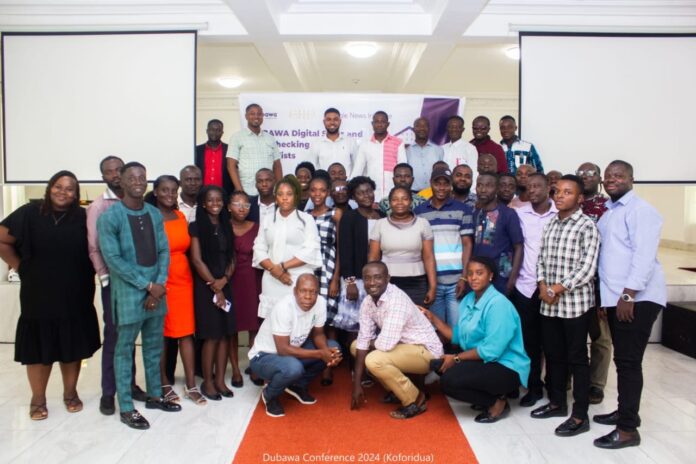
The Centre for Journalism Innovation and Development (CJID) through its fact-checking initiative DUBAWA in partnership with the Google News Initiative has organized a two-day digital verification and fact-checking workshop for some selected media practitioners in the Eastern Region.

The two days training workshop which was executed by Dubawa project was to build African newsrooms’ capacity in digital journalism skills, verification, and fact-checking journalism.

DUBAWA, a West African independent verification and fact-checking hub took the beneficiary Journalists through fact-checking techniques and how to deploy Google tools for general reporting.

Topics such as Understanding Information Disorder, Steps and Methodology of Fact-Checking, Digital Safety and Security among others were expertly presented by the various resource personalities including Dr. Aurelia Ayisi from the Department of Communication Studies of the University of Ghana, Augustine Brako, Fact-checker and Roselena Ahiable, Programme Officer, Dubawa

The rest of the resource personalities were lawyer Tanko Zakaria Musah, Legal Practitioner and Lecturer, Unimac-IJ, Nathan Gadugah and Mr. Nathaniel Kyere Bekoe, editor and Fact-Checker at DUBAWA respectively.

In her presentation, Dr. Aurelia Ayisi from the Department of Communication Studies of the University of Ghana who presented on Digital Safety and Security charged the participants to be conscious of their transactions on social media.

According to her, many people have consciously or unconsciously provided pieces of information about themselves to individuals or criminals through their various activities on social media.

To her, there is a thin line between real life and social media life since most of the things an individual undertake on social media are relatively the thoughts, location, and make-up of that individual in real life.

She disclosed that, social media life has contributed to some physical attacks, robberies among other social vices through the activities of the victims as they unconsciously send pictures containing their location, address, car numbers to their actors.

Touching on the topic “Understanding Information Disorder”, Mr. Nathaniel Kyere Bekoe averred that, the term fake news has over the years wrongly used since the particular piece of information put out there could not be entirely false but rather some section of it.

Mr. Bekoe entreated the general public and by large journalists to use the term information disorder with its components of misleading, disinformation and malformation instead of fake news.

He argued that, piece of information could not be entirely false but rather have either one or two of any of the components such as misleading, disinformation and malformation, hence it would be academically inappropriate to describe the entire piece of work as fake news.

On steps and methodology of facts-checking, an editor at DUBAWA Master Nathan Gadugah called on the media practitioners to jealously and religiously uphold the cardinal principles of journalism.

According to him, fact-checking is most important in the ecosystem of journalism and it is therefore imperative for media practitioners to act responsibly in checking and cross-checking pieces of information before reporting.

He indicated, there will be influx of negative and unsubstantiated pieces of news as the country prepares for this year’s elections, hence circumspection, fact-checking would be the most ingredients for media practitioners in order to avert confusion.

Lawyer Tanko Zakaria Musah, UNIMAC-GIJ, and Augustine Brako through the capacity-building impacted the knowledge of the journalists.

The Programme Officer at Dubawa madam Roselena Ahiable reiterated that DUBAWA is dedicated to promoting truth and verification within not only Ghanaian media ecosystem but the West Africa sub-region with its current presence in Nigeria, Ghana, Sierra Leone, Liberia and Gambia.

She continued that Dubawa’s mission statement is to institute a culture of truth and verification in public discourse and journalism through strategic partnerships between the media, government, civil society organizations, technology giants and the public.

Kwesi Yankah Writes: TO A WOMAN OF COURAGE: AKOSUA ADOMAKO AMPOFO

0
AKOSUA ADOMAKO AMPOFO

Today, I extend Happy Birthday greetings to a colleague and Fellow of the Ghana Academy of Arts and Sciences. This salutation, though, comes with an extended footnote for the benefit of younger ones interested in the history of activism propelling this 4th Republic.

Akosua Adomako Ampofo, a seasoned scholar whose political activism has gone unnoticed, is the one I highlight today on her birthday. She first came to my attention some three decades ago, 1993, when a major march was underway to protest the adventures of one Salifu Amankwah who was inflicted on Ghana by Rawlings’ 31st December revolution. Salifu was a no-nonsense Warrant Officer. Call him the virtual minister of Kwame Nkrumah Circle, in charge of discipline. He had a famous truck on which was permanently perched his famous monkey, call it 31st December monkey. If they formed a company, it was probably called Salifu & Monkeys Ltd.

If you ever saw Salifu in shirt, he was probably off duty. His bare chest was his working gear. Salifu’s major assignment was fighting indiscipline at the Kwame Nkrumah Circle (now interchange). Pedestrians feared to spit, or piss. If you felt like it while at the Circle, you held it until you reached a Salifu-free zone before facing the wall. If you strayed into no-walk zone, Salifu was there for an instant drill, slaps, kicks, etc. Taxi drivers dreaded to park. Salifu was simply a No Parking sign. If your car broke down at the Circle, you were safer abandoning it and taking to your heels. It all looked as if what ‘obibini’ blackman needed was a little ‘Salifu’ in his life.

All this happened until one day, Salifu overreached himself and was convicted of murder. Under very strange circumstances, however, he was pardoned by the Head of State, JJ Rawlings. Pardon for murder.

From 1992 onwards came constitutional democracy: a parliament, cabinet, President etc. Mike Gizo was the Minister for Greater Accra. Upon seeing the return of indiscipline at the Circle, Gizo decided that the pardoned murderer, Salifu Amankwah, should take back the same job which inspired him to kill.
Ghanaians were up in arms. ‘Keep murderers off our streets’ was the call.

Early May 1993, one bold woman and her husband, held in hand a protest letter, signed by two hundred people from all walks of life. The idea was to send a letter of protest to Mike Gizo, Minister for Greater Accra during the Rawlings constitutional regime. The protest leader was Akosua Adomako Ampofo; following in tow was her husband, Dr Kwame Ampofo of the Obstetrics & Gynaecology Dept, Korle Bu; Kwame Karikari, Communication Studies; and my good self, holding placards and heading to the office of the Greater Accra Regional Minister. To our surprise, the premises had been cordoned off by heavily armed policemen who had originally misread our agenda as a mass demonstration. Dramatically entered four non-armed scholars led by a heavily pregnant Akosua Ampofo. That foetus must be 30 years now. Akosua peacefully read our petition to the waiting press, and handed a copy to Mike Gizo, the Minister. Parts of the petition were as follows:

‘It is an insult to the competence of Ghanaians to imply that Warrant Officer Amankwah, out of the thousands of trained Ghanaians, is the only one qualified to beautify Accra.

‘Even though Salifu Amankwah was pardoned by Jerry Rawlings, Chairman of the PNDC, we consider it an insult, not only to the widow and family of Mr Quarshie (the deceased), but to the entire people of Ghana, that Salifu Amankwah has been reappointed to the ‘scene of the crime’. The message being sent to Ghanaians and our young children still forming their lives, is that crime carries with it no consequences; indeed, it may even be rewarded by officialdom.

‘Finally, we the undersigned are demanding the immediate withdrawal of Salifu Amankwah from the AMA Traffic and Sanitation Task Force, and from any other official responsibility.’

Signed on behalf of the signatories on the attached sheet.

Not long after this, Salifu Amankwah was withdrawn from the Circle.

2014. Years thereafter , Akosua bounced back: stimulating another fight for freedom on Legon campus. A series of groundbreaking incidents nearly brought University of Ghana to a collision with the NDC Government: the razing by Government of a newly constructed security gate near the Legon stadium; its restoration by Legon, and second reprisal demolition followed by another reconstruction, until the gates’ final completion in 2017. It may be recalled that this compelled Legon authorizes to name the site: ‘Academic Freedom Road.’ While the then Vice Chancellor Ernest Aryeetey, Legon’s Academic Board, Vice Chancellors of Ghana, UTAG, and the Legon Community should be applauded for fiercely safe guarding Legon’s academic freedom, I make special reference to a ‘concerned group’ of intellectuals that solicited thousands of signatures from sections of the public, and sent a protest note to President John Mahama, calling for the dismissal of Gbevlo Lartey, the national security coordinator who led the rude onslaught. That concerned group of intellectuals was led by Akosua Adomako Ampofo of the Institute of African Studies.

Next stop 2018. A Mahatma Ghandi statue unveiled in 2016 by the University of Ghana behind the Balme Library, was brought down aher 2 years of agitation by students and lecturers. Otherwise known for leading India’s struggle for independence in 1947, Ghandi later made racist remarks about black South Africans when he worked in South Africa. By hosting his statue at a prominent location, Legon was imprudently perpetuating the memory of a racist, who considered Indians as better than the ‘savages’ of Africa. The Ghandi statue was brought down after a long period of agitation by Legon students and faculty. His statue undermined the values of racial equality which the University of Ghana proudly upholds. The leadership that mobilized support leading to the ousting of the Ghandi statue from Legon, included Akosua Adomako Ampofo.

Some architects of Ghana’s freedom, democracy and their sustenance, are often like the precious waist beads, they do not rattle. Pardon me then as I rattle today the deeds of a virtuous woman of courage, and a great fellow of the Ghana Academy of Arts and Sciences.

Akosua Adomako Ampofo, a happy birthday! And Salutations to the entire family!

[Kwesi Yankah is a Fellow, American Academy of Arts and Sciences And Fellow, Ghana Academy of Arts and Sciences]

kwyankah@yahoo.com

CGTN’s GSV: Asia’s vision for collaboration, global responsibility

0
Asia

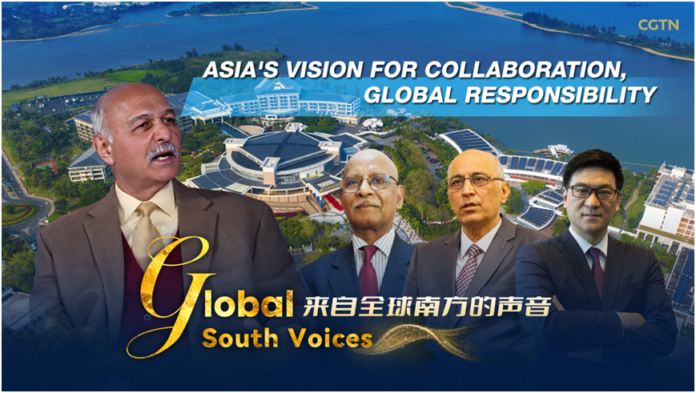
“The center of gravity of global economic development is shifting to Asia. With the rapid rise of Southeast Asian countries such as Malaysia and Indonesia, Asia has now become the most dynamic and vital region in the world, and China through the ‘Belt and Road’ Initiative and other projects, cooperation with neighboring countries, is playing an increasingly important role in Asia and even on the international stage,” said John Gong, a professor at the University of International Business and Economics (UIIBE) and VP-Research and Strategy at the UIBE-Israel at CGTN show Global South Voices.

Echoed with the theme “Asia and the World: Common Challenges, Shared Responsibilities” of the Boao Forum for Asia (BFA) Annual Conference 2024, the program focuses on the attractiveness of the Chinese market for Asian countries, the contrast between the influence of Western countries and China in the global South, and the opportunities and challenges facing Asia’s future development.

As the world’s most populous continent, Asia is known for its abundant resources and huge market size. The steady growth of the Asian economy not only promotes the development of the global economy but also brings in a huge impetus for international trade and investment. At the same time, political stability in Asia is also one of the key factors in maintaining global peace and security. In an era where the world is becoming increasingly interconnected, cooperation and mutual respect among Asian countries are crucial.

John Gong’s insights shed light on the burgeoning trade relations between China and the Association of Southeast Asian Nations (ASEAN), underscoring ASEAN’s ascendance as China’s premier trading partner, surpassing even the European Union. He advocates for ASEAN’s pivotal role in fostering regional collaboration, championing increased investment projects, and the exploration of emerging industries, all underpinned by a steadfast commitment to non-political cooperation.

Dr. Mahmud Ali, drawing from Malaysian Prime Minister Anwar Ibrahim’s recent remarks, articulates Malaysia’s perspective on China as a benign force, rooted in the diverse historical experiences of ASEAN and wider Asia. His reflections underscore a collective preference for a peaceful, mutually-beneficial economic development model that resonates across the continent.

Ambassador Moin ul Haque eloquently elucidates China’s visionary concept of a shared future for humanity, grounded in a governance philosophy prioritizing the welfare of its populace. He dispels Western misconceptions surrounding China’s governance, portraying it as a stalwart democracy deeply committed to uplifting its citizens, as evidenced by its monumental achievement of lifting over 800 million people out of poverty.

In traversing the intricate tapestry of trade dynamics, historical perspectives and visionary aspirations, this episode of “Global South Voices” unveils the nuanced complexities and boundless opportunities within the Asian region. It underscores the paramount importance of mutual respect, cooperation and inclusive development in charting a prosperous future for all stakeholders. With its rich array of insights and diverse viewpoints, the episode serves as a beacon of enlightenment, guiding stakeholders towards a shared vision of prosperity and harmony in the global arena.

Credit: CGTN show Global South Voices

The Ghanaian Chronicle