Home Blog Page 129

Danish PM fails to secure majority in party’s weakest election showing since 1903

0
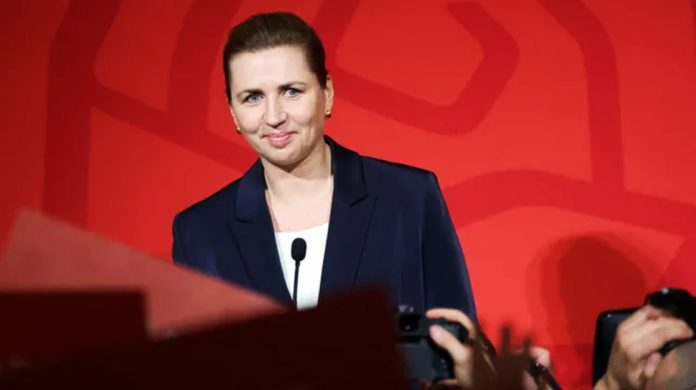
Mette Frederiksen, Denmark Prime Minister and leader of the Social Democrats party

Prime Minister Mette Frederiksen’s Social Democrats won the most votes in Tuesday’s Danish general election but slumped to its weakest performance since 1903, as her coalition bloc failed to secure a majority.

With 21.9% of the vote, Frederiksen’s party still has by the far the most seats, but her left-wing grouping has fallen well short of the 90 seats needed to form a majority.

The Social Democrats have been in power since 2019, and Frederiksen told cheering supporters she was “sorry that we did not get more votes”.

In a message of defiance, she added: “There is nothing today that can make me sad that the Social Democrats have once again become the Danes’ absolute favourite political party.”

The Social Democrats’ main right-wing rival, the Liberal party Venstre, also had its worst showing for a century, with just 10.1%, falling behind the Green Left SF.

Frederiksen still has a chance to stay in power for a third term, however Denmark is typically run by coalition governments, and so tough negotiations – which could take days or weeks – now loom.

Twelve different political parties were on the ballot paper, and this tightly contested race has come right down to the wire.

Claiming a total of 84 seats, the “red bloc” of left-wing parties have clinched a small lead over the “blue bloc” on the right, who have 77 seats combined.

Both blocs have fallen short of the 90 seats that are needed for a majority in Denmark’s 179-seat parliament.

It is not yet clear which bloc will be able to build a majority.

Credit: bbc.com

Finding Relief From Vaginal Dryness And Pain

0
Dyspareunia

There’s no reason to be embarrassed if you have vaginal dryness or pain with sex. After menopause, these things are pretty common. They’re part of a condition called genitourinary syndrome of menopause (GSM). There are a lot of ways to get help for your symptoms. And the fastest way to feel better is to talk to your doctor.

Before your visit, it’s a good idea to jot down all of your symptoms and questions so you remember them all.

Here are some questions to get you started:

  • What’s the difference between a lubricant and a vaginal moisturizer?
  • What are all of my treatment options for dryness and painful sex?
  • Is estrogen safe for me?
  • Are there natural ways I can find relief?
  • What other symptoms can I get?

Why Does Sex Hurt Now?

Pain with vaginal sex is called dyspareunia. After menopause, the most common cause is lower estrogen levels. This can lead to vaginal atrophy. That’s when the tissue in your vagina gets thinner, less elastic, and tears easily. And you lose some of your natural lubrication. You may get a “sandpaper” feeling during sex.

You should tell your doctor how long you’ve had pain and dryness. The length and type of symptoms you have will steer your doctor toward the best treatment.

It can be helpful for you to describe how it hurts. Is there pain at the opening of your vagina? Or is it deeper inside? Do you have aches that linger after sex is over?

What to expect from your visit: Your doctor may give you a pelvic exam to check for changes in your vagina. They’ll look for signs of infection, irritation, or other non-menopausal skin conditions that can cause vaginal problems.

Will Dryness Go Away on Its Own?

Unlike hot flashes, your dryness won’t get better by itself. In fact, your symptoms may get worse without treatment. And your vagina may start to itch or feel dry all the time, not just during sex.

Are There Other Symptoms to Look For?

With less lubrication, the skin around your vagina — your vulva — may burn or itch. Menopause symptoms can also affect your bladder and urethra. You may pee more often or feel a need to get to the bathroom right away. You may get more urinary tract infections. If your vaginal tissue tears, you may bleed a little after sex.

Your doctor can help you find out if your symptoms are related to menopause or not. See your doctor right away if you have any bleeding. It may not be anything to worry about. But it could be a sign of something serious.

What Are the Treatment Options?

One of the best ways to keep pain with sex from happening is to have more sex. Regular sexual activity can bump up blood flow and moisture to your vagina. To help make intimacy more comfortable, your doctor will likely offer you a step-by-step approach. They’ll usually start with the easiest option and go from there.

Your treatment may include:

For dryness and atrophy:

  • Lubricants to use during sex
  • Vaginal moisturizers
  • Low-dose vaginal estrogen
  • Estrogen-like medicine

If muscle or vaginal tightness causes pain, you may need:

  • Pelvic floor therapy
  • Vaginal dilators

Don’t be afraid to ask your doctor a lot of questions. It’s their job to help you feel comfortable through your treatment process.

What About Low Libido?

It’s normal for your sex drive to dip as you age. It can be caused by a lot of things. That includes lower hormone levels, medication, or other health conditions.

But low self-image, stress, relationship issues, depression, or fear of pain can make you less interested in sex. If any of these affect your desire, your doctor may want you to try:

  • Sex therapy
  • Talk therapy
  • Couples counseling

Credit: webmd

Feature: Learner Motivation In High Schools: Are We Losing It?

0

On a typical morning in many high schools across Ghana, learners rush to class, holding notebooks or gathering under trees for group discussions. From a distance, everything appears to be on track. But beneath this routine lies a growing concern: are learners truly motivated to learn, or simply going through the motions?

Recent reports of hooliganism, examination malpractice, sexual misconduct, and declining academic performance suggest that something deeper may be wrong. At the centre of it all is a critical question: are we losing learner motivation?

Motivation is the inner drive that pushes individuals to act, set goals, and strive for achievement. In the classroom, it determines whether a learner listens with curiosity or indifference, persists through difficulty or gives up halfway. It is the difference between learning with purpose and merely attending school.

Education experts consistently emphasize its importance. Motivated learners tend to perform better academically, build confidence, and develop a lasting interest in learning. They ask questions, engage actively, and take responsibility for their progress.

Yet motivation does not exist in a vacuum. It is shaped by the home, the school environment, and the wider society. A motivated learner is often supported, encouraged, and appropriately challenged. When these support systems weaken, motivation can quickly fade.

System strain

Beyond classroom behaviour and attitudes, national data also paints a worrying picture.

A survey conducted by the Ghana Statistical Service (GSS) reveals that as many as 25% of youth who should be in Senior High School (SHS) are not in school. At the primary level, about 19% of children are out of school, while 7% of those expected to be in Junior High School (JHS) are also not enrolled.

The Multiple Indicator Cluster Survey Six (MICS6), conducted in 2017/18, further shows that completion rates stand at 71% for primary school and 83% for JHS. However, the situation becomes more concerning at the secondary level, where less than half of students complete Senior High School.

These figures, highlighted in a report signed by Baah Wadieh, then Acting Government Statistician (Citinewsroom, 2019), suggest that access alone does not guarantee progression or completion. They raise deeper questions about engagement, persistence, and, ultimately, motivation.

Policy impact

There is no doubt that Free SHS has been transformative. It has opened doors for thousands of learners who might otherwise have been denied access to secondary education. Families have been relieved of financial burdens, and enrolment has increased significantly.

However, with guaranteed placement in senior high schools, the pressure that once pushed many learners to excel has reduced. For some, the urgency to perform exceptionally at the basic level is no longer as strong as it used to be (Casely-Hayford et al., 2025).

This does not suggest that the policy is flawed. Rather, it highlights a new challenge: how to sustain motivation in a system where access is no longer the main hurdle.

Changing culture

Memories of school in the past tell a different story. Academic work was often driven by a strong sense of competition and consequence. Failing an examination could mean repeating a class or missing out on a preferred school.

We studied not only to pass, but to excel to make our parents proud, earn recognition among peers, and secure admission into prestigious schools. During vacations, senior high learners shared vivid stories about boarding school life, building anticipation and aspiration. Education carried prestige, and academic success was widely celebrated.

Today, that culture appears to be shifting. On social media, some learners openly share results that would once have raised concern. Scores that previously signalled poor performance are sometimes displayed with surprising confidence.

At the same time, learners attend extra classes and engage in private study. Yet alongside these efforts are troubling trends. These include rumours of leaked examination questions and instances where some parents seek unfair advantages for their children.

This contradiction raises an uncomfortable question: are learners still driven by the desire to understand and succeed, or are they becoming more focused on simply “getting by”?

System challenges

It is important to recognise that motivation is not solely the responsibility of the learner. The education system itself plays a significant role.

Across many schools, persistent challenges remain. These include limited infrastructure, inadequate teaching materials, insufficient textbooks, and, in some cases, teacher shortages. Even the most determined learners can feel discouraged under such conditions.

When effort does not lead to meaningful results, frustration sets in. Over time, some learners disengage not because they lack ability, but because the system does not support their growth.

Assessment practices also influence motivation. Continuous (formative) assessment is widely recognised as effective, yet difficult to implement fully. Teachers often face heavy workloads and time constraints, making comprehensive assessment challenging.

One critical factor is feedback. When learners receive clear, constructive feedback, they are more likely to improve. It reassures them that their efforts matter and shows them how to do better.

Teaching methods are equally important. Lessons that are practical, interactive, and learner-centred tend to sustain interest. Unfortunately, in resource-constrained classrooms, teaching can become routine and uninspiring. In such situations, learners may appear attentive while remaining mentally disengaged.

Perceptions of inequality within the school system also affect motivation. The tendency to rank schools or label some as more desirable can shape how learners see themselves. Those placed in less-preferred schools may feel overlooked, weakening their confidence and commitment.

If these patterns continue, our nation risks raising a generation of learners who attend school without a genuine desire to learn. Motivation must not be taken for granted. It is the engine of meaningful education. Improving access to education is a major achievement, but it must be matched with efforts to sustain engagement and enthusiasm for learning.

A study by Dabie K. P. (2025), Motivation and Academic Performance: Evidence from Two Senior High Schools in Ghana, found that providing financial rewards improved academic performance, showing that motivation can be nurtured with the right strategies.

Parents must instill discipline and nurture curiosity at home. Teachers need support, training, and resources to make learning engaging and relevant. Policymakers must ensure that policies like Free SHS are complemented by strategies that promote responsibility, effort, and academic drive.

Ultimately, education should not be reduced to attendance or certification. It should inspire curiosity, build character, and prepare learners to contribute meaningfully to society.

The real question, therefore, is not whether learners are in school but whether they are truly learning.

Until that question is answered honestly, learner motivation will remain an issue that cannot be ignored.

By Henry Atta Nyame

Institutional Assessment Practitioner

(hattanyame@gmail.com)


For more news, join The Chronicle Newspaper channel on WhatsApp: https://whatsapp.com/channel/0029VbBSs55E50UqNPvSOm2z

Today’s FIFA World Cup Qualifying European playoff 

0
Alessandro Bastoni, Italy

Northern Ireland travel to Italy for playoff semi-final

One side will progress to the final, while the other must miss out on yet another World Cup, as Northern Ireland travel to Italy for their European playoff semi-final on Thursday evening.

The winner of a high-stakes clash in Bergamo will then visit either Wales or Bosnia-Herzegovina, with a place in this year’s global finals up for grabs.

Italy may be four-time world champions – most recently two decades ago – but despite winning the delayed Euros in 2021, they last trod the global stage some seven years earlier.

This is their third consecutive World Cup qualifying campaign to end with a place in the playoffs, following painful defeats to Sweden and North Macedonia.

Last September, the Azzurri started Group I with a 3-0 away loss to Norway, which forced former coach Luciano Spalletti to depart; under new boss Gennaro Gattuso, they posted six straight wins before facing the Norwegians again.

Requiring a huge margin of victory to seize top spot – and, with it, direct qualification – Gattuso’s side instead finished with another dispiriting defeat, as Erling Haaland struck twice in a stunning away win.

Citing the crowd’s angry reaction to that 4-1 reverse in Milan, 2006 World Cup winner Gattuso asked to play this week’s game in nearby Bergamo, rather than at his old home ground of San Siro.

Reasoning that a more compact stadium could work in Italy’s favour, he must now lead La Nazionale into a nerve-shredding playoff decider by beating Northern Ireland.

Credit: sportsmole.co.uk


Turkey host Romania at Besiktas Park

Turkey host Romania at Besiktas Park in the World Cup 2026 European playoff semi-finals, aiming to progress to next Tuesday’s final.

Arda Güler, Turkey

The most recent World Cup appearance for either nation came in 2002, underlining the importance of Thursday’s clash as both sides seek to move one step closer to the showpiece.

When Turkey claimed a bronze medal in only their second World Cup appearance in 2002, few would have predicted that would be their last finals appearance for some time.

That tournament in Asia ended a 48-year wait for the European nation, emphasising how rare it has been for them to feature on the global stage.

Although they are not yet guaranteed a place at the 2026 finals, Ay-Yildizlilar have an excellent opportunity to qualify under Vincenzo Montella.

Standing in their way are Romania, whose wait for a World Cup appearance stretches even longer than Turkiye’s, with Mircea Lucescu aiming to end the nation’s 28-year absence.

Having featured at every World Cup in the 1990s and reached the knockout rounds each time, the Tricolours have not kicked a ball at the tournament since exiting to Croatia in the 1998 round of 16.

Romania have twice fallen at the playoff stage, in 2002 and 2014, but hope it will be third time lucky.

A cagey encounter could be settled by a solitary moment of quality, with Turkey tipped to edge through.

Credit: sportsmole.co.uk


Ukraine are favourites to defeat Sweden 

Ukraine are favourites to defeat Sweden in Thursday’s World Cup 2026 European play-off semi-final at the Estadi Ciutat de València.

Viktor Gyokeres, Sweden

While Blagult have the element of surprise with Graham Potter now at the helm, Serhiy Rebrov’s side will hope to find solutions against opponents who went winless in Group B in qualifying.

Given that every match during World Cup qualifying effectively took place away from home, Ukraine reaching the playoffs was an admirable achievement for Rebrov’s team.

The national side’s only two defeats came against France, who reached the final in both 2018 and 2022 winning the former — and were always likely to top Group D.

The upshot of Ukraine’s inability to outdo Les Bleus is that they have once again failed to qualify automatically for the World Cup finals, with their only appearance remaining Germany 2006, when they reached the quarter-finals.

Only once in that period before the 2018 tournament have they failed to make the playoffs, ultimately losing to Greece in 2010, France in 2014 and Wales before the finals in Qatar.

Given that they are favourites to get the better of Sweden, it will be interesting to see if the national team can inflict further misery on Potter’s men and set up a playoff final with Poland or Albania.

Potter has been in charge of Sweden for only two matches, and the Englishman heads into Thursday’s tie aiming to rectify the nation’s previous mishaps.

Sweden’s attacking quality may threaten in moments, but Ukraine are still backed to claim a narrow victory.

Credit: sportsmole.co.uk


Poland and Albania battle it out in Warsaw

Poland and Albania battle it out at the Stadion Narodowy in Warsaw for a place in the playoff final of 2026 World Cup qualifying on Thursday night.

The victors of this one-off tie will come up against either Ukraine or Sweden away from home next Tuesday for a place at this summer’s tournament.

Robert Lewandowski, Poland

Poland are looking to qualify for the World Cup for the 10th time in their history and for the third successive tournament after competing in the 2018 and 2022 editions in Russia and Qatar respectively, reaching the last 16 in the latter. The Eagles were unfortunate not to qualify automatically for the 2026 tournament, after they won five times and drew 1-1 both home and away against the Netherlands, who went on to win Group G by three points.

Jan Urban is yet to lose as Poland head coach since his appointment in July last year, winning four and drawing two of his six games in charge, including a 3-2 away victory over European minnows Malta in their final qualifier in mid-November.

Ranked 34th in the world by FIFA, Poland head into Thursday’s contest having won five ad drawn one of their last six home matches in all competitions, keeping four clean sheets in the process.

No more than two goals have been scored in 12 of Albania’s last 15 competitive international games and Sylvinho’s side could be involved in another closely-contested battle with Poland on Thursday.

This is a match that may require extra time, but we are backing the Lewandowski-inspired hosts to find a way to secure their place in the playoff final.

Credit: sportsmole.co.uk


FIXTURES

Turkey 17:00 Romania

Czech Republic 19:45 Republic of Ireland

Denmark 19:45 North Macedonia

Italy 19:45 Northern Ireland

Poland 19:45 Albania

Slovakia 19:45 Kosovo

Ukraine 19:45 Sweden

Wales 19:45 Bosnia-Herzegovina


UN resolution urges reparations for slavery’s ‘historical wrongs’

0
File Photo: Image courtesy of UN News

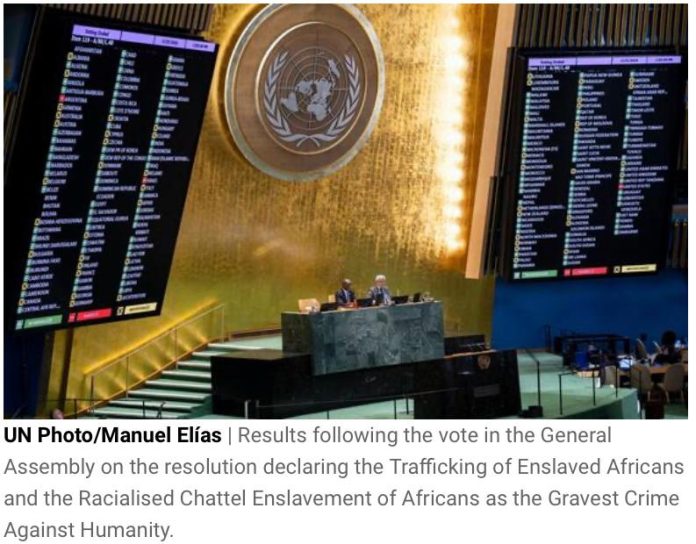
Applause erupted in the UN General Assembly Hall on Wednesday as Member States adopted a resolution declaring the transatlantic slave trade the gravest crime against humanity.

The resolution spearheaded by Ghana received 123 votes in favour. Three countries – Argentina, Israel and the United States – voted against and 52 abstained.

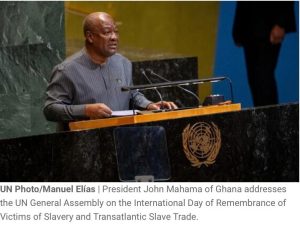
“Today, we come together in solemn solidarity to affirm truth and pursue a route to healing and reparative justice,” said Ghana’s President John Dramani Mahama, speaking ahead of the vote on behalf of the 54-member African Group – the largest regional bloc at the UN.

Stolen, shackled, shipped

For more than 400 years, millions of people were stolen from Africa, put in shackles and shipped to the New World to toil in cotton fields and sugar and coffee plantations under scorching heat and the crack of the whip.

Denied their basic humanity and even their own names, they were forced to endure generations of exploitation with repercussions that reverberate today including persistent anti-Black racism and discrimination.

The resolution emphasised “the trafficking of enslaved Africans and racialised chattel enslavement of Africans as the gravest crime against humanity by reason of the definitive break in world history, scale, duration, systemic nature, brutality and enduring consequences that continue to structure the lives of all people through racialized regimes of labour, property and capital.”

“There are spirits of the victims of slavery present in this room at this moment, and they are listening for one word only: justice.

Esther Philips, First Poet Laureate of Barbados.”

Address wrongs, support reparations

It affirmed the importance of addressing historical wrongs affecting Africans and people of the diaspora in a manner that promotes justice, human rights, dignity and healing, while emphasising that claims for reparations represent a concrete step towards remedy.

The text was “highly problematic in countless respects,” Ambassador Dan Negrea, US representative to the UN Economic and Social Council (ECOSOC), said prior to the vote.

He regretted that Washington “must once again remind this body that the United Nations exists to maintain international peace and security” and “was not founded to advance narrow specific interests and agendas, to establish niche International Days, or to create new costly meeting and reporting mandates.”

Furthermore, the US “does not recognise a legal right to reparations for historical wrongs that were not illegal under international law at the time they occurred.”

File Photo: Image courtesy of UN News

A grave human rights violation

The horrors of slavery echoed in the General Assembly Hall as Member States commemorated the International Day to remember its victims.

“The slave trade and slavery stand among the gravest violations of human rights in human history – an affront to the very principles enshrined in the Charter of our United Nations and the Universal Declaration of Human Rights, themselves born, in part, from these injustices of the past,” said Assembly President Annalena Baerbock.

The countries where enslaved Africans were taken from also suffered “a hollowing out” having lost entire generations who potentially could have helped them to prosper.

“It was, to put it in colder terms, mass resource extraction,” she said.

Remove persistent barriers

UN Secretary-General António Guterres called for confronting slavery’s lasting legacies of inequality and racism.

“Now we must remove the persistent barriers that prevent so many people of African descent from exercising their rights and realising their potential,” he said.

“We must commit — fully and without hesitation — to human rights, equality, and the inherent worth of every person.”

In this regard, the Second International Decade for People of African Descent and the African Union’s Decade of Reparations are significant.

Respect for African countries

He urged countries to use them to drive action to eradicate systemic racism, ensure reparatory justice and accelerate inclusive development, marked by equal access to education, health, employment, housing, and a safe environment.

“But far bolder actions — by many more States — are needed,” he added.

“This includes commitments to respect African countries’ ownership of their own natural resources. And steps to ensure their equal participation and influence in the global financial architecture and the UN Security Council.”

No peace without reparatory justice

The Poet Laureate of Barbados, Esther Philips, read from some of her works including a piece about a young girl walking on the grounds of a former sugar plantation and not understanding its historical significance as her ancestors buried there look on.

“There are spirits of the victims of slavery present in this room at this moment, and they are listening for one word only: justice,” Ms. Philips told delegates.

“Because for them and for the world, there can be no peace without justice –reparatory justice – and that call is answered only when words are turned into action. The question is, what will you do?”

Source: UN News


For more news, join The Chronicle Newspaper channel on WhatsApp: https://whatsapp.com/channel/0029VbBSs55E50UqNPvSOm2z
MAHAMA TAKES GHANA’S MORAL CRUSADE TO THE WORLD

0
John Dramani Mahama, former President

In a solemn chamber that has witnessed the convulsions of nations and the birth of resolutions that shaped the modern world, Ghana’s President John Dramani Mahama stepped to the podium of the United Nations General Assembly on Tuesday and staked his country — and the African continent — on the right side of history.
His mission was not ceremonial.It was surgical.

Speaking on the International Day of Remembrance of the Victims of Slavery and the Transatlantic Slave Trade, President Mahama formally presented a landmark draft resolution on behalf of the African Group, calling on the global community to declare the trafficking of enslaved Africans and the racialised chattel enslavement of Africans the gravest crime against humanity ever perpetrated.

The resolution, if adopted, would be the most consequential moral reckoning the United Nations has attempted since the Holocaust resolutions of the post-war era.

A Long Road to a Single Vote

Mahama opened not with thunder, but with measured philosophy — the kind that signals a man who has rehearsed both the weight of his words and the resistance they will meet.

“Progress is made in steps,” he told the General Assembly. “It’s the forward motion toward something better, and the changes are often incremental.”

It was a deliberate framing. The President was not presenting a sudden radical demand. He was placing Tuesday’s vote as the latest — and most decisive — step in a journey that began with the UN’s own conscience.

He traced that journey with precision: how in 2006, the global community resolved to designate the 25th of March a Day of Remembrance; how in 2007 the event was made annual; and how today, two decades later, that same spirit of incremental justice had arrived at its most consequential threshold.

“That marked an additional step in our forward motion,” he said of the earlier milestones — a phrase that carried the deliberate cadence of a man making a legal and moral argument, not merely a speech.

The Weight of 13 Million

At the heart of Mahama’s address was an accounting. Not of politics. Of people.He reminded the Assembly that approximately 13 million African men, women and children were enslaved over the course of several centuries — torn from their continent, stripped of their names, their languages, their humanity — in what he argued the world has for too long declined to name for what it truly was.

The memorial architecture was not lost on him. He acknowledged the Ark of Return — the memorial monument standing in the Visitors’ Plaza of the UN Headquarters, just outside the hall — as a site of documentation, grief, and the beginning of healing.

“Through these activities, we do more than remember,” Mahama said. “We document and educate; we gain a greater perspective; we find the delicate balance of learning from history so we do not repeat it, while leaving the pain behind.”

But the President made clear that leaving pain behind is not the same as erasing the record of who caused it.

September’s Promise, March’s Reckoning

Mahama reminded delegates that this was not a sudden impulse. At the 80th session of the General Assembly last September, he had publicly committed Ghana to moving this very motion.
Tuesday was the delivery on that promise.

The draft resolution, he explained, was the product of months of careful consultation — involving continental bodies, nations, legal experts, scholars and jurists — with the deliberate aim of building a united front. The architects of the resolution wanted it grounded not in rage or political theatre, but in “truth, compassion, and moral conscience, remembrance, education, and dialogue.”

It was a careful diplomatic construction, designed to survive the inevitable counter-pressures from Western powers who have historically resisted any language that could open the door to formal reparations obligations.

“Today, we come together in solemn solidarity to affirm truth and pursue a route to healing and reparative justice,” Mahama declared. “The adoption of this resolution serves as a safeguard against forgetting.”

Between Roosevelt and King

In a moment of rhetorical elegance that this correspondent found strikingly effective, Mahama closed not with African voices alone — but with two titans of the Western moral tradition.

He quoted Theodore Roosevelt, 26th President of the United States: “With a great moral issue involved, neutrality does not serve righteousness; for to be neutral between right and wrong is to serve wrong.”

Then came the words of Dr Martin Luther King Jr.: “The arc of the moral universe is long, but it bends toward justice.”

The choice was deliberate and shrewd. By invoking two white and Black American icons — one a former president, the other a martyred civil rights leader — Mahama was, in the language of diplomacy, removing the African Group’s resolution from the category of grievance politics and placing it squarely within the universal tradition of moral accountability.

It was a masterstroke. No Western delegate could rise to oppose the resolution without, in the same breath, opposing the words of Roosevelt and King.

What Happens Next

The vote on the resolution remains the defining question. Diplomatic sources at the UN suggest that while African and Caribbean nations are broadly aligned in support, key Western delegations — including some European powers and the United States — have not yet shown their hand.

Observers note that the resolution’s language around “reparative justice” will be its most contested terrain, with some nations wary of legal and financial precedents the wording might establish.

But Mahama appeared untroubled by the politics of delay. His speech was constructed for a longer audience than the room — for the historians, the archivists, the descendants of the enslaved who will read the record of this day long after its participants are gone.

“Let it be recorded,” he said, his voice dropping into the gravity of a man speaking to posterity, “that when history beckoned, we did what was right for the memory of the millions who suffered the indignity of slavery.”

“Let our vote on this resolution restore their dignity and humanity.”


For more news, join The Chronicle Newspaper channel on WhatsApp: https://whatsapp.com/channel/0029VbBSs55E50UqNPvSOm2z
Two Arrested Over Dzorwulu Jewellery Shop Robbery After Months-Long Police Hunt

0
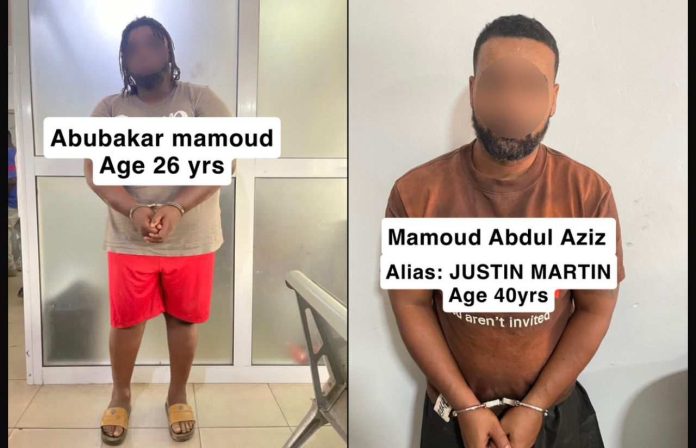
The two suspects in police custody

Two men are in police custody after detectives cracked a brazen armed robbery at a jewellery shop in one of Accra’s upscale neighbourhoods — a case that had gone unsolved for more than five months.

The Ghana Police Service announced on Wednesday that Abubakar Mamoud and Mahmoud Abdul Aziz, also known as Justin Martin, were arrested on February 24 at Anyaa in the Greater Accra Region, following sustained intelligence operations by a specialised team from the Criminal Investigation Department (CID) Headquarters.

The two suspects allegedly found in possession of a gun and hammer.”
The two suspects allegedly found in possession of a gun and hammer.

The arrests stem from a robbery on September 11, 2025, when two armed men on a motorbike descended on a jewellery shop near the Nyaho Clinic at Dzorwulu in Accra. The attackers assaulted a shop attendant, smashed a glass door, and fled with assorted jewellery.

The haul recovered from the suspects’ rooms tells a story of premeditation. Detectives retrieved a hammer — believed to have been used to shatter the shop’s glass door — alongside a black face mask, a toy pistol, a gold detector, a gold weighing scale, a diamond detector, a backpack, hand gloves, a helmet, and two motorbikes.

The toy pistol is a detail that will raise eyebrows. It suggests the robbers may have intimidated their victim with a fake weapon — a calculated risk that ultimately did not save them from the law.

Police recover a bag from one of the suspects, as seen on CCTV.

Under interrogation, both suspects admitted to the offence and fingered a third individual — identified only as Eddy of Oyarifa — as the receiver of the stolen jewellery. Police say efforts are underway to locate and arrest him. Until Eddy is in custody, a critical piece of this case remains open.

Mamoud and Abdul Aziz are expected to appear before court on Thursday, March 26.
The case underscores a broader pattern of motorbike-enabled street crime in Accra, where the mobility of two-wheeled getaway vehicles has made robberies increasingly difficult to prevent at the point of attack. That the CID ultimately closed in on the suspects through intelligence work, rather than catching them in the act, signals a more methodical approach to tackling such crimes.

For more news, join The Chronicle Newspaper channel on WhatsApp: https://whatsapp.com/channel/0029VbBSs55E50UqNPvSOm2z

Gold Fields Hands Over Damang Mine to Government, Assures Jobs and Community Support

0
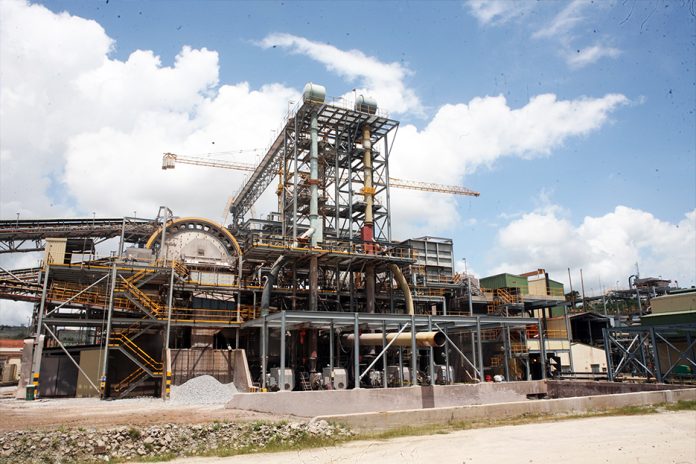
The processing plant of of Aboso Goldfields

Global mining firm Gold Fields has announced the final phase of its transition process for the Damang mine, confirming plans to transfer ownership to the Government of Ghana while assuring stakeholders of continued operational stability and support.

The company said the handover is in line with Ghana’s mining laws and existing agreements with the state, stressing that decisions on the mine’s future ownership will be determined solely by the government.
Gold Fields emphasised its commitment to ensuring a smooth and responsible transition, with a strong focus on protecting jobs, sustaining host community development, and maintaining the mine’s broader economic contributions.

In a statement issued this morning, the global mining giant indicated

“Our operations in Ghana currently employ more than 7,000 people, 99 percent of whom are Ghanaian,” the company noted, adding that it has consistently prioritised local capacity building and procurement from indigenous businesses.

The miner also highlighted over US$100 million in investments in health, education, infrastructure, and community development projects, which it says continue to deliver long-term benefits to its host communities.
Chief Executive Officer Mike Fraser reaffirmed the company’s enduring ties with Ghana, describing its more than 30-year presence as both impactful and mutually beneficial.

“Gold Fields has had the privilege of operating in Ghana for more than 30 years and we are proud of the partnerships that we have built with the Government of Ghana and our host communities over that time,” he said.

Despite exiting Damang, the company underscored that Ghana remains a cornerstone jurisdiction within its global portfolio, with continued operations at Tarkwa and a long-term commitment to the country’s mining sector.

Since 2000, Gold Fields has invested approximately US$5 billion in its Ghanaian operations and contributed about US$2.9 billion to the national fiscus through taxes, royalties, and dividends.

The company reiterated that it will work closely with stakeholders to ensure continuity of operations and a stable transition process, aimed at preserving livelihoods and sustaining economic value in the mining communities.


For more news, join The Chronicle Newspaper channel on WhatsApp: https://whatsapp.com/channel/0029VbBSs55E50UqNPvSOm2z

Minority Blows Cover On Ho Airport Deceit

0

A storm is brewing over the future of the Ho Airport, as the Ranking Member of Parliament’s Roads and Transport Committee, Kennedy Nyarko Osei, has raised serious doubts about government’s commitment to convert the facility into a Pilot Training Academy and Maintenance, Repair and Overhaul (MRO) hub.

The lawmaker cited the absence of budgetary allocations in both the 2025 and 2026 national budgets and a lack of a clear implementation framework, warning that without these, the ambitious plan risks becoming another unfulfilled promise.

Addressing a news conference in Accra yesterday, Kennedy Nyarko Osei, said a careful review of the 2025 and 2026 national budgets shows no allocation whatsoever for the Ho Airport redevelopment, despite assurances by John Dramani Mahama in the 2025 State of the Nation Address and subsequent reiteration by the Finance Ministry.

According to him, the absence of financing, coupled with the lack of a defined implementation framework, raises fundamental concerns about whether the project was backed by any concrete planning.

“This is not just about an announcement. Infrastructure of this scale requires feasibility studies, financing models, phased implementation strategies and institutional coordination. None of these have been made visible,” he stressed.

From a technical standpoint, an MRO facility is a capital-intensive aviation engineering ecosystem, requiring specialised hangars, avionics systems, skilled workforce pipelines and regulatory certification.

Similarly, a Pilot Training Academy demands simulators, airspace management integration and long-term operational funding, elements that cannot materialise without structured investment.

Prempeh I Airport: ‘International in Name Only’

Turning to the Prempeh I International Airport, Mr. Kennedy Nyarko Osei described the omission of runway extension funding in consecutive budgets as a critical oversight.

He explained that without extending the runway to accommodate wide-body aircraft, the airport cannot handle long-haul passenger flights or heavy cargo operations, effectively limiting its international status.

“In aviation engineering terms, runway length determines aircraft class compatibility. Without this upgrade, the airport’s operational capacity remains constrained,” he said.

The Minority warned that failure to complete this phase risks turning prior investments into underperforming assets, incapable of delivering expected economic returns.

Tamale Airport: Export Hub Vision Stalled

Similar concerns were raised about the Tamale International Airport, where Phase 3 development has yet to commence.

The airport, which boasts one of the longest runways in the country second only to Kotoka International Airport was strategically positioned to serve as a northern agro-export hub.

However, critical infrastructure such as cargo terminals, cold-chain logistics systems and expanded apron space remain unimplemented.

From an engineering and logistics perspective, these components are essential for handling perishable agricultural exports, ensuring temperature control, reducing post-harvest losses and enabling efficient aircraft turnaround.

“The delay in Phase 3 is not just administrative, it represents a lost opportunity to integrate Ghana’s northern agricultural belt into global supply chains,” Mr. Kennedy Nyarko Osei warned.

Pattern of Incomplete Infrastructure

The Minority concluded that the issues surrounding Ho, Kumasi and Tamale airports point to a broader systemic problem, the failure to complete infrastructure value chains.

While initial capital investments are made, the critical follow-up phases required to unlock full economic value are often neglected.

This, they argue, reflects weak planning continuity, poor prioritisation and inefficient utilisation of public funds.

Call for Urgent Action

The Roads and Transport Committee is, therefore, urging government to adopt a more structured and transparent approach to infrastructure delivery by ensuring that clear budgetary allocations are tied to specific phases of each project, rather than broad, unsupported announcements.

The Committee further called for the full disclosure of all public-private partnership agreements, particularly those involving entities such as the McDan Group, to guarantee transparency, accountability and value for money.

In addition, the Minority emphasised the need for clearly defined implementation timelines, supported by measurable performance benchmarks to track progress and prevent project abandonment.

They also stressed the importance of integrated transport planning – arguing that aviation, rail and road infrastructure must be developed as a coordinated system to maximise efficiency and economic impact.

According to the Committee, failure to adopt these measures could leave Ghana with what it described as “stranded infrastructure” projects that exist physically, but are unable to deliver meaningful economic returns.

“The country cannot afford to invest billions only to stop halfway. Infrastructure must be completed, integrated and made functional to serve its intended purpose,” Kennedy Nyarko Osei concluded.


Damang Mine: Minister Promises Competitive Bidding Process

0
Mr Emmanuel Armah-Kofi Buah - Minister for Lands and Natural Resources

The Ministry of Lands and Natural Resources has announced plans to safeguard employment and maintain uninterrupted operations at the Damang Mine.

It will also ensure competitive bidding process to secure credible investor and operator to enhance national development as the mines’ current lease nears expiration.

In a statement issued on March 24, 2026 the Ministry confirmed that the Damang Mining Lease, held by Abosso Goldfields Limited, a subsidiary of Gold Fields Limited, is set to expire on April 18, 2026 following a one-year extension.

Describing the mine as a vital national asset, the government emphasised its continued importance to Ghana’s gold production, export revenue and job creation.

To ensure a smooth transition beyond the lease period, authorities have initiated measures aimed at protecting jobs, maintaining existing service contracts and reassuring workers and stakeholders.

The Ministry indicated that these steps form part of a broader strategy to attract a credible investor and operator through a competitive bidding process to take over the mine’s operations.

According to the Ministry, the planned transition is intended to secure the mine’s long-term contribution to national development while promoting increased Ghanaian participation in ownership and investment.

It further assured that operations at the mine would continue during the transition period, with deliberate efforts to ensure that host communities and the country at large continue to benefit from its activities.

Reaffirming its commitment to transparency and responsible resource management, the Ministry expressed confidence that the next phase of operations at the Damang Mine would strengthen the mining sector and support sustainable, Ghanaian-led growth.

The Ghanaian Chronicle