Following Hearts of Oak’s 2-0 defeat to Heart of Lions at the Kpando Sports Stadium on Sunday, some fans have attributed the team’s poor performance to spiritual factors.
The Phobians, who had strong pre-season preparations including a stint in neighbouring Togo, are yet to win a match or even score in the 2024/25 Ghana Premier League season. They began the league with a 1-0 loss to debutants Basake Holy Stars at the Accra Sports Stadium.
In response to the team’s struggles, fans reacted strongly, booing the departing team bus and calling for the dismissal of head coach Aboubakar Ouattara.
Despite this, the management expressed their full support for both the coach and the players, urging them to secure at least a point from their game in Kpando.
However, the team’s woes continued as they conceded a goal in the final seven minutes of the match. Fans expressed frustration, noting that the team seems to be conceding goals in increasing margins.
One fan remarked, “Then, it could be 3-0 if something is not done by management. We have the players but nothing seems to be working.”
Others criticised the centre referee Gabrel Opoku Arhin, particularly regarding the first goal, and called for improvements in officiating.
“The GFA should help referees to help the game because this officiating is very bad,” they said.
Hearts of Oak will look to turn their fortunes around in their next match against Bechem United at the Accra Sports Stadium.
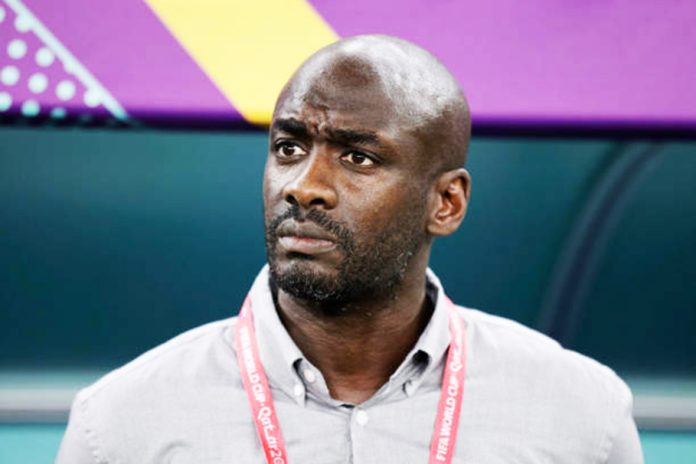
Black Stars coach Otto Addo has praised the progress of the Ghana Premier League, highlighting its development since the previous seasons.
Addo witnessed Medeama’s 1-0 victory over Legon Cities at the University of Ghana Stadium on Saturday, and he was impressed.
Speaking to reporters after the game, Addo stated “This is my first season observing the league closely. At the end of the last season, I watched a little bit of videos; it was okay in general.”
Medeama’s 1-0 victory over Legon Cities at the University of Ghana Stadium
He continued, “I think it’s picking up, it’s getting more interesting, and we have to see. I think it’s early; it’s now early [to make an assessment]. Let’s watch the season and see how the players perform. I think the performance, in general, is going up. When I compare it to two years ago, it has improved.”
In the recent squad for the 2025 Africa Cup of Nations qualifiers, Addo included only one – Kotoko’s goalkeeper Fredrick Asare.
However, he is expected to call up more home-based players for next month’s crucial games against Sudan, signalling his growing interest in the local league.
Addo’s involvement is a boost for the Ghana Premier League as he continues to scout talent and integrate local players into the national setup.
In the first-ever meeting between the two sides, holders Real Madrid will look to make a perfect start as they begin their quest for title number 16.
For the unprecedented 15-time Champions League winners, Real Madrid will begin the new campaign at the Santiago Bernabeu, three months after beating another German club in the final.
Real faced four clubs from Germany on their road to London last season, playing Union Berlin in the groups, RB Leipzig in the last 16 and juggernauts Bayern Munich in the semi-finals.
The hosts will be glad of playing another here, as Real’s record against German opposition is excellent in the Champions League, losing just one of their last 21 – winning 14.
Based on the UEFA coefficient, Real got one of the kinder draws for the league phase, but Stuttgart are, on paper, one of the toughest pot four sides in the competition.
The holders will also welcome Dortmund to the Bernabeu in a repeat of last season’s final, while they also must travel to face Liverpool and Europa League winners Atalanta.
As reigning champions, Real Madrid will enter this opening day fixture as heavy favourites, and they should extend their unbeaten start to the season with a victory despite some possible absences in midfield.
A trip to San Siro is a difficult start, while Real Madrid are also due to visit Anfield in the revamped first phase of Europe’s elite club competition. So too are German champions Bayer Leverkusen, with a certain Xabi Alonso in charge.
Games against Bologna, RB Leipzig, Girona, Lille and PSV are perhaps more favourable but Slot will be keen to get things off to a positive start in Milan this week.
Liverpool’s Harvey Elliott has been ruled out of action for around a month due to a fractured foot. Federico Chiesa has not made his debut yet, so it’ll be interesting to see whether or not he’s included in Tuesday’s squad.
Ac Milan coach Paulo Fonseca has struggled during the early stages of his tenure at Milan despite a big win over Venezia, so Liverpool should feel confident despite the Forest loss.
One of five teams making their Champions League debut this season, Aston Villa kick off their league phase campaign on Tuesday, as they visit Young Boys in Bern.
The clubs’ first competitive meeting comes with Villa flying high in the Premier League and the hosts struggling at the start of their Swiss title defence.
Aston Villa players
Becoming the 11th English team to feature in the Champions League proper, Aston Villa will finally return to UEFA’s elite competition after 41 years of waiting, after the Birmingham club broke into England’s top four last season.
However, ahead of their history-making trip to Bern on Tuesday, Villa have won just twice in 11 European away matches, including a chastening defeat in Greece that sealed last term’s semi-final exit.
Soon to face Bayern and Juve again, they will be keen to get points on the board against Swiss opposition: all four of Villa’s previous meetings with teams from Switzerland came in the Intertoto Cup, but two decades later they are finally back in the big time.
With Barcelona next up for Young Boys – and Bayern Munich awaiting Aston Villa – the pressure will be on both sides to start with a win.
It may be a stalemate, though, as Villa are less convincing away from home and YB seem to be recovering from a sluggish start to the season.
The six-time European champions were knocked off their perch in the Bundesliga last season but have started brightly this term, while Dinamo claimed top spot again in Croatia and are back for another crack at the big time.
Bayern Munich players
Part of the furniture in UEFA’s top club competition, Bayern Munich’s 17 successive group-stage appearances have all resulted in qualification for the last 16, and they boast a proud record in the first phase of the Champions League.
The Bavarian side are unbeaten in 40 group matches, of which they have won no fewer than 36 and had triumphed in a record-setting 17 on the spin before being held at home by Copenhagen last season.
Following their lowest league placing since 2011, a relative rookie, Vincent Kompany, was appointed to rejuvenate an ageing squad, and he has so far overseen four straight wins in all competitions.
After Leroy Sane returned to the matchday squad for the first time this season on Saturday, Bayern Munich boss Vincent Kompany should have all of his main men available in midweek.
Bayern have won 20 of their last 25 Champions League home games, losing only once, so it is a daunting first-day trip for Dinamo to make.
Blessed with an abundance of in-form attacking options, the hosts can continue in that vein and put three points on the board straight away.
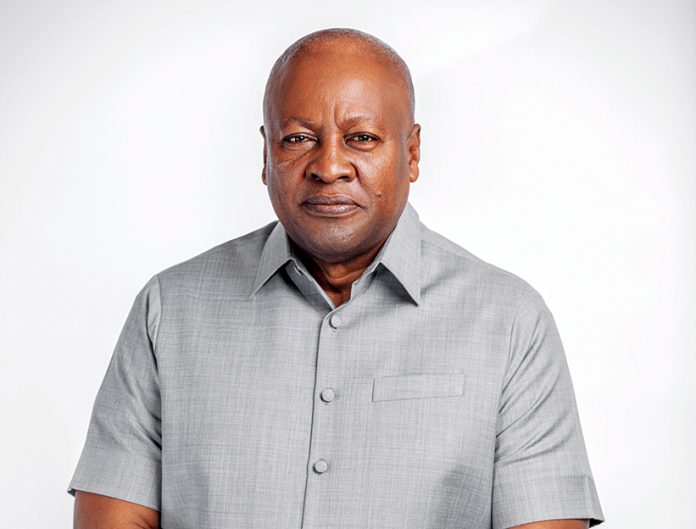
The National Democratic Congress (NDC) and its presidential candidate, John Dramani Mahama, have been exposed for what their opponent has described as dishonesty in their posture towards the Electoral Commission (EC).
On the internet, there are receipts of statements made by the NDC and Mr. Mahama in support of the work of the then EC, ahead of the 2016 elections, but are opposed to the commission on the same subject in 2024.
The words of the former president and the NDC are being played back to them on social media, following what has been termed the incessant attacks on the credibility of the EC by the opposition.
Mr. Mahama and the NDC, according to reports that have surfaced on the internet, ahead of the 2016 general elections, saw nothing wrong with the EC and its work and praised its credibility.
At the time, the position of the ruling NDC was that Ghana’s electoral system has inherent mechanisms that make it impossible for the election management body to rig elections in favour of any political party.
Speaking at a forum in Bordeaux, France, in 2016, the former president remarked that Ghana has an Electoral Commission that is independent and dismissed allegations of interference in the EC’s operations.
He indicated that Ghana’s electoral system is one of the best in the world—not just in Africa, but globally—because it has built-in instruments to guarantee its integrity.
The former president reiterated his strong belief in the EC at a campaign rally in Funsi, Wa East Constituency, on November 18, 2016 just before the general elections.
According to a report by Citifmonline dated August 5, 2015 under the headline:‘NPP lobbies smaller parties for new voters’ register’, then General Secretary of the NDC, Johnson Asiedu Nketiah, was reported to have said at a press conference in January, that year, that the voters’ register was the “most credible since independenc.”
The National First Vice Chairman of the then ruling NDC, Ofosu Ampofo, in August 2015, according to the same Citifmonline report, described the NPP’s call for an audit of the new voters register as “absurd.”
TURN AROUND
However, in a turn of events, Mr. Mahama and the NDC have launched series of attacks on the EC, particularly going into the 2024 general elections, raising questions about the credibility of the EC and recently the voter’s register.
The opposition NDC plans to embark on a protest tomorrow, September 17, 2024 across the country, dubbed ‘Enough is Enough Demo’.
They are hitting the streets to demand a forensic audit of the voters register, as they claim there are challenges with the electoral register.
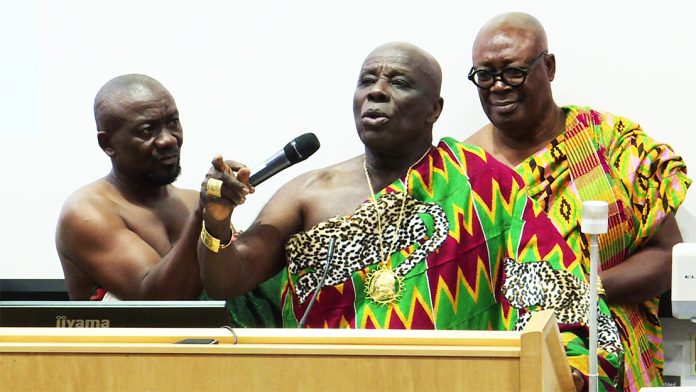
Okyenhene Amoatia Ofori-Panin speaking at Bradford University
The Okyenhene Osagyefuo Amoatia Ofori Panin says world leaders and the Western economies cannot be exonerated in the complicity of corruption on the African continent. He said some actions and inactions of the western leaders contribute to the menace of corruption in Africa.
The Okyenhene mentioned that the world leaders have made their countries a safe haven for corrupt politicians and African leaders to hide and enjoy their stolen wealth.
“If I walk to the bank today to deposit $15,000, the teller will take the money and report to the bank manager. The bank manager will invite me and inquire the sources of that money. But the African leaders have their own way to deposit huge monies in foreign banks without facing probes. Why must it be so?” Osagyefuo questioned.
Delivering a lecture under the theme: ‘Sustainable Leadership in African Governance’ at the School of Management, University of Bradford, in the UK, Okyenhene hinted that many African leaders and politicians have their way of depositing huge amounts in foreign accounts and investing in real estate business abroad without questions.
He said world leaders and their systems must be bold and question these investments by African leaders in their countries.
“Whoever wants to be great must become a servant. Whoever wants to be first among you must be your slave. That is what the Son of Man has done; He came to serve, not be served—and then to give away His life in exchange for the many who are held hostage,” Osagyefuo preached from the Bible.
Okyenhene called on African leaders to learn that service is the price we pay for the space we occupy.
Touching on climate change and its deadly effect on the survival of mankind, Osagyefuo Amoatia Ofori Panin expressed disappointment in world leadership.
“I feel the leaders of the great nations that contribute volumes of carbon to damaging the atmosphere are not doing enough. They sit at round tables to drink tea and laugh without concrete solutions to the catastrophic climate change phenomenon,” Osagyefuo noted.
Okyenhene mentioned that the world is heading towards an apocalypse, indicating that we will soon perish.
He opined that we are all intoxicated with material wealth if we continue in our insatiable quest to enlarge GDPs, increase shareholders’ value, and build big corporate profits.
He said some of our actions have brought us untold consequences, but with strong leadership, we can repair some of these damages over time, and with the right policies, we can regain the respect of nature.
According to Okyenhene, scientists have warned that hitting net-zero emissions by 2050 is now “too little, too late” and will not achieve the long-term temperature goals identified in the Paris Agreement.
He said we have an arduous task on our hands. A shift in emphasis towards net-negative emissions using methods like carbon capture and storage is the “only viable option.”
“The global CO2 concentration in the Earth’s atmosphere is currently rising at nearly 419.2 parts per million (ppm). This represents a 47.3% increase since the beginning of the Industrial Age, when the concentration was near 280 ppm, and an 11% increase since 2000, when it was near 370 ppm,” Osagyefuo quoted from research data.
The Kwaebibirimhene hinted that if the green gas emission rate continues this way, it will not take science to predict that by 2040, the air we breathe will contain 50+% of the toxin, carbon dioxide.
He said it is scary to think that the world will soon become uninhabitable.
Osagyefuo said this will have an incredible impact on our children, leaving them with far shorter lives than today. Adding that, it can’t be business as usual.
Touching on sustainable development and indigenous traditional governance, Okyenhene hinted that, long before the invasion of the westerners in Africa, there was a rule that our forebears lived under known as the ‘Rule of Nature’.
He said under God’s rule, one has to live in harmony with one’s environment and not dominate and destroy it.
He said our forebears understood and saw the earth as a sacred place and respected and defended that rule.
He said the African traditional leaders had Indigenous knowledge, which the early Europeans did not recognise, and because indigenous people did not share European ideas about land ownership, they were considered primitive and had no desire to place the sources of their survival, i.e., natural resources, into the stream of commerce; they were viewed as ignorant.
“This was the thinking of the early Europeans—in other words, they considered indigenous peoples lives as inferior.”
He said the hazardous exploitation of our natural resources continues to threaten the very survival of mankind.
He called for proper world leadership in saving the world and mankind from the danger ahead.
The Youth Employment Agency (YEA) has signed a co-operation agreement with the German Development Agency (GIZ) to launch the “Make Fashion Inclusive” program.
This initiative aims to empower People With Disabilities (PWDs) by providing them with skills training and economic opportunities in the fashion industry.
According to the YEA CEO, Mr. Kofi Baah Agyepong, the “Make Fashion Inclusive” program will provide training and resources to 50 Beneficiaries who will receive a guaranteed market for their products and a shop to facilitate sales.
“Existing fashion entrepreneurs and start-ups will also receive support with skills training, business development and financial literacy.”
He said that the partnership demonstrates YEA’s commitment to creating decent jobs and promoting inclusivity for all Ghanaian youth, particularly those with disabilities.
The CEO observed that with the support of GIZ and other collaborators, YEA is poised to make a significant impact in the lives of PWDs and contribute to a more inclusive and sustainable economy.
“The ‘Make Fashion Inclusive’ program is a testament to the power of collaboration and innovation in addressing social and economic challenges. By providing PWDs with skills training and economic opportunities, YEA and GIZ are helping to break down barriers and promote inclusivity in the fashion industry,” he said.
With the distribution of modern electric sewing machines and the establishment of a Skills and Fashion hub, Beneficiaries will have the tools and resources they need to succeed.
Mr. Agyepong noted that this program is not only empowering PWDs but also contributing to the growth and development of the fashion industry in Ghana.
A New Dawn
He described the partnership between YEA and GIZ as a new dawn for youth employment in Ghana, adding that by working together, they are creating decent jobs and promoting inclusivity for all Ghanaian youth.
As YEA CEO, Mr. Kofi Baah Agyepong noted, “This is a new dawn and a further growth in the cap of the Agency’s mission to create decent jobs.”
With initiatives like the ‘Make Fashion Inclusive’ program, YEA is solidifying its position as a leader in youth employment and empowerment.
The agency has already made significant strides in supporting PWDs, including the creation of Disability Desks in all 266 YEA offices across the country and the recruitment of 282 PWDs as District Disability Officers.
On his Part Mr Wilhelm Hugo, Head of Programme for the German Development Corporation’s Special Initiative “Decent Work for a Just Transition” announced a groundbreaking partnership with the YEA and other local stakeholders to launch the ‘Make Fashion Inclusive’ project in Ghana.
The initiative aims to promote inclusive economic development and sustainable employability in the fashion and textile sector, with a focus on innovation and job creation for all citizens, including those with disabilities.
Hugo emphasised the importance of collaboration and inclusive economic development, stating “We want to work together…for inclusive economic development…We stand by ability…We want to create jobs for all persons, for all citizens.”
The two-year project will kick off with a pilot training program, with plans to expand to other sectors and participants in the future.
Hugo expressed enthusiasm for the project’s innovative approach, saying, “The project is very innovative…We want to kick off this innovative development in the sector…for a bigger impact.”
This partnership demonstrates the German Development Corporation’s commitment to supporting sustainable economic growth and inclusive development in Ghana, with a focus on empowering marginalised communities and promoting decent work for all.
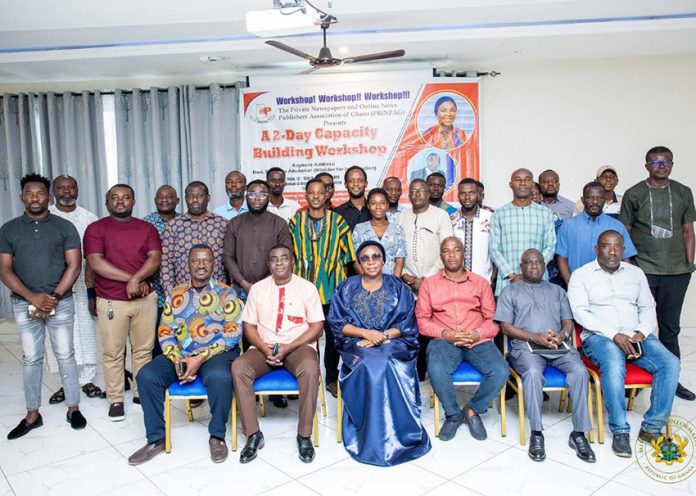
The Private Newspapers and Online News Publishers Association of Ghana (PRINPAG), with support from the Ministry of Information, has trained selected journalists on fact-checking and election reporting, ahead of the December 7, 2024 election.
Minister for Information, Fatimatu Abubarkar speaking at the opening ceremony
The two-day workshop was held at Somanya, in the Eastern Region on Thursday, September 12, and Friday, September 13, 2024.
The workshop, under the theme “Empowering Journalists for Credible Elections:
Enhancing Reporting and Fact-Checking Skills,” focused on equipping journalists with the skills necessary to be able to fact-check information, how and the need to report impartially on the upcoming elections.
EXPERT PRESENTATIONS
The Eastern Regional Director of the Electoral Commission, Mr. John Appiah Baffour, one of the resource persons, educated participants on the electoral system and process in Ghana.
He advocated collaboration between the EC and all stakeholders, including the media, to ensure peaceful elections.
He advised journalists against causing and fanning confusion but instead focus on providing accurate and clear information to the public.
A Political Science Lecturer at the University of Ghana, Dr. Kwame Asah-Asante, took participants through media ethics, particularly going into the elections.
The retired journalist urged his colleagues to remain objective in their election coverage and report accurately without being bias, but leave the readers or the public to make a conclusion from the report.
Kwaku Krobea Asante, Senior Programme Manager at the Media Foundation of West Africa, took participants through fact-checking, during which he guided participants on how to use technology to detect fake news.
The workshop, organised as part of PRINPAG’s ongoing efforts to prepare journalists for the December 2024 elections, aimed to ensure that the media plays a pivotal role in promoting transparency and accountability in the electoral process.
DANGERS
The Special Guest, the Minister for Information, Fatimatu Abubarkar, in her address to open the workshop underscored the dangers associated with misinformation and disinformation.
She pointed out that the phenomenon is a global threat and a canker to society that needs collective effort to address.
President of PRINGPAG, Edwin Arthur giving his address
The minister pleaded with journalists to protect Ghana’s peace and stability through responsible reporting before, during, and after election periods and warned against allowing misinformation to fuel conflict, citing international examples where rumours led to violence.
Again, she emphasised the critical role of training in ensuring professional success, particularly for journalists reporting on elections.
The Municipal Chief Executive of the Yilo Krobo Assembly, Eric Tetteh, used the opportunity to market Somanya and appealed to participants to consider investing in the area, which he said is economically viable.
MEDIA ROLE
The President of PRINPAG, Andrew Edwin Arthur, in his address underscored the critical role the media plays in fostering peace, democracy and accountability.
He stressed the need for journalists to be professional and adhere to ethical reporting during the general elections.
He cautioned against tendencies that can potentially undermine the industry through “fragmentation, greed, self-aggrandisement, needless sensationalism and politicisation of the media.”
FACT-CHECKING
Executive Secretary of PRINPAG, Jeorge Wilson Kingson, mentioned the importance of fact-checking in an era of rampant misinformation.
He urged his colleagues to apply the techniques learnt during the workshop to ensure their reporting is accurate, impartial, and credible.
He mentioned that the workshop was part of PRINPAG’s broader effort to enhance professionalism in the media and ensure peaceful and credible elections in December.
Ghanaian farmers and other stakeholders in agriculture have been assured that their welfare will be given maximum attention and support by Dr. Bawumia’s government.
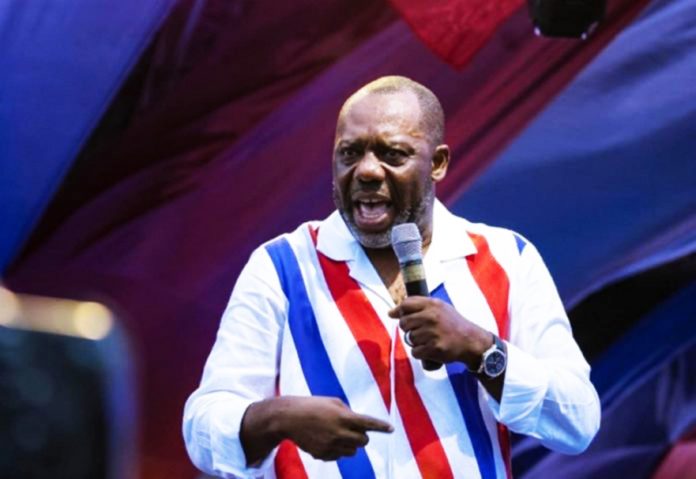
Giving the firm assurance, Dr. Matthew Opoku Prempeh, the New Patriotic Party (NPP) Vice Presidential Candidate, stated that the NPP values the role of agriculture in national development.
In this regard, he has announced that the Dr. Bawumia’s government will implement policies that will enhance Agribusinesses to immensely benefit stakeholders in the crucial sector.
Speaking at Kejeji, at Sene East, in the Bono East region, as part of his national campaign tour on Friday, Dr. Prempeh, also known as ‘Napo’, hinted that Agribusinesses will certainly flourish.
According to him, the necessary financial, technical and any other support that will help make Agribusinesses thrive in the country would be readily provided by the next NPP administration.
“The potential for expanding and creating thousands of new jobs in Agribusiness, in response to the opportunities in food security and food exports, including AgriTech, is significant.
“That’s why under Dr. Bawumia’s presidency, we plan to make significant investments and reforms in the sector, including agricultural research, food production, food preservation and value-addition,” he noted.
Highlighting some of the key things that Dr. Bawumia and Napo will do in earnest to promote Agribusinesses, he said “We shall create agricultural enclaves in each region based on its competitive advantage via private sector collaboration.
The in-coming government, Napo announced, will strategically invest in research and the development of digital and Al technologies to help boost food production and distribution.
“This is aimed at improving production, reducing post harvest losses and packaging agricultural produce for freshness/longer shelf life, as well as farming under arid conditions and Agric mechanisation,” he said.
Napo noted that “We shall also redirect Development Bank Ghana (DBG) to expand its financing and guarantee lines, especially through the proposed SME Bank that we will set up.
“This bank will support entities engaged in the manufacturing of value-added agricultural products consumed in large quantities by Ghanaians, including the processing and packaging of basic agricultural foods.”
Napo said the government will also accelerate the growth of agro-industries “through financing and guarantees from Development Bank Ghana (DBG) and the Ghana Incentive-Based Risk-Share System for Agricultural Lending (GIRSAL).”
The Judicial Service of Ghana has attributed delays in the Promotion of Proper Human Sexual Rights and Ghanaian Family Values Bill (Anti-LGBTQ+ Bill) hearing to the parties’ failure to meet court directives.
In a release issued on September 13, 2024, the Judicial Service revealed that as of August 31, 2024, parties involved in the case have not filed their memorandum of issues for trial, despite the plaintiff and the 1st defendant (Speaker of Parliament) having submitted their statements of case.
It stated that the Attorney-General (2nd defence) had not filed its statement of case, which has impeded the court’s progress.
“The parties have not completed the work they are to do before a hearing of the Supreme Court can be conducted,” he said.
This update comes in response to recent media reports about a planned protest against the Chief Justice on September 17, 2024. The protest, organised by sponsors of the bill, is being termed the ‘Family Values March.’
The protest targets the Chief Justice, whose decision to delay a ruling on an interlocutory injunction has drawn criticism from Member of Parliament (MP) for Ningo-Prampram, Sam Dzata George.
The MP alleges that the Chief Justice’s actions are a deliberate attempt to stall the bill’s passage and is calling for a clear timetable for the case’s hearing.
The Judicial Service provided an update on the two constitutional cases related to the bill currently before the Supreme Court:
Richard Sky vs. Parliament of Ghana and Attorney General and
Dr. Amanda Odoi vs. Speaker of Parliament and Attorney General.
Both cases involve applications for interlocutory injunctions to prevent Parliament from sending the bill to the President for assent.
On July 17, 2024 the Supreme Court opted to defer its ruling on these injunctions, choosing instead to address the full merits of the cases through an early trial.
The Court believes that a comprehensive trial will more effectively resolve the constitutional issues than addressing the interlocutory matters at this stage.
The Judicial Service reassured the public that all court registries are operational throughout legal vacations and the judiciary is prepared to hear cases as soon as they are ready.
A member of the New Patriotic Party’s (NPP) Communications Team, Alfred Thompson, has called on the public to address the fight against illegal mining, commonly known as galamsey, without partisan politics. Mr. Thompson emphasised that tackling galamsey requires a unified effort from all stakeholders to achieve meaningful results.
Speaking on The Big Issue on an Accra-based TV station on Saturday, September 14, he stated that the devastating effects of galamsey cut across political lines and, as such, the fight should be approached collectively to restore damaged lands and polluted water bodies.
“I was expecting that when we finished the first phase of the elections in 2020, we would have all sat down to say that we should collectively fight it (galamsey), not as political parties but as individuals fighting for a better Ghana because everybody is affected.
“When you go to certain areas like the Central region, water is a problem and it is affecting everybody and so we all have to come together and stop doing politics with it, because when you put in politics, I will have to resist and make sure that I do not lose out, because everyone wants to make sure that they are protecting their turf.”
He stressed on the efforts of the government aimed at defeating galamsey. Illegal mining remains one of the most pressing environmental, economic and social challenges facing the country. The call by Alfred Thompson to depoliticise the fight against galamsey is both timely and critical.
The devastating effects of galamsey do not discriminate based on political affiliation and addressing it as a non-partisan issue is essential to restoring damaged lands, polluted water bodies and ensuring the long-term health of Ghana’s environment.
The impact of galamsey on the country’s water bodies is perhaps the most visible and immediate consequence. Rivers that once provided clean water for drinking and irrigation have been rendered toxic, due to the heavy use of chemicals like mercury and cyanide in illegal mining operations.
The Ghana Water Company Limited (GWCL) has raised the alarm multiple times over the rising cost of treating water for public consumption, due to contamination from mining activities.
A 2021 report indicated that GWCL spends up to GH¢10 million more annually to treat polluted water, a cost ultimately passed on to consumers through higher water tariffs. This is an unacceptable burden that could have been avoided with stricter regulation and enforcement.
Mr. Thompson’s statement underscores the need for a unified, collective effort in tackling this crisis. The suggestion to remove politics from the fight against galamsey is crucial because political interference has historically undermined efforts to clamp down on illegal mining activities.
Research indicates that the politicians, in an attempt to secure votes often support galamsey operators. This political complicity enables illegal miners to operate with impunity, particularly in rural areas where regulation is lax. For example, in the lead-up to elections, politicians may promise to protect local miners’ interests or look the other way as galamsey activities escalate, further worsening the problem.
As a result many rural communities have lost access to clean water, leading to widespread health issues and reduced agricultural productivity.
According to a report by the World Bank, areas affected by galamsey experience reduced agricultural output due to land degradation, which in turn exacerbates poverty and food insecurity. Restoring these lands requires significant financial investment, technical expertise, and political will—factors that will only come together if the fight is seen as a national priority, not a partisan agenda.
Many of the individuals engaged in galamsey are driven by economic desperation, with mining often being one of the few available means of livelihood in impoverished rural communities.
To tackle galamsey effectively, a multi-faceted approach is necessary.
To nip this canker in the mud, The Chronicle believes there must be stricter enforcement of existing mining regulations, including the prosecution of not only miners but also those in political and business circles who enable illegal operations. Also, alternative livelihood programs must be scaled up to provide viable economic opportunities for people currently dependent on illegal mining. Programs such as the government’s Planting for Food and Jobs initiative have the potential to absorb some of the labor force from galamsey, but they need to be expanded and better funded.
The media, civil society organisations and community leaders must engage in sustained efforts to educate the public about the long-term consequences of illegal mining on the environment and public health.
The future of the country’s natural resources and the well-being of its people depend on the success of this fight, and it is a battle that must be fought without political interference.








 According to the YEA CEO, Mr. Kofi Baah Agyepong, the “Make Fashion Inclusive” program will provide training and resources to 50 Beneficiaries who will receive a guaranteed market for their products and a shop to facilitate sales.
 He described the partnership between YEA and GIZ as a new dawn for youth employment in Ghana, adding that by working together, they are creating decent jobs and promoting inclusivity for all Ghanaian youth.
 Hugo emphasised the importance of collaboration and inclusive economic development, stating “We want to work together…for inclusive economic development…We stand by ability…We want to create jobs for all persons, for all citizens.”