Home Blog Page 1259

New Format UEFA Europa League Starts Today

0
Artem Dovbyk, Roma

Roma face Athletic Bilbao in their Europa League opener

Seeking a successful return to the continental stage, Roma meet Athletic Bilbao in their Europa League opener, as they get their campaign under way on Thursday evening.

The clash at Stadio Olimpico will be the teams’ first meeting in UEFA competition, coming as the hosts have switched managers and their Basque visitors have run into top form.

Roma won the inaugural Conference League trophy under Mourinho just over two years ago, and they also have a strong recent record in Europe’s second-tier tournament.

Roma have lost just three of their last 18 Europa League matches – winning half – and across seven home games in the competition last season they suffered only one setback.

However, the capital club will head into Thursday’s game having won just one of their last eight against Spanish sides, of which Athletic Club will become the 10th they have faced.

While Roma are regulars in UEFA competition, Athletic last featured on the European stage back in 2018, when they were knocked out in the Europa League’s last 16 by Marseille.

The Bilbao club lost their last three games of that campaign, and six years on they will be keen to avoid losing four consecutive European ties for the first time in their history.

Now that Ivan Juric has taken the reins at Roma, the home side should be harder to beat, so Athletic Club’s wait for a win on the Italian peninsula may go on.

Both teams would probably settle for a point from one of their tougher league-phase contests, with much friendlier fixtures awaiting either side next month.

Credit: sportsmole.co.uk


Tottenham return to Europea as they host Qarabag

Tottenham Hotspur make their return to European competition when they welcome Azeri champions Qarabag FK to North London in the Europa League on Thursday.

Tottenham coach Ange Postecoglou will have been delighted to see them drawn at home against their upcoming opponents, avoiding the long-haul trek across Europe and into the Asian border in Azerbaijan.
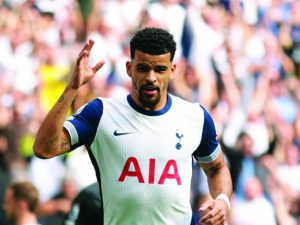
Dominic Solanke, Tottenham

It has been something of an underwhelming start for Tottenham in both league and cup so far this season, as they sit in mid-table after five Premier League games. While the home faithful will be glad to have European football back at the Tottenham Hotspur Stadium, the Champions League is what they desired, so losing out to Aston Villa was a huge disappointment.

Spurs have been woeful on the continent, failing to score in either leg of their last 16 defeat to AC Milan in the 2022-23 Champions League.

The season previous, Spurs were eliminated in the Conference League group stage, just months after being knocked out of the Europa League by Dinamo Zagreb.

On the other hand Qarabag had their best European campaign to date, and they were just minutes from a historic win to reach the quarter-finals of this competition. Qarabag have, however, lost all six of their previous meetings against English clubs, including two against Spurs back in 2015.

Qarabag rarely travel well, and their record against English clubs is damning, with six losses from six, and there is little to suggest they can arrest that run here.

Spurs should still have more than enough firepower to record a routine matchday one victory here.

Credit: sportsmole.co.uk


Ajax welcome Turkish giants Besiktas

Aiming to add a 2024-25 triumph to their illustrious European history, Ajax will start their Europa League campaign with the visit of Turkish giants Besiktas to Johan Cruijff Arena on Thursday night.

De Godenzonen are coming into this clash following a lacklustre draw in the Eredivisie on the weekend, whilst the Black Eagles enjoyed a dramatic victory in the Turkish Super Lig.
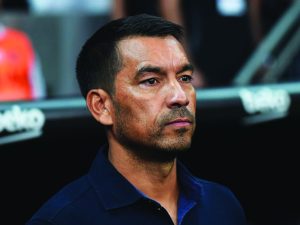
Besiktas head coach Giovanni van Bronckhorst

Despite their lowest league finish since the turn of the century last campaign, a fifth-placed standing for Ajax in the Eredivisie was still good enough to earn a spot in the qualification rounds of the Europa League, with the Dutch powerhouses working overtime in the summer to book their place in the League Phase of the competition.

Since returning to action following the September international break, Ajax have collected a respectable total of four points from a pair of Eredivisie contests.

With influential attacker Steven Bergwijn and Carlos Forbs leaving the club over the summer, Ajax needed to acquire reinforcements on the flanks during the transfer window, with former Aston Villa forward Bertrand Traore joining on a two-year deal.

Besiktas head coach Giovanni van Bronckhorst is now looking to add continental silverware to his managerial CV, with the 49-year-old losing the Europa League final in 2022 as Rangers boss to Eintracht Frankfurt. Besiktas are also restricted at the back ahead of Thursday’s clash, with defender Necip Uysal sidelined until the middle of November because of a ligament injury.

Ajax have won back-to-back home matches by an aggregate scoreline of 8-0 recently, although the visit of Besiktas should pose a much sterner test for the Dutch giants on Thursday.

Credit: sportsmole.co.uk


Rangers get campaign underway with a trip to face Malmo

Rangers get their Europa League campaign underway when they make the trip to Sweden to face Allsvenskan leaders Malmo on Thursday.

Philippe Clement‘s side have made an underwhelming start to the season, which they hope to rectify with a good showing on the continent.

Both clubs came up short in their attempts to reach the Champions League this season, losing in the qualifiers, but Malmo’s form since their playoff elimination has been excellent.

Henrik Rydstrom‘s side are cruising to the title in Sweden, and they have not conceded a goal in four league games since losing to Sparta Prague at the end of August.

Philippe Clement, Rangers coach

After missing out on Europe entirely last season though, playing eight games throughout the autumn and the winter will be most welcome, but they will hope to improve on their group-stage exit in the 2022-23 Europa League.

Being drawn against Rangers and Slavia Prague, arguably the two weakest teams in pot one, will give them belief that they can at least finish in the top 24 to seal a knockout place, with it estimated that nine points from the eight games could be enough.

Rangers will have similar ambitions, especially having been seeded in pot one, but they must recover from a very disappointing start to the season.

Rangers have never beaten a Swedish side in Europe in six attempts, four of which came against Malmo, and with their woeful away form an issue, this could be a more difficult fixture than it initially appears.

Credit: sportsmole.co.uk

League Stage Fixtures

Fenerbahçe 17:45 Union Saint-Gilloise

Malmö FF 17:45 Rangers

Ajax 20:00 Beşiktaş

Eintracht Frankfurt 20:00 Viktoria Plzeň

FCSB 20:00 Rīgas FS

Olympique Lyonnais 20:00 Olympiakos Piraeus
Roma 20:00 Athletic Club

Sporting Braga 20:00 Maccabi Tel Aviv

Tottenham Hotspur 20:00 Qarabağ

GHANA’S ECONOMY: A RESILIENT RISE TO PROSPERITY

0
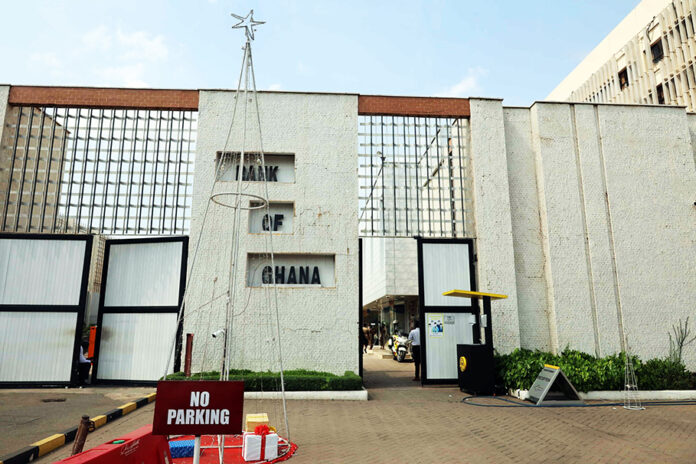
Bank of Ghana


By: Razak Adamah Vemmie

Hurriedly putting his government together a few weeks after being sworn in as the President of Ghana, His Excellency President Nana Akufo Addo hit the ground running, intimating in a famous interview that “I’m in a hurry.’’ By the middle of 2019, Ghana’s economy had blossomed with positive, optimistic economic figures covering almost every sector. For instance, according to the Ghana Statistical Service, Ghana’s Agriculture and sub-sectors real growth rate was 6.1% and 4.8% for 2017 and 2018, respectively. Ghana’s economy was in ascendancy even though short-lived due to external exigencies of COVID-19 and the Russia-Ukraine war.

SITUATION BEFORE THE EFFECTS OF EXTERNAL SHOCKS.
Ghana’s oil production experience has highlighted the resource’s double-edged nature. Initially, crude commercial output transformed the West African nation into a top investment hub. However, this newfound wealth also led successive governments to accumulate significant debt.
Investors have grown wary, dumping Ghana’s bonds and currency, the cedi, due to concerns over the country’s ability to service its debt. As a result of rising fuel costs (before the emergence of the Gold-for-oil policy), global supply chain disruptions, over-reliance on primary commodities and global economic pressures due to COVID-19, the cedi’s value plummeted, fueling skyrocketing inflation of above 50%. However, recent, well-managed measures by the government have ensured a sharp reduction in inflation to 20%, and it’s expected to fall further.
President Nana Akufo-Addo’s administration has sought assistance from the International Monetary Fund (IMF) to address these economic challenges, requesting a package worth up to $3 billion. Largely due to some prudence in place, noticeable macroeconomic gains have been embraced since the beginning of the first quarter of 2024 through corrective Fiscal and Monetary policies tailored to influence total demand, timely Debt Restructuring, Investment in Key Sectors including harnessing the opportunities offered by the Africa Continental Free Trade Agreement (ACFTA) and the government’s keen pursuit of Fiscal Consolidation.
.
WEST AFRICA’S RISING STAR
Ghana, West Africa’s shining star, has navigated economic challenges and emerged stronger. President Nana Akufo-Addo’s administration has implemented strategic reforms, fostering growth and restoring investor confidence.
Ghana’s appeal to investors stemmed from its reputation as a beacon of stability in a region often plagued by turmoil. As the first sub-Saharan African nation to achieve independence, Ghana has consistently held peaceful elections since the inception of its 4th Republican Constitution in 1992, with power transferring smoothly.

ECONOMIC STABILITY
Ghana’s economic stabilization efforts have yielded impressive results, with its fiscal deficit decreasing from 7.4% of GDP in 2016 to 4.5% in 2022, per IMF data. The inflation rate dropped to 12.3% in 2023, down from 15.4% in 2022, according to the Ghana Statistical Service. Refreshing of all, Ghana’s Cedi currency regained 15% of its value against the US dollar in 2023.

GDP GROWTH
Ghana’s Gross Domestic Product (GDP) growth rate is projected to rebound with a 5.6% growth rate forecast for 2024, up from 3.4% in 2020. Ghana’s impressive GDP growth of 6.9% for the second quarter of 2024 is the fastest in about 5 years, significantly driven by its Agriculture, Industry, and Services sectors.
By the end of 2024, the GDP of Ghana is anticipated to reach USD 78.97 billion with a 2025 projection of USD 82.36 billion.

AGRICULTURAL RESURGENCE
Ghana Cocoa Board states Ghana’s cocoa sector has witnessed remarkable growth in cocoa production, which increased by 15% in 2022/2023, reaching 850,000 metric tons.
Within the same period under review, data by the Ministry of Food and Agriculture (MOFA) indicates Ghana’s Agricultural exports rose by 20%, driven by mangoes, pineapples, and cashews.

TECHNOLOGY AND INNOVATION
With over 200 technology start-ups emerging in 2022, Ghana’s tech industry is thriving, focusing on Fintech, E-commerce, and Healthtech.
Data by the Bank of Ghana indicates Digital payments grew by 25% in 2022, reaching $50 billion in only one fiscal year.

TOURISM REVIVAL
Ghana’s tourism sector is bouncing back steadily, driven by cultural heritage and eco-tourism. For instance, Visitor numbers increased by 15% in 2022, as captured by the Ghana Tourism Authority. The Nana Addo and Dr Bawumia’s administration made positive strides in Tourism revenue in 2017 of about USD 919 Million. Travel restrictions due to the COVID-19 pandemic adversely affected Ghana’s revenue from Tourism. Nonetheless, the Nana Addo and Dr Bawumia’s administration spearheaded year-on-year revenue growth of the Tourism industry leading to about USD 664 Million contribution to Ghana’s GDP in 2021, a 348% increase from the USD 191 Million generated in 2020. Ghana went on to record its highest Tourism revenue of USD 2 Billion in 2022.
It is no wonder that President Akufo Addo’s government invested a whopping $100 million in tourism infrastructure development in 2022.

INFRASTRUCTURE DEVELOPMENT
The Government’s strategic investments in infrastructure have enhanced connectivity and trade tremendously. Of great notice is the $2 billion invested in transportation infrastructure between 2020-2022 through Ghana’s Ministry of Roads and Highways Authority.
Huge investments in the expansion and efficiency of the coastal nation’s ports and harbours increased cargo handling capacity by 30%.
FOREIGN INVESTMENT
Painstaking research revealed through the Ghana Investment Promotion Authority that Ghana’s investment climate has improved admirably since 2017, with an increase in Foreign Investment by 15% in 2022, driven mainly by significant interests in agriculture and renewable energy.
The steady gains chalked through the ingenuity of President Nana Addo and Dr Bawumia’s administration, despite the effects of external exigencies, made Ghana ranked 2nd in West Africa for ease of doing business, according to the World Bank.

HUMAN DEVELOPMENT
The life expectancy of Ghanaians increased to 68.4 years in 2022, up from 66.7 years in 2019, according to the data of the World Health Organization (WHO). Within the same period under review, access to education improved, with an 85% net enrollment rate in 2022, made possible by the legacy policy of the government’s Free Senior High School (Free SHS).
Having enjoyed free secondary school education at Nandom Senior High in the Upper West Region, the writer relates better and understands the positive impact of Free SHS on Ghanaian households.

CHALLENGES AND FUTURE PROSPECTS
Admittedly, challenges persist, but Ghana’s economic foundation has been strengthened by the Government’s commitment to private sector development and business-friendly policies, diversification efforts to reduce dependence on its traditional commodities, and Investments in human capital and infrastructure.

CONCLUSION
Ghana’s economic resurgence underscores the nation’s resilience and determination. With continued reforms and investments, Ghana is poised to reclaim its position as a beacon of stability and growth in West Africa. A new NPP government will possibly take over on 7th January 2025 to fulfil Ghana’s full potential through implementing Bold Solutions for the Future. There is an urgent need for continuity and sustenance of Ghana’s gains.

I Will Cap The Size Of Parliament …Says Bawumia In Election 2024 Manifesto

0
Mahamudu Bawumia

The next government of the New Patriotic Party (NPP), led by Dr. Mahamudu Bawumia, should Ghanaians vote for him, intends to cap the size of Parliament. This is contained in the 2024 manifesto of the NPP to help operate a lean government.

According to the manifesto, relevant acts and regulations will be amended to separate the creation of districts from constituencies, as is the case at the moment.

“We will amend the relevant Acts and regulations to delink the creation of districts from constituencies, to end the automatic increases in the size of Parliament, following the creation of new districts,” the manifesto states.

DOWNSIZE

The current number of constituencies in the 8th parliament of the 4th Republic is 275 and is expected to increase to 276 in the next parliament, as a result of the creation of the Guan constituency in the Oti Region.

The burden on taxpayers to pay for the growing number of Legislators and Parliament House staff has been of concern to citizens, hence the NPP’s promise to cap the legislature.

According to the manifesto, a Bawumia-led government will also, among others, merge and consolidate entities, programmes and funds to better administer the country.

“To achieve this objective, we will cap ministerial appointments to 50 and commit to working with not more than 50 ministers of state,” the manifesto said.

CREATION OF CONSTITUENCY

The 1992 constitution, under Article 47, mandates that Ghana be divided into constituencies for the purpose of electing Members of Parliament. It specifies that the number of constituencies should not be less than 140.

The constitution also gives the Electoral Commission the power to review and demarcate constituencies.

The EC may create new constituencies based on changes in population, shifts in administrative boundaries, or other factors such as geographical size, ease of communication, and administrative convenience in addition to population size.

Clause 5 of Article 47 says, “The Electoral Commission shall review the division of Ghana into constituencies at intervals of not less than seven years, or within twelve months after the publication of the enumeration figures after the holding of a census of the population of Ghana, whichever is earlier, and may, as a result, alter the constituencies.”

HISTORY

The first constituencies in Ghana were created for the 1951 Legislative Assembly elections, held under the British colonial government’s new 1950 constitution. At that time, the Gold Coast was divided into 38 constituencies, allowing people of the Gold Coast to elect members to the Legislative Assembly.

In 1954, the number of constituencies was increased to 104, as part of a broader process of expanding representation as the Gold Coast moved closer to independence.

The number increased to 198 in 1965, but was reduced to 104 after the military coup in 1966, which overthrew Kwame Nkrumah.

In 1979, under the third Republic, the number was set at 140 and when Ghana returned to constitutional rule under the fourth Republic in 1992, the constituencies increased to 200 for the general elections.

In 2000, the number increased to 230 by the Electoral Commission, based on population growth and the 2000 census, which allowed the EC to review and demarcate for the creation of new constituencies.

Ahead of the 2012 elections, 45 new constituencies were created, increasing the number to 275, following the 2010 population census.

Since 2012, Ghana has had two parliaments with the same 275 constituencies, but that will change after the December 2024 elections.

The creation of the Oti Region by the Akufo-Addo government necessitated the creation of new districts, which eventually birthed the Guan constituency, bringing the number to 276.

There is no single fixed population size for a constituency in Ghana, but the population quota serves as a guideline to ensure that constituencies have roughly equal populations.

Other factors are fair political representation, resource allocation and geographical size, ease of communication, economic viability and administrative convenience.

CREATION OF MDA

The first district in Ghana was created in 1959 under the Local Government Ordinance passed by the colonial government in 1951.

However, the major restructuring of the local government system happened under the Provisional National Defence Council (PNDC) government in 1988, when the Local Government Law (PNDCL 207) was introduced.

The law decentralised governance, dividing the country into metropolitan, municipal, and district assemblies. Meanwhile, going into the 2024 general election, the NPP has promised to cap the size of Parliament by delinking the creation of constituencies from the creation of districts.

Stop attacking EC -Napo cautions NDC

0
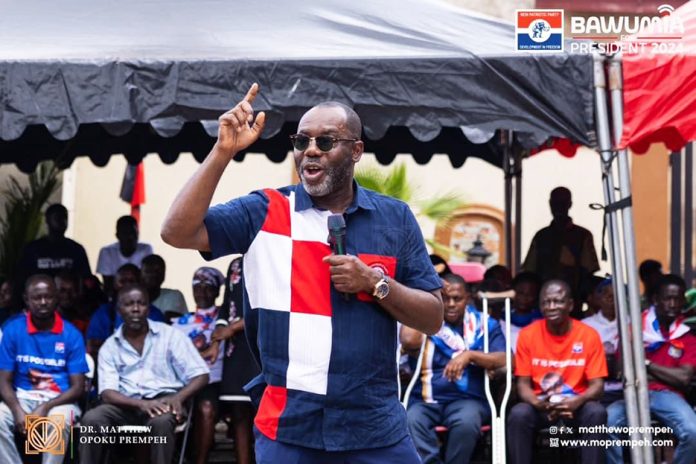
Dr Mathew Opoku Prempeh

The opposition National Democratic Congress (NDC) has been cautioned to refrain from unnecessarily attacking the Electoral Commission (EC), especially as the December 7 elections gradually draw closer.

Dr. Matthew Opoku Prempeh, aka ‘Napo’, the New Patriotic Party (NPP) Vice Presidential Candidate, sounding the caution, stated that the NDCs incessant attacks on the EC have the tendency of creating tension ahead of the elections.

According to him, the NDCs hankering of winning the impending polls should not blindfold their leadership, especially former President John Mahama, to put the peace, progress and security of the country in danger.

Speaking during an engagement with chiefs and religious leaders at New Edubiase in the Ashanti region on Monday, Dr. Prempeh, said political parties have the right to question the EC, but they must do so with decorum.

The various political parties, he said, should always ensure that their dealings with the EC would not cast doubts about the integrity and fairness of the electoral body, who are mandated by the constitution to supervise the polls.

“Political parties have the right to protest against the EC, but we must avoid disruptions that cast doubts on the intentions of fair elections”, Napo said, adding, the country would only be developed in a peaceful atmosphere.

The NPP vice presidential candidate also expressed worry about the way the NDC has been trying to make the public, especially their supporters, to see the EC as a bias body, which is planning to rig the polls for a certain political party.

According to him, the NDC weird and unpatriotic behaviour can easily create tension and disturb national peace, stressing the need for the NDC and their leadership to always prioritize the peace and progress of the country.

“All well-meaning persons must encourage the expression of concerns about the electoral process, but it must be done in the interest of our dear motherland. We must know that we have only one Ghana to develop”, Napo advised.

He urged all-and-sundry to play important roles to jealously protect and maintain the peace that’s being enjoyed in the country before, during and after the polls, saying that “Disturbances will draw the country’s development back”.

Okyenhene fights for Children in rural areas

0
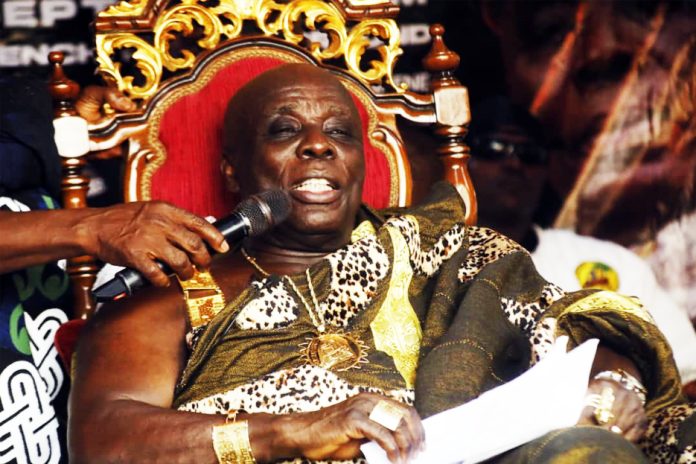
Okyenhene speaking at the function

Okyenhene Osagyefuo Amoatia Ofori Panin is advocating for equal opportunities for all Ghanaians, especially those in rural communities. He says most brilliant children in rural Ghana do not have the opportunities available to the many urban children to explore and unearth hidden talents.

Speaking at a traditional durbar organised at Akyem Wenchi, the seat of the Oseawuo division in the Akyem Abuakwa State, as part of activities marking his 25th Anniversary celebration of his ascension to the Ofori Panin stool, Osagyefuo Amoatia Ofori Panin hinted equal opportunities in education and all fields will help many rural children to discover their talents and be competitive.

He added that particular attention must be given to women empowerment since they have proven to be prudent with every little investment.

“We must give opportunities to people to explore. We must invest in our children’s education and give them the necessary support to be competitive.

“Women have proven to be prudent with little investments and it’s important that we pay attention to their education and support them to grow”, Osagyefuo noted.

As part of his commitment towards education, the Okyenhene set off to construct 10 model schools within the Akyem Abuakwa State.

The Amoatia Ofori Panin Model School consists of 9 classrooms, a computer laboratory, ICT center, headmaster’s office and a staff common room.

Okyenhene commissioned the Amoatia Ofori Panin Model School at Akyem Wenchi, prior to the traditional durbar.

He said, the Amoatia Ofori Panin Model Schools will pay particular attention to Mathematics, Science and Information Technology.

Osagyefuo Amoatia Ofori Panin hinted that Science and technology has become an essential component of mankind’s life hence it has become imperative to inculcate these skills in the children from the basic school level.

So far, the Achiase, Wenchi, Kyebi and Osino schools have been commissioned. The rest will be commissioned in the coming weeks.

Okyenhene maintained that mining is not entirely a bad activity but the irresponsible ways of mining leading to destructions of water bodies, bio-diversity and the eco-system should not be encouraged.

‘Those of us who lived here witnessed how mining was done decades ago. Those who started mining here mined responsibly. They didn’t destroy our water bodies and environment. They didn’t put mercury and other chemicals in the water.

“They even left behind huge deposits of natural resources. So why are we destroying the environment now,’ Osagyefuo questioned

According to Osagyefuo, all the mining communities in Ghana, including Akwatia, Obuasi and Tarkwa have close to nothing to show evidencing the benefit of mining within the communities as compared to Johannesburg in South Africa.

“When I returned to Akwatia after years of living in the States, I was sad. The Akwatia we grew up with has not gotten better years after we left. The devastation is troubling and I don’t like it”, Okyenhene said.

Delivering the State of Oseawuo report to Okyenhene, Oseawuohene Daasebre Dr. Asumadu Appiah announced that the Oseawuo division has stopped all forms of illegal lumbering within the Kwaebibirim enclave.

He said, Nananoom has engaged the youth of Oseawuo who were mining in and on the Birim River to stop the devastation.

According to DaasebreDr.Asumadu Appiah, the Birim River has been raided off all illegal mining activities and the turbidity level of the river has been restored to normalcy.

He said, Nananoom continues to educate the youth over government policy on sustainable community mining schemes that will benefit the masses rather than the privileged few.

Democracy Hub Protestors Remanded

0
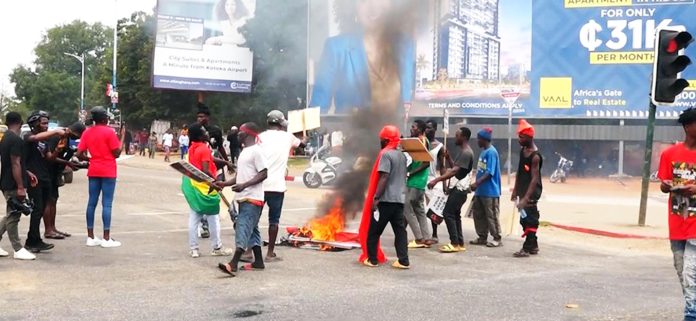
The protesters burning some things on the street

About forty members of the activist group, Democracy Hub, were arraigned at the Accra Circuit Court on multiple charges, including conspiracy to commit unlawful assembly, causing unlawful damage and assault on a public officer.

The accused appeared in groups of four before Judges Kwabena Kodua Obiri-Yeboah and Evelyn Adamoah on September 25, 2024.

The first group included Raphael Afful Williams, Razak Suleman, Gerald Delim, Comrad Abubakar Sadeeq, Bilal Mohammed, Ebenezer Ankomanyi Okyere, Norgbedzi Kelvin, Priscilla Tobili, Mohammed King Hassan and Tanko Nabong, aka Black Pyramid.

The second group included Kingsley Asiedu, Seth Coffie, Vera Gloria Louis, Nii Quaye Hammond, Dela Quarshie, Manuel Barsar Biney, Dorsese Joseph, Agbevi Mathias and Ernest Acheampong.

The third group was made up of Dorcas Sharifa Sulemana, aka Wise Girl, Emmanuel Attah, Allhassan Hudu, Grace Asantewaa, Raymsa Godson Jones, Isaac Agyapong, Shadrack Amoah, Otieku Alex, Raymond Sefa Boakye, Kallian Kofi Komashie, Daniel Adjei and Siah Kwame Daniel.

All accused persons pleaded not guilty to the charges.

They were remanded into police and prison custody, with their next court dates set for October 8 and 11, 2024 respectively.

A bench warrant was issued for Grace Asantewaa, who failed to appear in court despite being on police investigation bail.

State Attorney Nana Akusua Kusi outlined the circumstances leading to the arrests, stemming from a protest planned for July 9, 2024 at Revolutionary Square.

Although the police received notification of the protest, concerns about public safety led them to propose alternative locations, which the group declined.

Tensions escalated on September 25, 2024 when the group gathered at the 37 Roundabout, resulting in clashes with the police, who had set up barricades.

Protesters allegedly blocked major roads, causing significant traffic disruptions and damaging property, including billboards and political materials.

Defense attorneys Noah Adamtey Tetteh and Nelson Noble Amedewonu claimed their clients had been denied sufficient food and access to family and legal counsel since their arrests.

These claims were vehemently denied by prosecution and police representatives.

Engineering Council calls for robust regulatory outline to elevate standards

0
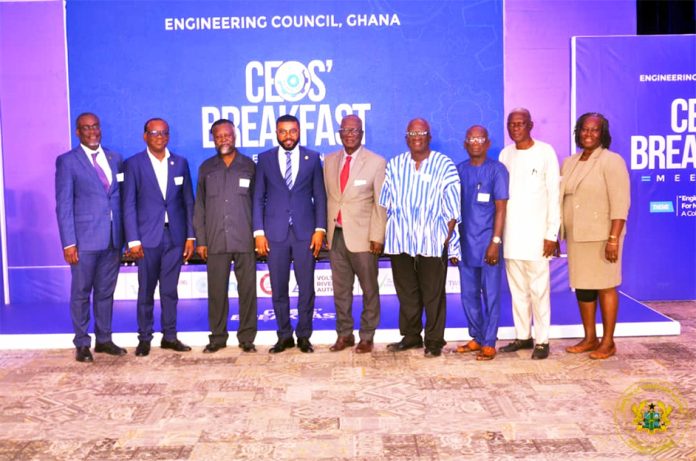
Officials of the Council pose for the cameras after the program

The Engineering Council of Ghana has urged the establishment of a robust regulatory framework to enhance engineering standards across the country.

The appeal was made by the Registrar of the Council, Ing Isaac Bedu, during the second edition of the CEOs’ Breakfast Meeting in Accra on Tuesday, September 24, 2024, where key stakeholders in the engineering and construction sectors gathered to discuss the vital role of engineering in national development.

“Engineering is fundamental to our national development, yet we often only recognize its importance especially when a building collapses or infrastructural failures,” he stated, adding “It is crucial that we proactively establish regulations that govern the engineering profession, safeguarding public safety and promoting excellence.”

He pointed out that while the Council has made strides in promoting professional standards, more needed to be done to engage private sector leaders and ensure compliance with established regulations.

“Many in the private sector may not be fully aware of the existing regulations governing engineering practice in Ghana.

“Our objective today is to bridge that knowledge gap and foster partnerships that can drive innovation and accountability,” he added.

The Registrar emphasised that collaboration is vital for advancing engineering education, research and innovation.

“We must work together to adopt cutting-edge technologies and sustainable solutions tailored to our national context. This is essential for addressing the pressing challenges our country faces,” he urged.

The meeting, themed “Engineering Excellence for National Development: A Collective Responsibility,” highlighted the collaborative effort required from both the government and private sectors to achieve engineering excellence.

In his address, the Deputy Minister for Works and Housing, Dr. Prince Hamid Armah, echoed these sentiments, underscoring the pivotal role of engineering in driving innovation and economic growth.

“We produce over 2,000 engineering graduates annually, yet we must ask ourselves: Are we creating an environment where these professionals can excel?” he queried.

Dr. Armah highlighted the impressive number of engineering graduates produced each year, noting that over 2,000 students graduate from KNUST alone.

However, he raised concerns about whether the current environment allows these graduates to excel and contribute effectively to national development.

“The Engineering Council was established to ensure that engineering practice in Ghana meets the highest standards,” he emphasised.

The gathering served as a platform for discussions on key objectives aimed at improving engineering practices in Ghana.

Mahama Endorses ‘For The Records’ Campaign Book

0
Mr John Mahama speaking at the launch

Former President John Dramani Mahama has endorsed a book titled “For The Records” which details the developmental achievements of the previous National Democratic Congress (NDC) administration in the Anyaa Sowutuom Constituency of the Ga Central Municipal Assembly.

Authored by Raphael Apetorgbor, Deputy Communications Officer of the constituency, the book meticulously documents various infrastructural projects, some of which have been neglected for more than seven years under the Akufo-Addo/Bawumia administration.

Speaking at a community engagement event in Sowutuom, Accra, Mr John Mahama, who is the flagbearer for the NDC, showcased the book as solid evidence of the NDC’s contributions to the constituency’s infrastructure, noting that it serves as a reminder of the party’s commitment to the constituency.

“This book shows the numerous infrastructural developments carried out by the NDC in this constituency during our time in government up till we handed over in 2017,” he said. “These projects stand as tangible proof of our commitment and the positive impact of our work.”

The former President promised that, if elected, he would ensure roads within the constituency are constructed and made motorable.

On education, he pledged to prioritise the completion of the Community Day Senior High School, popularly known as the ‘E-blocks’, which was earmarked for construction at Israel Park.

Mr Mahama further mentioned that dormitory blocks would be added to the E-blocks to accommodate students from nearby areas.

“The Community Day Senior High Schools will have an ultra-modern library, furnished classrooms, ICT laboratory, Biology laboratory, Physics laboratory, Chemistry laboratory, General Science laboratory, a school bus for students and a pick-up vehicle for office staff among others,” he said.

The “For The Records” book was formally launched by former Finance Minister, Mr Seth Terkper, on Sunday, August 25, 2024.

He urged NDC members and executives to use the book as a strategic tool to build support for the party, emphasising that it serves as crucial evidence to debunk claims that the NDC’s Green Book is riddled with inaccuracies.

As part of the launch, Mr. Terkper toured the Anyaa Sowutuom constituency to assess the state of various developmental projects initiated by the erstwhile NDC government, but left incomplete by the current Akufo-Addo/Bawumia administration.

During the tour, attention was drawn to several stalled projects, including the abandoned Ablekuma-Newtown Hospital, the non-operational Abaase market and an unfinished public toilet facility.

Other projects, such as the Olebu Community Health and Planning Services (CHPS) Compound and the Anyaa Bus terminal, were completed under the NDC, but have remained unused since the New Patriotic Party (NPP) took office in 2017.

The NDC Greater Accra Regional Chairman, Mr Emmanuel Nii Ashie Moore, also endorsed the book at the launch, reaffirming the party’s continuous efforts to develop and uplift the constituency.

Raphael Apetorgbor, in explaining his motivation for writing “For the Records,” expressed concern over the misinformation surrounding the NDC’s projects in the Anyaa Sowutuom constituency. He feared that without factual counter-narratives, such misinformation might gain traction.

“This publication is more than just a collection of photographs and writings; it is a comprehensive record of our achievements,” he stated.

Apetorgbor emphasised that the evidence presented in the 30-page book stands in stark contrast to the claims made by the New Patriotic Party (NPP), showcasing the significant contributions of the previous NDC government.

By Stephen Odoi-Larbi

Editorial: Banning Of Our Stadia – Why Was Mustapha Ussif Left Off The Hook?

0
Editorial

Following the decision by the Confederation of Africa Football (CAF) to withdraw the recognition of Baba Yara Sports Stadium in Kumasi to host international matches, which has actually embarrassed us as a nation, President Akufo-Addo decided to take decisive action by terminating the appointment of the Director General of the National Sports Authority, Mr Dodzie Numekevor.

The letter terminating the DG’s appointment, which was made public, did not state the reason why he was being removed from office. It is, however, on record that all the national sports stadia, which are under the direct supervision of the NSA, are not in the best of shape. Apart from the playing pitch at Baba Yara stadium, which CAF complained bitterly about, the African football governing body also raised serious concerns about the standard of the washrooms, referee changing room and the technical bench area.

Though CAF had overlooked these poor facilities at the stadium and allowed the senior national team, the Black Stars, to use the stadium to host international matches, The Chronicle suspects the way the national team coach of Angola complained about the poor pitch, might have been the last straw that broke the camel’s back.

But the big question is; why did the NSA sit down for the pitch to deteriorate to necessitate the ban? It is instructive to note that a few weeks to the hosting of Angola, the supervising authority – the NSA – took money from religious bodies to use the stadium for events. By the time the programme was over, the pitch had gone beyond repairs.

Though the NSA claimed to have brought the pitch back to its original state, any good observer will agree with us that it was very bumpy and not suitable for the game of football. Indeed, that was not the first time NSA had rented out the stadium for commercial purposes. Both Baba Yara and Accra Sports Stadium and lately the Aliu Mahama Stadium in Tamale have been rented out for religious and entertainment activities on numerous occasions.

At the end of these religious and musical shows, the pitches are destroyed, making it very difficult to play the game of football on it. Despite the public criticisms against these unacceptable decisions, the NSA kept repeating the act of renting out the stadia, in the name of raising funds to maintain the state owned stadia. Regrettably, despite all these revenues that have accrued to the NSA, our stadia are still not up to standard to host CAF sanctioned matches.

Now the Ghana Premier League has started and the NSA has come to add to the woes of the already suffering league by closing down both Baba Yara and Accra Sports stadia. If we have an authority that thinks about the development of football, which is the passion of the nation, all these useless decisions would not have been taken.

It is in the light of these developments, which we have enumerated above, that we fully support the dismissal of the NSA boss. His failure to maintain the stadia has really soiled the image of this football loving nation abroad.

Whilst we commend the president for his swift action, we are surprised that he left the Sports Minister, Mustapha Ussif, off the hook.

Even though the maintenance of the state owned stadia comes under direct supervision of the NSA, Minister Ussif is the overall boss. He must, therefore, bear the consequences of the actions taken by his subordinates.

Mustapha Ussif cannot convince The Chronicle that he did not hear the way sports journalists and the public as a whole were criticising the use of the pitches by churches and musicians for their shows. As the political head, it should have occurred to him that such decisions could have serious implications on our national security, but he ignored them.

Football in Ghana is religiously followed by the youth and now that the stadia have been closed down, where does Mr Ussif expect them to watch their idol clubs – Hearts of Oak and Asante Kotoko? Also, has the sports minister sat down to analyse the political implication of the Black Stars playing their home matches on foreign land?

In our opinion, Mr Mustapha Ussif has failed terribly as a sports minister and should have been fired alongside the NSA boss, but why he is still at post is a puzzle we are trying to solve.

Richlove Oduro, the Lone Star Shinning in the Dark Sky

0
Opinion

When I first watch the video clip on social media, in which Richlove Oduro was speaking, I thought she was a student of one of the Category A schools. She was very composed and so eloquent and spoke impeccably in English, which is very unusual of most students these days.

Apart from her oratory, she spoke with such wisdom like a research fellow with a doctorate degree, who was reporting on findings that took five years to complete. Her recommendations were just perfect and I wish education authorities would apply them for the sake of our education system.

Richlove Oduro, is a student of Nsein Senior High School, now Kwame Nkrumah High School (KNSHS), a virtually unknown school in the Category B rankings. What came out from Richlove, should place her among the elite in society who can genuinely provide solutions to Ghana’s problems.

She is the type we need in Parliament who will tackle issues in a non-partisan way for the good of Ghana in general. She could be a good judge, a good politician or a good administrator in the future, who will thrive to provide the best for society. She could even be our first female president, who will lead the country on the right path and be very fair in her delivery.She could certainly can make the difference and change the course of this country.

In summary, from the wisdom coming from her, there is the need for the Ghana Education Service (GES) to change its ways and recruit teachers, fairly to all schools. I will add that the GES must start endowing training schools, to produce very good teachers, like the ages gone past.

What is happening in this country today is that the well-endowed schools, who call themselves good schools, will always rush to grab the best students with good grades between 6 and 12. They are the good schools because they have the best products to work with.

But if a lower category school, like KNSHS, gets low performing students, with an average grade of20, but manages to turn them into very good students, better than most of those in Category A schools, then such schools should rather be classified as the good schools.

It looks like the GES is more concern about protecting the so-called well-endowed schools and pushing all that is good there, and leaving out the lower category schools.

A school like KNSHS, according to Richlove is for academic excellence. The students are trained to become nobles who will go out there, make an impact and correct mistakes been made. The school’s core values are discipline, integrity, hard work and to make perfect people for society. All these are shown in Richlove Oduro.

Richlove went on to state what many people seem afraid to say aboutthe National Science and Maths Quiz (NSMQ). She categorically stated that the NSMQ should not be the benchmark to rate schools. And here I agree with her. Even the WASCCE rankings, especially of the Year 2023, show that the top preforming NSMQ schools could not appear in the top five.

Even the quiz mistress of NSMQ, has come out to complain that students who top the quiz, perform poorly at international competitions.

Holy Child Senior High School, never won the NSMQ competition, however in 2007 or thereabouts, the school won an international science competition.

Three Ghanaian students topped over two million students in the whole of West Africa in WASSCE 2023. They were Amo-Kordieh and Asenso-Gyambibi from St James Seminary, in Abesim, Bono region and Dzandu from Labone SHS in Accra.Amo-Kordieh and Dzandu are reading medicine.

These schools never won the NSMQ.In the two examples, Richlove was right in saying, the NSMQ is just a show and must not be used to rate schools.

Richlove’s statements made something clear. There is a problem with the education system in Ghana and until this is checked and corrected, our educational standards will remain low.

Here in Ghana, teachers and lecturers grade themselves more on the number of students who fail their exams than on the number who pass. Elsewhere, teachers do their best to impart knowledge into the students who perform remarkably and the teachers feel elevated. Education in Ghana is on rocky grounds now. The method of teaching where students are made to chew and pour instead learning to apply knowledge is distancing us from the rest of the world. Something must be done on the Ghana case.

To correct lapses in the education system, Richlove, rightly put it that the GES must not be bias, but make resources equally available for all schools. The old school-syndrome where people in authority push resources to their old schools which are well-endowed and leaving out the less-endowed ones, is not helping.

I support Richlove Oduro when she suggested that every school must be treated equally. I thank God for her life and pray that the authorities, including the executive arm of government, should invite her for discussions. She has good ideas that can transform not only our educational system, but society as a whole.

Richlove is a lone star shining in the dark sky. Her light can shine on our path to progress and development. May God bless her and endow her with more wisdom to help Ghana and Africa.

By Hon. Daniel Dugan

The views expressed in this article are the author’s own and do not necessarily reflect The Chronicle’s stance.

The Ghanaian Chronicle