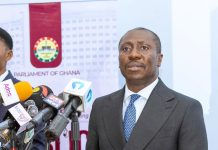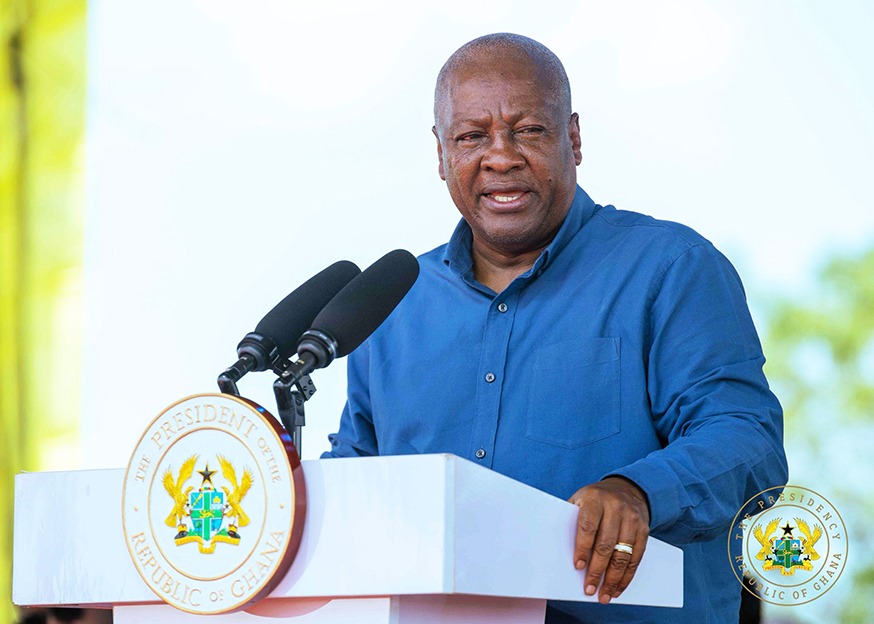
President John Dramani Mahama has warned that persistent underdevelopment and poverty in Northern Ghana are fuelling rural-urban migration and placing increasing pressure on infrastructure and social services in the more economically-endowed parts of the country.
Addressing residents during his “Resetting Ghana” tour in the Savannah Region, President Mahama said national poverty surveys continue to show that the five northern regions remain among the poorest areas in the country, despite constitutional provisions requiring equitable national development.
According to him, the imbalance in development opportunities between northern and southern Ghana has created a dangerous socio-economic trend in which people migrate from deprived regions in search of jobs and better living conditions elsewhere.
“If we have a situation where a certain part of the country is richer and has more opportunities, then what happens is you have migration from the poorer parts of the country to the other parts where there are opportunities,” the President stated.
He explained that the resulting population movement places enormous strain on housing, healthcare, roads, schools and other public infrastructure in urban centres already struggling with rapid expansion.
“And when that happens, it means that there’s pressure on social services and infrastructure in the areas that are more endowed,” he added.
President Mahama argued that balanced national development was not merely a constitutional obligation, but also an economic necessity to prevent widening inequality and demographic pressure on cities.
“That’s why every country tries to achieve balanced development,” he stressed, adding that poorer regions must receive targeted interventions to close development gaps.
The President identified the Savannah Region as one of the areas requiring urgent state attention and outlined a series of infrastructure and social investment projects his administration is undertaking to improve living conditions and reduce outward migration.
Among the flagship interventions announced was the establishment of a Science and Technology University in the Savannah Region to expand access to higher education and create opportunities for young people within the area.
President Mahama disclosed that the Chinese government had already provided a $30 million grant for the commencement of the university project, while Ghana had applied to the Arab Bank for Economic Development in Africa (BADEA) for an additional $100 million to support the construction of the campus.
“Savannah Region is going to get a new university dedicated to science and technology,” he announced.
The President also revealed plans for a 300-bed Savannah Regional Hospital, expected to serve as a referral centre for district hospitals across the region.
According to him, the facility would be equipped with modern medical infrastructure, including CT scan, MRI and X-ray facilities, to improve healthcare delivery and reduce the need for patients to travel long distances for specialised treatment.
In the area of water supply, President Mahama announced that government was finalising processes to commence the Damongo Water Project, which will draw water from Yapei and supply several communities including Busunu, Damongo, Larabanga and the Mole enclave.
He further indicated that Savannah Region would benefit from ongoing road projects under Phase Two of the government’s “Big Push” infrastructure programme, while additional investments in electrification were expected to increase the region’s electricity coverage from the current 68% closer to the national average of nearly 90%.
The President disclosed that 172 communities in the region had already been earmarked for electrification under Phase One of the programme, with solar-powered solutions planned for remote communities beyond the national grid.
President Mahama maintained that such investments were necessary not only to improve living standards in deprived regions, but also to stem the tide of migration that continues to widen the development divide between northern and southern Ghana.
For more news, join The Chronicle Newspaper channel on WhatsApp: https://whatsapp.com/channel/0029VbBSs55E50UqNPvSOm2z