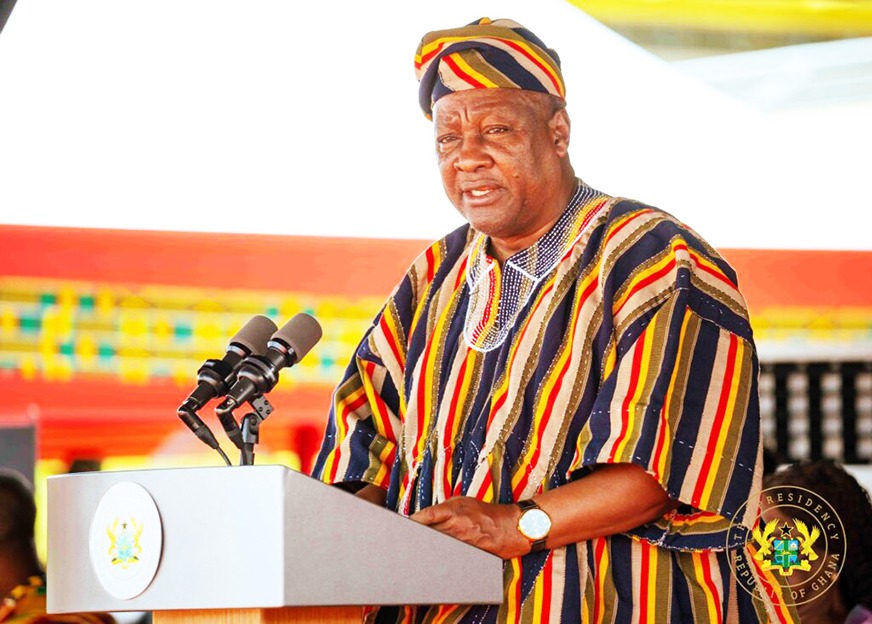
President John Dramani Mahama has declared that Ghana’s economy has staged a major recovery under his administration, moving from the 11th to the 8th largest economy in Africa within a little over a year.
Addressing residents and stakeholders in the Savannah Region during his nationwide “Resetting Ghana” tour, President Mahama said the country’s economic turnaround was evident in falling inflation, stable exchange rates, rising foreign reserves and rapid expansion in Gross Domestic Product (GDP).
According to him, Ghana’s economy, which stood at approximately $80 billion when his administration assumed office, has now grown to $114 billion.
“Today, as I speak with you, Ghana has moved from number 11 biggest economy in Africa to the 8th biggest economy in Africa,” he announced to applause from the gathering.
The President attributed the growth to what he described as prudent economic management and strict fiscal discipline introduced after inheriting an economy that was struggling under an IMF-supported programme.
He disclosed that inflation, which previously reacted sharply to external shocks, had remained relatively stable despite recent global economic pressures.
“We have achieved macro-economic stability. Inflation came down to 3.2% and recently rose marginally to 3.4% because of external factors, but that is a sign of a resilient economy,” he stated.
President Mahama further revealed that Ghana’s foreign reserves had risen to $13.9 billion, enough to cover 5.7 months of imports, with government now targeting reserves capable of supporting up to 15 months of imports to shield the country from future external shocks.
On Ghana’s engagement with the International Monetary Fund (IMF), the President said his administration had succeeded in restoring confidence in the programme after it had veered off-track before the change of government.
He explained that stringent measures introduced by his government helped realign the programme, leading to successful reviews by successive IMF missions.
“The final mission just left Ghana last week and they have given us a satisfying mark for performance,” he said, adding that the IMF Board was expected to approve the release of the final tranche of $380 million.
However, President Mahama stressed that his administration would not celebrate Ghana’s exit from the bailout programme prematurely.
“We are not going to have a kinky party because we know that our economy still needs a lot of work,” he remarked, in what appeared to be a swipe at previous celebrations marking Ghana’s exit from earlier IMF arrangements.
Instead, he disclosed that government had agreed with the IMF to transition from the Extended Credit Facility to a Policy Coordination Instrument, under which Ghana and the IMF would continue periodic assessments of economic reforms and fiscal discipline without additional bailout support.
“It is my hope that this is the last time Ghana will go to the IMF for a bailout,” he declared.
President Mahama also highlighted growth in non-traditional exports, noting that earnings from the sector had increased from $3.83 billion to over $5 billion within a year.
He argued that the expansion of exports and the broader economy would create jobs and enable government to invest more heavily in education, agriculture, roads and local infrastructure.
The President further touted reforms in the disbursement of the District Assemblies Common Fund, stating that 80% of the allocations are now transferred directly to district assemblies in a timely manner, compared to barely 40% under the previous administration.
According to him, the increased releases are already driving visible development across the districts, including the construction of schools, CHPS compounds and 24-hour markets.
President Mahama said every one of Ghana’s 261 districts would receive a 24-hour economy market to stimulate local commerce and improve opportunities for farmers and traders.
“Markets are centres where money circulates among the people,” he noted, explaining that the initiative was intended to deepen economic activity at the grassroots level.
For more news, join The Chronicle Newspaper channel on WhatsApp: https://whatsapp.com/channel/0029VbBSs55E50UqNPvSOm2z