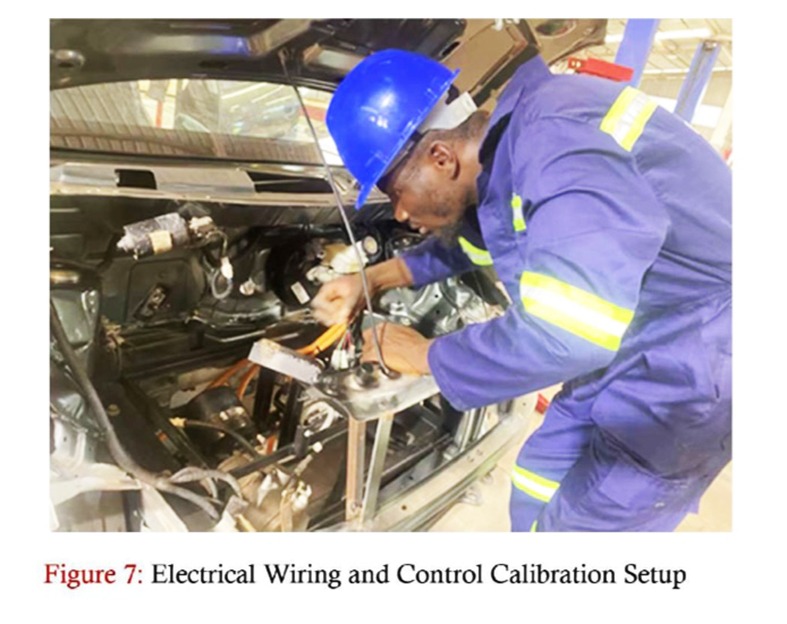
Three final-year engineering students at Kumasi Technical University (KsTU) have achieved a milestone by building Ghana’s first electric vehicle with self-charging capabilities. Dubbed the Nimdea Hyren REV—drawing from the Akan phrase “Knowledge Shines”—this prototype generates power on the move, extending its range and addressing a core barrier to EV adoption in Ghana.
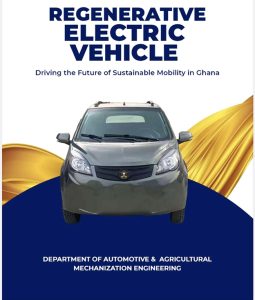
Led by Boaneges Safo Nyansaba Jnr., with Jacob Gyan and Nathaniel Bamfo, the team worked under Prof. Ing. Prince Owusu-Ansah, Head of KsTU’s Automotive and Agricultural Mechanization Engineering Department, built mostly from local scrap, the car travels about 150 km per charge.
In a nation where innovative ideas often stall on paper, this one drives and rigorous performance tests prove its real-world viability.
Nyansaba Jnr and Prof. Owusu-Ansah shared insights in interviews with The Chronicle, detailing the physics, build challenges and the innovation’s precarious future.
Ghana’s EV hesitation stems from sparse charging infrastructure and “range anxiety”, the dread of a dead battery mid-journey. Unlike petrol vehicles refuelable anywhere, EVs demand outlets, which are rare outside urban hubs.
“The fear of stranding discourages even eco-conscious drivers,” Nyansaba Jnr explained. Anticipating global EV dominance, the team targeted this pain point: a vehicle that recaptures energy during deceleration, mimicking nature’s efficiency.
The Science of Self-Charging
The innovation hinges on regenerative braking, a proven technology in premium EVs like Teslas, but ingeniously adapted here. When decelerating, kinetic energy normally lost as brake heat, is converted to electricity.
The Nimdea Hyren REV employs dual mechanisms, Braking regeneration, Pressing the brake reverses the electric motor into a generator, feeding power back to the lithium-ion battery pack.
Coasting regeneration: Easing off the throttle triggers motor drag, harvesting energy from momentum alone.
This enables one-pedal driving: accelerate with the pedal, release to brake and recharge. In Kumasi or Accra’s stop-go traffic, frequent decelerations yield significant top-ups, potentially 10-20% range extension in urban cycles, per team estimates.
A custom Battery Management System (BMS) safeguards operations, monitoring voltage, temperature, and charge flow to prevent overvoltage or thermal runaway.
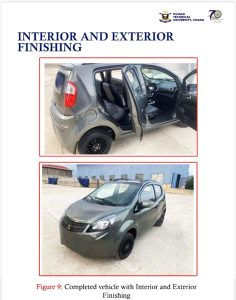
The monocoque body, where the plywood-and-plastic shell doubles as chassis slashes weight, boosting efficiency.
Performance Testing Validates Design
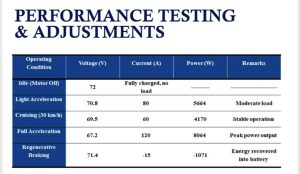
Real-world tests confirm the REV’s engineering prowess. Under controlled conditions, the 72V system delivered stable outputs across operating modes.
These metrics highlight efficiency: cruising sips 4.2 kW at 30 km/h, while regen braking actively recovers 1 kW—directly feeding the battery. Voltage dips under load (to 67.2V at peak), but rebounds during recovery (71.4V), proving the BMS’s smarts. Adjustments post-testing refined motor control for smoother coasting regen.
Grit Amid Setbacks
Construction was gruelling. An initial steel frame drained the battery too fast. “The chassis weight killed our range,” Nyansaba Jnr said.
They scrapped it for a lightweight plywood unibody, delaying timelines, but enabling the tested performance.
The monocoque body, where the plywood-and-plastic shell doubles as chassis slashes weight, boosting efficiency.Prof. Owusu-Ansah acknowledge that further work is required before commercialisation, including regulatory certification, durability testing and potential upgrades to battery technology.
Policy, Funding and the Future of Innovation
Prof. Owusu-Ansah used the project to highlight broader systemic challenges in Ghana’s innovation ecosystem, particularly limited funding and weak industrial support for student-led engineering projects.
“We have the ideas, but many remain on the shelves due to lack of support. If there is deliberate investment in technical education and innovation, projects like this can transform into industries,” he argued.
The team is currently seeking partnerships with both government and private sector actors to scale the project, with plans to develop larger vehicle models such as pickups or SUVs in future iterations.
A Test Case for Ghana’s Industrial Ambition
The Nimdea Hyren REV is more than a student project; it is a test case for whether Ghana’s technical institutions can translate academic knowledge into industrially relevant technology.
Its success — or stagnation — will depend less on engineering feasibility, which has been demonstrated, and more on whether the country’s policy and investment environment can support its transition from workshop innovation to commercial product.
For more news, join The Chronicle Newspaper channel on WhatsApp: https://whatsapp.com/channel/0029VbBSs55E50UqNPvSOm2z