A youth pressure group has openly declared the government’s anti-illegal mining architecture ineffective and is demanding that President John Dramani Mahama invoke emergency powers to halt what it describes as a full-scale environmental catastrophe.
The Dynamic Youth Movement of Ghana (DYMOG), together with Concerned Citizens of Ghana, defied a court directive and took to the streets of Accra, under the banner #StopGalamsey, accusing the National Anti-Illegal Mining Operations Secretariat (NAIMOS) of failing to deliver on its mandate.
Clad in red and black, the protestors marched through the capital, wielding Ghana flags and placards emblazoned with bold messages like: “We Can’t Drink Gold,” “No Justice, No Peace for Polluters,” and “If the Law Works, We Would Be Heroes.”
At the heart of their protest was a blunt verdict: NAIMOS has not lived up to expectations.
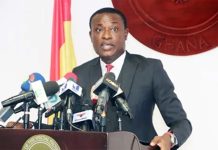
“As we speak, NAIMOS has failed,” declared Mr Edward Seyram Tuttor, Convener of DYMOG, moments after presenting a petition to the Ministry of the Interior.
“When the President met civil society organisations, we were assured that financiers and labourers behind galamsey would be smoked out. But what is happening on the ground tells a different story.”
Ahafo Hwediem Incident Raises Questions
The group cited the recent unrest at Ahafo Hwediem in the Asutifi South Constituency, where illegal miners and some community members reportedly clashed with security personnel engaged in anti-galamsey operations.
According to DYMOG, the incident exposed operational weaknesses and demonstrated that enforcement efforts have not deterred illegal mining networks.
“Looking at what happened at Hwediem, it tells us that whatever is happening in the bush cannot be handled the way it is being handled,” Mr Tuttor argued.
“If security officers are being attacked in the line of duty, then clearly the system is not working.”
Call for Emergency Powers
Invoking Article 31 of the 1992 Constitution, the group insisted that the destruction of Ghana’s water bodies, farmlands and forest reserves now meets the constitutional threshold for a state of emergency.
Article 31 empowers the President to declare a state of emergency where public safety, health or essential life-support systems are under serious threat.
“When the very resources that sustain life – water, food, clean air – are under attack, the President must act,” Mr Tuttor stressed.
“Only he can trigger those emergency powers.”
The group warned that if decisive action is not taken, protests will intensify nationwide.
EPA’s Chemical Approach Rejected
DYMOG also turned its attention to the Environmental Protection Agency (EPA) over its proposal to deploy nano-ionic copper technology to treat polluted water bodies.
The group dismissed the approach as scientifically inadequate and potentially misleading.
“Making polluted water appear clear does not make it safe,” Mr Tuttor argued. “Heavy metals such as mercury, cyanide, arsenic and lead cannot simply be neutralised to make the water potable.”
He maintained that no responsible medical practitioner would advise citizens to consume water treated through what he described as ionic aggregation processes.
Chanfang Machines Still Active
The protestors further alleged that Chanfang machines, imported equipment, widely used in alluvial mining were recently sighted along the Ankobra, Bia and Black Volta rivers.
To them, this is proof that illegal mining remains deeply entrenched despite the establishment of NAIMOS.
“The calamity is still ongoing,” Mr Tuttor said. “So the question is: where is NAIMOS? If there is a reset in the economy but not in the fight against galamsey, then the reset is incomplete.”
Health and Food Security at Risk
Beyond water pollution, DYMOG warned of long-term consequences for agriculture and public health.
“Our staple foods are under threat. The health implications are enormous — kidney complications, liver problems, neurological disorders, risks to unborn children,” Mr Tuttor cautioned.
“This is not just about rivers. This is about national survival.” He stressed that the protest was non-partisan and rooted in patriotism.
“We are not here for any political party. We are here for the motherland,” he said, expressing hope that their petition would be received in the spirit of the 1992 Constitution.
Growing Public Pressure
The protest underscores mounting public frustration over the persistence of illegal mining despite successive government interventions.
NAIMOS was established to coordinate intelligence-led operations against galamsey, including targeting financiers and supply chains.
However, recent incidents and continued reports of polluted water bodies have intensified scrutiny of its effectiveness.
With civil society now openly demanding emergency rule, the political and environmental stakes have risen significantly.
Whether the President will heed the call remains to be seen. But on the streets of Accra yesterday, one message rang loud and clear:
“We can’t drink gold.”