Ghana has secured commitments from buyers to purchase four million tonnes of its newly issued forest carbon credits at an estimated US$43 million, with farmers, traditional authorities and forest-fringe communities expected to receive 46 per cent of the benefits.
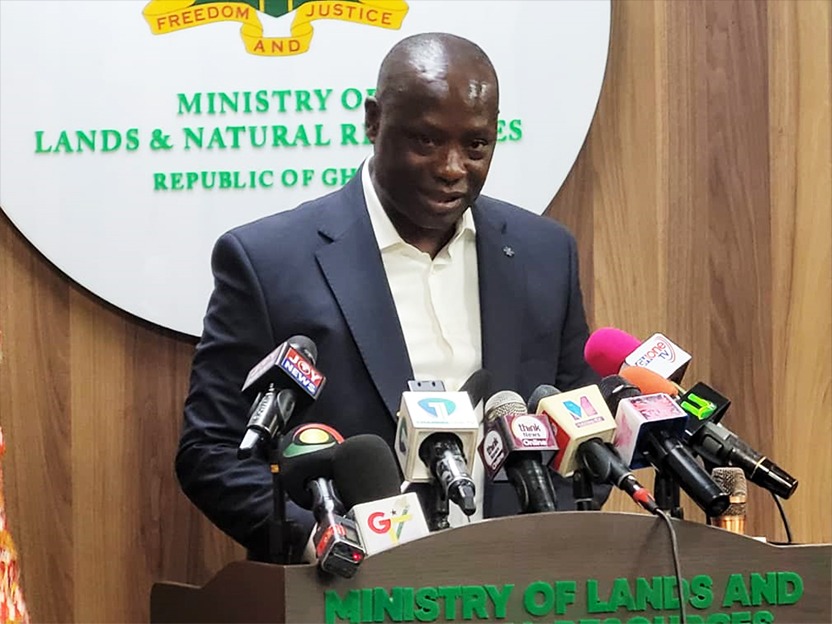
The Minister for Lands and Natural Resources, Emmanuel Armah-Kofi Buah, who announced this at a press engagement in Accra, said the country had also made available approximately 2.5 million additional credits for future transactions, which could generate another US$25 million.
He, however, clarified that the country was yet to receive the corresponding payments for the four million credits committed for purchase, stressing that the government was working to secure appropriate value from the transactions.
The Minister said the approved benefit-sharing arrangement allocated 46 per cent to communities, including farmers and traditional authorities, while government institutions would receive 39 per cent.
Non-governmental organisations would receive two per cent, the private sector three per cent and the Project Management Unit 10 per cent, as a fixed management cost.
According to Mr Buah, the arrangement was developed through a multi-stakeholder consultative process to ensure that communities contributing to forest protection also benefited from the financial returns.
The announcement follows Ghana’s issuance of approximately 6.5 million tonnes of carbon dioxide equivalent in verified emission reductions under the Architecture for REDD+ Transactions (ART) and its REDD+ Environmental Excellence Standard (TREES).
Approved on November 10, 2026, the issuance makes Ghana the first African country and the third globally, after Guyana and Costa Rica, to achieve jurisdictional forest carbon credit issuance under the standard.
The credits represent verified emission reductions achieved between 2017 and 2021 through avoided deforestation, reduced forest degradation and forest landscape restoration.
Mr Buah explained that, unlike project-based carbon credits, the ART TREES programme assesses forest changes across an entire jurisdiction, taking into account communities, farms, and on-reserve and off-reserve forests.
He said buyers, including participants through the LEAF Coalition, had committed to purchasing the four million credits at prices ranging from US$10 to US$13 per credit.
Community benefits
The Minister cited Ghana’s experience under the Ghana Cocoa Forest REDD+ Programme, supported by the Forest Carbon Partnership Facility, through which the country received approximately US$21.8 million between 2023 and 2024.
He said the programme’s benefits supported forest protection and landscape restoration, farming inputs, boreholes, Community-based Health Planning and Services compounds, school blocks and school furniture.
He expressed the expectation that the new carbon credit arrangement would provide additional resources for forest conservation, restoration and sustainable forest management while improving rural livelihoods.
Threats to future gains
Mr Buah, however, warned that illegal mining, illegal logging, wildfires and unsustainable agricultural expansion continued to threaten Ghana’s forests and the country’s prospects of securing further carbon credits.
He said the latest issuance covered emission reductions achieved between 2017 and 2021, while the next monitoring period would cover 2022 to 2026.
He stressed that further issuance would depend on Ghana demonstrating additional emission reductions through avoided deforestation, reduced forest degradation and forest landscape restoration, alongside independent verification and continued compliance with the TREES standard.
The Ministry, he said, would work with the Forestry Commission, district assemblies, traditional authorities and local communities to strengthen forest protection, law enforcement, public education and the provision of alternative sustainable livelihoods.
He also urged farmers, traditional leaders, district authorities and personnel of the Ghana National Fire Service and Forestry Commission to intensify efforts to prevent and respond promptly to bushfires as the harmattan season approaches.
Nearly two decades of preparation
Ghana began its REDD+ journey in 2008, with successive governments investing in forest protection, monitoring, restoration, environmental safeguards and benefit-sharing arrangements.
The Minister said ART approved Ghana’s TREES Concept in 2021, while the country’s registration document and monitoring report covering 2017 to 2021 were accepted in January 2024.
AENOR CONFIA S.A. was appointed as the independent third-party verifier in May 2024 to assess the country’s forest data, carbon accounting, reported results and compliance with environmental and social safeguards.
Following technical consultations, clarifications and corrections spanning about two years, the verifier cleared Ghana’s submission and forwarded the reviewed documents to the ART Secretariat in September 2026, leading to the ART Board’s approval in November.
Mr Buah acknowledged the contributions of the Food and Agriculture Organisation of the United Nations, the United Nations Development Programme and the United Nations Environment Programme, including support through the UN-REDD partnership.
For more news, join The Chronicle Newspaper channel on WhatsApp: https://whatsapp.com/channel/0029VbBSs55E50UqNPvSOm2z