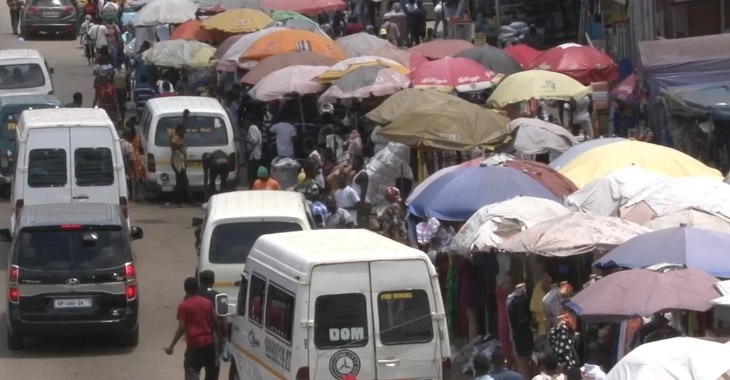
Last month, the Greater Accra Regional Minister, Linda Obenewaa Ocloo, together with the Municipal Chief Executive (MCE) for Okaikwei North visited Lapaz, a major commercial hub in Accra, to engage traders and hawkers operating on pavements and road medians. The officials directed them to vacate those spaces and cease trading there.
The traders were subsequently given a seven-day ultimatum to leave the roadside or face enforcement action. The visit formed part of efforts by the Greater Accra Regional Coordinating Council to decongest Lapaz and restore the free movement of vehicles and pedestrians. Accompanying the Regional Minister were the Mayor of Accra, Michael Kpakpo Allotey, the Okaikwei North MCE, Christian Tetteh Badger and other officials.
Addressing the traders, the Regional Minister acknowledged the importance of protecting livelihoods, but stressed that trading on pavements and roadsides posed serious safety risks and contributed significantly to traffic congestion. She warned that a vehicle suffering brake failure on the busy stretch could result in catastrophic injuries or fatalities among traders and pedestrians. Consequently, she directed the traders to relocate to designated markets, including those at Achimota and Abeka.
The MCE for Okaikwei North also told the media that traders had been given one week to comply with the directive. He further stated that traders would be permitted to operate only on weekends, from Friday to Sunday, and announced plans to establish a 24-hour task force to enforce the regulations.
Indeed, The Chronicle observed personnel from the Okaikwei North Municipal Assembly, clad in lime-green vests, directing recalcitrant traders to leave the pavements and medians in an apparent attempt to implement the Minister’s directives.
However, the exercise appears to have been short-lived. The Chronicle can state on authority that the intervention by the Regional Minister and her entourage has largely become an exercise in futility.
From Abrantie to Lapaz, traders have once again taken over the pavements. The situation has become so severe that taxi ranks operating around Abrantie and the Ecobank area have effectively occupied pedestrian walkways, all under the watch of law enforcement agencies, with little or no intervention.
Lapaz has virtually been transformed into a sprawling marketplace, with trading activities extending deep into the night. The Chronicle has observed traders using makeshift electrical connections to access power from the national grid for lighting purposes. This dangerous practice exposes both traders and the general public to the risk of electrocution. In some instances, vehicles have been seen driving over these exposed wires.
We wish to emphasise that The Chronicle is not opposed to petty trading, nor are we attempting to deprive citizens of their means of livelihood. Ghana, as a developing country, relies heavily on informal economic activity for employment and survival.
According to the Ghana Statistical Service, approximately 80 percent of Ghana’s workforce operates within the informal sector. While these figures underscore the importance of the informal economy, they do not justify conducting business in a manner that undermines public safety and order.
No civilised society permits indiscriminate trading at the expense of the wider public interest. We are, therefore, unable to understand why the Assembly appears to have allowed traders back onto medians and pavements.
What is unfolding at Lapaz raises serious questions about leadership and the effectiveness of Ghana’s local governance system. An effective decentralised system ought to nip challenges such as illegal mining, indiscriminate trading and poor spatial planning in the bud before they escalate into national crises. The essence of decentralisation is to empower local authorities to identify emerging problems and enforce regulations within their jurisdictions. When they fail to do so, local challenges inevitably assume national dimensions.
The Chronicle, therefore, urges the Greater Accra Regional Minister to summon the Okaikwei North MCE to explain the apparent collapse of the decongestion exercise. What is happening at Lapaz reflects a complete failure of leadership!
For more news, join The Chronicle Newspaper channel on WhatsApp: https://whatsapp.com/channel/0029VbBSs55E50UqNPvSOm2z