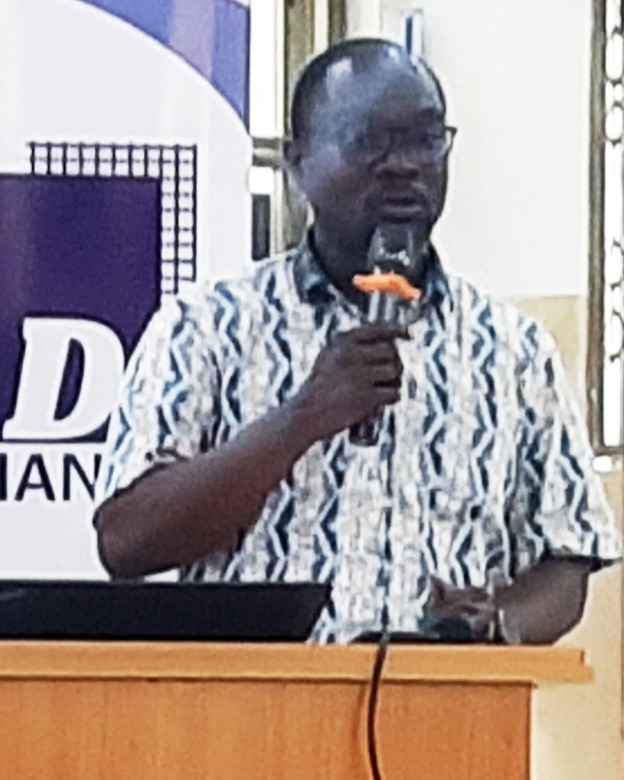
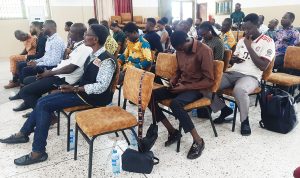
The Ghana Centre for Democratic Development (CDD-Ghana) has organised a day’s workshop on “Regulating Political Party Financing in Ghana” for media men in Kumasi.
The workshop, facilitated by Joseph Oti Frimpong, Programmes Officer, Elections, CDD-Ghana and Zakari Tanko Musah, Legal Consultant, Corruption Watch-CDD-Ghana and funded by the British High Commission, sought to help media practitioners recognise their critical role in promoting transparency and accountability.
Frederick Adu Gyamfi, Director of Programmes and Operations, CDD-Ghana indicated that the question of money in politics is not only a concern for political parties, neither is it a concern for only candidates or regulators, but also civil society or parties like CDD-Ghana, stressing that it is a fundamentally issue of democratic accountability, electoral integrity and good governance.
He disclosed that any research, CDD-Ghana put out must be something that can point to the evidence indicating that political parties require substantial resources to compete yet, the public often know very little about “where those resources come from and how much is raised, how much is spent.
Mr. Gyamfi explained that the consequences of unregulated political financing do not end where they are balanced, stressing that money plays an important role in politics, which cannot be ignored.
“The question is, how to ensure that money does not replace ideas, Money does not replace integrity, commitment and service”, he said.
Mr. Adu Gyamfi noted that a Journalist’s responsibility should not necessarily end with telling citizens who won an election, but also who financed the campaign; the source of the money; how much was spent or if public resources were used.
The journalist must also tell who the major financiers are and how those who finance a political party subsequently benefit from public power after the elections. According to him, these are questions that regulators alone cannot answer and that investigative journalists, editors, broadcasters and community-based media have important roles to play in this regard.
Speaking to the media, Joseph Oti Frimpong, Programmes Officer, Elections, CDD-Ghana disclosed that his outfit found out that the cost of politics is rising and that a study has revealed that in 2012, for someone to contest as an MP, the person needed to spend approximately GHC124,000 plus, while in 2016, it was discovered that the figure had increased to GHc235,000.
According to him, the figure increased in 2020 to GHc4 million plus while the presidential election cost a candidate approximately around GHc579 million. As a result of the trend, the state needs to regulate how political parties make and spend money during elections, hence the workshop.
Highlighting the gaps found after the Research, Mr. Frimpong indicated that Ghana has “no defined campaign period” as well as spending limit, explaining that once there is no defined campaign period and limit, it means political parties and candidates have to spend more during the campaign period.
He noted that even though the Political Parties Act in the 1992 Constitution helps to regulate political party financing, there are still gaps.
Mr. Frimpong further explained that the tendency to spend more during the elections affects creating an equal playing field for the candidates, hence CDD-Ghana advocating the need to regulate political party financing by setting up a defined campaign period for campaigning within the country and also have limits on the contribution that individuals or entities can give to political parties by setting limits of the amount of money that political parties or candidates can spend during elections.
From Oswald P. Freiku, Kumasi