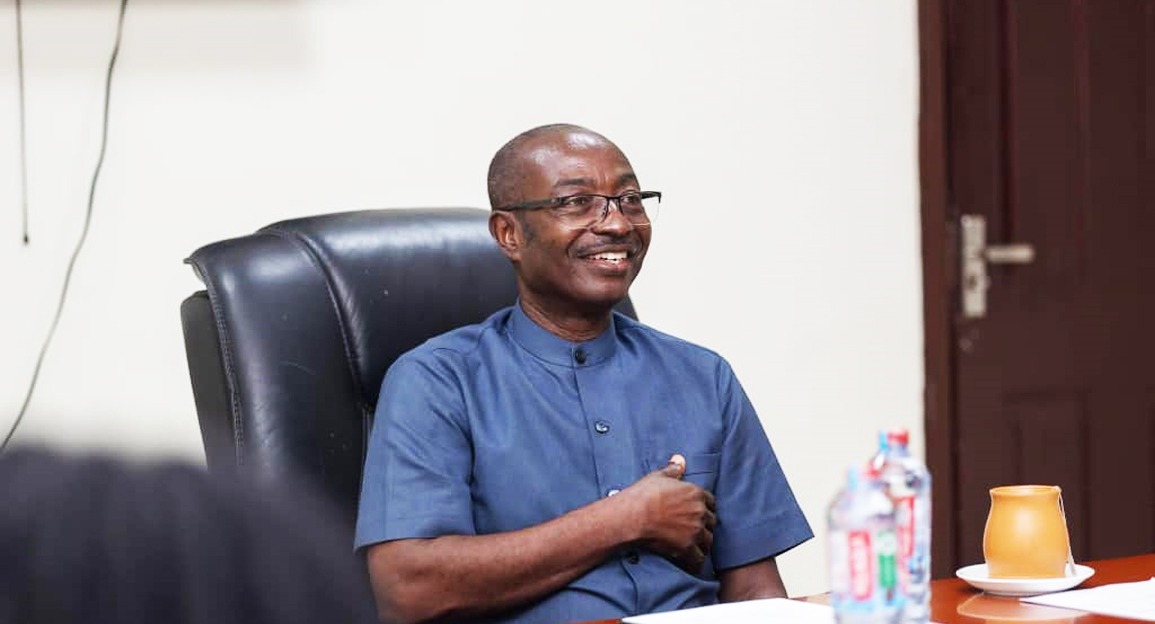
The Founder and Vice-Chancellor of All Nations University (ANU), Rev. Dr. Samuel H. Donkor has called on the government to support the university’s ambitious space science and technology programme, particularly its plans to develop a third satellite, SAT-3, as part of efforts to strengthen Ghana’s position in the global space technology industry.
He said sustained government investment and institutional collaboration were critical to advancing the country’s space research capabilities, promoting technological innovation and positioning Ghana and Africa to participate more meaningfully in the rapidly evolving global space economy.
Speaking to journalists after the university’s 35th and 36th Graduation Ceremony, Rev. Dr. Donkor disclosed that the institution had successfully completed Ghana’s second space satellite, SAT-2, describing the achievement as another significant milestone in the country’s quest to develop indigenous space science and technology expertise.

He maintained that the university’s satellite development programme represented more than an institutional achievement, stressing that it offered Ghana an opportunity to build local scientific capacity, encourage research and innovation, and inspire young people to pursue careers in science, engineering and technology.
According to him, the development of SAT-3 would require sustained support and collaboration, particularly from the government, to enable the university to consolidate the gains made through its earlier satellite projects.
Rev. Dr. Donkor also drew attention to the African Union’s ambitions in satellite development, arguing that Africa could not afford to remain on the sidelines of the technological revolution taking place in space science.
He called for greater investment by African governments and institutions in research, satellite technology and scientific innovation to help address the continent’s development challenges and reduce dependence on external technological solutions.
Graduates challenged to transform Africa
Beyond the university’s technological ambitions, Rev. Dr. Donkor had a strong message for the approximately 546 graduates who received their degrees and other academic qualifications at the ceremony.
He challenged them to move beyond the celebration of academic success and become agents of transformation, urging them to apply their knowledge, skills and creativity to address the developmental challenges confronting Ghana and the African continent.
Rev. Dr. Donkor said the future of Africa depended largely on the willingness of its educated young people to think innovatively, embrace hard work and translate their academic training into practical solutions.
The Vice-Chancellor urged the graduates not to allow their certificates to become mere symbols of academic achievement, but to see them as instruments of responsibility, leadership and service to society.
He further encouraged them to remain committed to lifelong learning, entrepreneurship, innovation and the pursuit of excellence in their respective professional fields.
‘The Africa we build begins with you’
The 35th and 36th Graduation Ceremony was held under the theme, “The Africa We Build Begins With You,” which underscored the responsibility of individuals, particularly the younger generation, in shaping the continent’s development trajectory.
The theme placed the spotlight on the role of education, individual initiative, leadership and innovation in building an Africa capable of competing effectively in an increasingly technology-driven global environment.
It also reinforced the university’s commitment to producing graduates who are not only academically equipped, but also prepared to contribute meaningfully to national development and the transformation of the continent.
The ceremony brought together members of the university’s governing and academic communities, parents, guardians, alumni and other distinguished guests to celebrate the academic accomplishments of approximately 546 graduates.
The graduation further highlighted All Nations University’s broader vision of combining academic excellence, Christian values, scientific innovation and practical skills development to prepare graduates for the demands of a changing world.
With its renewed call for government support for SAT-3 and its challenge to the graduating class, the university used the occasion to advance a broader message: that Africa’s technological and economic transformation must be driven by deliberate investment in research, education, innovation and the capabilities of its people.
For more news, join The Chronicle Newspaper channel on WhatsApp: https://whatsapp.com/channel/0029VbBSs55E50UqNPvSOm2z