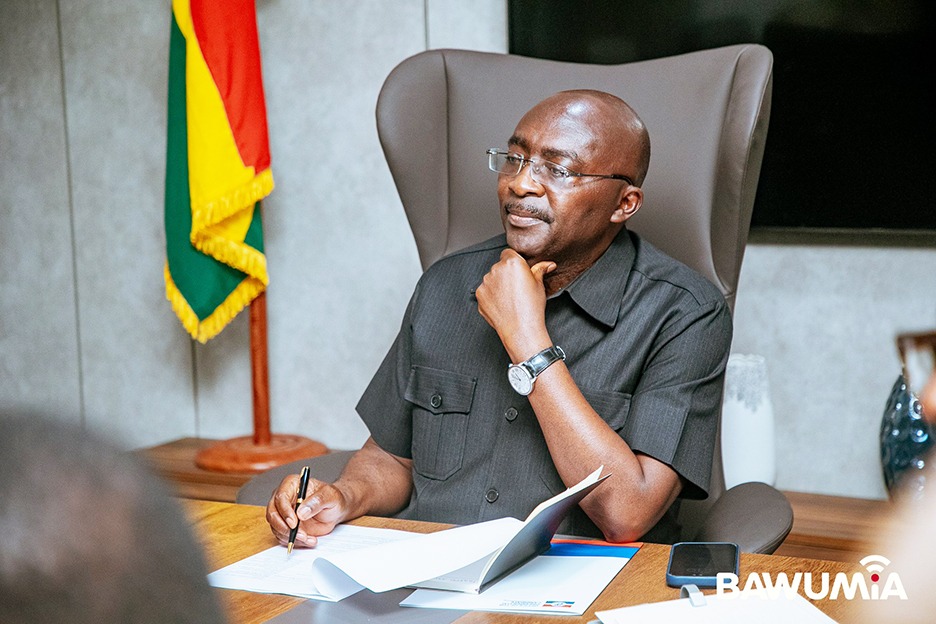
The flagbearer of the New Patriotic Party (NPP), Dr Mahamudu Bawumia, has criticised the Bank of Ghana’s gold reserve programme, claiming that the decision to trade in gold has resulted in losses of US$1.7 billion.
He argued that the losses could have been avoided if the central bank had adopted the reserve accumulation approach proposed by the previous NPP administration rather than engaging in gold trading.
Dr Bawumia, who was speaking at a meeting with the Ghanaian community in Japan, during his official visit to the Asian country, maintained that the financial implications of the programme were only beginning to emerge and urged Ghanaians to exercise patience as developments unfolded.
“The day the Central Bank floated the gold programme and made losses of US$1.7 billion… if they had followed the way we wanted to do the gold reserve programme in terms of accumulating reserves, those losses would not have been made.
But once you decide to start trading in gold, you will make those losses,” he said. He added: “We are just at the beginning of things. I am asking everybody to be patient and let’s watch what will happen.”
The former Vice President’s comments are likely to reignite debate over the Bank of Ghana’s gold purchasing and reserve management strategy, particularly the financial costs and benefits of the country’s gold-backed reserve accumulation efforts.
However, he did not provide a breakdown of the US$1.7 billion figure or explain the methodology used to arrive at the claimed losses.
Digital economy
Beyond his criticism of the gold programme, Dr Bawumia defended the previous NPP government’s emphasis on digitalisation, arguing that technology had become central to economic growth and that countries that failed to embrace the digital economy risked being left behind.
Responding to concerns about the government’s focus on digitalisation at the expense of traditional economic activities, he insisted that digital transformation was not separate from economic development but an important means of achieving it.
“Many people don’t understand that the world economy is now digital. If you don’t go digital, you cannot prosper in this global economy,” he said.
He cited the introduction of mobile money interoperability as one of the major achievements of the previous administration’s digitalisation agenda.
According to him, annual mobile money transactions in Ghana stood at GH¢76 billion before the introduction of interoperability, but increased to GH¢4.5 trillion last year.
He argued that the significant increase demonstrated how digital infrastructure could expand economic activity, facilitate payments and improve financial transactions.
ECG revenue
Dr Bawumia also pointed to the digitalisation of the Electricity Company of Ghana (ECG) as another example of how technology could improve public sector revenue mobilisation.
He recalled that ECG was collecting approximately GH¢450 million monthly when the previous administration decided to introduce digital payment systems and discourage cash transactions.
He said the initiative had contributed to an increase in the company’s monthly collections to approximately GH¢2 billion.
“When I came, when I decided to digitalise ECG, ECG was collecting GH¢450 million a month. I said something must be wrong. Let’s digitalise this. And let’s stop ECG from accepting cash,” he said.
He further highlighted the convenience of digital payment platforms, noting that Ghanaians living abroad could purchase electricity for their homes in Ghana through the ECG Power App without physically being in the country.
Ghana’s digital transformation
The NPP flagbearer maintained that digitalisation should be understood as an economic development strategy rather than merely the introduction of technology into public institutions.
He cited the Ghana Card and its contribution to revenue mobilisation by the Ghana Revenue Authority (GRA) as another illustration of the economic benefits of digital infrastructure.
Dr Bawumia’s official visit to Japan in November 2026 was primarily focused on a technological study tour to explore how advanced scientific research and innovation could be applied to address Ghana’s developmental and environmental challenges.
His engagement with the Ghanaian community provided an opportunity to discuss economic management, digital transformation and the country’s development priorities.
For more news, join The Chronicle Newspaper channel on WhatsApp: https://whatsapp.com/channel/0029VbBSs55E50UqNPvSOm2z