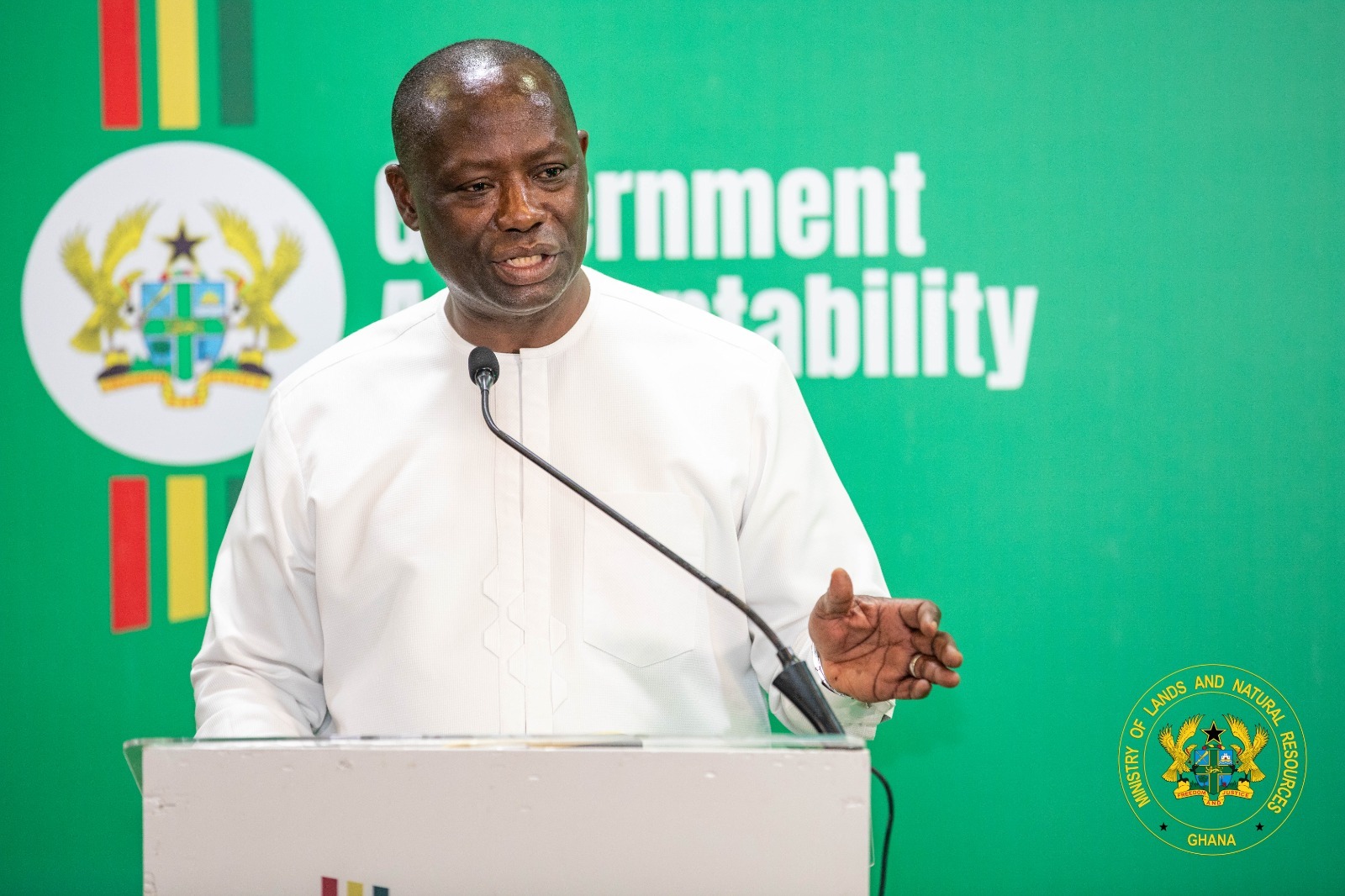
Government says security agencies arrested 465 suspects and seized 112 pump-action guns, excavators and other mining equipment during a six-month nationwide crackdown on illegal mining, popularly known as galamsey, as authorities intensified efforts to protect Ghana’s forests, rivers and mineral resources.
Presenting the Ministry of Lands and Natural Resources’ performance for the first half of 2026 at the Government Accountability Series in Accra on Wednesday, the Minister for Lands and Natural Resources, Mr Emmanuel Armah-Kofi Buah, said the operations formed part of a broader strategy combining law enforcement, legislative reforms, environmental restoration and institutional reforms.
According to the Minister, the Forestry Commission arrested 258 suspects during operations in forest reserves between January and June this year.
The Commission also seized six excavators, 1,225 pumping machines, 765 chamfer machines, 212 motorbikes and tricycles and 40 gold detectors allegedly used in illegal mining activities.
Mr Buah said the National Anti-Illegal Mining Operations Secretariat (NAMOS) conducted 200 operations across 53 districts in six regions – Ashanti, Western North, Eastern, Bono, Ahafo and Central – resulting in the arrest of 207 suspects made up of 161 Ghanaians and 46 foreign nationals. He placed the Secretariat’s operational strike rate at 84.1 per cent.
The Minister said NAMOS also recovered 112 pump-action rifles, two side-arms, two locally manufactured rifles and 1,637 rounds of ammunition, illustrating what he described as the growing security concerns surrounding illegal mining.
In addition, the Secretariat seized 78 excavators, demobilised another 90 excavators, destroyed 2,800 chamfer machines, and dismantled 1,244 illegal mining camp structures.
“Our rivers are not for sale. Our forests are not expendable. Our mineral wealth is a sacred national inheritance that we have a duty to protect. The era of impunity is over,” Mr Buah said.
Technology and community interventions
The Minister said the government has stepped up technology-based monitoring of mining equipment to improve oversight and curb illegal operations.
According to him, 4,300 mining-related vehicles and equipment have been registered nationwide, with 1,864 units fitted with electronic tracking devices. Nearly 2,000 excavators are now being monitored through a geofencing system operated by the Minerals Commission, while more than 3,000 excavators remain unclaimed in a separate holding system.
On the protection of water bodies, Mr Buah announced that the government had deployed an additional 452 Blue Water Guards, bringing the total strength of the community-based river protection corps to 2,069 personnel operating across eight regions.
He also reported that under the Community Mining Skills Development Programme (CONDEP), more than 9,000 small-scale miners and 700 cooperatives have been registered and trained in mercury-free gold processing and improved safety standards as part of efforts to formalise the small-scale mining sector.
Mining law overhaul
Beyond enforcement, Mr Buah announced that Cabinet has approved a comprehensive review of the Minerals and Mining Act, 2006 (Act 703) and forwarded the revised Bill to Parliament.
He said the proposed legislation introduces District Mining Committees as the entry point for licensing, creates a new medium-scale mining category and replaces reconnaissance licences with a single prospecting licence valid for a maximum of five years.
The Bill also limits mining leases to 20 years and makes Community Development Agreements mandatory for all mining leases to ensure host communities derive direct benefits from mining activities.
The Minister further disclosed that Cabinet had approved a revised Minerals and Mining Policy together with the Minerals and Mining (Royalties) Regulations, 2025 (L.I. 2517), which introduces a sliding-scale royalty regime linked to commodity prices.
According to him, the reforms are intended to strengthen regulation while providing a more predictable investment environment and increasing local participation in the mining sector.
Land reforms and revenue
Mr Buah said the government has launched the Strategic Land Administration Reform Project (SLARP) to modernise land administration through digitisation, systematic land titling, improved mapping and stronger customary land administration.
He said the Ministry had also revised the Public Land Application Form, proposed a new premium framework to align state land values with market prices, and established a Public Land Protection Task Force to combat encroachment on public lands.
The Minister disclosed that the Office of the Administrator of Stool Lands (OASL) had mobilised GH¢265.61 million by the end of June, representing 75.48 per cent of its annual target of GH¢351.88 million, while four new district offices had been opened to improve service delivery.
Forestry restoration
On environmental restoration, Mr Buah said the government, in partnership with the private sector, had reclaimed 1,535 acres of degraded land in the Ashanti Region and expects to restore another 1,500 acres before the end of the year. Government is also reclaiming an additional 960 acres of degraded land across the country.
He added that about 31 million seedlings were planted under the Tree for Life Restoration Initiative in 2025, restoring approximately 23,600 hectares of degraded land, with another 30 million seedlings targeted for planting this year.
In a related development, the Minister announced that Cabinet, on June 24, 2026, revoked the Executive Instruments that had altered the status of the Achimota Forest, restoring it as a protected forest reserve.
He also disclosed that Ghana had issued 411 Forest Law Enforcement, Governance and Trade (FLEGT) licences in 2026, reflecting continued efforts to promote legal timber trade and sustainable forest management.
Mr Buah appealed to Ghanaians to support the government’s efforts to protect the country’s lands, forests and water bodies, stressing that safeguarding natural resources requires collective national action.
For more news, join The Chronicle Newspaper channel on WhatsApp: https://whatsapp.com/channel/0029VbBSs55E50UqNPvSOm2z