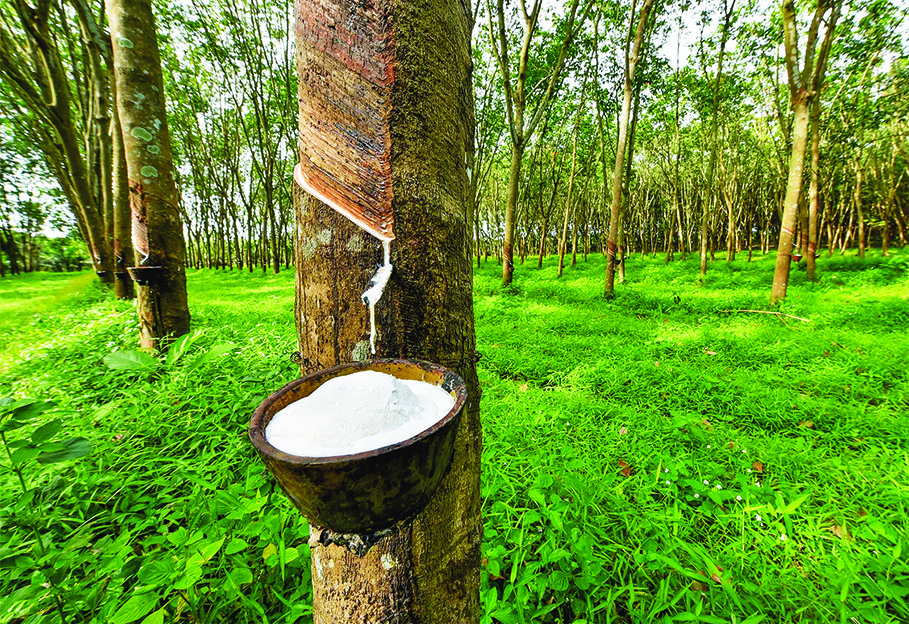
The Rubber Processors Association of Ghana (RUPAG) has defended the government’s temporary ban on the export of raw rubber, insisting that the policy is protecting national industrial interests, rather than creating monopolies as alleged by some industry players.
According to the association, available industry data shows that the export restriction has not deprived farmers, traders or aggregators of market opportunities, but has instead expanded the domestic market for raw rubber while supporting government’s industrialisation agenda and the implementation of the 24-Hour Economy Policy.
In a statement issued yesterday, RUPAG dismissed claims contained in a recent publication titled – “Protecting Jobs or Creating Monopolies? The Hidden Toll of Ghana’s Raw Rubber Export Ban,” describing the assertions as misleading and unsupported by evidence.
The association maintained that the temporary export ban is fully aligned with President John Dramani Mahama’s vision of promoting value addition, increasing foreign exchange earnings, creating employment and strengthening Ghana’s manufacturing sector.
RUPAG disclosed that local rubber processors purchased about 30,967 tonnes (dry) of raw rubber between January and June this year with 13,431 tonnes sourced from traders and aggregators and 17,535 tonnes bought directly from farmers.
It said purchases from traders and aggregators rose sharply following the announcement of the export ban, increasing from 534 tonnes in April to 2,028 tonnes in May, before climbing further to 3,131 tonnes in June.
The association said purchases from traders and aggregators during the first half of 2026 represented a 124 per cent increase over the corresponding period in 2025, while direct purchases from farmers also rose by 12 per cent, from 15,640 tonnes to 17,535 tonnes.
According to RUPAG, these figures demonstrate that farmers and traders continue to enjoy access to an expanding domestic market, contrary to claims that the export ban has destroyed market opportunities.
Addressing allegations that some processors have refused to buy rubber and are attempting to create monopolistic conditions, the association said it had formally requested evidence from trader and aggregator associations on July 6, 2026.
It noted that despite requesting details including the names of processors involved, dates, locations, quantities affected and documentary proof, no evidence had been submitted.
“National policies of strategic importance should not be influenced by unsubstantiated allegations,” the association stressed.
RUPAG further argued that allowing the export of scarce raw materials while government pursues a 24-hour manufacturing economy would be economically inconsistent.
It explained that local processors have already begun expanding production, increasing employment and preparing to introduce multiple production shifts in line with government’s industrial policy.
The association also maintained that Ghana currently does not produce enough natural rubber to satisfy local processing demand.
According to RUPAG, Ghana produced approximately 110,800 tonnes of natural rubber in 2025 against an installed processing capacity of 171,460 tonnes, leaving a structural deficit of more than 60,000 tonnes and reducing factory capacity utilisation to only 41 per cent.
It therefore argued that proposals to introduce export quotas cannot be justified under the current production levels.
On the economic benefits of local processing, RUPAG projected that Ghana could earn an additional US$1.36 billion in foreign exchange between 2026 and 2031 by processing raw rubber locally instead of exporting it.
The association also estimated that exporting raw rubber could result in forgone tax revenues of about GH¢326 million over the same period.
It added that local processing generates employment, transport and logistics activities, port revenues and wider economic opportunities throughout the rubber value chain.
Drawing comparisons with other producing countries, RUPAG said Ghana’s policy direction mirrors global trends towards value addition.
It noted that Côte d’Ivoire and Liberia have adopted measures restricting raw rubber exports to support domestic processing industries, while Nigeria processes virtually all of its natural rubber into Technically Specified Rubber before export.
The association also cited industry intelligence indicating that Malaysia continues to strengthen its downstream rubber manufacturing sector by importing raw materials, including from Ghana.
According to RUPAG, Ghana currently accounts for about 15.2 per cent of Malaysia’s natural rubber imports, a situation it said effectively exports jobs and industrial opportunities that could otherwise be created locally.
RUPAG called on farmers, traders, aggregators, processors, transporters, freight forwarders, nursery operators, regulators and government to work together to build a competitive and sustainable rubber industry.
It maintained that the temporary export ban is intended to promote industrialisation, create sustainable jobs, increase foreign exchange earnings and maximise value addition within Ghana rather than disadvantage any stakeholder.
For more news, join The Chronicle Newspaper channel on WhatsApp: https://whatsapp.com/channel/0029VbBSs55E50UqNPvSOm2z