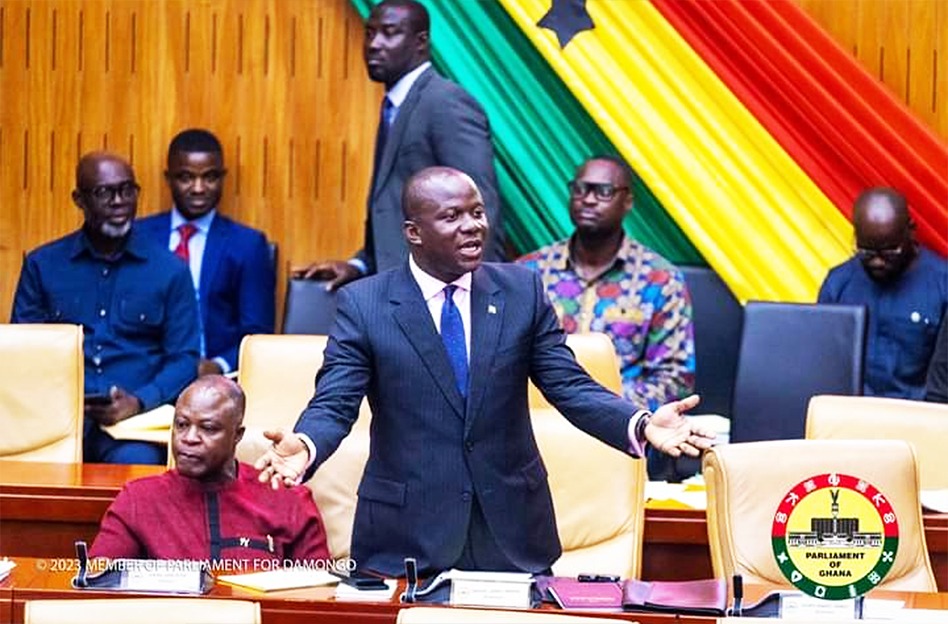
The reintroduction of regional tribunals has triggered a heated debate in Parliament, with the Member of Parliament for Damongo, Samuel Abu Jinapor, warning that the institutions evoke memories of what he described as the “dark days” of Ghana’s history under the PNDC Military era.
Mr Jinapor made the remarks when the Attorney-General and Minister for Justice, Dr Dominic Ayine, laid the Tribunal Bill, 2026 before the House to establish a reformed tribunal system aimed at strengthening justice delivery and addressing case backlogs.
Although the Damongo MP acknowledged that the 1992 Constitution provides for the establishment of regional tribunals, he argued that their historical application in Ghana raised serious concerns about fairness, due process and public confidence in the justice system.
He said the country’s experience with tribunals during the PNDC era was unpleasant and left many citizens with painful memories.
“The history of regional tribunals is one that is not pleasant. Many Ghanaians have had very terrible experiences when it comes to regional tribunals of our country,” Mr Jinapor told Parliament.
According to him, some of the tribunals that operated during the period dispensed justice in ways that resulted in injustices against citizens.
“These were tribunals where you could not even see the faces of judges and these were tribunals which dispensed with justice in a manner which, in the end, perpetuated enormous injustices to many Ghanaians,” he stated.
Mr Jinapor argued that constitutional institutions must be assessed not only by their legal foundation, but also by the historical experiences associated with them.
“The Constitution is not only a written document. The Constitution is almost like a living organism that has a history and aspirations,” he said.
The MP questioned the policy justification for introducing regional tribunals when Ghana already has a structured court system comprising District Courts, Circuit Courts, High Courts, the Court of Appeal and the Supreme Court.
He asked why government would establish another judicial mechanism instead of strengthening existing courts to improve efficiency.
“What is the policy rationale of this sudden attempt to have regional tribunals when, in the life of the Fourth Republic, we have done well with the existing judicial structures?” he questioned.
Mr Jinapor suggested that government should rather invest in expanding the capacity of existing courts by recruiting more judges and judicial staff, providing modern equipment and improving court infrastructure.
“If you want to have more courts, you want to have more judges, you want to have more judicial staff, just follow up with what President Akufo-Addo did when he built almost a hundred court complexes in our country,” he said.
He also cautioned against the possibility of the tribunals being used for political purposes, warning that Ghana should avoid creating institutions that could undermine confidence in justice.
“I don’t want to believe this is a job for the boys,” he stated.
Mr Jinapor further warned against the creation of a system where political opponents could be subjected to a separate judicial process.
“We do not want regional tribunals. They bring about bad memories, scary memories and bad dreams and intimidation in our country,” he added.
However, Speaker of Parliament Alban Sumana Kingsford Bagbin cautioned lawmakers against treating tribunals as inherently negative institutions because of Ghana’s past experiences.
The Speaker said tribunals exist in many jurisdictions around the world and should be assessed based on their purpose and safeguards rather than their historical associations.
“The word tribunal, by implication, means something bad or wrong. Don’t have that,” Mr Bagbin told the House.
He acknowledged that previous tribunal systems had challenges but argued that tribunals remained useful tools within justice administration.
“Yes, there were ills. There were problems. But it’s a useful tool,” he stated.
Mr Bagbin urged MPs to approach the debate with an open mind and focus on whether the proposed framework would serve Ghana’s justice needs.
“If at the end of the day, we come to a decision that what they are proposing is not correct, it is our duty. We make the law. We have to correct it,” he said.
The Attorney General, Dr Dominic Ayine, on his part challenged Mr Jinapor’s account of the history of tribunals under the Fourth Republic, insisting that the system was operationalised after Ghana returned to constitutional rule in 1993.
“As a matter of historical record, the Honourable Member for Damongo made a statement to the effect that during the life of this Fourth Republic, the tribunal system has never been operationalised. That is not correct,” the Attorney-General said.
He explained that regional tribunals became part of the judiciary after the transition to constitutional rule on January 7, 1993 before later becoming inactive.
“When we made a transition to constitutional rule in 1993, the tribunal system was operationalised and became an integral part of the judiciary of this country,” Dr Ayine stated.
The Attorney-General maintained that the proposed legislation was designed to establish a modern tribunal system with constitutional backing, oversight mechanisms and safeguards to prevent abuses associated with earlier arrangements. The Tribunal Bill, 2026, is expected to continue receiving parliamentary scrutiny as lawmakers weigh the government’s argument for improved access to justice against concerns over duplication, independence and public confidence.
For more news, join The Chronicle Newspaper channel on WhatsApp: https://whatsapp.com/channel/0029VbBSs55E50UqNPvSOm2z