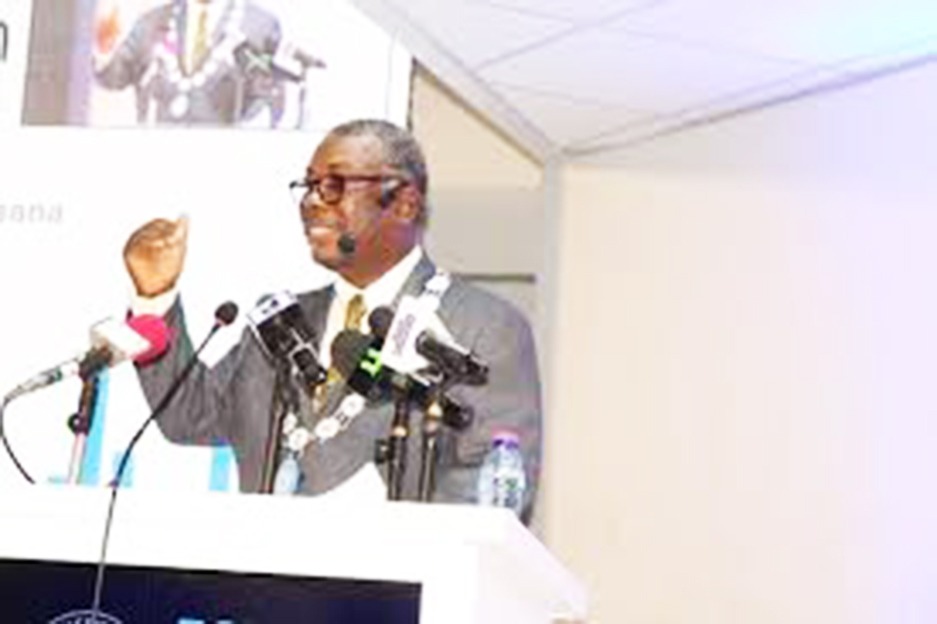
The newly elected President of the Ghana Institution of Engineers (GhIE), Ing. Ludwig Annang Hesse, has stated that the only effective solution remaining to curb Accra’s persistent flooding is the compulsory harvesting and temporary storage of rainwater by households and estate developers before gradually releasing it into drainage systems.
According to him, decades of uncontrolled urbanisation have destroyed almost all of Greater Accra’s natural water retention ponds, causing storm water to reach flood-prone communities at unprecedented speeds.
Speaking on Citi FM’s Breakfast Show, Ing. Hesse said studies conducted indicate that water which previously took about 12 hours to travel from Aburi to Accra now arrives within approximately one hour, due to the disappearance of natural holding areas.
“The only option left for us to stop flooding in Accra is to start storing water in our houses locally. When the rain falls, we should hold the water there, so that all of it doesn’t get to Accra at once. After the rain, we can release it gradually,” he stated.
He disclosed that GhIE recently submitted a policy note to the Ministry of Works, Housing and Water Resources recommending mandatory rainwater harvesting and on-site water storage systems for all new housing developments.
Ing. Hesse stressed that every estate developer should be compelled by law to incorporate rainwater harvesting infrastructure capable of temporarily storing storm water during rainfall events.
“We should now be compelling every estate developer to do rain harvesting and store the water on site when the rain falls and release it gradually. That is the only way we can stop flooding in Accra now,” he emphasised.
The engineering expert explained that the city’s flood challenge has gone beyond simply constructing drains, roads and interchanges, arguing that such projects cannot solve flooding when the volume and speed of runoff entering the city continue to increase.
Citing the example of the Kwame Nkrumah Interchange, he noted that floodwaters originate from locations far beyond the immediate area and, therefore, require a city-wide storm water management strategy.
“One interchange at a point cannot solve all the drainage problems that exist in Accra today,” he said.
Ing. Hesse further advocated the construction of underground storm water storage facilities at residential and community levels to replicate the role once played by natural retention ponds that have since been built over or reclaimed.
“We have to delay the runoff. We have to slow it down. Previously, nature was doing that for us through retention ponds. Since those systems are gone, we must now create them artificially in our homes,” he explained.
Touching on the state of the country’s roads Ing. Hesse attributed the rapid deterioration of road infrastructure partly to poor maintenance culture and inadequate attention to drainage systems. He lamented that Ghana had abandoned routine road maintenance practices such as desilting drains, clearing roadside vegetation and repairing potholes immediately they appear.
According to him, a pothole should not remain on a major road for more than a day if proper maintenance systems are functioning effectively.
“We have completely lost the culture of maintaining our roads. It is not enough to build new roads if we do not maintain them. When silt collects in drains, it must be removed. When potholes appear, they must be patched immediately,” he said.
He argued that blocked drains and poor storm water management accelerate road deterioration, making road maintenance and flood control inseparable issues.
The GhIE President also questioned the sustainability of the country’s road development strategy, noting that successive governments have awarded road contracts far beyond available funding, resulting in delays, quality concerns and mounting debts.
While supporting the demolition of structures erected on waterways Ing. Hesse cautioned that demolition exercises alone would not eliminate flooding in the capital.
“Those who have built in waterways should be removed. It will help mitigate flooding locally, but it will not solve Accra’s flooding problem,” he stated.
According to him, unless authorities adopt a comprehensive strategy that combines drainage improvements, protection of wetlands, demolition of illegal structures, routine infrastructure maintenance and widespread rainwater retention systems, flooding will continue to occur annually.
“Every year, Accra gets three or four major floods and this will continue if we do not put in place long-term solutions,” he warned.
Ing. Hesse also called for a metropolitan-wide management framework for Greater Accra, arguing that the fragmentation of the city into numerous municipal assemblies has weakened coordination in addressing environmental challenges such as flooding, drainage management and river basin protection.
He maintained that despite the severity of the problem, Accra remains salvageable if authorities are prepared to implement difficult but necessary policy reforms aimed at restoring the city’s resilience to extreme rainfall events.
For more news, join The Chronicle Newspaper channel on WhatsApp: https://whatsapp.com/channel/0029VbBSs55E50UqNPvSOm2z