Ten years ago, the decision was considered daring, controversial, and politically risky.
At the time, Ghana’s polytechnics occupied a lower rung within the country’s tertiary education hierarchy, often perceived as alternatives to the more prestigious traditional universities.
While they produced skilled technical manpower essential for national development, they lacked the institutional recognition, expanded research mandate, and academic authority associated with university status.
But in 2016, then-President John Dramani Mahama made a decision that would fundamentally alter Ghana’s technical and vocational education landscape: the conversion of the nation’s polytechnics into technical universities.
The move immediately sparked debate across academic and political circles. Supporters described it as visionary and long overdue. Critics questioned whether the institutions possessed the infrastructure, staffing, and capacity required for university status.
Yet, despite the uncertainty surrounding the policy at the time, the Mahama administration proceeded with the transformation under the supervision of then-Education Minister, Prof. Jane Naana Opoku-Agyemang — who today serves as Ghana’s Vice President. Ironically, only months after the conversion process was completed, President Mahama lost the 2016 general election.
But history, it appears, had not finished writing the story. A decade later, Mahama has returned to the presidency following his victory in the 2024 elections, sworn into office alongside Prof. Jane Naana Opoku-Agyemang — the very minister who helped execute the educational reform ten years earlier.
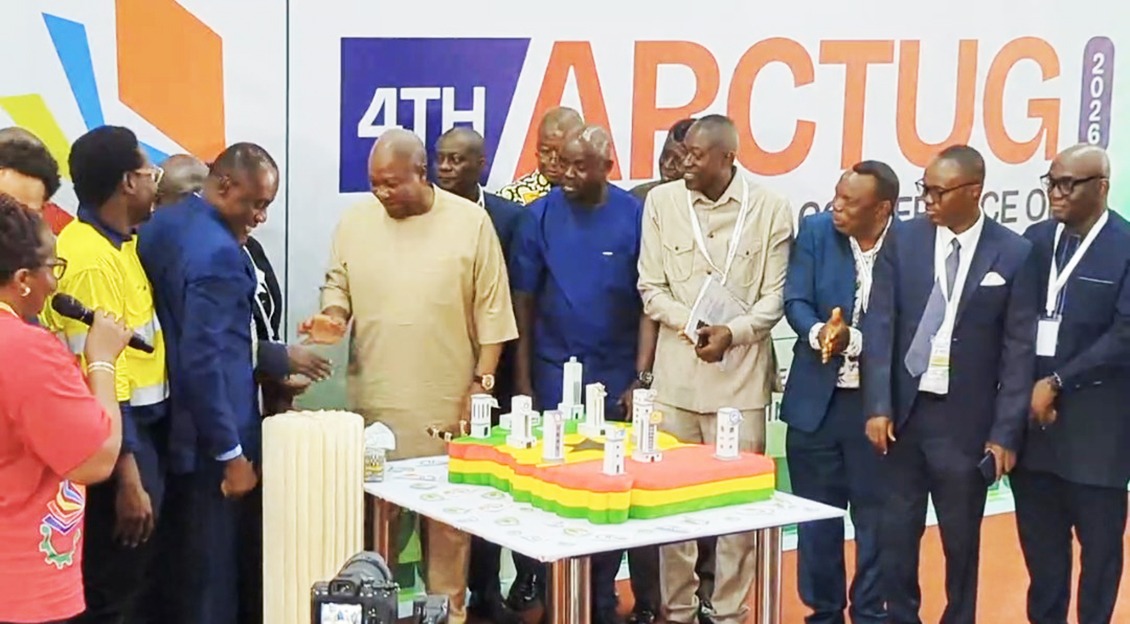
And in what many described as a deeply symbolic moment, President Mahama joined leaders of Ghana’s Technical Universities at the Fourth Applied Research Conference to celebrate ten years of the historic conversion by cutting an anniversary cake marking the milestone. For many within the technical university community, the moment represented more than ceremony. It was the closing of a historic circle.
Chairman of the Vice-Chancellors of Technical Universities, Prof. Appiah Adinkrah, captured the emotional significance of the occasion in a reflective address delivered before President Mahama, joined by the Education Minister, Haruna Iddrisu, academics, researchers, students, and industry leaders.
“This year’s conference is particularly special,” Prof. Adinkrah declared. “It marks the historic celebration of ten years of the conversion of polytechnics into technical universities,” he added. The conference, which was themed “Advancing TVET for innovation, technology transfer and entrepreneurship for sustainable developments” was sponsored by GoldFields Ghana Foundation.
He described the anniversary as a national milestone deserving celebration and openly credited President Mahama for the bold decision that birthed the technical university system.
“With great pride, we celebrate this national milestone officially commissioned under your leadership,” he said while addressing the President directly.
The applause that followed reflected the deep sense of appreciation within the sector.
Prof. Adinkrah noted that the conversion was not simply a change in name, but a deliberate restructuring intended to position technical universities as centers of innovation, industrial collaboration, entrepreneurship, and applied research.
“The Technical Universities Act mandates competency-based training, practical-oriented teaching, industrial collaboration, innovation, and applied research,” he stressed.
According to him, technical universities now carry the responsibility of producing practical solutions to Ghana’s economic and industrial challenges. “Our responsibility extends beyond knowledge transmission to developing skills, innovation, practical solutions, and entrepreneurship that directly impact society and industry,” he said.
Mahama Reflects on a Decade of Transformation
President Mahama, in his address, also reflected on the significance of the conversion and the future expectations of technical universities. Speaking with the confidence of a leader revisiting one of his most enduring policy decisions, the President emphasized that the institutions must now move beyond theory and become active engines of industrial transformation.
“Industry must not view our technical universities as distant academic institutions or ivory towers. Instead, it must see them as partners in production, innovation, and competitiveness,” President Mahama stated.
He challenged the universities themselves to become more practical, entrepreneurial, and solution-oriented. “At the same time, technical universities must become more outward-looking, entrepreneurial, and solution-driven,” he said.
The President argued that Ghana’s future competitiveness would depend not on merely importing knowledge and technology, but on building institutions capable of innovation and production.
“The future will not reward nations that merely consume technology developed elsewhere,” he stressed. Adding, “It will reward those that innovate, adapt, produce, and compete.”
For President Mahama, the conversion of the polytechnics was therefore never simply about upgrading institutions. It was about repositioning Ghana’s economy towards industrialization and technological advancement.
The President also used the occasion to issue a direct challenge to stakeholders within the sector.
“Vice-Chancellors must provide bold leadership at the institutional level. Lecturers must inspire creativity, problem-solving, critical thinking, and entrepreneurial efforts,” he said.
He further urged industry players to deepen collaboration with academia while encouraging students to see themselves not merely as job seekers, but future nation-builders.
“Students themselves must recognize that they are not merely being trained for employment, but for leadership in building Ghana’s future,” he added.
The Next Decade
Perhaps the most powerful moment in President Mahama’s reflections came when he turned his attention to the future. “The next decade must, therefore, be one of measurable national impact for technical universities in Ghana,” he declared.
His words carried special weight considering the political and historical journey surrounding the conversion itself. For nearly ten years after losing office, Mahama watched the technical university system evolve from afar. Now, returned to power, he stood before the institutions he helped create — not defending the policy anymore, but celebrating its survival and growth.
The President linked the future of technical universities directly to Ghana’s broader educational transformation agenda, particularly the government’s new STEM-focused policy direction.
He announced that STEM education, artificial intelligence, and robotics would now be integrated into Ghana’s educational curriculum from kindergarten through secondary school.
“The government is committed to continuous STEM education from kindergarten right up to university,” he said. According to him, the strategy is intended to create a stronger pipeline of technically skilled students capable of thriving in a rapidly evolving global economy.
A Legacy Beyond Politics
As the anniversary cake was cut and applause filled the conference auditorium, the symbolism was unmistakable.Ten years earlier, the conversion of polytechnics into technical universities had been viewed by some as an uncertain experiment.
Today, those same institutions are hosting international conferences, driving applied research, strengthening industrial partnerships, and positioning themselves at the center of Ghana’s innovation agenda.
Challenges remain — funding gaps, infrastructure deficits, and industrial capacity limitations continue to confront the sector. Yet the transformation itself has endured.
And perhaps that is the enduring significance of the moment: some political decisions are judged not by immediate political outcomes, but by the long-term impact they leave on national development. A decade later, Ghana’s technical universities are increasingly becoming the living legacy of one of John Mahama’s boldest educational reforms.
For more news, join The Chronicle Newspaper channel on WhatsApp: https://whatsapp.com/channel/0029VbBSs55E50UqNPvSOm2z