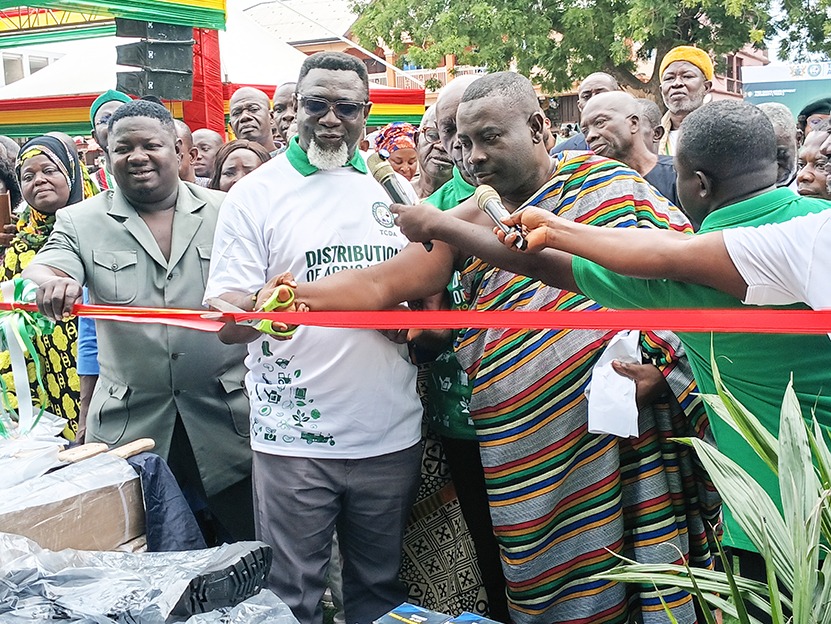
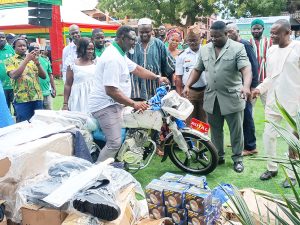
The Tree Crops Development Authority (TCDA) has officially launched the nationwide distribution of agricultural inputs to tree crop farmers for the 2026 planting season, at a ceremony at Mampong in the Ashanti Region.
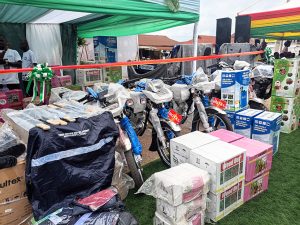
The occasion confirms the Government’s renewed commitment to building a productive, competitive, resilient and sustainable tree crops sector. Items distributed included improved seedlings, raincoats, tricycles, Wellington Boots and other inputs.

The crops are intended to support approximately 1.6 million households and contribute significantly to rural livelihoods, employment, agro-industrial development and export earnings.
Dr. Andy Okrah, Chief Executive Officer (CEO) of the TCDA, explained that the TCDA had the statutory responsibility to regulate and promote the development of Ghana’s six strategic tree crops: cashew, coconut, oil palm, rubber, mango and shea, collectively referred to as CCORMS and that the gathering goes beyond the handing-over of agricultural inputs.
He said the nationwide distribution of inputs was aimed at addressing key constraints facing farmers, including limited access to production inputs, low productivity, climate-related challenges and inadequate adoption of improved agricultural practices.
According to him, his outfit chose Mampong for the national launch because of the Ashanti Region’s important contribution to Ghana’s agricultural economy and its significant potential for the development of tree crops.
Dr. Okrah identified major challenges in the sector as ageing farms, pests and diseases, climate variability, limited access to quality planting materials, post-harvest losses, limited value addition and market constraints.
The CEO said the Authority was pursuing an integrated approach that combines regulation with farmer support, productivity enhancement, research, market development, traceability, value addition and investment promotion.
He stressed that while inputs alone cannot transform the sector, farmers with access to quality inputs, improved planting materials, technology, extension services and reliable markets are better positioned to increase productivity and incomes. In the cashew sector, for instance, the TCDA is promoting the commercial utilization of cashew apple alongside raw cashew nuts.
He said similar opportunities exist across the other tree crops through processing and product development.
Dr. Okrah also referenced the National Oil Palm Multi-Stakeholder Roundtable Forum held on August 12, 2026, as part of efforts to deepen stakeholder collaboration and unlock the potential of Ghana’s oil palm industry. He mentioned that the Authority is strengthening surveillance and response mechanisms against climate change, pests and diseases, citing recent cases of powdery mildew in cashew production areas.
Dr. Okrah called on traditional authorities, District Assemblies, farmer organizations, development partners and the private sector to support the national tree crops agenda for which a target of 100,000 hectares of oil palm for this year has been set urging stakeholders to make land available and engage the youth to ensure the project’s success.
The CEO expressed appreciation to Daasebre Osei Bonsu III, Mamponghene, and the chiefs and people of the Mampong Traditional Area for hosting the national event.
He also thanked the Minister for Food and Agriculture, the Ashanti Regional Minister, the Municipal Chief Executive, development partners, private-sector actors, farmer organizations and farmers for their continued support. Nana Nyansah, representing beneficiary farmers, expressed gratitude to the government and the TCDA.