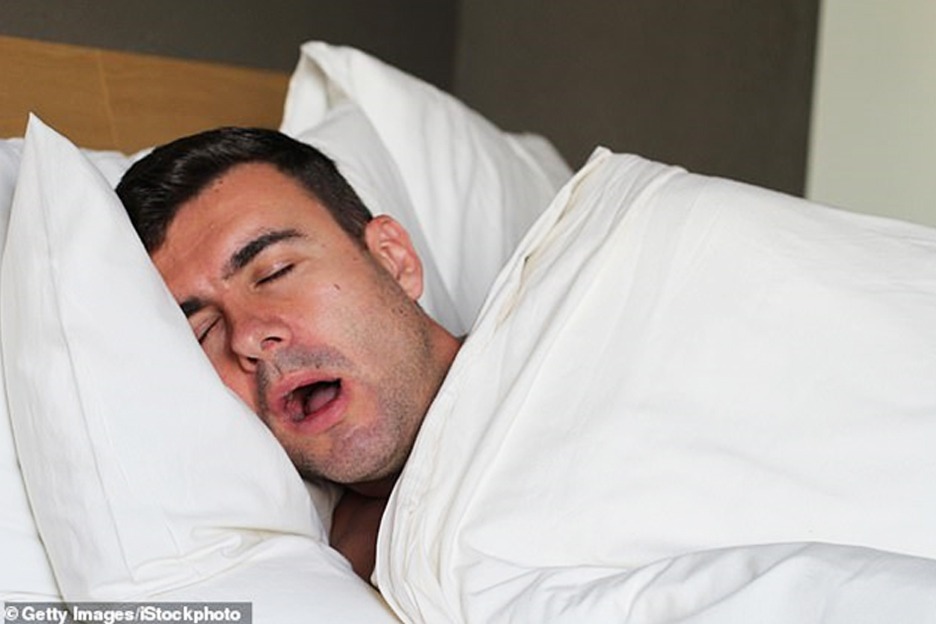
Every night, in homes across the country, bedrooms reverberate with the trumpeting, whistling and whining of the nation’s snorers. In severe cases, a blocked airway can lead to a condition called obstructive sleep apnoea.
This is where the walls of the throat relax so much that patients momentarily stop breathing. Over time, this can raise the risk of deadly heart attack and stroke.
But there are, according to experts speaking to the Daily Mail, steps you can take to reduce the risk of raucous snoring.
And they don’t involve investing in the lucrative and ever-growing market of snore-busting gadgets and gimmicks.
Stop sleeping on your back
It is unclear exactly why some people are more prone to sleeping on their back.
Yet, research suggests up to one in ten people sleep like this — while the vast majority lay on their front or side.
Studies also show that the position significantly increases the chances of snoring.
One 2013 Dutch paper concluded that 65 per cent of those who sleep on their back regularly snore.
This is because by sleeping on our back, ‘the fat around our neck is more likely to narrow our airways due to gravity,’ James Wilson, better known as the Sleep Geek, says.
Mr Wilson, who appears on ITV’s This Morning and BBC Breakfast as a sleep expert, adds: ‘Sleeping on your front is not an option as this is bad for your neck, back and knees.’
Side sleeping, meanwhile is best not just for snoring, but also your physical health, he says.
To train your body to sleep on its side, either use a body or maternity pillow (a long pillow shaped like a sausage), or take a normal pillow and hug it and put another pillow between your legs.
Ashok Rokade, president of the British Rhinological Society and a consultant ENT surgeon in Hampshire, agrees.
‘Use a positional sleep aid or specially shaped pillow,’ he says.
Alternatively a ‘simple hack’ also involves sewing a tennis ball into the back of your pyjamas to prevent rolling onto the back.
witch up your pillow
Down, feathers and some man made fibres in pillows can also make snoring worse, Mr Wilson says.
For those people whose blocked airways are caused by allergies, such pillows don’t help ‘as they are more likely to harbour irritants that will leave you sniffly’ and narrow the airways, he adds.
Instead, try opting for a foam pillow that is more likely to be free of such ‘nasties’ and ‘prevent you from getting snotty in the night’.
If your pillow is overstuffed, this can also push your head forward and narrow your airways, increasing snoring risk, experts say.
The ideal temperature for sleep is also between 18-20C (60-68F).
According to research published in the journal Nature earlier this year, sleeping in higher temperatures increases the risk of obstructive sleep apnea (OSA) by up to 45 per cent on a given night.
Ditch alcohol before bed
Leading experts have rowed about the harms of moderate drinking for decades.
The NHS recommends people drink no more than 14 ‘units’ of alcohol — around six glasses of wine, or pints of beer — per week.
But a few drinks will make snoring worse, too, experts say.
This is because alcohol acts as a sedative, keeping you for longer in the deep sleep that relaxes all your muscles — including the muscles of your throat and tongue.
‘Alcohol relaxes throat muscles, making the airway more floppy,’ Mr Rokade says.
‘This makes vibration more likely and often causes louder snoring. It also fragments sleep, worsening airway control.’
To slash the risk of snoring avoid alcohol for three to four hours before bedtime he advises.
‘If avoiding isn’t possible, definitely reduce the quantity and do avoid binge drinking,’ he adds.
Steer clear of spicy food
Diet, too, can play a role in either alleviating or aggravating snoring.
‘Spicy food has a similar effect to alcohol on the airways and can leave you rumbling away all night long,’ Mr Wilson says.
Research suggests that spicy food may trigger acid reflux by relaxing the lower esophageal sphincter, allowing stomach acid to irritate the throat.
One study published in the International Journal of Psychophysiology also linked spicy and hot foods with disturbed sleep patterns because ‘spicy food elevated body temperature during the first sleep cycle’.
Mr Wilson adds: ‘For both alcohol and spicy food, a tip to reduce the inflammation is to have a spoonful of olive oil before bed.
‘It doesn’t necessarily stop you snoring all night.
‘But it will give you and your partner chance to get into sleep without being disturbed by the noises emitting from you.’
Combat the sniffles and coughs early
At this time of year, many people’s snoring can also be aggravated by sniffles, coughs and colds, experts say.
‘When the nose blocks, people switch to mouth breathing,’ Mr Rokade adds.
‘Mouth breathing draws air across a loose soft palate and uvula, which easily vibrate and produce snoring.’
But taking antihistamines for hay fever and allergies can make us drowsy and relax the throat muscles, leading to potentially more frequent or severe breathing pauses during sleep. These can help snoring by reducing nasal congestion and inflammation, improving airflow through the nose.
Credit: dailymail.co.uk